Thank you for visiting SNEWPapers!
Sign up free
Editorial
November 7, 1837
The New Hampshire Gazette
Portsmouth, Rockingham County, New Hampshire
What is this article about?
An editorial from Portsmouth, NH, on November 7, 1837, critiques a Journal article advocating cheap paper currency over specie, arguing that while specie is safest, paper risks the poor and middling classes. It urges approximation to a specie basis for stable value, dismissing cheapness arguments and noting historical specie inflows.
Clipping
OCR Quality
95%
Excellent
Full Text
PORTSMOUTH:
TUESDAY MORNING, NOV. 7, 1837.
"BANKS AND CURRENCY," "STANDARD OF VALUE," &C.
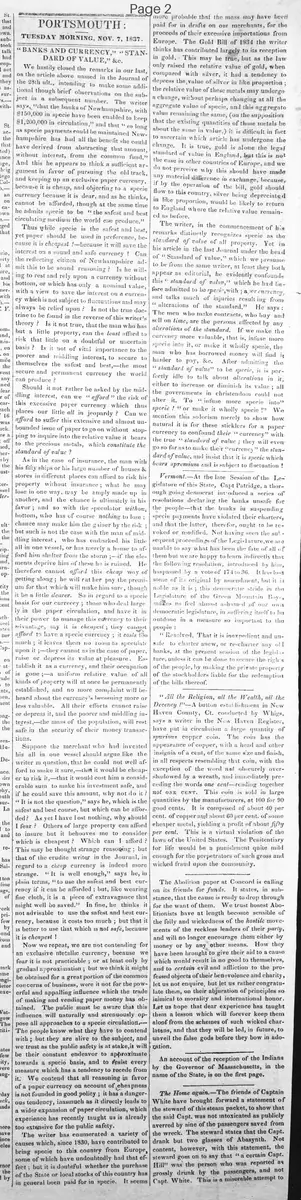
We hastily closed the remarks in our last, on the article above named in the Journal of the 28th ult., intending to make some additional though brief observations on the subject in a subsequent number. The writer says, "that the banks of New Hampshire, with $150,000 in specie have been enabled to keep $1,200,000 in circulation," and that "so long as specie payments could be maintained New-Hampshire has had all the benefit she could have derived from abstracting that amount, without interest, from the common fund."
And this he appears to think a sufficient argument in favor of pursuing the old track, and keeping up an exclusive paper currency, because it is cheap, and objecting to a specie currency because it is dear, and as he thinks, cannot be afforded, though at the same time he admits specie to be "the safest and best circulating medium the world can produce."
Thus while specie is the safest and best, yet paper should be used in preference, because it is cheapest!—because it will save the interest on a sound and safe currency! Can the reflecting citizen of New Hampshire admit this to be sound reasoning? Is he willing to rest and rely upon a currency without bottom, or which has only a nominal value with a view to save the interest on a currency which is not subject to fluctuations and may always be relied upon? Is not the true doctrine to be found in the reverse of this writer's theory? Is it not true, that the man who has but a little property, can the least afford to risk that little on a doubtful or uncertain basis? Is it not of vital importance to the poorer and middling interest, to secure to themselves the safest and best,—the most secure and permanent currency the world can produce?
Should it not rather be asked by the middling interest, can we "afford" the risk of this excessive paper currency which thus places our little all in jeopardy? Can we afford to suffer this extensive and almost unbounded issue of paper to go on without stopping to inquire into the relative value it bears to the precious metals, which constitute the standard of value?
As in the case of insurance, the man with his fifty ships or his large number of houses & stores in different places can afford to risk his property without insurance; what he may lose in one way, may be amply made up in another, and the chance is ultimately in his favor; and so with the speculator without bottom, who has of course nothing to lose; chance may make him the gainer by the risk; but such is not the case with the man of middling interest, who has embarked his little all in one vessel, or has merely a house to afford him shelter from the storm;—if the elements deprive him of these he is ruined. He therefore cannot afford this cheap way of getting along; he will rather pay the premium for that which will make him sure, though it be a little dearer. So in regard to a specie basis for our currency; those who deal largely in the paper circulation, and have it in their power to manage this currency to their advantage, say it is cheapest; they cannot afford to have a specie currency; it costs too much; it leaves them no room to speculate upon it;—they cannot as in the case of paper, raise or depress its value at pleasure. Establish it as a currency, and their occupation is gone;—a uniform relative value of all kinds of property will at once be permanently established, and no more complaint will be heard about the currency's becoming more or less valuable. All their efforts cannot raise or depress it, and the poorer and middling interest,—the mass of the population, will rest safe in the security of their money transactions.
Suppose the merchant who had invested his all in one vessel should argue like the writer in question, that he could not well afford to make it sure,—that it would be cheaper to risk it,—that it would cost him a considerable sum to make his investment safe, and if he could save this amount, why not do it? "It is not the question," says he, which is the safest and best course, but which can be afforded? As yet I have lost nothing, why should I fear? Others of large property can afford to insure but it behooves me to consider which is cheapest? Which can I afford?
This may be thought strange reasoning; but that of the erudite writer in the Journal, in regard to a cheap currency is indeed more strange. "It is well enough," says he, in plain terms, "to use the safest and best currency if it can be afforded; but, like wearing fine cloth, it is a piece of extravagance that might well be saved." In fine, he thinks it not advisable to use the safest and best currency, because it costs too much; but that it is better to use that which is not safe, because it is cheapest!
Now we repeat, we are not contending for an exclusive metallic currency, because we fear it is not practicable; or at least only by gradual approximation; but we think it might be obtained for a great portion of the common concerns of business, were it not for the powerful and appalling influence which the trade of making and vending paper money has obtained. The public must be aware that this influence will naturally and strenuously oppose all approaches to a specie circulation— The people know what they have to contend with; but they are alive to the subject, and we trust as the public safety is at stake, it will be their constant endeavor to approximate towards a specie basis, and to resist every measure which has a tendency to recede from it. We contend that all reasoning in favor of a paper currency on account of cheapness is not founded in good policy; it has a dangerous tendency, inasmuch as it directly leads to a wider expansion of paper circulation, which experience has recently taught us is already too extensive for the public safety.
The writer has enumerated a variety of causes which, since 1830, have contributed to bring specie to this country from Europe. Some of which have undoubtedly had that effect; but it is doubtful whether the purchase of the State or local stocks of this country has in general been paid for in specie. It seems more probable that the mass may have been paid for in drafts on our merchants, for the proceeds of their excessive importations from Europe. The Gold Bill of 1834 the writer thinks has contributed largely to its reception in gold. This may be true, but as the law only raised the relative value of gold, when compared with silver, it had a tendency to depress the value of silver in like proportion; the relative value of these metals may undergo a change, without perhaps changing at all the aggregate value of specie, and this aggregate value remaining the same, (on the supposition that the existing quantities of those metals be about the same in value,) it is difficult in fact to ascertain which article has undergone the change. It is true, gold is alone the legal standard of value in England, but this is not the case in other countries of Europe, and we do not perceive why this should have made any material difference in exchange, because, if by the operation of the bill, gold should flow to this country, silver being depreciated in like proportion, would be likely to return to England where the relative value remained as before.
The writer, in the commencement of his remarks distinctly recognizes specie as the standard of value of all property. Yet in his article in the last Journal under the head of "Standard of value," which we presume to be from the same writer, at least they both appear as editorial, he evidently confounds this "standard of value," which he had before admitted to be specie, with paper currency and talks much of injuries resulting from "alterations of the standard." He says:
The men who make contracts, who buy and sell on time, are the persons affected by any alterations of the standard. If we make the currency more valuable, that is, infuse more specie into it, or make it wholly specie, the man who has borrowed money will find it harder to pay, &c. After admitting the "standard of value" to be specie, it is perfectly idle to talk about alterations in it, either to increase or diminish its value; all the governments in christendom could not alter it. To "infuse more specie into" specie! "or make it wholly specie!" We mention this solecism merely to show how natural it is for these sticklers for a paper currency to confound their "currency" with the true "standard of value;" they will even go so far as to make their "currency" the standard of value, and insist that it is specie which bears a premium and is subject to fluctuation!
TUESDAY MORNING, NOV. 7, 1837.
"BANKS AND CURRENCY," "STANDARD OF VALUE," &C.
We hastily closed the remarks in our last, on the article above named in the Journal of the 28th ult., intending to make some additional though brief observations on the subject in a subsequent number. The writer says, "that the banks of New Hampshire, with $150,000 in specie have been enabled to keep $1,200,000 in circulation," and that "so long as specie payments could be maintained New-Hampshire has had all the benefit she could have derived from abstracting that amount, without interest, from the common fund."
And this he appears to think a sufficient argument in favor of pursuing the old track, and keeping up an exclusive paper currency, because it is cheap, and objecting to a specie currency because it is dear, and as he thinks, cannot be afforded, though at the same time he admits specie to be "the safest and best circulating medium the world can produce."
Thus while specie is the safest and best, yet paper should be used in preference, because it is cheapest!—because it will save the interest on a sound and safe currency! Can the reflecting citizen of New Hampshire admit this to be sound reasoning? Is he willing to rest and rely upon a currency without bottom, or which has only a nominal value with a view to save the interest on a currency which is not subject to fluctuations and may always be relied upon? Is not the true doctrine to be found in the reverse of this writer's theory? Is it not true, that the man who has but a little property, can the least afford to risk that little on a doubtful or uncertain basis? Is it not of vital importance to the poorer and middling interest, to secure to themselves the safest and best,—the most secure and permanent currency the world can produce?
Should it not rather be asked by the middling interest, can we "afford" the risk of this excessive paper currency which thus places our little all in jeopardy? Can we afford to suffer this extensive and almost unbounded issue of paper to go on without stopping to inquire into the relative value it bears to the precious metals, which constitute the standard of value?
As in the case of insurance, the man with his fifty ships or his large number of houses & stores in different places can afford to risk his property without insurance; what he may lose in one way, may be amply made up in another, and the chance is ultimately in his favor; and so with the speculator without bottom, who has of course nothing to lose; chance may make him the gainer by the risk; but such is not the case with the man of middling interest, who has embarked his little all in one vessel, or has merely a house to afford him shelter from the storm;—if the elements deprive him of these he is ruined. He therefore cannot afford this cheap way of getting along; he will rather pay the premium for that which will make him sure, though it be a little dearer. So in regard to a specie basis for our currency; those who deal largely in the paper circulation, and have it in their power to manage this currency to their advantage, say it is cheapest; they cannot afford to have a specie currency; it costs too much; it leaves them no room to speculate upon it;—they cannot as in the case of paper, raise or depress its value at pleasure. Establish it as a currency, and their occupation is gone;—a uniform relative value of all kinds of property will at once be permanently established, and no more complaint will be heard about the currency's becoming more or less valuable. All their efforts cannot raise or depress it, and the poorer and middling interest,—the mass of the population, will rest safe in the security of their money transactions.
Suppose the merchant who had invested his all in one vessel should argue like the writer in question, that he could not well afford to make it sure,—that it would be cheaper to risk it,—that it would cost him a considerable sum to make his investment safe, and if he could save this amount, why not do it? "It is not the question," says he, which is the safest and best course, but which can be afforded? As yet I have lost nothing, why should I fear? Others of large property can afford to insure but it behooves me to consider which is cheapest? Which can I afford?
This may be thought strange reasoning; but that of the erudite writer in the Journal, in regard to a cheap currency is indeed more strange. "It is well enough," says he, in plain terms, "to use the safest and best currency if it can be afforded; but, like wearing fine cloth, it is a piece of extravagance that might well be saved." In fine, he thinks it not advisable to use the safest and best currency, because it costs too much; but that it is better to use that which is not safe, because it is cheapest!
Now we repeat, we are not contending for an exclusive metallic currency, because we fear it is not practicable; or at least only by gradual approximation; but we think it might be obtained for a great portion of the common concerns of business, were it not for the powerful and appalling influence which the trade of making and vending paper money has obtained. The public must be aware that this influence will naturally and strenuously oppose all approaches to a specie circulation— The people know what they have to contend with; but they are alive to the subject, and we trust as the public safety is at stake, it will be their constant endeavor to approximate towards a specie basis, and to resist every measure which has a tendency to recede from it. We contend that all reasoning in favor of a paper currency on account of cheapness is not founded in good policy; it has a dangerous tendency, inasmuch as it directly leads to a wider expansion of paper circulation, which experience has recently taught us is already too extensive for the public safety.
The writer has enumerated a variety of causes which, since 1830, have contributed to bring specie to this country from Europe. Some of which have undoubtedly had that effect; but it is doubtful whether the purchase of the State or local stocks of this country has in general been paid for in specie. It seems more probable that the mass may have been paid for in drafts on our merchants, for the proceeds of their excessive importations from Europe. The Gold Bill of 1834 the writer thinks has contributed largely to its reception in gold. This may be true, but as the law only raised the relative value of gold, when compared with silver, it had a tendency to depress the value of silver in like proportion; the relative value of these metals may undergo a change, without perhaps changing at all the aggregate value of specie, and this aggregate value remaining the same, (on the supposition that the existing quantities of those metals be about the same in value,) it is difficult in fact to ascertain which article has undergone the change. It is true, gold is alone the legal standard of value in England, but this is not the case in other countries of Europe, and we do not perceive why this should have made any material difference in exchange, because, if by the operation of the bill, gold should flow to this country, silver being depreciated in like proportion, would be likely to return to England where the relative value remained as before.
The writer, in the commencement of his remarks distinctly recognizes specie as the standard of value of all property. Yet in his article in the last Journal under the head of "Standard of value," which we presume to be from the same writer, at least they both appear as editorial, he evidently confounds this "standard of value," which he had before admitted to be specie, with paper currency and talks much of injuries resulting from "alterations of the standard." He says:
The men who make contracts, who buy and sell on time, are the persons affected by any alterations of the standard. If we make the currency more valuable, that is, infuse more specie into it, or make it wholly specie, the man who has borrowed money will find it harder to pay, &c. After admitting the "standard of value" to be specie, it is perfectly idle to talk about alterations in it, either to increase or diminish its value; all the governments in christendom could not alter it. To "infuse more specie into" specie! "or make it wholly specie!" We mention this solecism merely to show how natural it is for these sticklers for a paper currency to confound their "currency" with the true "standard of value;" they will even go so far as to make their "currency" the standard of value, and insist that it is specie which bears a premium and is subject to fluctuation!
What sub-type of article is it?
Economic Policy
What keywords are associated?
Banks
Currency
Specie
Paper Money
New Hampshire
Standard Of Value
Economic Policy
What entities or persons were involved?
Banks Of New Hampshire
Journal Writer
Editorial Details
Primary Topic
Critique Of Paper Currency In Favor Of Specie Standard
Stance / Tone
Advocacy For Safer Specie Based Currency Over Cheap But Risky Paper Money
Key Figures
Banks Of New Hampshire
Journal Writer
Key Arguments
Specie Is The Safest And Best Circulating Medium, Yet Paper Is Preferred For Cheapness
Poorer And Middling Interests Cannot Afford Risks Of Excessive Paper Currency
Paper Currency Allows Speculation And Fluctuation, Harming The Masses
Analogy To Insurance: The Wealthy Can Risk, But Not Those With Little Property
Reasoning For Cheap Paper Is Unsound And Dangerous Policy
Approximate Toward Specie Basis Despite Opposition From Paper Money Interests
Critique Of Confusing Paper Currency With True Specie Standard Of Value