Thank you for visiting SNEWPapers!
Sign up free
Wisconsin Herald, And Grant County Advertiser
Lancaster, Grant County, Wisconsin
What is this article about?
Peter H. Burnett's letter from Linnton, Oregon, dated July 25, 1841, describes the new town's founding, location on the Wallamette River, economic opportunities, provisions prices, climate, agriculture, and praises the territory for settlement.
Clipping
OCR Quality
Full Text
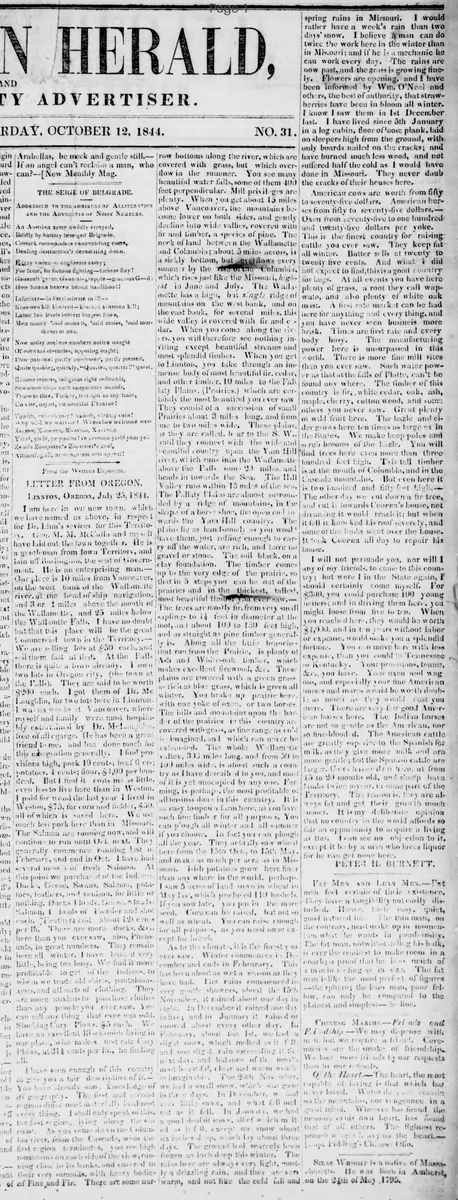
LETTER FROM OREGON
Linnton, Oregon, July 25, 1841.
I am here in our new town, which we have named as above, in respect for Dr. Linn's services for this Territory. Col. M. M. McCarly and myself have laid out the town together. He is a gentleman from Iowa Territory, and laid off Burlington, the seat of Government. He is an enterprising man.—Our place is 10 miles from Vancouver, on the west bank of the Wallamette river, at the head of ship navigation, and 3 or 4 miles above the mouth of the Wallamette, and 25 miles below the Wallamette Falls. I have no doubt but that this place will be the great Commercial town in the Territory.—We are selling lots at $50 each, and sell them fast at that. At the Falls there is quite a town already. I own two lots in Oregon city, (the town at the Falls). They are said to be worth $500 each. I got them of Dr. McLaughlin, for two lots here in Linnton. I was six weeks at Vancouver, where myself and family were most hospitably entertained by Dr. McLaughlin, free of all charge. He has been a great friend to me, and has done much for this emigration generally. I find provisions high, pork 10 cents; beef 6 cts; potatoes, 4 cents; flour, $8.00 per hundred. But I find it costs me as little, even less to live here than in Weston. I paid for wood the last year I lived in Weston, $75, for corn and fodder, $50, all of which is saved here. We use much less pork here than in Missouri. The Salmon are running now, and will continue to run until Oct. next. They generally commence running last June, and end in Oct. I have had several messes of fresh Salmon. At this point we purchase of the Indians, Ducks, Geese, Swans, Salmon, potatoes, feathers, and venison, for little or nothing. Ducks 1 lod., Geese 2 lods., Salmon, 4 lods. of powder and shot each. Feathers cost about 12 cts per lb. There are more ducks, &c., here than you ever saw, also, Pheasants, in great numbers. They remain here all winter. I have hunted very little, being too busy. We find it more profitable to get off the Indians, to whom we trade old shirts, pantaloons, &c., and all sorts of clothing. They are more anxious to purchase cloth, than any people you ever saw. You can sell anything that ever was sold. Stocking yarn 50 cts., Ploughs, $50 each. We have an excellent Blacksmith living in our place, who makes first rate Cay Plove, at 25 cents per lb., by finding ..ii.
I have seen enough of this country to give you a fair description of it. You have already some knowledge of its geography. The first and second regions are most horrid and monotonous every thing. I shall only speak of the third region, lying along the coast. As you come down the Columbia river, from the Cascades, where the first region terminates, you enter high mountains on each side of the view, running close to its banks, and covered to their very summits, with heavy bodies of Pine and Fir. There are some narrow bottoms along the river, which are covered with grass, but which overflow in the summer. You see many beautiful water falls, some of them 400 feet perpendicular. Mill privileges are plenty. When you get about 15 miles above Vancouver, the mountains become lower on both sides, and gently decline into wide vallies, covered with fir and timber, a species of pine. The neck of land between the Wallamette and Columbia; about 5 miles across, is a sickly bottom, but overflows every summer by the rise of the Columbia, which rises just like the Missouri, highest in June and July. The Wallamette has a high, but single ridge of mountains on the west bank, and on the east bank, for several miles, this wide valley is covered with fir and cedar. When you come along the river, you will therefore see nothing inviting except beautiful streams and most splendid timber. When you get to Linnton, you take through an immense body of most beautiful fir, cedar, and other timber, 10 miles to the Flaty Plains, (Prairies,) which are certainly the most beautiful you ever saw They consist of a succession of small Prairies about 3 miles long, and from one to two miles wide. These plains, as they are called, bear to the S. W., until they connect with the wide and beautiful country upon the Yam Hill river, which runs into the Wallamette above the Falls some 50 miles, and heads in towards the Sea. The Hill Valley runs within 15 miles of the sea. The Flaty Plains are almost surrounded by a ridge of mountains, in the shape of a horse shoe, the open end towards the Yam hill country. The plains lie as handsomely as you would have them, just rolling enough to carry off the water, are rich, and have no gravel or stone. The soil black, on a clay foundation. The timber comes up to the very edge of the prairie, so that in 5 steps you can be out of the prairies and in the thickest, tallest, most beautiful timber your ever saw.—The trees are mostly fir, from very small saplings to 6 feet in diameter at the foot, and about 100 to 150 feet high, and as straight as pine timber generally is. Along all the little branches that run from the Prairie, is plenty of Ash and White-oak timber, which makes excellent firewood, &c. These plains are covered with a green grass as rich as blue grass, which is green all winter. You break up prairie bare, with one yoke of oxen, or two horses. The hills and mountains upon the border of the prairies in this country are covered with grass, as fine range as could be imagined, and which can never be exhausted. The whole Wallamette valley, 300 miles long, and from 50 to 100 miles wide, is about such a country as I have described to you, and most of it is yet unoccupied by any one. Farming, is perhaps, the most profitable of all business done in this country. It is so easy to open a farm here, as you have such fine timber for all purposes. You can plough all winter and all summer if you choose. in fact you can plough all the year. They actually sow wheat here from the 15th Oct., to 15th May, and make as much per acre as in Missouri. Irish potatoes grow here finer than anywhere in the world, perhaps. I saw 5 acres of land sown in wheat in May last, which produced 110 bushels. If you sow late, you put in the more seed. Corn can be raised, but not so well as wheat. You can raise enough for all purposes, as you need none except for bread. As to the climate, it is the finest you ever saw. Winter commences in December and ends in February. This has been about as wet a season as they have had. The rains commenced very gentle showers, about the 15th, November. it rained about one day in eight. In December it rained one day in five: and in January it rained or snowed about every other day. In February, about the 1st. we had a light snow, which melted as it fell and one night rain succeeding it, next day, and balance of the month beautiful, clear and warm weather oringia.bte, The Pith November, we had a sadl snow, which aae gon inthr edws. io December, we id vore Hte anov, and whit Cll md ted as it fll. in January, wehad a goo dalot snov, allef w ich m It ed s is f I.xcept, one snow ahout six inclys d p, " ich lw about three diys. The ground hed searccly boen frozen an inchdecp this winter. The r.ins here are alw.ys very light, most. ly a drizzling rain. and they ar-ven warm, and not like the cold fall and spring rains in Missouri. I would rather have a week's rain than two days'snow. I believe a man can do twice the work here in the winter than in Missouri: and if he is a mechanic be can work every day. The rains are now past, and the grass is growing finely. Flowers are opening. and I have been informed by Wm, O'Neal and others, the best of authority, that strawberries have been in bloom all winter. I know I saw them in 1st December last. I have lived since 5th January in a log cabin, floor of loose plank, laid on sleepers high from the ground, with only boards nailed on the cracks: and have burned much less wood, and not suffered half the cold as I would have done in Missouri. They never daub the cracks of their houses here. American cows are worth from fifty to seventy-five dollars. American horses from fifty to seventy-five dollars.—Oxen from seventy-five to one hundred and twenty-five dollars per yoke. This is the finest country for raising cattle you ever saw. They keep fat all winter. Butter sells at twenty to twenty five cents. And what I did not expect to find, this is a good country for hogs. At all events you have here plenty of grass, a root they call wap-wato, and also plenty of white oak mast. A first rate market can be had here for anything and every thing, and you have never seen business more brisk. Times are first rate and everybody busy. The manufacturing power here is unsurpassed in this world. There is more fine mill sites than you ever saw. Such water power as that at the falls of Platte, can't be found anywhere. The timber of this country is fir, white cedar, oak, ash, maple, cherry, cotton wood, and some others you never saw. Great plenty of wild fruit here. The hazel and elder grows here ten times as large as in the States. We make hoop poles and scrub brooms of the hazel. You will find trees here even more than three hundred feet high. This tall timber is at the mouth of Columbia, and in the Cascado mountains. But even here it is two hundred and fifty foot high.—The other day we cut down a fir tree, and cut it towards Cooper's house, not dreaming it would reach it: but when it fell it knocked his roof severely, and some of thin links went over the house. It took Cooper all day to repair his house. I will not persuade you, nor will I any of my friends, to come to this country; but were I in the State again, I should certainly come myself. For $300, you could purchase 100 young neters; and in driving them here. you might loose from five to ten. When you reached here, they would be worth $100, and in ten years without labor or expense. would make you a splendid fortune. You can move here with less expense, than you could to Tennessee or Kentucky. Four provisions, teams, &c., you have. Your oxen and wagons, and especially your fine American horses and mares would be worth double as much as they would cost you there. There are very few good American horses here. The Indian horses are not so gentle as the American, nor so fine-blooded. The American cattle are greatly superior to the Spanish for milk, as they give more milk and are more gentle; but the Spanish cattle are larger. Cows have calves here, at from 6 to 12 months old, and sheep have lambs twice a-year, in some part of the Territory. The reason is, they are always fat and get their growth much sooner. It is my deliberate opinion that no country in the world affords so fair an opportunity to acquire a living as this. I see no objection to it, except it be—by a man who loves liquor for he can get none here.
PETER H. BURNETT.
What sub-type of article is it?
What keywords are associated?
What entities or persons were involved?
Where did it happen?
Domestic News Details
Primary Location
Linnton, Oregon
Event Date
July 25, 1841
Key Persons
Outcome
positive economic prospects with lots selling quickly, low living costs compared to missouri, abundant resources, and encouragement for settlement without persuasion.
Event Details
Peter H. Burnett describes founding Linnton with Col. McCarly, its advantageous location for commerce, trade with Indians, high provisions prices but overall cheaper living, detailed geography and climate of the Wallamette Valley, superior farming and livestock raising opportunities, and brisk business environment.