Thank you for visiting SNEWPapers!
Sign up free
Daily National Intelligencer
Washington, District Of Columbia
What is this article about?
In a U.S. congressional debate, Rep. R. Poindexter argues against premature recognition of the United Provinces of the Rio de la Plata, citing constitutional issues, historical precedents from the American Revolution, and instability in Spanish American revolutions like Mexico. Rep. Forsyth responds, defending his views on the patriot cause and emphasizing unity despite differences on timing.
Clipping
OCR Quality
Full Text
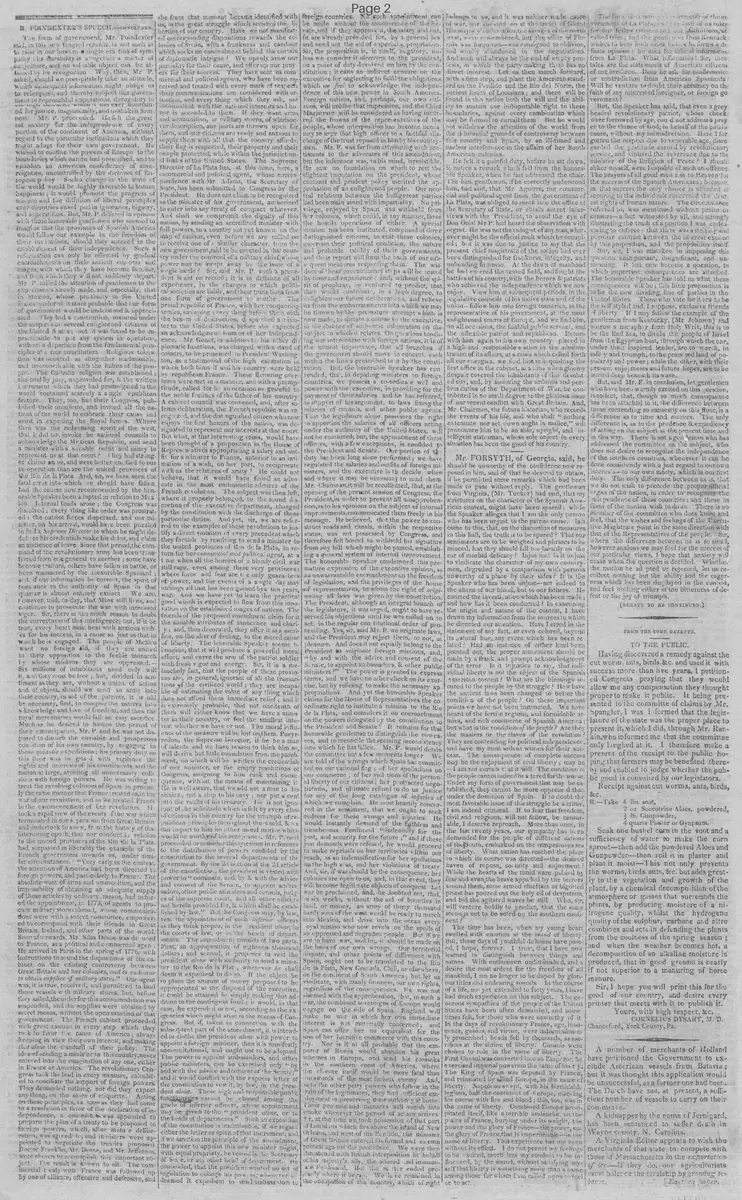
The form of government, Mr. Poindexter said, in this new fangled republic, is not such as to raise in our bosoms a single emotion of sympathy; its durability is altogether a matter of conjecture, and no valuable object can be attained by its recognition. Why, then, Mr. P. asked, should we precipitately take an attitude, which subsequent information might oblige us to relinquish, and thereby subject this government to reproachful imputations, derogatory to the high character which it has ever maintained for justice, magnanimity, and unshaken firmness. Mr. P. proceeded. He felt the greatest anxiety for the independence of every portion of the continent of America, without regard to the particular institutions which they might adopt for their own government. He wished to confine the powers of Europe to the boundaries which nature had prescribed, and to establish an American confederacy of sovereignties, uncontrolled by the doctrines of European policy. Such a change in the state of the world would be highly favorable to human happiness; it would promote the progress of science and the diffusion of liberal principles over countries enveloped in ignorance, bigotry, and superstition. But, Mr. P. differed in opinion with those honorable gentlemen who seemed to imagine that the provinces of Spanish America would follow our example in the freedom of their institutions, should they succeed in the establishment of their independence. Such a reformation can only be effected by gradual encroachments on their ancient customs and usages, with which they have become familiar, and from which they will not suddenly depart. Mr. P. called the attention of gentlemen to the experiments already made, and especially, that in Mexico, whose proximity to the United States rendered it more probable that our form of government would be understood & appreciated. They had a constitution, matured under the auspices of several enlightened citizens of the United States; but it was found to be impracticable to put any system in operation, without a departure from the fundamental principles of a free constitution. Religious toleration was scouted as altogether inadmissible and irreconcileable with the habits of the people. The Catholic religion was established; the trial by jury, unprovided for, & the written instrument which they had promulgated to the world contained scarcely a single republican feature. They, too, had their Congress, published their manifesto, and invited all the nations of the world to embrace their cause and assist in expelling the Royal forces. Where then was the redeeming spirit of the west, that it did not invoke the national councils to acknowledge the Mexican Republic, and send a minister with a suitable outfit and salary to represent us at that court? They had stronger claims on us, and were better entitled to our co-operation than are the united provinces of the Rio de la Plata. And, sir, we have seen the fatal error into which we should have fallen had the course now recommended by the honorable Speaker been adopted in relation to Mexico. Internal feuds arose; the Congress was dissolved: every thing like order was prostrated: the patriot forces dispersed, and our minister, on his arrival, would have been puzzled to find a Supreme Director, to whom he might deliver his credentials, make his debut, and claim an audience of leave. Since that period, the command of the revolutionary army has been transferred from one general to another; some have become traitors, others have fallen in battle, or been massacred by the inexorable Spaniard; and, if our information be correct, the spirit of resistance to the authority of Spain in that quarter is almost entirely extinct. We are, however, told, to-day, that Mina still lives, and continues to prosecute the war with increased vigor. Sir, there is too much reason to doubt the correctness of this intelligence; but, if it be true, every heart must beat with anxious wishes for his success, in a cause so just as that in which he is engaged. The people of Mexico want no foreign aid, if they are united in their opposition to the feeble monarch by whose minions they are oppressed.—Six millions of inhabitants need only will it, and they must be free; but, divided in sentiment as they are, without a union of action and of object, should we send an army into their country, in aid of the patriots, it would be necessary, first, to conquer the natives into a knowledge and love of freedom, and then the royal mercenaries would fall an easy sacrifice. Much as he desired to hasten the period of their emancipation, Mr. P. said he was not disposed to disturb the enviable and prosperous condition of his own country, by engaging in these quixotic expeditions; his primary duty on this floor was to guard with vigilance the rights and interests of his constituents and the nation at large, avoiding all unnecessary collisions with foreign powers. He was willing to treat the revolting colonies of Spain in precisely the same manner that France treated us, in the war of our revolution, and as we treated France in the commencement of her revolution. He took a rapid view of the events of the war which terminated in our separation from Great Britain and undertook to show, from the history of that interesting epoch, that our conduct in relation to the united provinces of the Rio de la Plata had surpassed in liberality the example of the French government towards us, under similar circumstances. "Very early in the contest. the attention of America had been directed to foreign powers, and particularly to France. The absolute want of arms and ammunition, and the impossibility of obtaining an adequate supply of those articles by ordinary means, had induced the appointment, in 1775, of agents to procure military stores abroad, whose communications were with a secret committee, empowered to correspond with their friends in Great Britain, Ireland, and other parts of the world. Soon afterwards, Mr. Silas Deane was deputed to France, as a political and commercial agent. He arrived in Paris in the spring of 1776, with instructions to sound the dispositions of the cabinet on the existing controversy between Great Britain and her colonies, and to endeavor to obtain supplies of military stores." Our agent was, it is true, received, and permitted to load three vessels with military stores, but, before they sailed, the order for this accommodation was suspended, and the supplies were obtained by secret means, without the open sanction of that government. The French cabinet proceeded with great caution in every step which they took to favor the cause of America; always keeping in view their own interest, and making that alone the standard of their policy. The idea of sending a minister to this country, never entered into the imagination of any one, either in France or America. The revolutionary Congress took the lead in every measure, calculated to conciliate the support of foreign powers. They demanded nothing, nor did they expect any thing, on the score of etiquette. Acting on these principles, as soon as they had come to a resolution in favor of the declaration of independence, a committee was appointed to prepare the plan of a treaty to be proposed to foreign powers, which, after mature deliberation, was agreed to, and ministers were appointed to negotiate the treaties proposed. Doctor Franklin, Mr. Deane, and Mr. Jefferson, were chosen to accomplish this important object. The result is known to all. The commercial treaty with France was followed up by one of alliance, offensive and defensive, and she from that moment became identified with us, in the great struggle which secured the liberties of our country. Have we not manifested corresponding dispositions towards the colonies of Spain, with a frankness and candour which seeks no concealment behind the curtain of diplomatic intrigue? We openly avow our partiality for their cause, and offer up our prayers for their success. They have sent us commercial and political agents, who have been received and treated with every mark of respect; their communications are considered with attention, and every thing which they ask, not inconsistent with the national interests and honor, is accorded to them. If they want arms and ammunition, or military stores, of whatsoever description, our ports are thrown open for them, and our citizens are ready and anxious to supply them with all that the country affords: their flag is respected, their property and their people protected, while within the jurisdictional limits of the United States. The Supreme Director of La Plata has, at this time, here, a commercial and political agent, whose correspondence with Mr. Adams, the Secretary of State, has been submitted to Congress by the President. He does not claim to be recognized as the minister of his government, authorized to enter into any treaty of compact whatever. And shall we compromit the dignity of this nation, by sending an accredited minister with full powers, to a country not yet known on the map of nations, even before we are called on to receive one of similar character from the new government, said to be erected in that country under the controul of a military chief, whose power may be swept away by the issue of a single battle? Sir, said Mr. P. such a precedent is not on record: it is in defiance of all experience, in the changes to which political societies are liable, and their transitions from one form of government to another. The proud republic of France, with her conquering armies, sweeping every thing before them with the besom of destruction, dispatched a minister to the United States, before she expected an acknowledgment from us of her independence. Mr. Genet, in addition to his other diplomatic functions, was charged with a stand of colours, to be presented to President Washington, as a testimonial of the high estimation in which both himself and his country were held by republican France. These flattering overtures were met in a manner, and with a promptitude, called for by an occasion so grateful to the noble feelings of the father of his country. A cabinet council was convened, and, after solemn deliberation, the French republic was recognized, and the distinguished citizen who now enjoys the first honors of the nation, was designated to represent our interests at that court. But what, at that interesting crisis, would have been thought of a proposition in the House of Representatives appropriating a salary and outfit for a minister to France, anterior to an intimation of a wish, on her part, to reciprocate with us the relations of amity? He could not believe that it would have found an advocate in the most enthusiastic admirer of the French revolution. The subject was then left, where it properly belonged, to the sound discretion of the executive department, charged by the constitution with the discharge of those particular duties. And yet, sir, we are referred to the examples of these revolutions to justify a direct violation of every precedent which they furnish by resolving to send a minister to the united provinces of Rio de la Plata, in return for her commercial and political agent, at a time when all the horrors of a bloody civil war still rage, even among these very provinces; where force and fear are the only guarantees of power, and the events of a single day may unhinge all that has been gained by a ten years' war. And we have yet to learn the practical good which is expected to flow from this innovation on the established usages of nations. The friends of the proposed amendment claim for it the amiable attributes of innocence and charity; and, thus decorated, they offer it as a sacrifice, on the altar of feeling, to the sacred cause of liberty. The honorable Speaker seems to imagine, that it will produce a powerful moral effect, and nerve the arm of the patriot soldier with fresh vigor and energy. Sir, it is a melancholy fact, that the people of these provinces are, in general, ignorant of all the transactions of the civilized world; they are incapable of estimating the value of any thing which does not afford them immediate relief; and it is extremely probable, that not one-tenth of them will either know that we have a minister in their country, or feel the smallest interest whether we have or not. The moral influence of the measure will be lost on them. Pueyrredon, the Supreme Director, if he be a man of talents and we have reason to think him so, will derive but little consolation from the parchment, on which will be written the credentials of our minister, or the empty resolutions of Congress, assigning to him rank and consequence, without the means of maintaining it. He is well aware, that we add not a man to his armies; not a ship to his navy; nor put a cent into the vaults of his treasury. He is not ignorant of the solicitude which is felt by every class of citizens in this country for the triumph of republican principles throughout the world, & we can impart to him no other moral motive which would be worthy of his acceptance. Mr. P. next proceeded to consider this question in reference to the distribution of powers confided by the constitution to the several departments of the government. By the 2d section of the 2d article of the constitution, the president is vested with power to "nominate, and by & with the advice and consent of the Senate, to appoint ambassadors, other public ministers and consuls, judges of the supreme court, and all other officers not herein provided for, & which shall be established by law." But the Congress may, by law, vest the appointment of such inferior officers as they think proper, in the president alone, in the courts of law, or in the heads of departments. The amendment consists of two parts: First, an appropriation of eighteen thousand dollars; and second, it proposes to vest the president alone with authority to send a minister to the Rio de la Plata, whenever he shall deem it expedient to do so. If the object be to place the amount of money proposed to be appropriated at the disposal of the executive, it could be attained by simply making that addition to the contingent fund; it would, in that case, be expended or not, according to the exigencies which might arise in the recess of Congress. But if, taken in connection with the subsequent part of the amendment, it is intended to clothe the president alone with power to appoint a foreign minister, then it is manifestly unconstitutional, and ought not to be adopted. The power to appoint ambassadors, and other public ministers, can be exercised only "by and with the advice and consent of the Senate;" and it would conflict with the express letter of the constitution to vest it, by law, in the president alone. These high and responsible public functionaries cannot be classed among the grade of inferior officers, whose appointment may be given to the "president alone, or to the heads of departments." Such an exposition of the constitution is inadmissible, if we regard either the letter or spirit of that instrument; and if we sanction the principle of the amendment, the power to appoint this new minister might, with equal propriety, be vested in the Secretary of State, or any other head of department. He contended, that the president wanted no act of legislation to enlarge his powers, whenever he deemed it expedient to send ambassadors to foreign countries. No such appointment can be made without the concurrence of the Senate, and if they approve it, the salary and outfit are already provided for, by a general law and need not the aid of a special appropriation. Sir, the proposition is, in itself, nugatory, unless we consider it directory to the president, on a point of duty devolved on him by the constitution; it casts an indirect censure on the executive for neglecting to fulfil the obligations which we feel to acknowledge the independence of this new power in South America. Foreign nations, and, perhaps, our own citizens, will imbibe that impression, and the Chief Magistrate will be considered as having incurred the frowns of the representatives of the people, whose interposition has become necessary to urge that high officer to a faithful discharge of the trust reposed in him by his country. Mr. P. was far from attributing such sentiments to the advocates of this amendment, but the inference was, to his mind, irresistible. He saw no foundation on which to rest the slightest imputation on the president, whose cautious and prudent policy merited the approbation of an enlightened people. Our neutral relations between the belligerent parties had been maintained with impartiality. No privilege, enjoyed by Spain was withheld from her colonies, which could, in any manner, favor the hostile operations of either. A special mission has been instituted, composed of three distinguished citizens, to visit these colonies, ascertain their political condition, the nature and probable stability of their governments, and their report will form the basis of our subsequent measures respecting them. The wisdom of these precautionary steps will be tested by time and experience; and, without the spirit of prophesy, he ventured to predict, that they would contribute, in a high degree, to enlighten our future deliberations, and relieve us from the embarrassments into which we may be thrown by the premature attempt which is now made, to dictate a course to the executive, in the absence of authentic information on the subject to which it relates. On questions touching our intercourse with foreign nations, it is of the utmost importance, that all branches of the government should move in concert, each within the limits prescribed to it by the constitution. But, the honorable Speaker has contended, that, in deputing ministers to foreign countries, we possess a co-ordinate will and power with the executive, in providing for the payment of their salaries and he has referred, in support of his argument, to laws fixing the salaries of consuls, and other public agents. That the legislature alone possesses the right to apportion the salaries of all officers acting under the authority of the United States, will not be contested; but, the appointment of these officers, with a few exceptions, is confided to the President and Senate. Our portion of the duty has been long since performed; we have regulated the salaries and outfits of foreign ministers, and the executive is to decide when and where it may be necessary to send them. Mr. Chairman, it will be recollected, that, at the opening of the present session of Congress, the President, in order to prevent all misapprehension, as to his opinions on the subject of internal improvements, communicated them freely in his message. He believed, that the power to construct roads and canals, within the respective states, was not possessed by Congress, and therefore felt bound to withhold his signature from any bill which might be passed, establishing a general system of internal improvement. The honorable Speaker condemned this premature expression of the executive opinion, as an unwarrantable encroachment on the freedom of legislation, and the privileges of the house of representatives, to whom the right of originating all laws was given by the constitution. The President, although an integral branch of the legislature, it was urged, ought to have reserved his objections until he was called on to act, in the regular constitutional order of proceeding. Yes, sir, said Mr. P. we originate laws, and the President may reject them, or not, at pleasure. And does it not equally belong to the President to originate foreign missions, and, "by and with the advice and consent of the Senate, to appoint ambassadors, & other public ministers?" The power is granted in express terms, and we have no other check on its exercise, but by refusing to make the necessary appropriations. And yet the honorable Speaker claims for the House of Representatives the co-ordinate right to institute a mission to the Rio de la Plata, and considers it no encroachment on the powers delegated by the constitution to the President and Senate! It remains for that honorable gentleman to distinguish the two cases, and to reconcile the seeming inconsistency into which he has fallen. Mr. P. would detain the committee but a few moments longer. We are told of the wrongs which Spain has committed on our national flag; of her spoliations on our commerce; of her violations of the personal liberty of our citizens; her protracted negotiations, and ultimate refusal to do us justice for any of the long catalogue of injuries of which we complain. He most heartily concurred in the sentiment, that we ought to seek redress for these wrongs and injuries. He would instantly demand of the faithless and treacherous Ferdinand "indemnity for the past, and security for the future;" and if these just demands were refused, he would proceed to make reprisals on her territories within our reach, as an indemnification for her spoliations on the high seas, and her violations of treaty. And, sir, if war should be the consequence, her colonies are open to us, and, in that event, they will become legitimate objects of conquest. Let war be proclaimed, and, he doubted not, that, in six weeks, without the aid of bounties in land, or money, an army of thirty thousand hardy sons of the west would be ready to march into Mexico, and drive into the ocean every royal minion who now revels on the spoils of an oppressed and degraded people. But if we are to have war, said he, it should be made on the basis of our own wrongs. Our territorial dispute, and other points of difference with Spain, ought not to be transferred to the Rio de la Plata, New Grenada, Chili, or elsewhere, on the continent of South America; but let us vindicate, with manly firmness, our own rights, regardless of the consequences. He was not alarmed with the apprehension, that, in such a war, the combined sovereigns of Europe would engage on the side of Spain. England will make no war in which her own immediate interest is not materially concerned; and Spain can offer her no equivalent for the loss of her lucrative commerce with this country. Nor is it at all probable that the emperor of Russia would abandon his great schemes in Europe, and send his cossacks to the southern coast of America, where the climate itself would be more fatal than the swords of the most furious enemy. And, as to the other petty powers who follow in the train of the legitimates, they find sufficient employment in preserving their authority at home. Their protests and menaces will vanish into smoke whenever the period of action arrives. Sir, at the time we took possession of that part of Louisiana which lies above the island of New Orleans, and west of the Perdido, the minister of Great Britain entered his formal and solemn protest against the procedure. We were then threatened with British interposition in behalf of his majesty's ally, the adored and immaculate Ferdinand. But the matter ended precisely where it began. We have remained in the occupation of the country, which of right belongs to us, and it was neither made cause of war, nor insisted on at the treaty of Ghent. His majesty's other allies, the savages of the north west, were remembered, but the affair of Florida was forgotten, was consigned to oblivion, and wholly abandoned in the negotiations. And such will always be the end of empty protests, in which the party making them has no direct interest. Let us then march forward, with a firm step, and plant the American standard on the Perdido and the Rio del Norte, the ancient limits of Louisiana; and there will be found in this nation both the will and the ability to sustain our indisputable right to these boundaries, against every combination which may be formed to curtail them. But he would not withdraw the attention of the world from the substantial grounds of controversy between this country and Spain, by an ill-timed and useless interference in the affairs of her South American colonies. He felt it a painful duty, before he sat down, to notice a remark which fell from the honorable Speaker, when he last addressed the chair. (The hon. gentleman, if he correctly understood him, had said, that Mr. Aguirre, the commercial and political agent from the government of La Plata, was obliged to sneak into the office of the Secretary of State, or obtain secret interviews with the President, to avoid the eye of Don Onis! Mr. P. had heard the observation with regret. He was not the eulogist of any man, whatever might be the official rank which he occupied; but it was due to justice to say that the present chief magistrate of the nation had ever been distinguished for frankness, integrity, and unbending firmness. At the dawn of manhood he had entered the tented field, and fought the battles of his country, with the heroes & patriots who achieved the independence which we now enjoy. View him at subsequent periods, in the legislative councils of his native state and of the union—follow him into foreign countries, as the representative of his government, at the most enlightened courts of Europe, and we find him, on all occasions, the faithful public servant, and the inflexible patriot and republican. Return with him again to his own country placed in a high and responsible station in the administration of its affairs, at a crisis which called forth all our energies, we find him relinquishing the first office in the cabinet, at a time when gloomy despair covered the inhabitants of this desolated city, and, by assuming the arduous and perilous duties of the Department of War, he contributed in no small degree to the glorious issue of our recent conflict with Great Britain. And Mr. Chairman, the future historian, who records the events of his life, and who shall "nothing extenuate nor set down aught in malice," will pronounce him to be an able, upright, and intelligent statesman, whose sole object in every situation has been the good of his country.
Mr. FORSYTH, of Georgia, said he should be unworthy of the confidence now reposed in him, and of that he desired to obtain, if he permitted some remarks which had been made to pass without reply. The gentleman from Virginia, (Mr. Tucker) had said, that my strictures on the character of the Spanish American contest, might have been spared; while the Speaker alleges that I am the only person who has been unjust to the patriot cause. Is it come to this, that, on the discussion of measures in this hall, the truth is to be spared? That our sentiments are to be weighed and phrases to be minced, lest they should fall too harshly on the ear of morbid delicacy? Injustice! Is it unjust to vindicate the character of my own countrymen, degraded by a comparison with persons unworthy of a place by their sides? It is the Speaker who has been unjust—not indeed to the aliens of our blood, but to our fathers. He courted the investigation which has been made; and how has it been conducted? In examining the origin and nature of the contest, I have drawn my information from the sources to which he directed our attention. Have I erred in the statement of any fact, or even colored, beyond its natural hue, any event which has been related? Had an instance of either kind been pointed out, the proper atonement should be made by a frank and prompt acknowledgment of the error. Is it injustice to say, that individual liberty is not the object of the Spanish American contest? What are the blessings secured to the people by the struggle? How have the ancient laws been changed to better the condition of the people? On these important points we have not been instructed. We have heard of the fertile regions, and formidable armies, and rich commerce of Spanish America; but what is the condition of the people? Are they the masters or the slaves of the revolution? They are contending for political independence, and have my most ardent wishes for their success. The consequence of complete success may be the enjoyment of civil liberty; may be—I am not certain that it will. The condition of the people cannot indeed be bettered forth worse. Under any form of government that may be established, they cannot be more oppressed than under the dominion of Spain. If to doubt the most favorable issue of this struggle be a crime, I am indeed criminal. If to fear that freedom, civil and religious, will not follow, be censurable, I deserve reproach. More than once, in the last twenty years, our sympathy has been demanded for the people of different nations of the South, embarked on the tempestuous sea of liberty. What nation has reached the place to which its course was directed—the desired haven of repose, security and enjoyment? While the hearts of the timid were palsied by fear and even the brave appalled by the terrors around them, some armed chieftain or bigotted priest has poured out the holy oil of despotism, and bid the agitated waves be still. Who, sir, will venture boldly to predict, that the same scene is not to be acted on the southern continent? The time has been, when my young heart swelled with emotion at the sound of liberty. But, these days of youthful delusion have passed, I hope, forever. I trust, that I have now learned to distinguish between things and names. With enthusiasm undiminished, and a desire the most ardent for the freedom of all mankind, I am no longer to be duped by glorious titles and endearing sounds. In the course of a life, not yet extended to forty years, I have had much experience on this subject. The generous sympathies of the people of the United States have been often demanded, and sometimes felt, for those who were unworthy of it. In the days of revolutionary France, age, innocence, genius, and virtue, were indiscriminately proscribed; heads fell by thousands, as sacrifices at the shrine of liberty. Consuls were chosen to rule in the name of liberty. The First Consul was converted into an Emperor, he exercised imperial powers in the name of liberty. The King of Spain was deposed by France, and reinstated by allied Europe, in the name of liberty. Napoleon swept, with his formidable legions, half the continent of Europe, marking his course with fire and blood; this, too, was in the name of liberty. Combined Europe precipitated itself, like a terrible avalanche, on the plains of France, burying under its weight, the power and the glory of France—the power, not the glory of France, that is imperishable—in the name of liberty. This experience has not been without its effect. I do not permit my feelings to be excited, much less my conduct to be influenced, by the sound, without satisfying myself that liberty is something more than a name among those for whom I am called upon to feel or to act. The fact has rather strengthened the government of La Plata, so the love of its ruler for our fellow citizens and our institutions, are called tales; and the gentleman from Kentucky wishes to hear both sides before he forms a definite opinion: he asks for official information from La Plata. What infatuation! Sir, these tales are the statements of American citizens of our brethren. Does he ask for confirmation or contradiction from American Spaniards? Will he venture to doubt their accuracy on the faith of any interested foreigner, or foreign government? But, the Speaker has said, that even a grey headed revolutionary patriot, whose cheek were furrowed by age, could not address a prayer to the throne of God, in behalf of the patriot cause, without my animadversion. Have I forgotten the respect due to venerable age, disregarded the gratitude earned by revolutionary service, and violated the reverence due to the minister of the Religion of Peace? I should abhor myself, were I capable of such an offence. The prayers of all good men rise to Heaven for the success of the Spanish Americans; because, in that success the only chance is afforded of securing to the individuals concerned the dearest rights of human nature. The circumstance referred to, was mentioned without praise or censure—a fact witnessed by all, and strongly illustrating the truth of a position I was endeavoring to enforce: that there was a striking and peculiar contrast between the interest excited by this proposition, and the proposition itself. But, sir, I was mistaken in supposing this question unimportant, insignificant, and unmeaning. It has now become a question, to which important consequences are attached. The honorable Speaker has told us what these consequences will be; this little proposition is to be the new dividing line of parties in the United States. Those who vote for it are to be the stiff styled and, I suppose, exclusive friends of liberty. If I may follow the example of the gentleman from Kentucky, (Mr. Johnson) and borrow a metaphor from Holy Writ, this is to be the Red Sea, to divide the people of Israel from the Egyptian host, through which the one, under their inspired leader, are to march, in safety and triumph, to the promised land of popularity and power; while the other, with their present enjoyments and future hopes, are to be buried deep beneath its wave. But, said Mr. F. in conclusion, let gentlemen who have been warmly excited on this question, recollect, that, though so much consequence has been attached to it, the difference between those contending so earnestly on this floor, is a difference as to time and manner. The only difference is, as to the prudence & expediency of acting on the subject at the present time and in this way. There is not a gentleman who has addressed the committee on the subject, who does not desire to recognize the independence of the southern countries, whenever it can be done consistently with a just regard to our own interests—to our own safety, which is our first duty. The only difference between us is, that we do not wish to precede the proper official organ of the nation, in order to recognize the independence of these countries; and those in favor of the motion wish to do so. There is no member of the committee who does not know and feel, that the wishes and feelings of the Executive Magistrate point in the same direction with that of the Representatives of the people. Sir, where the difference between us is so small, however anxious we may feel for the success of our particular views, I hope that anxiety will cease when the question is decided. Whether the motion be adopted or rejected, let us recollect nothing but the ability and the eagerness which has been displayed in the contest, and feel nothing either of the bitterness of defeat or the joy of triumph.
(DEBATE TO BE CONTINUED.)
What sub-type of article is it?
What themes does it cover?
What keywords are associated?
What entities or persons were involved?
Where did it happen?
Story Details
Key Persons
Location
United States House Of Representatives
Story Details
Rep. Poindexter delivers a speech opposing premature U.S. recognition of the United Provinces of the Rio de la Plata, arguing constitutional limits, instability in revolutions like Mexico, and historical precedents from the American Revolution where France aided cautiously. He praises U.S. support via supplies and agents without formal recognition. Forsyth responds, defending his cautious sympathy for Spanish American independence, critiquing overly optimistic views of liberty, and urging unity on timing.