Thank you for visiting SNEWPapers!
Sign up free
Story
March 10, 1896
The Progressive Farmer
Raleigh, Winston Salem, Winston, Wake County, Forsyth County, North Carolina
What is this article about?
Article advocates selective breeding of high-quality saddle horses for profit, despite bicycle popularity, providing detailed advice on selecting intelligent, well-conformed mares and pairing with good stallions, as shared by E. T. Riddick in American Agriculturist.
Clipping
OCR Quality
95%
Excellent
Full Text
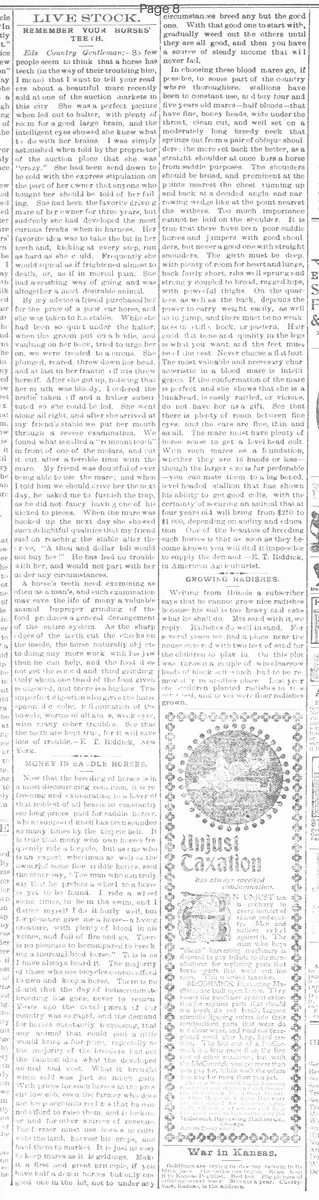
MONEY IN SADDLE HORSES.
Now that the breeding of horses is in a most discouraging condition, it is refreshing and exhilarating to a lover of that noblest of all beasts to constantly see long prices paid for saddle horses, whose supplanted knell has been sounded so many times by the bicycle bell. It is true that many who own horses frequently ride a bicycle, but as one who is an expert wheelman as well as the owner of some fine saddle horses, said the other day, 'The man who can truly say that he prefers a wheel to a horse is yet to be found. I ride a wheel sometimes, to be in the swim, and I flatter myself I do it fairly well, but for pleasure give me a horse-a living creature, with plenty of blood in his veins, and full of fire and go. There is no pleasure to be compared to breaking a thoroughbred horse.' This is as I have always heard it. The majority of those who use bicycles cannot afford to own and keep a horse. There is no doubt that the day of indiscriminate breeding is gone, never to return.
Years ago the development of our country was so rapid, and the demand for horses constantly increasing, that any animal that could pull a little would bring a fair price, especially as the majority of the breeders had not the faintest idea what the developed animal had cost. What it brought when sold was just so much gain.
With prices for such horses at the present low ebb, even the farmer who does not keep accounts realizes that he can not afford to raise them and is looking around for other sources of revenue. The farmer must use horses to cultivate the land, harvest his crops, and haul them to market. It is just as easy to keep mares as it is geldings. Make it a first and great principle, if you have half a dozen horses but only one good one in the lot, not to under any circumstances breed any but the good one. With that good one to start with, gradually weed out the others until they are all good, and then you have a source of steady income that will never fail.
In choosing these blood mares go, if possible, to some part of the country where thoroughbred stallions have been in constant use, and buy four and five years old mares-half bloods-that have fine, bony heads, wide under the throat, clean cut, and well set on a moderately long breedy neck that springs out from a pair of oblique shoulders; the more set back the better, as a straight shoulder at once bars a horse from saddle purposes. The shoulders should be broad, and prominent at the points nearest the chest, running up and back at a decided angle, and narrowing wedge like at the point nearest the withers. Too much importance cannot be laid on the shoulder. It is true that there have been poor saddle horses and jumpers with good shoulders, but never a good one with straight shoulders. The girth must be deep, with plenty of room for heart and lungs, back fairly short, ribs well sprung and strongly coupled to broad, ragged hips, with powerful thighs. On the quarters, as well as the back, depends the power to carry weight easily, as well as to jump, and there must be no weakness in stifle, back, or pectorals. Hair good, flat bone and quality in the legs is what you want, and the feet must be of the best. Never choose a flat foot.
The most valuable and necessary characteristic in a blood mare is intelligence. If the conformation of the mare is perfect and she shows that she is a lunkhead, is easily rattled, or vicious, do not have her as a gift. See that there is plenty of room between fine eyes, and the ears are fine, thin and small. The mare must have plenty of horse sense to get a level head colt. With such mares as a foundation, whether they are 16 hands or less- though the larger size is far preferable -you can mate them to a big boned, level headed stallion that has shown his ability to get good colts, with the certainty of securing an animal that at four years old will bring from $250 to $1000, depending on ability and education. One of the beauties of breeding such horses is that as soon as they become known you will find it impossible to supply the demand. -E. T. Riddick, in American Agriculturist.
Now that the breeding of horses is in a most discouraging condition, it is refreshing and exhilarating to a lover of that noblest of all beasts to constantly see long prices paid for saddle horses, whose supplanted knell has been sounded so many times by the bicycle bell. It is true that many who own horses frequently ride a bicycle, but as one who is an expert wheelman as well as the owner of some fine saddle horses, said the other day, 'The man who can truly say that he prefers a wheel to a horse is yet to be found. I ride a wheel sometimes, to be in the swim, and I flatter myself I do it fairly well, but for pleasure give me a horse-a living creature, with plenty of blood in his veins, and full of fire and go. There is no pleasure to be compared to breaking a thoroughbred horse.' This is as I have always heard it. The majority of those who use bicycles cannot afford to own and keep a horse. There is no doubt that the day of indiscriminate breeding is gone, never to return.
Years ago the development of our country was so rapid, and the demand for horses constantly increasing, that any animal that could pull a little would bring a fair price, especially as the majority of the breeders had not the faintest idea what the developed animal had cost. What it brought when sold was just so much gain.
With prices for such horses at the present low ebb, even the farmer who does not keep accounts realizes that he can not afford to raise them and is looking around for other sources of revenue. The farmer must use horses to cultivate the land, harvest his crops, and haul them to market. It is just as easy to keep mares as it is geldings. Make it a first and great principle, if you have half a dozen horses but only one good one in the lot, not to under any circumstances breed any but the good one. With that good one to start with, gradually weed out the others until they are all good, and then you have a source of steady income that will never fail.
In choosing these blood mares go, if possible, to some part of the country where thoroughbred stallions have been in constant use, and buy four and five years old mares-half bloods-that have fine, bony heads, wide under the throat, clean cut, and well set on a moderately long breedy neck that springs out from a pair of oblique shoulders; the more set back the better, as a straight shoulder at once bars a horse from saddle purposes. The shoulders should be broad, and prominent at the points nearest the chest, running up and back at a decided angle, and narrowing wedge like at the point nearest the withers. Too much importance cannot be laid on the shoulder. It is true that there have been poor saddle horses and jumpers with good shoulders, but never a good one with straight shoulders. The girth must be deep, with plenty of room for heart and lungs, back fairly short, ribs well sprung and strongly coupled to broad, ragged hips, with powerful thighs. On the quarters, as well as the back, depends the power to carry weight easily, as well as to jump, and there must be no weakness in stifle, back, or pectorals. Hair good, flat bone and quality in the legs is what you want, and the feet must be of the best. Never choose a flat foot.
The most valuable and necessary characteristic in a blood mare is intelligence. If the conformation of the mare is perfect and she shows that she is a lunkhead, is easily rattled, or vicious, do not have her as a gift. See that there is plenty of room between fine eyes, and the ears are fine, thin and small. The mare must have plenty of horse sense to get a level head colt. With such mares as a foundation, whether they are 16 hands or less- though the larger size is far preferable -you can mate them to a big boned, level headed stallion that has shown his ability to get good colts, with the certainty of securing an animal that at four years old will bring from $250 to $1000, depending on ability and education. One of the beauties of breeding such horses is that as soon as they become known you will find it impossible to supply the demand. -E. T. Riddick, in American Agriculturist.
What sub-type of article is it?
Curiosity
What themes does it cover?
Moral Virtue
Triumph
What keywords are associated?
Saddle Horses
Horse Breeding
Thoroughbred Mares
Bicycle Impact
Agricultural Revenue
Mare Conformation
Stallion Selection
What entities or persons were involved?
E. T. Riddick
Story Details
Key Persons
E. T. Riddick
Story Details
Encourages selective breeding of superior saddle horses for profit, detailing ideal mare conformation, intelligence, and mating with quality stallions to produce valuable colts worth $250-$1000.