Thank you for visiting SNEWPapers!
Sign up free
Literary
May 17, 1886
Daily Honolulu Press
Honolulu, Honolulu County, Hawaii
What is this article about?
In this chapter continuation, young Susan Coventry visits her friend Princess Charmian at Earl's Gate Place. Amidst grief over Charmian's upcoming departure, Susan admires her beauty and reconciliatory happiness with Lord Lorraine. At Mrs. Purefoy's dinner party, Susan feels plain but enjoys observing celebrities, interacts with cousin Dudley Probyn and Lady Louisa, who disapproves of Charmian.
Clipping
OCR Quality
98%
Excellent
Full Text
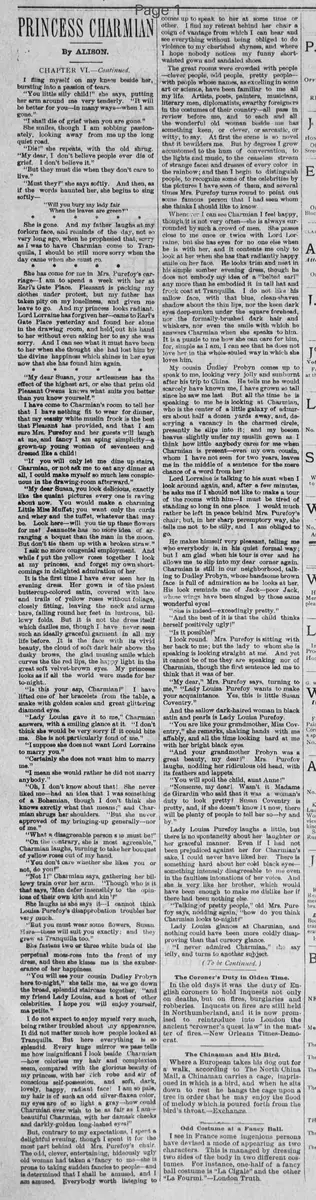
PRINCESS CHARMIAN
By ALISON.
CHAPTER VI.—Continued.
I fling myself on my knees beside her, bursting into a passion of tears.
"You little silly child!" she says, putting her arm around me very tenderly. "It will be better for you—in many ways—when I am gone."
"I shall die of grief when you are gone."
She smiles, though I am sobbing passionately, looking away from me up the long quiet road.
"Die!" she repeats, with the old shrug. "My dear, I don't believe people ever die of grief. I don't believe it."
"But they must die when they don't care to live."
"Must they?" she says softly. And then, as if the words haunted her, she begins to sing softly—
"Will you bury my lady fair
When the leaves are green?"
She is gone. And my father laughs at my forlorn face, and reminds me of the day, not so very long ago, when he prophesied that, sorry as I was to have Charmian come to Tranquilla, I should be still more sorry when the day came when she must go.
She has come for me in Mrs. Purefoy's carriage—I am to spend a week with her at Earl's Gate Place. Pleasant is packing my clothes under protest, but my father has taken pity on my loneliness, and given me leave to go. And my princess looks radiant.
Lord Lorraine has forgiven her—came to Earl's Gate Place yesterday and found her alone in the drawing room, and held out his hand to her without even asking her to say she was sorry. And I can see what it must have been to her when she thought she had lost him by the divine happiness which shines in her eyes now that she has found him again.
"My dear Susan, your artlessness has the effect of the highest art, or else that prim old Pleasant Owens knows what suits you better than you know yourself."
I have come to Charmian's room to tell her that I have nothing fit to wear for dinner, that my saucy white muslin frock is the best that Pleasant has provided, and that I am sure Mrs. Purefoy and her guests will laugh at me, and fancy I am aping simplicity—a grown-up young woman of seventeen and dressed like a child!
"If you will only let me dine upstairs, Charmian, or not ask me to eat any dinner at all, I could make myself so much less conspicuous in the drawing-room afterward."
"My dear Susan, you look delicious, exactly like the quaint pictures every one is raving about now. You would make a charming Little Miss Muffet; you want only the curds and whey and the tuffet, whatever that may be. Look here—will you tie up these flowers for me? Jeannette has no more idea of arranging a bouquet than the man in the moon. But don't tie them up with a broken straw."
I ask no more congenial employment. And while I put the yellow roses together I look at my princess, and forget my own shortcomings in delighted admiration of her.
It is the first time I have ever seen her in evening dress. Her gown is of the palest buttercup-colored satin, covered with lace and trails of yellow roses without foliage, closely fitting, leaving the neck and arms bare, falling round her feet in lustrous, billowy folds. But it is not the dress itself which dazzles me, though I have never seen such an ideally graceful garment in all my life before. It is the face with its vivid beauty, the cloud of soft dark hair above the dusky brows, the glad musing smile which curves the red lips, the happy light in the great soft velvet-brown eyes. My princess looks as if all the world were made for her to-night.
"Is this your asp, Charmian?" I have lifted one of her bracelets from the table, a snake with golden scales and great glittering diamond eyes.
"Lady Louisa gave it to me," Charmian answers, with a smiling glance at it. "I don't think she would be very sorry if it could bite me. She is not particularly fond of me."
"I suppose she does not want Lord Lorraine to marry you."
"Certainly she does not want him to marry me."
"I mean she would rather he did not marry anybody."
"Oh, I don't know about that! She never liked me—had an idea that I was something of a Bohemian, though I don't think she knows exactly what that means;" and Charmian shrugs her shoulders. "But she never approved of my bringing-up generally—nor of me."
"What a disagreeable person she must be!"
"On the contrary, she is most agreeable," Charmian laughs, turning to take her bouquet of yellow roses out of my hand.
"You don't care whether she likes you or not, do you?"
"Not I!" Charmian says, gathering her billowy train over her arm. "Though who is it that says, 'Men defer insensibly to the opinions of their own kith and kin'?"
She laughs as she says it. I cannot think Louisa Purefoy's disapprobation troubles her very much.
"But you must wear some flowers, Susan. Here—these will suit you exactly: and they grew at Tranquilla too."
She fastens two or three white buds of the perpetual moss-rose into the front of my dress, and then she kisses me in the exuberance of her happiness.
"You will see your cousin Dudley Probyn here to-night," she tells me, as we go down the broad, splendid staircase together, "and my friend Lady Louisa, and a host of other celebrities. I hope you will enjoy yourself, ma petite."
I do not expect to enjoy myself very much, being rather troubled about my appearance. It did not matter much how people looked at Tranquilla. But here everything is so splendid. Every huge mirror we pass tells me how insignificant I look beside Charmian—how colorless my hair and complexion seem, compared with the glorious beauty of my princess, with her rich robe and air of conscious self-possession, and soft, dark, lovely, happy, radiant face! I am so pale, my hair is of such an odd silver-flaxen color, my eyes are of so light a gray—how could Charmian ever wish to be as fair as I am—beautiful Charmian, with her damask cheeks and darkly-golden long-lashed eyes?
But, contrary to my expectations, I spend a delightful evening, though I spend it for the most part behind old Mrs. Purefoy's chair.
The odd, clever, entertaining, hideously ugly old woman had taken a fancy to me—she is prone to taking sudden fancies to people—and is determined that I shall be amused, and I am amused. Everybody worth listening to comes up to speak to her at some time or other. I find my retreat behind her chair a coign of vantage from which I can hear and see everything without being obliged to do violence to my cherished shyness, and where I hope nobody notices my funny short-waisted gown and sandaled shoes.
The great rooms were crowded with people—clever people, odd people, pretty people—with people whose names, as excelling in some art or science, have been familiar to me all my life. Artists, poets, painters, musicians, literary men, diplomatists, swarthy foreigners in the costumes of their country—all pass in review before me, and to each and all the wonderful old woman beside me has something keen, or clever, or sarcastic, or witty, to say. At first the scene is so novel that it bewilders me. But by degrees I grow accustomed to the hum of conversation, to the lights and music, to the ceaseless stream of strange faces and dresses of every color in the rainbow; and then I begin to distinguish people, to recognize some of the celebrities by the pictures I have seen of them, and several times Mrs. Purefoy turns round to point out some famous person that I had seen whom she thinks I should like to know.
Whenever I can see Charmian I feel happy, though it is not very often—she is always surrounded by such a crowd of men. She passes close to me once or twice with Lord Lorraine, but she has eyes for no one else when he is with her, and it contents me only to look at her when she has that radiantly happy smile on her face. He looks trim and neat in his simple somber evening dress, though he does not embody my idea of a "belted earl" any more than he embodied it in tall hat and frock coat at Tranquilla. I do not like his sallow face, with that blue, clean-shaven shadow about the thin lips, nor the keen dark eyes deep-sunken under the square forehead, nor the formally-brushed dark hair and whiskers, nor even the smile with which he answers Charmian when she speaks to him.
It is a puzzle to me how she can care for him, for, simple as I am, I can see that he does not love her in the whole-souled way in which she loves him.
My cousin Dudley Probyn comes up to speak to me, looking very jolly and sunburnt after his trip to China. He tells me he would scarcely have known me, I have grown so tall since he saw me last. But all the time he is speaking to me he is looking at Charmian, who is the center of a little galaxy of admirers about half a dozen yards away, and, descrying a vacancy in the charmed circle, presently he slips into it; and my bosom heaves slightly under my muslin gown as I think how little anybody cares for me when Charmian is present—even my own cousin, whom I have not seen for two years, leaves me in the middle of a sentence for the mere chance of a word from her.
Lord Lorraine is talking to his aunt when I look around again, and, after a few minutes, he asks me if I should not like to make a tour of the rooms with him—I must be tired of standing so long in one place. I would much rather be left in peace behind Mrs. Purefoy's chair; but, in her sharp peremptory way, she tells me not to be silly, and I am obliged to go.
He makes himself very pleasant, telling me who everybody is, in his quiet formal way; but I am glad when his tour is over and he allows me to slip into my dear corner again.
Charmian is still in our neighborhood, talking to Dudley Probyn, whose handsome brown face is full of admiration as he looks at her. His look reminds me of Jack—poor Jack, whose wings have been singed by those same wonderful eyes!
"She is indeed—exceedingly pretty."
"And the best of it is that the child thinks herself positively ugly!"
"Is it possible?"
I look round. Mrs. Purefoy is sitting with her back to me; but the lady to whom she is speaking is looking straight at me. And yet it cannot be of me they are speaking nor of Charmian, though the first sentence led me to think that it was of her.
"My dear," Mrs. Purefoy says, turning to me, "Lady Louisa Purefoy wants to make your acquaintance. Yes, this is little Susan Coventry."
And the sallow dark-haired woman in black satin and pearls is Lady Louisa Purefoy.
"You are like your grandmother, Miss Coventry," she remarks, shaking hands with me affably, and all the time looking hard at me with her bright black eyes.
"And your grandmother Probyn was a great beauty, my dear!" Mrs. Purefoy laughs, nodding her ridiculous old head, with its feathers and lappets.
"You will spoil the child, aunt Anne!"
"Nonsense, my dear! Wasn't it Madame de Girardin who said that it was a woman's duty to look pretty? Susan Coventry is pretty, and, if she doesn't know it now, there will be plenty of people to tell her so—by and by."
Lady Louisa Purefoy laughs a little, but there is no spontaneity about her laughter or her graceful manner. Even if I had not been prejudiced against her for Charmian's sake, I could never have liked her. There is something hard about her cold black eyes—something intensely disagreeable to me even in the faultless intonations of her voice. And she is very like her brother, which would have been enough to make me dislike her if there had been nothing else.
"Talking of pretty people," old Mrs. Purefoy says, nodding again, "how do you think Charmian looks to-night?"
Lady Louisa glances at Charmian, and nothing could have been more coldly disapproving than that cursory glance.
"I never admired Charmian," she says icily, and turns to another subject.
(To be Continued.)
By ALISON.
CHAPTER VI.—Continued.
I fling myself on my knees beside her, bursting into a passion of tears.
"You little silly child!" she says, putting her arm around me very tenderly. "It will be better for you—in many ways—when I am gone."
"I shall die of grief when you are gone."
She smiles, though I am sobbing passionately, looking away from me up the long quiet road.
"Die!" she repeats, with the old shrug. "My dear, I don't believe people ever die of grief. I don't believe it."
"But they must die when they don't care to live."
"Must they?" she says softly. And then, as if the words haunted her, she begins to sing softly—
"Will you bury my lady fair
When the leaves are green?"
She is gone. And my father laughs at my forlorn face, and reminds me of the day, not so very long ago, when he prophesied that, sorry as I was to have Charmian come to Tranquilla, I should be still more sorry when the day came when she must go.
She has come for me in Mrs. Purefoy's carriage—I am to spend a week with her at Earl's Gate Place. Pleasant is packing my clothes under protest, but my father has taken pity on my loneliness, and given me leave to go. And my princess looks radiant.
Lord Lorraine has forgiven her—came to Earl's Gate Place yesterday and found her alone in the drawing room, and held out his hand to her without even asking her to say she was sorry. And I can see what it must have been to her when she thought she had lost him by the divine happiness which shines in her eyes now that she has found him again.
"My dear Susan, your artlessness has the effect of the highest art, or else that prim old Pleasant Owens knows what suits you better than you know yourself."
I have come to Charmian's room to tell her that I have nothing fit to wear for dinner, that my saucy white muslin frock is the best that Pleasant has provided, and that I am sure Mrs. Purefoy and her guests will laugh at me, and fancy I am aping simplicity—a grown-up young woman of seventeen and dressed like a child!
"If you will only let me dine upstairs, Charmian, or not ask me to eat any dinner at all, I could make myself so much less conspicuous in the drawing-room afterward."
"My dear Susan, you look delicious, exactly like the quaint pictures every one is raving about now. You would make a charming Little Miss Muffet; you want only the curds and whey and the tuffet, whatever that may be. Look here—will you tie up these flowers for me? Jeannette has no more idea of arranging a bouquet than the man in the moon. But don't tie them up with a broken straw."
I ask no more congenial employment. And while I put the yellow roses together I look at my princess, and forget my own shortcomings in delighted admiration of her.
It is the first time I have ever seen her in evening dress. Her gown is of the palest buttercup-colored satin, covered with lace and trails of yellow roses without foliage, closely fitting, leaving the neck and arms bare, falling round her feet in lustrous, billowy folds. But it is not the dress itself which dazzles me, though I have never seen such an ideally graceful garment in all my life before. It is the face with its vivid beauty, the cloud of soft dark hair above the dusky brows, the glad musing smile which curves the red lips, the happy light in the great soft velvet-brown eyes. My princess looks as if all the world were made for her to-night.
"Is this your asp, Charmian?" I have lifted one of her bracelets from the table, a snake with golden scales and great glittering diamond eyes.
"Lady Louisa gave it to me," Charmian answers, with a smiling glance at it. "I don't think she would be very sorry if it could bite me. She is not particularly fond of me."
"I suppose she does not want Lord Lorraine to marry you."
"Certainly she does not want him to marry me."
"I mean she would rather he did not marry anybody."
"Oh, I don't know about that! She never liked me—had an idea that I was something of a Bohemian, though I don't think she knows exactly what that means;" and Charmian shrugs her shoulders. "But she never approved of my bringing-up generally—nor of me."
"What a disagreeable person she must be!"
"On the contrary, she is most agreeable," Charmian laughs, turning to take her bouquet of yellow roses out of my hand.
"You don't care whether she likes you or not, do you?"
"Not I!" Charmian says, gathering her billowy train over her arm. "Though who is it that says, 'Men defer insensibly to the opinions of their own kith and kin'?"
She laughs as she says it. I cannot think Louisa Purefoy's disapprobation troubles her very much.
"But you must wear some flowers, Susan. Here—these will suit you exactly: and they grew at Tranquilla too."
She fastens two or three white buds of the perpetual moss-rose into the front of my dress, and then she kisses me in the exuberance of her happiness.
"You will see your cousin Dudley Probyn here to-night," she tells me, as we go down the broad, splendid staircase together, "and my friend Lady Louisa, and a host of other celebrities. I hope you will enjoy yourself, ma petite."
I do not expect to enjoy myself very much, being rather troubled about my appearance. It did not matter much how people looked at Tranquilla. But here everything is so splendid. Every huge mirror we pass tells me how insignificant I look beside Charmian—how colorless my hair and complexion seem, compared with the glorious beauty of my princess, with her rich robe and air of conscious self-possession, and soft, dark, lovely, happy, radiant face! I am so pale, my hair is of such an odd silver-flaxen color, my eyes are of so light a gray—how could Charmian ever wish to be as fair as I am—beautiful Charmian, with her damask cheeks and darkly-golden long-lashed eyes?
But, contrary to my expectations, I spend a delightful evening, though I spend it for the most part behind old Mrs. Purefoy's chair.
The odd, clever, entertaining, hideously ugly old woman had taken a fancy to me—she is prone to taking sudden fancies to people—and is determined that I shall be amused, and I am amused. Everybody worth listening to comes up to speak to her at some time or other. I find my retreat behind her chair a coign of vantage from which I can hear and see everything without being obliged to do violence to my cherished shyness, and where I hope nobody notices my funny short-waisted gown and sandaled shoes.
The great rooms were crowded with people—clever people, odd people, pretty people—with people whose names, as excelling in some art or science, have been familiar to me all my life. Artists, poets, painters, musicians, literary men, diplomatists, swarthy foreigners in the costumes of their country—all pass in review before me, and to each and all the wonderful old woman beside me has something keen, or clever, or sarcastic, or witty, to say. At first the scene is so novel that it bewilders me. But by degrees I grow accustomed to the hum of conversation, to the lights and music, to the ceaseless stream of strange faces and dresses of every color in the rainbow; and then I begin to distinguish people, to recognize some of the celebrities by the pictures I have seen of them, and several times Mrs. Purefoy turns round to point out some famous person that I had seen whom she thinks I should like to know.
Whenever I can see Charmian I feel happy, though it is not very often—she is always surrounded by such a crowd of men. She passes close to me once or twice with Lord Lorraine, but she has eyes for no one else when he is with her, and it contents me only to look at her when she has that radiantly happy smile on her face. He looks trim and neat in his simple somber evening dress, though he does not embody my idea of a "belted earl" any more than he embodied it in tall hat and frock coat at Tranquilla. I do not like his sallow face, with that blue, clean-shaven shadow about the thin lips, nor the keen dark eyes deep-sunken under the square forehead, nor the formally-brushed dark hair and whiskers, nor even the smile with which he answers Charmian when she speaks to him.
It is a puzzle to me how she can care for him, for, simple as I am, I can see that he does not love her in the whole-souled way in which she loves him.
My cousin Dudley Probyn comes up to speak to me, looking very jolly and sunburnt after his trip to China. He tells me he would scarcely have known me, I have grown so tall since he saw me last. But all the time he is speaking to me he is looking at Charmian, who is the center of a little galaxy of admirers about half a dozen yards away, and, descrying a vacancy in the charmed circle, presently he slips into it; and my bosom heaves slightly under my muslin gown as I think how little anybody cares for me when Charmian is present—even my own cousin, whom I have not seen for two years, leaves me in the middle of a sentence for the mere chance of a word from her.
Lord Lorraine is talking to his aunt when I look around again, and, after a few minutes, he asks me if I should not like to make a tour of the rooms with him—I must be tired of standing so long in one place. I would much rather be left in peace behind Mrs. Purefoy's chair; but, in her sharp peremptory way, she tells me not to be silly, and I am obliged to go.
He makes himself very pleasant, telling me who everybody is, in his quiet formal way; but I am glad when his tour is over and he allows me to slip into my dear corner again.
Charmian is still in our neighborhood, talking to Dudley Probyn, whose handsome brown face is full of admiration as he looks at her. His look reminds me of Jack—poor Jack, whose wings have been singed by those same wonderful eyes!
"She is indeed—exceedingly pretty."
"And the best of it is that the child thinks herself positively ugly!"
"Is it possible?"
I look round. Mrs. Purefoy is sitting with her back to me; but the lady to whom she is speaking is looking straight at me. And yet it cannot be of me they are speaking nor of Charmian, though the first sentence led me to think that it was of her.
"My dear," Mrs. Purefoy says, turning to me, "Lady Louisa Purefoy wants to make your acquaintance. Yes, this is little Susan Coventry."
And the sallow dark-haired woman in black satin and pearls is Lady Louisa Purefoy.
"You are like your grandmother, Miss Coventry," she remarks, shaking hands with me affably, and all the time looking hard at me with her bright black eyes.
"And your grandmother Probyn was a great beauty, my dear!" Mrs. Purefoy laughs, nodding her ridiculous old head, with its feathers and lappets.
"You will spoil the child, aunt Anne!"
"Nonsense, my dear! Wasn't it Madame de Girardin who said that it was a woman's duty to look pretty? Susan Coventry is pretty, and, if she doesn't know it now, there will be plenty of people to tell her so—by and by."
Lady Louisa Purefoy laughs a little, but there is no spontaneity about her laughter or her graceful manner. Even if I had not been prejudiced against her for Charmian's sake, I could never have liked her. There is something hard about her cold black eyes—something intensely disagreeable to me even in the faultless intonations of her voice. And she is very like her brother, which would have been enough to make me dislike her if there had been nothing else.
"Talking of pretty people," old Mrs. Purefoy says, nodding again, "how do you think Charmian looks to-night?"
Lady Louisa glances at Charmian, and nothing could have been more coldly disapproving than that cursory glance.
"I never admired Charmian," she says icily, and turns to another subject.
(To be Continued.)
What sub-type of article is it?
Prose Fiction
What themes does it cover?
Love Romance
Social Manners
Friendship
What keywords are associated?
Romance
Society
Beauty
Jealousy
Dinner Party
Celebrities
Friendship
What entities or persons were involved?
By Alison.
Literary Details
Title
Princess Charmian Chapter Vi.—Continued.
Author
By Alison.
Key Lines
"Will You Bury My Lady Fair
When The Leaves Are Green?"
"My Dear Susan, Your Artlessness Has The Effect Of The Highest Art, Or Else That Prim Old Pleasant Owens Knows What Suits You Better Than You Know Yourself."
My Princess Looks As If All The World Were Made For Her To Night.
"She Is Indeed—Exceedingly Pretty."
"And The Best Of It Is That The Child Thinks Herself Positively Ugly!"
"I Never Admired Charmian," She Says Icily, And Turns To Another Subject.