Thank you for visiting SNEWPapers!
Sign up free
The Enquirer
Richmond, Henrico County, Virginia
What is this article about?
European news on English financial stability via Bank advances on Omnium stock; French journal analysis contrasts England's commerce-dependent economy and political oppression with France's self-sufficient revenue, prosperous manufactures, and tolerant governance amid continental system impacts.
Merged-components note: Continuation of the same Europe/English funds article across page break, sequential reading order.
Clippings
1 of 2
OCR Quality
Full Text
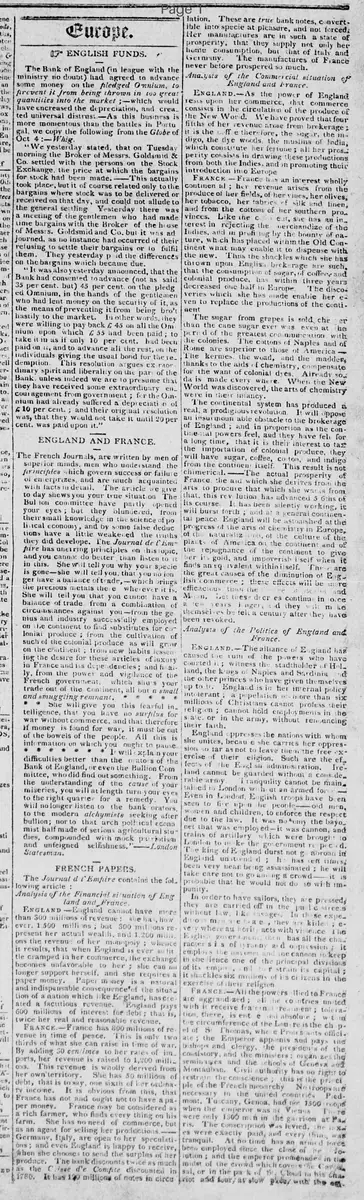
ENGLISH FUNDS.
The Bank of England (in league with the ministry no doubt) had agreed to advance some money on the pledged Omnium, to prevent it from being thrown in too great quantities into the market;—which would have increased the depreciation, and created universal distrust.—As this business is more momentous than the battles in Portugal, we copy the following from the Globe of Oct 4:—Whig.
"We yesterday stated, that on Tuesday morning the Broker of Messrs. Goldsmid & Co. settled with the persons on the Stock Exchange. the price at which the bargains for stock had been made.—This actually took place, but it of course related only to the bargains where stock was to be delivered or received on that day, and could not allude to the general settling Yesterday there was a meeting of the gentlemen who had made time bargains with the Broker of the house of Messrs. Goldsmid and Co. but it was adjourned, as no instance had occurred of their refusing to settle their bargains or to fulfil them. They yesterday paid the differences on the bargains which became due.
"It was also yesterday announced, that the Bank had consented to advance (not as said 35 per cent. but) 45 per cent. on the pledged Omnium, in the hands of the gentlemen who had lent money on the security of it, as the means of preventing it from being bro't hastily to the market. In other words, they were willing to pay back 45 on all the Omnium upon which 55 had been paid; to take it in as if only 10 per cent. had been paid on it, and to advance all the rest, on the individuals giving the usual bond for the redemption. This resolution argues extraordinary spirit and liberality on the part of the Bank, unless indeed we are to presume that they have received some extraordinary encouragement from government; for the Omnium had already suffered a depreciation of 10 per cent.; and their original resolution was, that they would not take it until 20 per cent. was paid upon it."
ENGLAND AND FRANCE.
The French Journals, are written by men of superior minds. men who understand the principles which govern success or failure of enterprises, and are much acquainted with facts in detail. The article we give to day shews you your true situation The Bullion committee have partly opened your eyes; but they blundered, from their small knowledge in the science of political economy, and by some false deductions have a little weakened the truths they did develope. The Journal de l'Empire has unerring principles on his topic, and you cannot do better than listen to it in this. She will tell you why your specie is gone—she will tell you, that you no longer have a balance of trade,—which brings the precious metals the e wherever it is.
She will tell you that you cannot have a balance of trade. from a combination of circumstances against you—from the genius and industry successfully employed on the continent to find substitutes for colonial produce; from the cultivation of such of the colonial produce as will grow on the continent; from new habits lessening the desire for these articles of luxury in France and its dependencies; and finally, from the power and vigilance of the French government, which shuts your trade out of the Continent, all but a small and smuggling remnant.
She will give you this fearful intelligence, that you have no surplus for war without commerce, and that therefore if money is found for war, it must be out of the bowels of the people. All this is information on which you ought to pause.
It will explain your difficulties better than the orations of the Bank of England, or even the Bullion Committee, who did find out something. From the understanding of the cause of your miseries, you will at length turn your eyes to the right quarter for a remedy. You will no longer listen to the bank orators, to the modern alchymists seeking after bullion; nor to that arch political economist half made of serious agricultural studies, compounded with mock patriotism and unfeigned selfishness."—London Statesman.
FRENCH PAPERS.
The Journal d'Empire contains the following article:
Analysis of the Financial situation of England and France.
England—England cannot have more than 800 millions of revenue: she has, however, 1500 millions; but 800 millions represent her actual wealth, and 1200 millions the revenue of her monopoly; whence it results, that when England is ever so little cramped in her commerce, the exchange becomes unfavorable to her; she can no longer support herself, and she requires a paper money. Paper money is a natural and indispensable consequence of the situation of a nation which like England, has created a factitious revenue. England pays 600 millions of interest for debt; that is, twice her real and reasonable revenue.
France—France has 800 millions of revenue in time of peace, This is only two thirds of what she can raise in time of war. By adding 50 per cent to her rates of imports, her revenue is raised to 1900 millions. This revenue is wholly derived from her own territory. She has 50 millions of debt, that is to say, one sixth of her ordinary income. It is obvious from this, that France has not and ought not to have a paper money. France may be considered as a rich farmer, who finds every thing on his farm. She has no need of commerce, but as an agent for selling her productions—Germany, Italy, are open to her speculations: and even England is happy to receive, when she chooses to send the surplus of her produce. The bank discounts twice as much as the Caisse d'Escompte discounted in 1780. It has 10 millions of notes in circulation. These are true bank notes, Convertible into specie at pleasure, and not forced: Her manufactures are in such a state of prosperity, that they supply not only her home consumption, but that of Italy and Germany. The manufactures of France never before prospered so much.
Analysis of the Commercial situation England and France.
England—As the power of England rests upon her commerce, that commerce consists in the circulation of the produce of the New World. We have proved that four fifths of her revenue arose from brokerage; it is the true therefore, the sugar, the indigo, the dye woods, the muslins of India, which constitute her fortune; all her prosperity consists in drawing these productions from both the Indies, and on promoting their introduction into Europe
France—France has an interest wholly continental; her revenue arises from the produce of her fields, of her vines, her olives, her tobacco, her fabrics of silk and linen, and from the cottons of her southern provinces. Like the continent, she has an interest in rejecting the merchandize of the Indies, and in profiting by the bounty of nature, which has placed within the Old Continent what may enable it to dispense with the new. Thus the shackles which she has thrown upon English brokerage are such, that the consumption of sugar, of coffee and colonial produce, has within three years decreased one half in Europe The discoveries which she has made enable her even to replace the productions of the continent
The sugar from grapes is sold cheaper than the cane sugar ever was even at the period of the greatest communication with The colonies. The cottons of Naples and of Rome are superior to those of America—The kermes, the woad, and the madder, thanks to the aids of chemistry, Compensate for the want of colonial dyes. Already soap is made everywhere. When the New World was discovered, the arts of chemistry were in their infancy.
The continental system has produced a real, a prodigious revolution. It will oppose an insurmountable obstacle to the brokerage of England; and in proportion as the Continental powers feel, and they have felt for a long time, that it is their interest to tax the importation of colonial produce, they will have sugar, coffee, cotton, and indigo from the continent itself. This result is not chimerical. The actual prosperity of France, the aid which she derives from the arts to procure that which she wants from that, this revolution has advanced 5/6ths of its course. It has been silently working. it will burst forth; and at a general continental peace England will be astonished at the progress of the arts of chemistry in Europe, of the naturalization, of the culture of the plants of America on the continent and of the repugnance of the continent to give her its gold, and impoverish itself when it finds an equivalent within itself. These are the great causes of the diminution of English commerce; these effects will be more efficacious than the decrees—Let the decrees decrease in once a year longer, and they will make themselves be felt a century after they have been revoked.
Analysis of the Politics of England and France.
England—The alliance of England has caused the ruin of the powers who have Courted it; witness the stadtholder of Holland, the kings of Naples and Sardinia. and the other princes who have given themselves up to it. England is in her infernal policy intolerant; a population—more than six millions of Christians cannot profess their religion; cannot hold employments in the state. or in the army, without renouncing their faith.
England oppresses the nations with whom she unites, because she carries her oppression so far as not to leave them the free exercise of their religion. Such are the effects of the English administration. Ireland cannot be guarded without a considerable army
Tranquility cannot be maintained in London without an armed force. Even in London, English troops have been seen to fire upon the people—old men, women and children, to enforce the respect due to the law. It was not only the bayonet that was employed—it was cannon, and trains of artillery which were brought to London to make the government respected.
The king of England durst not go abroad in England unattended; It has been very near being assassinated; he will take care not to go among a crowd— it is probable that he would not do so with impunity.
In order to have sailors, they are pressed they are carried off in the public streets without law. The savages. In these expeditions, they are killed;—every where authority acts with violence The English government, then has all the character of tyranny and oppression; it employs the bayonet and the cannon to keep in obedience one of the principal divisions of its empire; it restrains its capital; it shackles six millions of its citizens in the exercise of their religion
France—All the powers allied to France are aggrandized; the countries united with receive from her resident; toleration, there, is entire and absolute; within the circumference of the Louvre is the chapel of St Thomas, where Protestants officiate; the Emperor appoints and pays one bishops and clergy, the presidents of the consistory, and the ministers: organizes the seminaries and the schools of Geneva and Montauban. Civil authority has no right to restrain the conscience; this is the principle of the French monarchy No troops are necessary in the united countries Piedmont, Tuscany, Genoa, had not 1500 troops when the emperor was at Vienna There were only 1500 men in the garrison at Paris. The Conscription Was levied, the Taxes were exactly paid, and every thing was tranquil. At no time has an armed force been employed since the close of the revolution; and the emperor promenaded in the midst of the crowd which covers the Carrousel, or in the parks, crowd in his Chaise a la da quatre, at slow pace, with the en.
press, and a single page. and amidst 150,000 spectators surrounding his carriage, and blessing the father of the country. Opinion is all powerful in France, from the lowest class to the highest; all listen to reason. and march when the trumpet sounds. The conscription is regulated like the taxes; it is levied without commotion, without disorder; the magistrates of the people preside over the whole. there is nothing of violence or tumult to be seen.
What sub-type of article is it?
What keywords are associated?
What entities or persons were involved?
Where did it happen?
Foreign News Details
Primary Location
Europe
Event Date
Oct 4
Key Persons
Outcome
bank advances 45 per cent on pledged omnium to prevent market depreciation; analysis shows england's commerce diminished by continental system, france's prosperity increased
Event Details
Report on English funds where Bank of England advances money on Omnium to stabilize market; commentary on French journals analyzing England's lack of trade balance due to continental substitutes and blockades; detailed French analysis comparing financial, commercial, and political situations of England and France, highlighting England's reliance on colonial trade and paper money versus France's self-sufficient revenue and stability.