Thank you for visiting SNEWPapers!
Sign up free
Editorial
July 13, 1861
New York Daily Tribune
New York, New York County, New York
What is this article about?
An editorial criticizes General Benjamin F. Butler's June 20 order from Fortress Monroe banning reporters from publishing military information or opinions, arguing that newspapers made Butler's career and that press reporting serves the public's vital interest in the war, urging officers to keep secrets internally.
Clipping
OCR Quality
95%
Excellent
Full Text
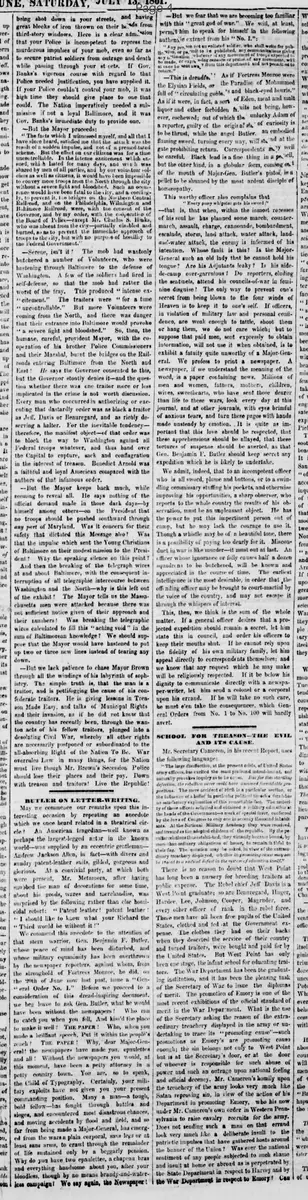
BUTLER ON LETTER-WRITING.
May we commence our remarks upon this interesting occasion by repeating an anecdote which we once heard related in a theatrical circle? An American tragedian—well known as perhaps the largest-legged actor in the known world—was supplied by an eccentric gentleman—Andrew Jackson Allen, in fact—with divers and sundry patent-leather suits, gilded, gorgeous and glorious. At a convivial party, at which both were present, Mr. Metamora, after having snubbed the man of decorations for some time, about his goods, wares and merchandise, was surprised by the following rather than else homicidal retort: 'Patent leather! patent leather! I should like to know what your Richard the Third would be without it!'
We commend this anecdote to the attention of that stern warrior, Gen. Benjamin F. Butler, whose peace of mind has been disturbed, and whose military equanimity has been overthrown by the newspaper reporters, against whom, from the stronghold of Fortress Monroe, he did, on the 20th of June now last past, issue a 'General Order No. I.' Before we proceed to a consideration of this dread-inspiring document, we beg leave to ask Gen. Butler, what he would have been without the newspapers? Who ran to catch you when you fell, And kiss'd the place to make it well? THE PAPER! Who, when you made a brilliant speech, Put it within the people's reach? THE PAPER! Why, dear Major-General! the newspapers have made you, epaulettes and all: Without the newspapers you would, at this moment, have been a petty attorney in a petty country town. You are, so to speak, the Child of Typography. Certainly, your military exploits have not given you your present commanding position. Many a man—a tough, bold fellow—has fought through battles and sieges, and encountered most disastrous chances, and moving accidents by flood and field, and so far from being made a Major-General, has emerged from the wars a plain corporal, sans legs or at least sans arms, to crawl through the remainder of life sustained only by a beggarly pension. Why do you have two epaulettes, a chapeau bras and everything handsome about you, after your bloodless, though by no means brandy-and-water-less campaign? We say again, the Newspaper!
But we fear that we are becoming too familiar with this 'great god of war.' We will, at least, permit him to speak for himself in the following authentic extract from his 'No. I.':
'Any person not an enlisted soldier, who shall write for publication, or permit to be published, any communication giving the position of any of the forces of the United States in this department, or any communication whatever expressing censure or praise of any movement, will at once be sent away from this department and not permitted to return.'
This is dreadful! As if Fortress Monroe were the Elysian Fields, or the Paradise of Mohammed full of 'circulating goblets and black-eyed houris.' As if it were, in fact, a sort of Eden, meat and malt liquor and other forbidden fruits not being, however, eschewed; out of which the unlucky Adam of a reporter, guilty of the original sin of curiosity is to be thrust, while the angel Butler, an embodied flaming sword, turning every way, will stand at the gate prohibiting return. Correspondents may well be careful. Black lead is a fine thing in a pencil, but the other kind, in a globular form, coming out of the mouth of Major-Gen. Butler's pistol, is a pellet to be shunned by the most ardent disciple of homopathy.
This worthy officer also complains that 'Every puny whipster gets his sword;'—that is, that when, within the inmost recesses of his soul he has planned some march, counter march, assault, charge, cannonade, bombardment, escalade, storm, land attack, water attack, land-and-water attack, the enemy is informed of his intention. Whose fault is this? Is the Major-General such an old lady that he cannot hold his tongue? Are his Adjutants leaky? Is his aide-de-camp over-garrulous? Do reporters, eluding the sentinels, attend his councils-of-war in feminine disguise? The only way to prevent one's secret from being blown to the four winds of Heaven is to keep it to one's self. If officers, in violation of military law and personal confidence, are weak enough to tattle, shoot them or hang them, we do not care which; but to suppose that paid men, sent expressly to obtain information, will not use it when obtained, is to exhibit a fatuity quite unworthy of a Major-General. We profess to print a newspaper. A newspaper, if we understand the meaning of the word, is a paper containing news. Millions of men and women, fathers, mothers, children, wives, sweethearts, who have sent those dearer than life to these wars, look every day at this journal, and at other journals, with eyes brimful of anxious tears, and turn these pages with hands made unsteady by emotion. It is quite as important that this love should be respected, that these apprehensions should be allayed, that these tortures of suspense should be averted, as that Gen. Benjamin F. Butler should keep secret any expedition which he is likely to undertake.
We admit, indeed, that to an incompetent officer who is all sword, plume and buttons, or to a swindling commissary stuffing his pockets, and otherwise improving his opportunities, a sharp observer, who reports to the whole country the results of his observation, must be an unpleasant object. He has the power to put this impertinent person out of camp, but he may lack the courage to use it. Though a whistle may be of a beautiful tone, there is a possibility of paying too dearly for it. Misconduct in war is like murder—it must out at last. An officer whose ignorance or folly causes half a dozen squadrons to be butchered, will be known and appreciated in the course of time. The earliest intelligence is the most desirable, in order that the offending officer may be brought to court-martial by the voice of the country, and may not escape it through the whispers of interest.
This, then, we think is the sum of the whole matter. If a general officer desires that a projected expedition should remain a secret, let him state this in council, and order his officers to keep their mouths shut. If he cannot rely upon the fidelity of his own military family, let him appeal directly to correspondents themselves; and we know that any request which he may make will be religiously respected. If it be below his dignity to communicate directly with a newspaper-writer, let him send a colonel or a corporal upon his errand. If he will take no such care, he must e'en take the consequences, which General Orders from No. 1 to No. 100 will hardly avert.
May we commence our remarks upon this interesting occasion by repeating an anecdote which we once heard related in a theatrical circle? An American tragedian—well known as perhaps the largest-legged actor in the known world—was supplied by an eccentric gentleman—Andrew Jackson Allen, in fact—with divers and sundry patent-leather suits, gilded, gorgeous and glorious. At a convivial party, at which both were present, Mr. Metamora, after having snubbed the man of decorations for some time, about his goods, wares and merchandise, was surprised by the following rather than else homicidal retort: 'Patent leather! patent leather! I should like to know what your Richard the Third would be without it!'
We commend this anecdote to the attention of that stern warrior, Gen. Benjamin F. Butler, whose peace of mind has been disturbed, and whose military equanimity has been overthrown by the newspaper reporters, against whom, from the stronghold of Fortress Monroe, he did, on the 20th of June now last past, issue a 'General Order No. I.' Before we proceed to a consideration of this dread-inspiring document, we beg leave to ask Gen. Butler, what he would have been without the newspapers? Who ran to catch you when you fell, And kiss'd the place to make it well? THE PAPER! Who, when you made a brilliant speech, Put it within the people's reach? THE PAPER! Why, dear Major-General! the newspapers have made you, epaulettes and all: Without the newspapers you would, at this moment, have been a petty attorney in a petty country town. You are, so to speak, the Child of Typography. Certainly, your military exploits have not given you your present commanding position. Many a man—a tough, bold fellow—has fought through battles and sieges, and encountered most disastrous chances, and moving accidents by flood and field, and so far from being made a Major-General, has emerged from the wars a plain corporal, sans legs or at least sans arms, to crawl through the remainder of life sustained only by a beggarly pension. Why do you have two epaulettes, a chapeau bras and everything handsome about you, after your bloodless, though by no means brandy-and-water-less campaign? We say again, the Newspaper!
But we fear that we are becoming too familiar with this 'great god of war.' We will, at least, permit him to speak for himself in the following authentic extract from his 'No. I.':
'Any person not an enlisted soldier, who shall write for publication, or permit to be published, any communication giving the position of any of the forces of the United States in this department, or any communication whatever expressing censure or praise of any movement, will at once be sent away from this department and not permitted to return.'
This is dreadful! As if Fortress Monroe were the Elysian Fields, or the Paradise of Mohammed full of 'circulating goblets and black-eyed houris.' As if it were, in fact, a sort of Eden, meat and malt liquor and other forbidden fruits not being, however, eschewed; out of which the unlucky Adam of a reporter, guilty of the original sin of curiosity is to be thrust, while the angel Butler, an embodied flaming sword, turning every way, will stand at the gate prohibiting return. Correspondents may well be careful. Black lead is a fine thing in a pencil, but the other kind, in a globular form, coming out of the mouth of Major-Gen. Butler's pistol, is a pellet to be shunned by the most ardent disciple of homopathy.
This worthy officer also complains that 'Every puny whipster gets his sword;'—that is, that when, within the inmost recesses of his soul he has planned some march, counter march, assault, charge, cannonade, bombardment, escalade, storm, land attack, water attack, land-and-water attack, the enemy is informed of his intention. Whose fault is this? Is the Major-General such an old lady that he cannot hold his tongue? Are his Adjutants leaky? Is his aide-de-camp over-garrulous? Do reporters, eluding the sentinels, attend his councils-of-war in feminine disguise? The only way to prevent one's secret from being blown to the four winds of Heaven is to keep it to one's self. If officers, in violation of military law and personal confidence, are weak enough to tattle, shoot them or hang them, we do not care which; but to suppose that paid men, sent expressly to obtain information, will not use it when obtained, is to exhibit a fatuity quite unworthy of a Major-General. We profess to print a newspaper. A newspaper, if we understand the meaning of the word, is a paper containing news. Millions of men and women, fathers, mothers, children, wives, sweethearts, who have sent those dearer than life to these wars, look every day at this journal, and at other journals, with eyes brimful of anxious tears, and turn these pages with hands made unsteady by emotion. It is quite as important that this love should be respected, that these apprehensions should be allayed, that these tortures of suspense should be averted, as that Gen. Benjamin F. Butler should keep secret any expedition which he is likely to undertake.
We admit, indeed, that to an incompetent officer who is all sword, plume and buttons, or to a swindling commissary stuffing his pockets, and otherwise improving his opportunities, a sharp observer, who reports to the whole country the results of his observation, must be an unpleasant object. He has the power to put this impertinent person out of camp, but he may lack the courage to use it. Though a whistle may be of a beautiful tone, there is a possibility of paying too dearly for it. Misconduct in war is like murder—it must out at last. An officer whose ignorance or folly causes half a dozen squadrons to be butchered, will be known and appreciated in the course of time. The earliest intelligence is the most desirable, in order that the offending officer may be brought to court-martial by the voice of the country, and may not escape it through the whispers of interest.
This, then, we think is the sum of the whole matter. If a general officer desires that a projected expedition should remain a secret, let him state this in council, and order his officers to keep their mouths shut. If he cannot rely upon the fidelity of his own military family, let him appeal directly to correspondents themselves; and we know that any request which he may make will be religiously respected. If it be below his dignity to communicate directly with a newspaper-writer, let him send a colonel or a corporal upon his errand. If he will take no such care, he must e'en take the consequences, which General Orders from No. 1 to No. 100 will hardly avert.
What sub-type of article is it?
Press Freedom
Military Affairs
What keywords are associated?
Press Freedom
Military Censorship
Butler Order
Newspaper Reporters
Fortress Monroe
What entities or persons were involved?
Gen. Benjamin F. Butler
Newspaper Reporters
Fortress Monroe
Editorial Details
Primary Topic
Criticism Of General Butler's Order Restricting Newspaper Reporters
Stance / Tone
Defensive Of Press Rights And Critical Of Military Censorship
Key Figures
Gen. Benjamin F. Butler
Newspaper Reporters
Fortress Monroe
Key Arguments
Newspapers Have Elevated Butler To His Position
Reporters Provide Essential Information To The Public About The War
Military Officers Should Maintain Secrecy Themselves Rather Than Blame Reporters
Censorship Hinders Public Knowledge And Accountability For Misconduct