Thank you for visiting SNEWPapers!
Sign up free
Letter to Editor
March 5, 1810
Portland Gazette, And Maine Advertiser
Portland, Cumberland County, Maine
What is this article about?
Letter from 'Honestus' to Mr. Shirley opposes a proposed bankruptcy system for insolvent debtors, arguing it enables fraud and dishonesty, references the 1803 repeal of the national law due to its flaws, and notes it benefits merchants over poor farmers and laborers. Editorial notes frame the publication and counter local sentiments.
Clipping
OCR Quality
95%
Excellent
Full Text
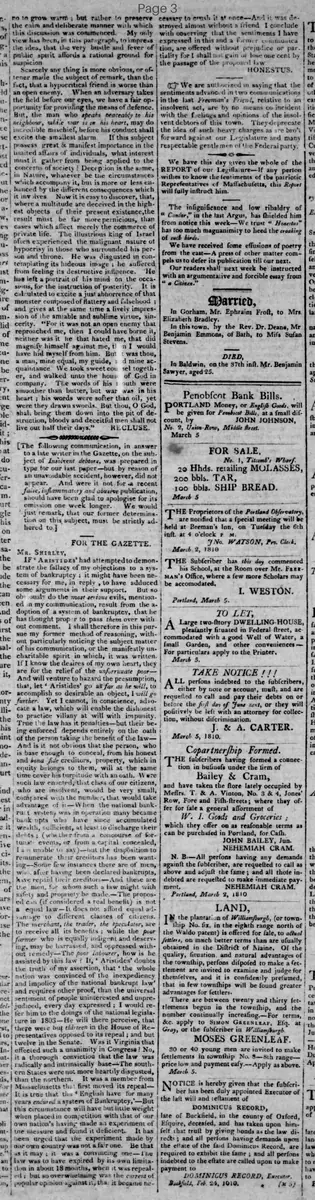
[The following communication, in answer to a late writer in the Gazette, on the subject of Insolvent debtors, was prepared in type for our last paper—but by reason of an unavoidable accident, however, did not appear. And were it not for a recent false, inflammatory and abusive publication, should have been glad to apologise for its omission one week longer. We would just remark, that our former determination on this subject, must be strictly adhered to.]
FOR THE GAZETTE.
MR. SHIRLEY,
IF Aristides had attempted to demonstrate the fallacy of my objections to a system of bankruptcy: it might have been necessary for me, in reply, to have adduced some arguments in their support. But so obviously do the most serious evils, mentioned in my communication, result from the adoption of a system of bankruptcy, that he has thought proper to pass them over without comment. I shall therefore in this pursue my former method of reasoning, without particularly noticing the subject matter of his communication, or the manifestly uncharitable spirit in which, it was written. If I know the desires of my own heart, they are for the relief of the unfortunate poor—And will venture to hazard the presumption, that, let 'Aristides' go as far as he will, to accomplish so desirable an object, I will go further. Yet I cannot, in conscience, advocate a law, which will enable the dishonest to practice villany at will with impunity. True the law has its penalties—but their being enforced depends entirely on the oath of the person taking the benefit of the law—And is it not obvious that the person who is base enough to conceal, from his honest and bona fide creditors, property, which in equity belongs to them, will at the same time cover his turpitude with an oath. Were such law enacted, that class of our citizens who are insolvent, would be very small, compared with the number, that would take advantage of it—When the national bankrupt system, was in operation many became bankrupts who have since accumulated wealth, sufficient, at least to discharge their debts: (whether from a concourse of fortunate events, or from a capital concealed, I am unable to say)—but the disposition to remunerate their creditors has been wanting—Some few instances there are of men, who, after having been declared bankrupts, have repaid their creditors—And these are the men, for whom such a law might with safety and propriety be made.—The proposed plan (if considered a real benefit) is not an equal law—It does not afford equal advantage to different classes of citizens. The merchant, the trader, the speculator, are to receive all its benefits; while the poor farmer who is equally indigent and deserving, may be harassed, and oppressed without remedy—The poor labourer, how is he assisted by this law? If, 'Aristides' doubts the truth of my assertion, that 'the whole nation was convinced of the inexpediency and impolicy of the national bankrupt law' and requires other proof, than the universal sentiment of people uninterested and unprejudiced, every day expressed; I would refer him to the doings of the national legislature in 1803—He will there perceive, that there were but thirteen in the House of Representatives opposed to its repeal; and but twelve in the Senate. Was it Virginia that effected such a unanimity in Congress? No, it a thorough conviction that the law was radically and intrinsically bad—The southern States were not more heartily disgusted, than the northern. It was a member from Massachusetts that first moved its repeal—It is true that the 'English have for many years endured a system of Bankruptcy,'—But this circumstance will have but little weight when placed in competition with that of our own nation's having made an experiment of the measure and found it deficient. It has been urged that the experiment made by our own country was not a fair one. Be that as it may; it was a convincing one—The law was to have expired by its own limitation in about 18 months, when it was repealed; but so overwhelming was the current of popular opinion against it, that it became necessary to crush it at once—And it was destroyed almost without a friend I conclude with observing that the sentiments I have expressed in this and a former communication, are offered without prejudice or partiality for I shall not gain or lose one cent by the passage of the proposed law
HONESTUS.
We are authorized in saying that the sentiments advanced in two communications in the last Freeman's Friend, relative to an insolvent act, are by no means coincident with the feelings and opinions of the insolvent debtors of this town. They deprecate the idea of such heavy charges as are bro't forward against our Legislature and many respectable gentlemen of the Federal party. We have this day given the whole of the REPORT of our Legislature—If any person wishes to know the sentiments of the patriotic Representatives of Massachusetts, this Report will fully instruct him. The insignificance and low ribaldry of "Candor," in the last Argus, has shielded him from notice this week—We trust "Honestus" has too much magnanimity to heed the creaking of such birds. We have received some effusions of poetry from the east—A press of other matter compels us to defer its publication till our next. Our readers shall next week be instructed with an argumentative and forcible essay from "Citizen."
FOR THE GAZETTE.
MR. SHIRLEY,
IF Aristides had attempted to demonstrate the fallacy of my objections to a system of bankruptcy: it might have been necessary for me, in reply, to have adduced some arguments in their support. But so obviously do the most serious evils, mentioned in my communication, result from the adoption of a system of bankruptcy, that he has thought proper to pass them over without comment. I shall therefore in this pursue my former method of reasoning, without particularly noticing the subject matter of his communication, or the manifestly uncharitable spirit in which, it was written. If I know the desires of my own heart, they are for the relief of the unfortunate poor—And will venture to hazard the presumption, that, let 'Aristides' go as far as he will, to accomplish so desirable an object, I will go further. Yet I cannot, in conscience, advocate a law, which will enable the dishonest to practice villany at will with impunity. True the law has its penalties—but their being enforced depends entirely on the oath of the person taking the benefit of the law—And is it not obvious that the person who is base enough to conceal, from his honest and bona fide creditors, property, which in equity belongs to them, will at the same time cover his turpitude with an oath. Were such law enacted, that class of our citizens who are insolvent, would be very small, compared with the number, that would take advantage of it—When the national bankrupt system, was in operation many became bankrupts who have since accumulated wealth, sufficient, at least to discharge their debts: (whether from a concourse of fortunate events, or from a capital concealed, I am unable to say)—but the disposition to remunerate their creditors has been wanting—Some few instances there are of men, who, after having been declared bankrupts, have repaid their creditors—And these are the men, for whom such a law might with safety and propriety be made.—The proposed plan (if considered a real benefit) is not an equal law—It does not afford equal advantage to different classes of citizens. The merchant, the trader, the speculator, are to receive all its benefits; while the poor farmer who is equally indigent and deserving, may be harassed, and oppressed without remedy—The poor labourer, how is he assisted by this law? If, 'Aristides' doubts the truth of my assertion, that 'the whole nation was convinced of the inexpediency and impolicy of the national bankrupt law' and requires other proof, than the universal sentiment of people uninterested and unprejudiced, every day expressed; I would refer him to the doings of the national legislature in 1803—He will there perceive, that there were but thirteen in the House of Representatives opposed to its repeal; and but twelve in the Senate. Was it Virginia that effected such a unanimity in Congress? No, it a thorough conviction that the law was radically and intrinsically bad—The southern States were not more heartily disgusted, than the northern. It was a member from Massachusetts that first moved its repeal—It is true that the 'English have for many years endured a system of Bankruptcy,'—But this circumstance will have but little weight when placed in competition with that of our own nation's having made an experiment of the measure and found it deficient. It has been urged that the experiment made by our own country was not a fair one. Be that as it may; it was a convincing one—The law was to have expired by its own limitation in about 18 months, when it was repealed; but so overwhelming was the current of popular opinion against it, that it became necessary to crush it at once—And it was destroyed almost without a friend I conclude with observing that the sentiments I have expressed in this and a former communication, are offered without prejudice or partiality for I shall not gain or lose one cent by the passage of the proposed law
HONESTUS.
We are authorized in saying that the sentiments advanced in two communications in the last Freeman's Friend, relative to an insolvent act, are by no means coincident with the feelings and opinions of the insolvent debtors of this town. They deprecate the idea of such heavy charges as are bro't forward against our Legislature and many respectable gentlemen of the Federal party. We have this day given the whole of the REPORT of our Legislature—If any person wishes to know the sentiments of the patriotic Representatives of Massachusetts, this Report will fully instruct him. The insignificance and low ribaldry of "Candor," in the last Argus, has shielded him from notice this week—We trust "Honestus" has too much magnanimity to heed the creaking of such birds. We have received some effusions of poetry from the east—A press of other matter compels us to defer its publication till our next. Our readers shall next week be instructed with an argumentative and forcible essay from "Citizen."
What sub-type of article is it?
Persuasive
Ethical Moral
Political
What themes does it cover?
Economic Policy
Morality
Politics
What keywords are associated?
Bankruptcy Law
Insolvent Debtors
Dishonesty
National Repeal
1803 Legislature
Creditor Fraud
Economic Inequity
What entities or persons were involved?
Honestus
Mr. Shirley
Letter to Editor Details
Author
Honestus
Recipient
Mr. Shirley
Main Argument
opposes enacting a bankruptcy law for insolvent debtors as it would enable dishonest individuals to defraud creditors with impunity, citing the 1803 repeal of the national law due to its proven flaws and inequity favoring merchants over poor farmers and laborers.
Notable Details
Response To Aristides
References National Bankrupt Law Repeal In 1803 With Near Unanimous Congressional Vote
Critiques English System As Irrelevant
Emphasizes Personal Lack Of Financial Stake