Thank you for visiting SNEWPapers!
Sign up free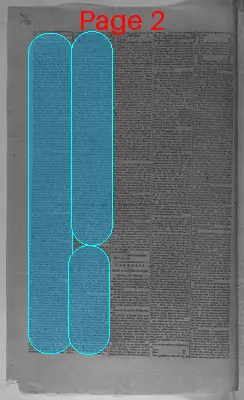
Editorial
March 4, 1795
Gazette Of The United States And Daily Evening Advertiser
Philadelphia, Philadelphia County, Pennsylvania
What is this article about?
This editorial reviews the key measures of the terminating congressional session, including troop stationing at Pittsburgh, naturalization reforms, military enhancements, militia provisions, Western relief, frontier regulations, Algerine loan facilitation, and a Sinking Fund for debt redemption, praising their benefits and the roles of key figures like Hamilton and Smith.
Clipping
OCR Quality
98%
Excellent
Full Text
For the Gazette of the United States
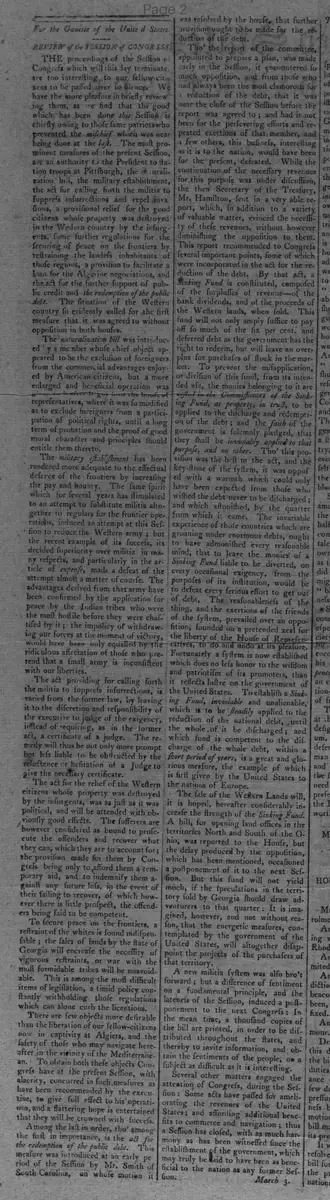
REVIEW of the SESSION of CONGRESS
The proceedings of the Session of Congress which will this day terminate, are too interesting to our fellow-citizens to be passed over in silence. We have the more pleasure in briefly reviewing them, as we find that the good which has been done this Session is chiefly owing to those same patriots who prevented the mischief which was near being done at the last. The most prominent measures of the present Session, gave an authority to the President to station troops at Pittsburgh, the naturalization bill, the military establishment, the act for calling forth the militia to suppress insurrections and repel invasions, a provisional relief for the good citizens whose property was destroyed in the Western country by the insurgents, some further regulations for the securing of peace on the frontiers by restraining the lawless inhabitants of those regions, a provision to facilitate a loan for the Algerine negotiations, and the act for the further support of public credit and the redemption of the public debt. The situation of the Western country so evidently called for the first measure that it was agreed to without opposition in both houses.
The naturalization bill was introduced by a member whose chief object appeared to be the exclusion of foreigners from the commercial advantages enjoyed by American citizens, but a more enlarged and beneficial operation was not in view the business of representatives, where it was so modified as to exclude foreigners from a participation of political rights, until a long term of probation and the proof of good moral character and principles should entitle them thereto.
The military establishment has been rendered more adequate to the effectual defence of the frontiers by increasing the pay and bounty. The same spirit which for several years has stimulated to an attempt to substitute militia altogether to regulars for the frontier operations, induced an attempt at this Session to reduce the Western army: but the recent example of its success, its decided superiority over militia in many respects, and particularly in the article of expense, made a defeat of the attempt almost a matter of course. The advantages derived from that army have been confirmed by the application for peace by the Indian tribes who were the most hostile before they were chastised by it; the impolicy of withdrawing our forces at the moment of victory, would have been badly equalled by the ridiculous affectation of those who pretend that a small army is inconsistent with our liberties.
The act providing for calling forth the militia to suppress insurrections, is varied from the former law, by leaving it to the discretion and responsibility of the executive to judge of the exigency, instead of requiring, as in the former act, a certificate of a judge. The remedy will thus be not only more prompt but less liable to be obstructed by the reluctance or hesitation of a Judge to give the necessary certificate.
The act for the relief of the Western citizens whose property was destroyed by the insurgents, was as just as it was political, and will be attended with obviously good effects. The sufferers are however considered as bound to prosecute the offenders and recover what they can, which they are to account for; the provision made for them by Congress being only to afford them a temporary aid, and to indemnify them against any future loss, in the event of their failing to recover, of which however there is little prospect, the offenders being said to be competent.
To secure peace on the frontiers, a restraint of the whites is found indispensable: the sales of lands by the state of Georgia will increase the necessity of vigorous restraints, or war with the most formidable tribes will be unavoidable. This is among the most difficult items of legislation, a timid policy constantly withholding those regulations which can alone curb the licentious.
There are few objects more desirable than the liberation of our fellow-citizens now in captivity at Algiers, and the safety of those who may navigate hereafter in the vicinity of the Mediterranean. To obtain both these objects Congress have at the present Session, with alacrity, concurred in such measures as have been recommended by the executive, to give full effect to his operations, and a flattering hope is entertained that they will be crowned with success.
Among the last in order, though among the first in importance, is the act for the redemption of the public debt. This measure was introduced at an early period of the Session by Mr. Smith of South Carolina, on whose motion it was resolved by the house, that further provision ought to be made for the reduction of the debt. Though the report of the committee appointed to prepare a plan, was made early in the Session, it encountered so much opposition, and from those who had always been the most clamorous for reduction of the debt, that it was near the close of the Session before the report was agreed to; and had it not been for the persevering efforts and repeated exertions of that member, and a few others, this business, interesting as it is to the nation, would have been for the present, defeated. While the continuation of the necessary revenues for this purpose was under discussion, the then Secretary of the Treasury, Mr. Hamilton, sent in a very able report, which, in addition to a variety of valuable matter, evinced the necessity of these revenues, without however diminishing the opposition to them. This report recommended to Congress several important points, some of which were incorporated in the act for the reduction of the debt. By that act, a Sinking Fund is constituted, composed of the surplus of revenue-of the bank dividends, and of the proceeds of the Western lands, when sold. This fund will not only amply suffice to pay off so much of the six per cent. and deferred debt as the government has the right to redeem, but will leave an overplus for purchases of stock in the market. To prevent the misapplication, or division of this fund, from its intended use, the monies belonging to it are vested in the Commissioners of the Sinking Fund, as property, in trust, to be applied to the discharge and redemption of the debt; and the faith of the government is solemnly pledged, that they shall be inviolably applied to that purpose, and no other. Though this provision was the best in the act, and the key-stone of the system, it was opposed with a warmth which could only have been expected from those who wished the debt never to be discharged; and which astonished, by the quarter from which it came. The invariable experience of those countries which are groaning under enormous debts, ought to have admonished every reasonable mind, that to leave the monies of a Sinking Fund liable to be diverted, on every occasional exigency, from the purposes of its institution, would be to defeat every serious effort to get out of debt. The reasonableness of the thing, and the exertions of the friends of the system, prevailed over an opposition, founded on a pretended zeal for the liberty of the House of Representatives, to do and undo at its pleasure. Fortunately a system is now established which does no less honor to the wisdom and patriotism of its promoters, than it reflects lustre on the government of the United States. To establish a Sinking Fund, inviolable and unalienable, which is to be steadily applied to the reduction of the national debt, until the whole of it be discharged; and which fund is competent to the discharge of the whole debt, within a short period of years, is a great and glorious measure, the example of which is first given by the United States to the nations of Europe.
The sale of the Western Lands will, it is hoped, hereafter considerably increase the strength of the Sinking Fund. A bill, for opening land offices in the territories North and South of the Ohio, was reported to the House, but the delay produced by the opposition, which has been mentioned, occasioned a postponement of it to the next Session. But this fund will not yield much, if the speculations in the territory sold by Georgia should draw adventurers to that quarter: It is imagined, however, and not without reason, that the energetic measures, contemplated by the government of the United States, will altogether disappoint the projects of the purchasers of that territory.
A new militia system was also brought forward; but a difference of sentiment on a fundamental principle, and the lateness of the Session, induced a postponement to the next Congress: In the mean time, a thousand copies of the bill are printed, in order to be distributed throughout the states, and thereby to invite information, and obtain the sentiments of the people, on a subject as difficult as it is interesting.
Several other matters engaged the attention of Congress, during the Session: Some acts have passed for ameliorating the revenues of the United States; and affording additional benefits to commerce and navigation; thus a Session has closed, with as much harmony as has been witnessed since the establishment of the government, which may truly be said to have been as beneficial to the nation as any former Session.
March 3.
REVIEW of the SESSION of CONGRESS
The proceedings of the Session of Congress which will this day terminate, are too interesting to our fellow-citizens to be passed over in silence. We have the more pleasure in briefly reviewing them, as we find that the good which has been done this Session is chiefly owing to those same patriots who prevented the mischief which was near being done at the last. The most prominent measures of the present Session, gave an authority to the President to station troops at Pittsburgh, the naturalization bill, the military establishment, the act for calling forth the militia to suppress insurrections and repel invasions, a provisional relief for the good citizens whose property was destroyed in the Western country by the insurgents, some further regulations for the securing of peace on the frontiers by restraining the lawless inhabitants of those regions, a provision to facilitate a loan for the Algerine negotiations, and the act for the further support of public credit and the redemption of the public debt. The situation of the Western country so evidently called for the first measure that it was agreed to without opposition in both houses.
The naturalization bill was introduced by a member whose chief object appeared to be the exclusion of foreigners from the commercial advantages enjoyed by American citizens, but a more enlarged and beneficial operation was not in view the business of representatives, where it was so modified as to exclude foreigners from a participation of political rights, until a long term of probation and the proof of good moral character and principles should entitle them thereto.
The military establishment has been rendered more adequate to the effectual defence of the frontiers by increasing the pay and bounty. The same spirit which for several years has stimulated to an attempt to substitute militia altogether to regulars for the frontier operations, induced an attempt at this Session to reduce the Western army: but the recent example of its success, its decided superiority over militia in many respects, and particularly in the article of expense, made a defeat of the attempt almost a matter of course. The advantages derived from that army have been confirmed by the application for peace by the Indian tribes who were the most hostile before they were chastised by it; the impolicy of withdrawing our forces at the moment of victory, would have been badly equalled by the ridiculous affectation of those who pretend that a small army is inconsistent with our liberties.
The act providing for calling forth the militia to suppress insurrections, is varied from the former law, by leaving it to the discretion and responsibility of the executive to judge of the exigency, instead of requiring, as in the former act, a certificate of a judge. The remedy will thus be not only more prompt but less liable to be obstructed by the reluctance or hesitation of a Judge to give the necessary certificate.
The act for the relief of the Western citizens whose property was destroyed by the insurgents, was as just as it was political, and will be attended with obviously good effects. The sufferers are however considered as bound to prosecute the offenders and recover what they can, which they are to account for; the provision made for them by Congress being only to afford them a temporary aid, and to indemnify them against any future loss, in the event of their failing to recover, of which however there is little prospect, the offenders being said to be competent.
To secure peace on the frontiers, a restraint of the whites is found indispensable: the sales of lands by the state of Georgia will increase the necessity of vigorous restraints, or war with the most formidable tribes will be unavoidable. This is among the most difficult items of legislation, a timid policy constantly withholding those regulations which can alone curb the licentious.
There are few objects more desirable than the liberation of our fellow-citizens now in captivity at Algiers, and the safety of those who may navigate hereafter in the vicinity of the Mediterranean. To obtain both these objects Congress have at the present Session, with alacrity, concurred in such measures as have been recommended by the executive, to give full effect to his operations, and a flattering hope is entertained that they will be crowned with success.
Among the last in order, though among the first in importance, is the act for the redemption of the public debt. This measure was introduced at an early period of the Session by Mr. Smith of South Carolina, on whose motion it was resolved by the house, that further provision ought to be made for the reduction of the debt. Though the report of the committee appointed to prepare a plan, was made early in the Session, it encountered so much opposition, and from those who had always been the most clamorous for reduction of the debt, that it was near the close of the Session before the report was agreed to; and had it not been for the persevering efforts and repeated exertions of that member, and a few others, this business, interesting as it is to the nation, would have been for the present, defeated. While the continuation of the necessary revenues for this purpose was under discussion, the then Secretary of the Treasury, Mr. Hamilton, sent in a very able report, which, in addition to a variety of valuable matter, evinced the necessity of these revenues, without however diminishing the opposition to them. This report recommended to Congress several important points, some of which were incorporated in the act for the reduction of the debt. By that act, a Sinking Fund is constituted, composed of the surplus of revenue-of the bank dividends, and of the proceeds of the Western lands, when sold. This fund will not only amply suffice to pay off so much of the six per cent. and deferred debt as the government has the right to redeem, but will leave an overplus for purchases of stock in the market. To prevent the misapplication, or division of this fund, from its intended use, the monies belonging to it are vested in the Commissioners of the Sinking Fund, as property, in trust, to be applied to the discharge and redemption of the debt; and the faith of the government is solemnly pledged, that they shall be inviolably applied to that purpose, and no other. Though this provision was the best in the act, and the key-stone of the system, it was opposed with a warmth which could only have been expected from those who wished the debt never to be discharged; and which astonished, by the quarter from which it came. The invariable experience of those countries which are groaning under enormous debts, ought to have admonished every reasonable mind, that to leave the monies of a Sinking Fund liable to be diverted, on every occasional exigency, from the purposes of its institution, would be to defeat every serious effort to get out of debt. The reasonableness of the thing, and the exertions of the friends of the system, prevailed over an opposition, founded on a pretended zeal for the liberty of the House of Representatives, to do and undo at its pleasure. Fortunately a system is now established which does no less honor to the wisdom and patriotism of its promoters, than it reflects lustre on the government of the United States. To establish a Sinking Fund, inviolable and unalienable, which is to be steadily applied to the reduction of the national debt, until the whole of it be discharged; and which fund is competent to the discharge of the whole debt, within a short period of years, is a great and glorious measure, the example of which is first given by the United States to the nations of Europe.
The sale of the Western Lands will, it is hoped, hereafter considerably increase the strength of the Sinking Fund. A bill, for opening land offices in the territories North and South of the Ohio, was reported to the House, but the delay produced by the opposition, which has been mentioned, occasioned a postponement of it to the next Session. But this fund will not yield much, if the speculations in the territory sold by Georgia should draw adventurers to that quarter: It is imagined, however, and not without reason, that the energetic measures, contemplated by the government of the United States, will altogether disappoint the projects of the purchasers of that territory.
A new militia system was also brought forward; but a difference of sentiment on a fundamental principle, and the lateness of the Session, induced a postponement to the next Congress: In the mean time, a thousand copies of the bill are printed, in order to be distributed throughout the states, and thereby to invite information, and obtain the sentiments of the people, on a subject as difficult as it is interesting.
Several other matters engaged the attention of Congress, during the Session: Some acts have passed for ameliorating the revenues of the United States; and affording additional benefits to commerce and navigation; thus a Session has closed, with as much harmony as has been witnessed since the establishment of the government, which may truly be said to have been as beneficial to the nation as any former Session.
March 3.
What sub-type of article is it?
Economic Policy
Military Affairs
Foreign Affairs
What keywords are associated?
Congress Session
Public Debt
Sinking Fund
Military Establishment
Naturalization Bill
Frontier Defense
Algerine Negotiations
Western Relief
What entities or persons were involved?
President
Mr. Smith Of South Carolina
Mr. Hamilton
Congress
Indian Tribes
Algerine Negotiations
Editorial Details
Primary Topic
Review Of Congressional Session Measures Including Debt Redemption And Military Provisions
Stance / Tone
Supportive Of Federal Achievements And Debt Reduction Efforts
Key Figures
President
Mr. Smith Of South Carolina
Mr. Hamilton
Congress
Indian Tribes
Algerine Negotiations
Key Arguments
Authority Granted To Station Troops At Pittsburgh
Naturalization Bill Modified To Limit Foreigners' Political Rights After Probation
Military Establishment Increased For Frontier Defense
Militia Act Allows Executive Discretion In Calling Forth Forces
Relief Provided To Western Citizens Whose Property Was Destroyed By Insurgents
Measures To Secure Frontier Peace By Restraining Lawless Inhabitants
Provisions To Facilitate Loan For Algerine Negotiations
Sinking Fund Established For Public Debt Redemption Using Surplus Revenue And Other Sources