Thank you for visiting SNEWPapers!
Sign up free
Literary
August 14, 1787
The New York Packet
New York, New York County, New York
What is this article about?
An essay titled 'Complaining Regulated' discusses the prevalence of complaints about bad times, scarcity, taxes, and public affairs. It provides rules for complaining wisely: examine issues thoroughly, avoid complaining about necessities, irreparable matters, personal faults, or trifles; focus on reform rather than vain grumbling.
Clipping
OCR Quality
98%
Excellent
Full Text
MISCELLANY
Complaining Regulated.
Nunc sera querelis
Haud justis auris, et irrita jurgia jactas.
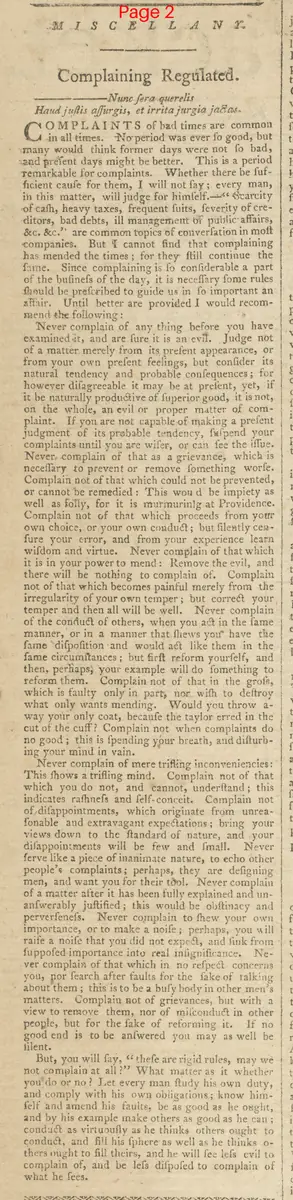
COMPLAINTS of bad times are common in all times. No period was ever so good, but many would think former days were not so bad, and present days might be better. This is a period remarkable for complaints. Whether there be sufficient cause for them, I will not say; every man, in this matter, will judge for himself. The Scarcity of cash, heavy taxes, frequent suits, severity of creditors, bad debts, ill management of public affairs, &c. &c. are common topics of conversation in most companies. But I cannot find that complaining has mended the times; for they still continue the same. Since complaining is so considerable a part of the business of the day, it is necessary some rules should be prescribed to guide us in so important an affair. Until better are provided I would recommend the following:
Never complain of any thing before you have examined it, and are sure it is an evil. Judge not of a matter merely from its present appearance, or from your own present feelings, but consider its natural tendency and probable consequences; for however disagreeable it may be at present, yet, if it be naturally productive of superior good, it is not, on the whole, an evil or proper matter of complaint. If you are not capable of making a present judgment of its probable tendency, suspend your complaints until you are wiser, or can see the issue.
Never complain of that as a grievance, which is necessary to prevent or remove something worse.
Complain not of that which could not be prevented, or cannot be remedied: This would be impiety as well as folly, for it is murmuring at Providence.
Complain not of that which proceeds from your own choice, or your own conduct; but silently censure your error, and from your experience learn wisdom and virtue. Never complain of that which it is in your power to mend: Remove the evil, and there will be nothing to complain of. Complain not of that which becomes painful merely from the irregularity of your own temper; but correct your temper and then all will be well. Never complain of the conduct of others, when you act in the same manner, or in a manner that shows you have the same disposition and would act like them in the same circumstances; but first reform yourself, and then, perhaps, your example will do something to reform them. Complain not of that in the gross, which is faulty only in part, nor wish to destroy what only wants mending. Would you throw away your only coat, because the tailor erred in the cut of the cuff? Complain not when complaints do no good; this is spending your breath, and disturbing your mind in vain.
Never complain of mere trifling inconveniencies: This shows a trifling mind. Complain not of that which you do not, and cannot, understand; this indicates rashness and self-conceit. Complain not of disappointments, which originate from unreasonable and extravagant expectations; bring your views down to the standard of nature, and your disappointments will be few and small. Never serve like a piece of inanimate nature, to echo other people's complaints; perhaps, they are designing men, and want you for their tool. Never complain of a matter after it has been fully explained and unanswerably justified; this would be obstinacy and perverseness. Never complain to show your own importance, or to make a noise; perhaps, you will raise a noise that you did not expect, and sink from supposed importance into real insignificance. Never complain of that which in no respect concerns you, nor search after faults for the sake of talking about them; this is to be a busy body in other men's matters. Complain not of grievances, but with a view to remove them, nor of misconduct in other people, but for the sake of reforming it. If no good end is to be answered you may as well be silent.
But, you will say, "these are rigid rules, may we not complain at all?" What matter is it whether you do or no? Let every man study his own duty, and comply with his own obligations; know himself and amend his faults, be as good as he ought, and by his example make others as good as he can; conduct as virtuously as he thinks others ought to conduct, and fill his sphere as well as he thinks others ought to fill theirs, and he will see less evil to complain of, and be less disposed to complain of what he sees.
Complaining Regulated.
Nunc sera querelis
Haud justis auris, et irrita jurgia jactas.
COMPLAINTS of bad times are common in all times. No period was ever so good, but many would think former days were not so bad, and present days might be better. This is a period remarkable for complaints. Whether there be sufficient cause for them, I will not say; every man, in this matter, will judge for himself. The Scarcity of cash, heavy taxes, frequent suits, severity of creditors, bad debts, ill management of public affairs, &c. &c. are common topics of conversation in most companies. But I cannot find that complaining has mended the times; for they still continue the same. Since complaining is so considerable a part of the business of the day, it is necessary some rules should be prescribed to guide us in so important an affair. Until better are provided I would recommend the following:
Never complain of any thing before you have examined it, and are sure it is an evil. Judge not of a matter merely from its present appearance, or from your own present feelings, but consider its natural tendency and probable consequences; for however disagreeable it may be at present, yet, if it be naturally productive of superior good, it is not, on the whole, an evil or proper matter of complaint. If you are not capable of making a present judgment of its probable tendency, suspend your complaints until you are wiser, or can see the issue.
Never complain of that as a grievance, which is necessary to prevent or remove something worse.
Complain not of that which could not be prevented, or cannot be remedied: This would be impiety as well as folly, for it is murmuring at Providence.
Complain not of that which proceeds from your own choice, or your own conduct; but silently censure your error, and from your experience learn wisdom and virtue. Never complain of that which it is in your power to mend: Remove the evil, and there will be nothing to complain of. Complain not of that which becomes painful merely from the irregularity of your own temper; but correct your temper and then all will be well. Never complain of the conduct of others, when you act in the same manner, or in a manner that shows you have the same disposition and would act like them in the same circumstances; but first reform yourself, and then, perhaps, your example will do something to reform them. Complain not of that in the gross, which is faulty only in part, nor wish to destroy what only wants mending. Would you throw away your only coat, because the tailor erred in the cut of the cuff? Complain not when complaints do no good; this is spending your breath, and disturbing your mind in vain.
Never complain of mere trifling inconveniencies: This shows a trifling mind. Complain not of that which you do not, and cannot, understand; this indicates rashness and self-conceit. Complain not of disappointments, which originate from unreasonable and extravagant expectations; bring your views down to the standard of nature, and your disappointments will be few and small. Never serve like a piece of inanimate nature, to echo other people's complaints; perhaps, they are designing men, and want you for their tool. Never complain of a matter after it has been fully explained and unanswerably justified; this would be obstinacy and perverseness. Never complain to show your own importance, or to make a noise; perhaps, you will raise a noise that you did not expect, and sink from supposed importance into real insignificance. Never complain of that which in no respect concerns you, nor search after faults for the sake of talking about them; this is to be a busy body in other men's matters. Complain not of grievances, but with a view to remove them, nor of misconduct in other people, but for the sake of reforming it. If no good end is to be answered you may as well be silent.
But, you will say, "these are rigid rules, may we not complain at all?" What matter is it whether you do or no? Let every man study his own duty, and comply with his own obligations; know himself and amend his faults, be as good as he ought, and by his example make others as good as he can; conduct as virtuously as he thinks others ought to conduct, and fill his sphere as well as he thinks others ought to fill theirs, and he will see less evil to complain of, and be less disposed to complain of what he sees.
What sub-type of article is it?
Essay
What themes does it cover?
Moral Virtue
Temperance
What keywords are associated?
Complaining
Moral Advice
Self Reform
Providence
Temper Control
Public Affairs
Taxes
Scarcity
Literary Details
Title
Complaining Regulated.
Key Lines
Never Complain Of Any Thing Before You Have Examined It, And Are Sure It Is An Evil.
Complain Not Of That Which Could Not Be Prevented, Or Cannot Be Remedied: This Would Be Impiety As Well As Folly, For It Is Murmuring At Providence.
Complain Not Of That Which Proceeds From Your Own Choice, Or Your Own Conduct; But Silently Censure Your Error, And From Your Experience Learn Wisdom And Virtue.
Complain Not When Complaints Do No Good; This Is Spending Your Breath, And Disturbing Your Mind In Vain.
Let Every Man Study His Own Duty, And Comply With His Own Obligations; Know Himself And Amend His Faults...