Thank you for visiting SNEWPapers!
Sign up free
Literary
April 16, 1798
The Gazette
Portland, Cumberland County, Maine
What is this article about?
Oration by W. Bache on the history, cultivation, qualities, and benefits of the Irish potato, from its Mexican origins to its role in diet, medicine, commerce, and Irish contributions to liberty and population growth.
Clipping
OCR Quality
85%
Good
Full Text
POTATOES.
ORATION ON POTATOES.-By W. BACHE.
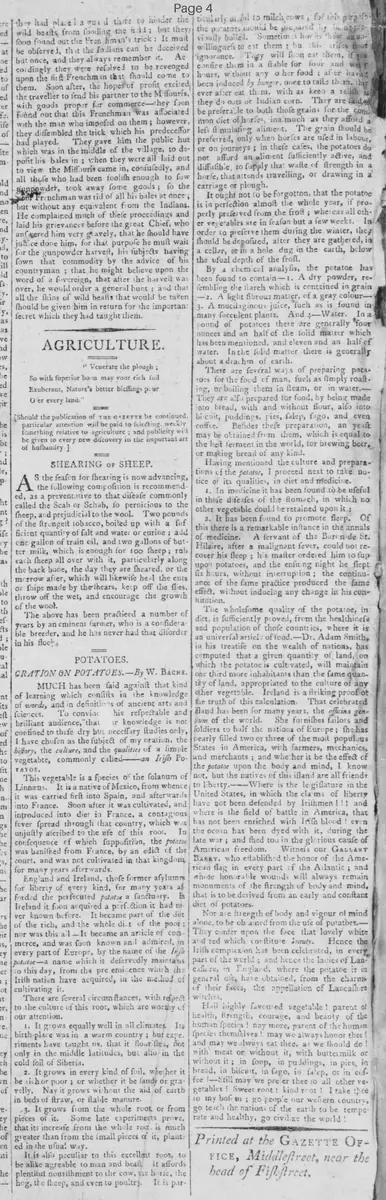
MUCH has been said against that kind of learning which consists in the knowledge of words, and in definitions of ancient arts and sciences. To convince his respectable and brilliant audience, "that this knowledge is not confined to these dry but necessary studies only, I have chosen as the subject of my oration, the history, the culture, and the qualities of a simple vegetable, commonly called--an Irish Potato. This vegetable is a species of the solanum of Linnaeus. It is a native of Mexico, from whence it was carried first into Spain, and afterwards into France. Soon after it was cultivated, and introduced into diet in France, a contagious fever spread through that country, which was unjustly ascribed to the use of this root. In consequence of which supposition, the potato was banished from France, by an edict of the court, and was not cultivated in that kingdom for many years afterwards. England and Ireland, those former asylums for liberty of every kind, for many years afforded the persecuted potato a sanctuary. In Ireland it soon acquired a perfection it had never known before. It became part of the diet of the rich, and the whole diet of the poor; nor was this all--it became an article of commerce, and was soon known and admired, in every part of Europe, by the name of the Irish potato--a name which it deservedly maintains to this day, from the pre-eminence which the Irish nation have acquired, in the method of cultivating it. There are several circumstances, with respect to the culture of this root, which are worthy of our attention. I. It grows equally well in all climates. Its birth place was in a warm country; but experiments have taught us, that it flourishes, not only in the middle latitudes, but also in the cold soil of Siberia. 2. It grows in every kind of soil, whether it be rich or poor; or whether it be sandy or gravelly. Nay it grows without the aid of earth in beds of straw, or stable manure. 3. It grows from the whole root, or from pieces of it. Some late experiments prove, that its increase from the whole root is much greater than from the small pieces of it, planted in the usual way. It is also peculiar to this excellent root, to be alike agreeable to man and beast. It affords plentiful nourishment to the cow, the horse, the hog, the sheep, and even to poultry. It is particularly useful to milch cows, for this purpose the potatoes should be prepared by previously boiled. Sometimes horses show an unwillingness to eat them; but this arises from ignorance. They will soon eat them, if you confine them in a stable for four or twenty hours, without any other food; after having been induced by hunger, once to taste them, they ever after eat them, with as keen a relish as they do oats or Indian corn. They are said to be preferable to both those grains for the common diet of horses, inasmuch as they afford a less stimulating aliment. The grain should be preferred, only when horses are used in labour or on journeys; in these cases, the potatoes do not afford an aliment sufficiently active, and diffusible, to supply that waste of strength in a horse, that attends travelling, or drawing in a carriage or plough. It ought not to be forgotten, that the potato is in perfection almost the whole year, if properly preserved from the frost; whereas all other vegetables are in season but a few weeks. In order to preserve them during the winter, they should be deposited, after they are gathered, in a cellar, or in a hole dug in the earth, below the usual depth of the frost. By a chemical analysis, the potato has been found to contain-1. A dry powder, resembling the starch which is contained in grain--2. A light fibrous matter, of a gray colour--3. A mucilaginous juice, such as is found in many succulent plants. And 4-Water. In a pound of potatoes there are generally four ounces and an half of the solid matter which has been mentioned, and eleven and an half of water. In the solid matter there is generally about a drachm of earth. There are several ways of preparing potatoes for the food of man, such as simply roasting, or boiling them in steam, or in water.--They are also prepared for food, by being made into bread, with and without flour, also into biscuit, puddings, pies, salep, sago, and even coffee. Besides these preparations, a yeast may be obtained from them, which is equal to the best ferment in the world, for brewing beer, or making bread of any kind. Having mentioned the culture and preparations of the potato, I proceed next to take notice of its qualities. in diet and medicine. I. In medicine it has been found to be useful in those diseases of the stomach, in which no other vegetable could be retained upon it: 2. It has been found to promote sleep. Of this there is a remarkable instance in the annals of medicine. A servant of the Baron de St. Hilaire, after a malignant fever, could not recover his sleep; his master ordered him to sup upon potatoes, and the ensuing night he slept six hours, without interruption; the continuance of the same practice produced the same effect, without inducing any change in his constitution. The wholesome quality of the potato, in diet, is sufficiently proved, from the healthiness and population of those countries, where it is an universal article of food.-Dr. Adam Smith. in his treatise on the wealth of nations, has computed that a given quantity of land, on which the potato is cultivated, will maintain one third more inhabitants than the same quantity of land, appropriated to the culture of any other vegetable. Ireland is a striking proof of the truth of this calculation. That celebrated island has been for many years, the officina gentium of the world. She furnishes sailors and soldiers to half the nations of Europe: she has nearly filled two or three of the most populous States in America, with farmers, mechanics, and merchants; and whether it be the effect of the potato upon the body and mind, I know not, but the natives of this island are all friends to liberty.--Where is the legislature in the United States, in which the claims of liberty have not been defended by Irishmen!!! and where is the field of battle in America, that has not been enriched with Irish blood! even the ocean has been dyed with it, during the late war; and shed too in the glorious cause of American freedom. Witness our Gallant Barry. who established the honor of the American flag in every part of the Atlantic: and whose honorable wounds will always remain monuments of the strength of body and mind, that is to be derived from an early and constant diet of potatoes. Nor are strength of body and vigour of mind alone, to be obtained from the use of potatoes.- They confer upon the face that lovely white and red which constitute beauty. Hence the Irish complexion has been celebrated, in every part of the world: and hence the ladies of Lancashire, in England, where the potato is in general use, have obtained, from the charms of their faces, the appellation of Lancashire witches. Hail highly favoured vegetable! parent of health, strength, courage, and beauty of the human species! nay more, parent of the human species themselves! may we always honor thee! and may we always eat thee. as we should do! with meat or without it, with buttermilk or without it; in soup, in puddings, in pies, in bread, in biscuit, in sago, in salep, or in coffee! Still may we prefer thee to all other vegetables! Sweet root! Kind root! I take thee to my bosom; go people our western country, go teach the nations of the earth to be temperate and healthy, go civilize the world:
ORATION ON POTATOES.-By W. BACHE.
MUCH has been said against that kind of learning which consists in the knowledge of words, and in definitions of ancient arts and sciences. To convince his respectable and brilliant audience, "that this knowledge is not confined to these dry but necessary studies only, I have chosen as the subject of my oration, the history, the culture, and the qualities of a simple vegetable, commonly called--an Irish Potato. This vegetable is a species of the solanum of Linnaeus. It is a native of Mexico, from whence it was carried first into Spain, and afterwards into France. Soon after it was cultivated, and introduced into diet in France, a contagious fever spread through that country, which was unjustly ascribed to the use of this root. In consequence of which supposition, the potato was banished from France, by an edict of the court, and was not cultivated in that kingdom for many years afterwards. England and Ireland, those former asylums for liberty of every kind, for many years afforded the persecuted potato a sanctuary. In Ireland it soon acquired a perfection it had never known before. It became part of the diet of the rich, and the whole diet of the poor; nor was this all--it became an article of commerce, and was soon known and admired, in every part of Europe, by the name of the Irish potato--a name which it deservedly maintains to this day, from the pre-eminence which the Irish nation have acquired, in the method of cultivating it. There are several circumstances, with respect to the culture of this root, which are worthy of our attention. I. It grows equally well in all climates. Its birth place was in a warm country; but experiments have taught us, that it flourishes, not only in the middle latitudes, but also in the cold soil of Siberia. 2. It grows in every kind of soil, whether it be rich or poor; or whether it be sandy or gravelly. Nay it grows without the aid of earth in beds of straw, or stable manure. 3. It grows from the whole root, or from pieces of it. Some late experiments prove, that its increase from the whole root is much greater than from the small pieces of it, planted in the usual way. It is also peculiar to this excellent root, to be alike agreeable to man and beast. It affords plentiful nourishment to the cow, the horse, the hog, the sheep, and even to poultry. It is particularly useful to milch cows, for this purpose the potatoes should be prepared by previously boiled. Sometimes horses show an unwillingness to eat them; but this arises from ignorance. They will soon eat them, if you confine them in a stable for four or twenty hours, without any other food; after having been induced by hunger, once to taste them, they ever after eat them, with as keen a relish as they do oats or Indian corn. They are said to be preferable to both those grains for the common diet of horses, inasmuch as they afford a less stimulating aliment. The grain should be preferred, only when horses are used in labour or on journeys; in these cases, the potatoes do not afford an aliment sufficiently active, and diffusible, to supply that waste of strength in a horse, that attends travelling, or drawing in a carriage or plough. It ought not to be forgotten, that the potato is in perfection almost the whole year, if properly preserved from the frost; whereas all other vegetables are in season but a few weeks. In order to preserve them during the winter, they should be deposited, after they are gathered, in a cellar, or in a hole dug in the earth, below the usual depth of the frost. By a chemical analysis, the potato has been found to contain-1. A dry powder, resembling the starch which is contained in grain--2. A light fibrous matter, of a gray colour--3. A mucilaginous juice, such as is found in many succulent plants. And 4-Water. In a pound of potatoes there are generally four ounces and an half of the solid matter which has been mentioned, and eleven and an half of water. In the solid matter there is generally about a drachm of earth. There are several ways of preparing potatoes for the food of man, such as simply roasting, or boiling them in steam, or in water.--They are also prepared for food, by being made into bread, with and without flour, also into biscuit, puddings, pies, salep, sago, and even coffee. Besides these preparations, a yeast may be obtained from them, which is equal to the best ferment in the world, for brewing beer, or making bread of any kind. Having mentioned the culture and preparations of the potato, I proceed next to take notice of its qualities. in diet and medicine. I. In medicine it has been found to be useful in those diseases of the stomach, in which no other vegetable could be retained upon it: 2. It has been found to promote sleep. Of this there is a remarkable instance in the annals of medicine. A servant of the Baron de St. Hilaire, after a malignant fever, could not recover his sleep; his master ordered him to sup upon potatoes, and the ensuing night he slept six hours, without interruption; the continuance of the same practice produced the same effect, without inducing any change in his constitution. The wholesome quality of the potato, in diet, is sufficiently proved, from the healthiness and population of those countries, where it is an universal article of food.-Dr. Adam Smith. in his treatise on the wealth of nations, has computed that a given quantity of land, on which the potato is cultivated, will maintain one third more inhabitants than the same quantity of land, appropriated to the culture of any other vegetable. Ireland is a striking proof of the truth of this calculation. That celebrated island has been for many years, the officina gentium of the world. She furnishes sailors and soldiers to half the nations of Europe: she has nearly filled two or three of the most populous States in America, with farmers, mechanics, and merchants; and whether it be the effect of the potato upon the body and mind, I know not, but the natives of this island are all friends to liberty.--Where is the legislature in the United States, in which the claims of liberty have not been defended by Irishmen!!! and where is the field of battle in America, that has not been enriched with Irish blood! even the ocean has been dyed with it, during the late war; and shed too in the glorious cause of American freedom. Witness our Gallant Barry. who established the honor of the American flag in every part of the Atlantic: and whose honorable wounds will always remain monuments of the strength of body and mind, that is to be derived from an early and constant diet of potatoes. Nor are strength of body and vigour of mind alone, to be obtained from the use of potatoes.- They confer upon the face that lovely white and red which constitute beauty. Hence the Irish complexion has been celebrated, in every part of the world: and hence the ladies of Lancashire, in England, where the potato is in general use, have obtained, from the charms of their faces, the appellation of Lancashire witches. Hail highly favoured vegetable! parent of health, strength, courage, and beauty of the human species! nay more, parent of the human species themselves! may we always honor thee! and may we always eat thee. as we should do! with meat or without it, with buttermilk or without it; in soup, in puddings, in pies, in bread, in biscuit, in sago, in salep, or in coffee! Still may we prefer thee to all other vegetables! Sweet root! Kind root! I take thee to my bosom; go people our western country, go teach the nations of the earth to be temperate and healthy, go civilize the world:
What sub-type of article is it?
Essay
What themes does it cover?
Agriculture Rural
Liberty Freedom
Moral Virtue
What keywords are associated?
Irish Potato
Cultivation
Diet
Medicine
Liberty
Ireland
Nutrition
History
What entities or persons were involved?
By W. Bache.
Literary Details
Title
Oration On Potatoes. By W. Bache.
Author
By W. Bache.
Subject
The History, The Culture, And The Qualities Of A Simple Vegetable, Commonly Called An Irish Potato
Form / Style
Prose Oration
Key Lines
Hail Highly Favoured Vegetable! Parent Of Health, Strength, Courage, And Beauty Of The Human Species! Nay More, Parent Of The Human Species Themselves!
The Natives Of This Island Are All Friends To Liberty. Where Is The Legislature In The United States, In Which The Claims Of Liberty Have Not Been Defended By Irishmen!!!
It Became Part Of The Diet Of The Rich, And The Whole Diet Of The Poor; Nor Was This All It Became An Article Of Commerce
By A Chemical Analysis, The Potato Has Been Found To Contain 1. A Dry Powder, Resembling The Starch Which Is Contained In Grain 2. A Light Fibrous Matter, Of A Gray Colour 3. A Mucilaginous Juice, Such As Is Found In Many Succulent Plants. And 4 Water.
Witness Our Gallant Barry. Who Established The Honor Of The American Flag In Every Part Of The Atlantic