Thank you for visiting SNEWPapers!
Sign up free
Gazette Of The United States
New York, New York County, New York
What is this article about?
In a letter to Mr. Fenno, 'An Opponent' from New Jersey refutes 'Respondent's' speculation that a dismal summer in parts of the country indicates defects in the U.S. Constitution and laws. The writer argues that general prosperity stems from liberty and wholesome governance, with partial droughts as providential exceptions amid overall fertility.
Merged-components note: This is a single continuous letter to the editor spanning page 1 and page 2, debating political and constitutional matters; text flows directly from one component to the next.
Clippings
1 of 2
OCR Quality
Full Text
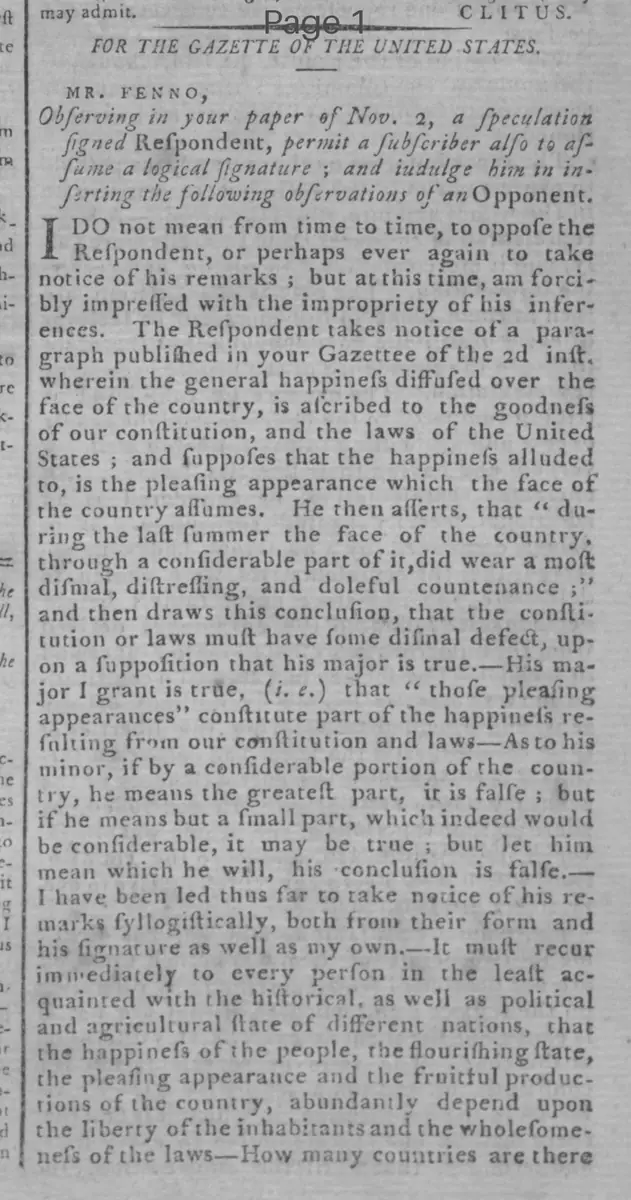
MR. FENNO,
Observing in your paper of Nov. 2, a speculation signed Respondent, permit a subscriber also to assume a logical signature; and indulge him in inserting the following observations of an Opponent.
I DO not mean from time to time, to oppose the Respondent, or perhaps ever again to take notice of his remarks; but at this time, am forcibly impressed with the impropriety of his inferences. The Respondent takes notice of a paragraph published in your Gazette of the 2d inst. wherein the general happiness diffused over the face of the country, is ascribed to the goodness of our constitution, and the laws of the United States; and supposes that the happiness alluded to, is the pleasing appearance which the face of the country assumes. He then asserts, that "during the last summer the face of the country, through a considerable part of it, did wear a most dismal, distressing, and doleful countenance;" and then draws this conclusion, that the constitution or laws must have some dismal defect, upon a supposition that his major is true.—His major I grant is true, (i. e.) that "those pleasing appearances" constitute part of the happiness resulting from our constitution and laws—As to his minor, if by a considerable portion of the country, he means the greatest part, it is false; but if he means but a small part, which indeed would be considerable, it may be true; but let him mean which he will, his conclusion is false.—
I have been led thus far to take notice of his remarks syllogistically, both from their form and his signature as well as my own.—It must recur immediately to every person in the least acquainted with the historical, as well as political and agricultural state of different nations, that the happiness of the people, the flourishing state, the pleasing appearance and the fruitful productions of the country, abundantly depend upon the liberty of the inhabitants and the wholesomeness of the laws—How many countries are there
Under despotic governments, whose soil in itself is the most fertile imaginable, that scarcely produce subsistence for the inhabitants, and entirely owing to the badness of the governments—Where there is no security for property, none are ambitious of acquiring it; the accumulation thereof, is but an inducement to their tyrants to deprive them even of their lives, in order to possess their property—Under these circumstances men are desirous of procuring only so much as shall be barely sufficient for their sustenance—The consequence is plain, the agricultural interest suffers, the ground not half tilled, and the country wearing a miserable appearance—On the contrary, where the citizen enjoys liberty and security for his property, he is desirous of increasing it, and makes the best use of his lands; the country puts on "a gay, pleasant and prosperous appearance," and that in gradation from a tyrannical government to a free one, in proportion to the goodness of the constitution. These effects of our excellent constitution are visible to every observer, and acknowledged by every friend to the government—All who acknowledge a divine Providence, must own that to be the prime source of both prosperity and adversity; and sometimes, for wise purposes, it is exercised in adverse dispensations; thus we see partial evil in the midst of general good, without destroying the universal influence of second causes—Such may have been the case during the last summer—In the course of Providence a drought prevailed in some places, yet notwithstanding, there was a general appearance of fertility in the country—though grass failed in some places, yet was there a plentiful harvest; nor did that partial evil militate against the benign influence of our government, in its happy effects upon the country at large, nor lead to a conclusion that the government is defective. I am at the same time sorry to find our Respondent casting reflections upon a state, which however a mistaken policy may for a while have made backward in subscribing to the constitution, yet now is a sister in union with us.
AN OPPONENT.
New-Jersey, November 10, 1791.
What sub-type of article is it?
What themes does it cover?
What keywords are associated?
What entities or persons were involved?
Letter to Editor Details
Author
An Opponent.
Recipient
Mr. Fenno,
Main Argument
the u.s. constitution and laws promote general happiness and prosperity through liberty and security of property, leading to flourishing agriculture; partial summer droughts do not indicate governmental defects but are providential exceptions amid overall fertility.
Notable Details