Thank you for visiting SNEWPapers!
Sign up free
The Daily Dispatch
Richmond, Virginia
What is this article about?
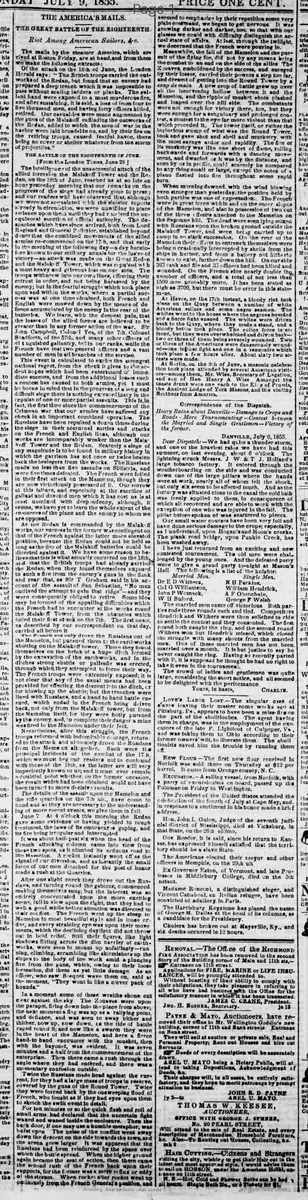
Report from London Times on the failed allied assault on the Malakoff Tower and Redan at Sevastopol on June 18, 1855, during the Crimean War siege. Heavy British and French losses, including key officers; first major check for allies. Includes details of prior June 7 Mamelon capture.
Merged-components note: Continuation of the article on the Battle of the Eighteenth of June across columns on the same page.
Clipping
OCR Quality
Full Text
From the London Times, June 23.
The intelligence of the unsuccessful attack of the
allied forces on the Malakoff Tower and the Redan, on the 18th of June, reached us at so late an
hour yesterday morning that our remarks on the
progress of the siege had already gone to press;
and our readers will have observed that, although
we were not acquainted with the sinister reports
already in circulation, we were unwilling to place
reliance upon them until they had received the unqualified sanction of official authority. The despatches which have since arrived, both from Lord
Raglan and General Pelissier, establish beyond
doubt that the combined movements of the allied
armies re-commenced on the 17th, and that early
in the morning of the following day—a day heretofore known to our military annals for the lustre of
victory—an attack was made on the Great Redan
and the Malakoff Tower, which was repulsed with
a most heavy and grievous loss on our side. The
troops withdrew into our own lines, effecting their
retreat in order, and not being harassed by the
enemy; but in the fearful struggle which took place upon and within the works, where a partial success was at one time obtained, both French and
English were mowed down by the means of defence accumulated by the enemy in the rear of the
batteries. We learn, with the deepest pain, that
the losses of the allied forces are believed to be
greater than in any former action of the war. Sir
John Campbell, Colonel Yea, of the 7th, Colonel
Shadforth, of the 57th, and many other officers of
distinguished gallantry, fell in our ranks, while the
French have lost two general officers and a vast
number of men in all branches of the service.
This event is calculated to excite the strongest
national regret, from the check it gives to the ardent hopes which had been entertained of immediate success, and from the additional losses such
a contest has caused to both armies, yet it must
be borne in mind that in the progress of a long and
difficult siege there is nothing extraordinary in the
repulse of one or more partial assaults. This is, in
fact, the first time since the commencement of the
Crimean war that our armies have suffered any
check in an important combined operation. The
Russians have been repulsed a dozen times during
the siege in their nocturnal sorties and attack
on the French and English lines, although our
works are incomparably weaker than the Malakoff Tower and the Redan. Scarcely a siege of
any magnitude is to be found in military history in
which the garrison has not once or twice beaten
back the besiegers from the works. The Russians
made no less than five assaults on Silistria, and
were five times defeated. The French were foiled
in their first attack on the Mamelon, though they
are now victoriously possessed of it. Our sorrow
at this failure, and especially at the sacrifice of
gallant and devoted men which it has cost us is at
least unmixed with despondency, although, it
seems, we have yet to learn the whole extent of the
resources of the place and the enemy to whom we
are opposed.
As the Redan is commanded by the Malakoff
works, our success in the former was contingent on
that of the French against the latter more elevated
position, because the Redan could not be held as
long as the fire of the Malakoff batteries could be
directed against it. We have some reason to believe that this is what actually occurred on the 18th,
and that the British troops had already carried
the Redan, when they found themselves exposed
to such a fire from the enemy's guns in the flank
and rear that, as Sir T. Graham said in his account of the assault of San Sebastian, "No man
outlived the attempt to gain that ridge"—and they
were consequently obliged to retire. Some idea
may be formed of the appalling difficulties which
the French had to encounter at the works round
the Malakoff Tower, from the obstacles which
foiled their first attack on the 7th. Their first onset, as described by our correspondent on that day,
carried all before it.
The French not only drove the Russians out of
the Mamelon, but pursued them to the earthworks
abutting on the Malakoff tower. There they found
themselves on the brink of a huge ditch formed
by the excavation of the earthworks, and in the
ditches strong abattis or palisade was erected.
through which they attempted to force their way.
The French troops were extremely exposed; it is
not clear that any of the usual means had been
provided for effecting the descent into the ditch, or
for blowing up the abattis; but the trenches were
lined with Russians, and a hand to hand battle ensued, which ended in the French being driven
back, not only from the Malakoff tower, but from
the Mamelon itself, for they were hotly pursued
by the enemy, and, to complete their danger a mine
was fired in the Mamelon under their feet.
Nevertheless, after this struggle, the French
troops reformed with indomitable courage, returned to the attack and ultimately drove the Russians from the Mamelon altogether. Such were the
principal incidents of the combat of the 17th,
which we must beg our readers not to confound
with those of the 18th, as the latter are still very
imperfectly known to us; and it must ever remain
a doubtful point whether, on the former occasion,
the result which had been obtained could not have
been turned to more decisive results.
The details of the assault upon the Mamelon and
the rifle quarries on the 7th ult., have come to
hand and as they are necessary to the understanding of more recent events, we give them in full.
June 7. At 4 o'clock this morning the Redan
gave some evidence of having yielded to rough
treatment, the jaws of its embrasures gaping, and
its fire being irregular and interrupted.
It was about half-past six when the head of the
French attacking column came into view from
these two spots, as it climbed its arduous road to
the Mamelon. A rocket instantly went off as the
signal of our diversion, and as instantly the small
force of our men detached for the post of honor
made a rush at the Quarries.
After one slight check they drove out the Russians, and turning round the gabione, commenced
making themselves snug; but the interest was so
entirely concentrated upon the more exciting
scene, full in view upon the right, that they had to
wait a good while before attention was directed to
their conflict. The French went up the steep to
Mamelon in most beautiful style and in loose order, and every straining eye was upon their movements, which the declining daylight did not throw
out in bold relief. Still their figures, like light
shadows flitting across the dim barrier of earthworks, were seen to mount up unfailingly—running, climbing, scrambling like skirmishers up the
slopes to the body of the work amid a plunging
fire from the guns, which, owing to their loose
formation, did them as yet little damage. As an
officer, who saw Bosquet wave them on, said at
the moment,
"They went in like a clever pack of
hounds."
In a moment some of these wraiths shone out
clear against the sky. The Zouaves were upon
the parapet, firing down into the place from above;
the next moment a flag was up as a rallying point.
and defiance, and was seen to sway hither and
thither, now up, now down, as the tide of battle
raged round it; and now like a swarm they were
in the heart of the Mamelon, and here a fierce
hand-to-hand encounter with the musket, then
with the bayonet, was evident. It was seven
minutes and a half from the commencement of the
enterprise. Then there came a rush through the
angle where they had entered, and
there was a
momentary confusion outside.
Twice the Russians made head against the current, for they had a large mass of troops in reserve,
covered by the guns of the Round Tower. Twice
they were forced back by the onsweeping flood of
French, who fought as if they had eyes upon them
to sketch the swift event in detail.
For ten minutes or so the quick flash and roll of
small arms had declared that the uncertain fight
waxed and waned inside the enclosure. Then the
back door, if one may use a
humble metaphor, was
burst open.
The noise of the conflict went away
down the descent on the side towards the town, and
the arena grew larger.
It was apparent that the
Russians had been reinforced by the space over
which the battle spread.
When the higher ground
again became the seat of action, then there came
the second rush of the French back upon their
supports, for the former was a mere reflux or eddy
of the stream. When rocket after rocket went up
ominously from the French General's position, and
seemed to emphasize by their repetition some very
plain command, we began to get nervous. It was
growing darker and darker, too, so that with our
glasses we could with difficulty distinguish the actual state of affairs. At last, through the twilight,
we discerned that the French were pouring in.
Meanwhile, the fall of the Mamelon and the pursuit of the flying foe, did not by any means bring
the combat to an end on the side of the allies. The
Zouaves, emboldened by the success, and enraged
by their losses, carried their
powers a step too far,
and dreamt of getting into the Round Tower by a
coup de main.
A new crop of battle grew up over
all the intervening hollow
between it and the
Mamelon, and the ripple of musket shots plashed
and leaped over the hill side.
The combatants
were not enough for victory there, too, but they
were enough for a sanguinary and prolonged contest, a contest to the eye far more violent than that
which preceded it. The tower itself, or rather the
inglorious stump of what was the Round Tower,
took and gave shot and shell and musketry, with
the most savage ardor and rapidity. The fire of
its musketry was like one sheet of flame, rolling
backwards and forwards with a dancing movement, and dwarfed as it was by the distance, and
seen by us in profile, could scarcely be compared
to any thing small or large, except the notes of a
piano flashed
into fire throughout some rapid
turn.
When morning dawned, with the wind blowing
even stronger than yesterday, the position held by
both parties was one of expectation. The French
were in great force within and on the outer slopes
of the Mamelon, and also in possession of two out
of the three rifle pits attached to the Mamelon on
the Sapouné hill. The dead were seen lying mixed
with Russians upon the broken ground outside the
Malakoff Tower, and were being carried up to
camp in no slack succession. On the rear of the
Mamelon their efforts to entrench themselves were
being occasionally interrupted by shells from the
ships in harbor, and from a battery not hitherto
known to exist, further down the hill. On our side
365 rank and file and 35 officers had been killed and
wounded. On the French side nearly double the
number of officers, and a total of not less than
1500 men, probably more. It has been stated as
high as 3700, but there must be error in this statement.
What sub-type of article is it?
What keywords are associated?
What entities or persons were involved?
Where did it happen?
Foreign News Details
Primary Location
Sevastopol
Event Date
18th Of June
Key Persons
Outcome
allied assault repulsed with heavy losses greater than any former action; british officers including sir john campbell, colonel yea, colonel shadforth killed; french lost two generals and vast numbers; troops withdrew in order.
Event Details
Allied forces recommenced movements on 17th June; on 18th, attacked Great Redan and Malakoff Tower but were repulsed after partial success, mowed down by enemy defenses. First major check in Crimean War siege. Background on prior assaults: French captured Mamelon on 7th after initial repulse, with British taking rifle quarries; heavy casualties reported for that action.