Thank you for visiting SNEWPapers!
Sign up free
Martinsburg Gazette
Martinsburg, Berkeley County, West Virginia
What is this article about?
British House of Commons debate on the Oregon territorial dispute between the US and UK, initiated by Lord John Russell, with Sir Robert Peel responding firmly on British claims. Debate highlights stalled negotiations and risks of conflict, amid minor European news like Texas annexation indifference and cotton market stability.
Merged-components note: Continuation of foreign news report on the Caledonia steamer and Oregon debate; text flows directly from one to the next.
Clippings
1 of 2
OCR Quality
Full Text
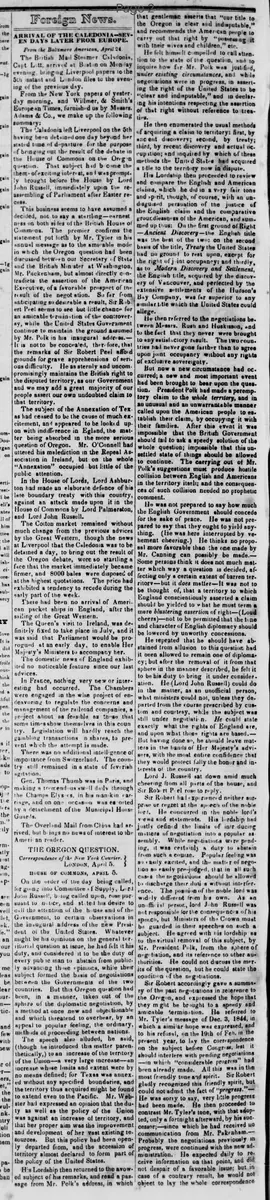
ARRIVAL OF THE CALEDONIA—SEVEN DAYS LATER FROM EUROPE.
From the Baltimore American, April 24
The British Mail Steamer Caledonia, Capt. Lott, arrived at Boston on Monday evening, bringing Liverpool papers to the 5th instant and London files to the evening of the previous day.
From the New York papers of yesterday morning, and Willmer, & Smith's European Times, furnished us by Messrs. Adams & Co., we make up the following summary:
The Caledonia left Liverpool on the 5th having been detained one day beyond her stated time of departure for the purpose of bringing out the result of the debate in the House of Commons on the Oregon question. That subject had become the theme of exciting interest, and was promptly brought before the House by Lord John Russell, immediately upon the re-assembling of Parliament after Easter recess.
This business seems to have assumed a decided, not to say a startling earnestness on both sides of the British House of Commons. The premier confirms the statement put forth by Mr. Tyler in his annual message as to the amicable mode in which the Oregon question had been discussed between our Secretary of State and the British Minister at Washington, Mr. Pakenham, but almost directly contradicts the assertion of the American Executive, of a favorable prospect of the result of the negotiation. So far from anticipating so desirable a result, Sir Robert Peel seems to see but little chance of an amicable termination of the controversy, while the United States Government continue to maintain the ground assumed by Mr. Polk in his inaugural address.— It is not to be concealed, therefore, that the remarks of Sir Robert Peel afford grounds for grave apprehensions of serious difficulty. He as sternly and uncompromisingly maintains the British right to the disputed territory, as our Government and we may add a great majority of our people assert our own undoubted claim to that territory.
The subject of the Annexation of Texas had ceased to be the cause of much excitement, and appeared to be looked upon with indifference in England, the matter being absorbed in the more serious question of Oregon. Mr. O'Connell had uttered his malediction in the Repeal Association in Ireland, but on the whole "Annexation" occupied but little of the public attention.
In the House of Lords, Lord Ashburton had made an elaborate defence of his late boundary treaty with this country, against an attack made upon it in the House of Commons by Lord Palmerston and Lord John Russell.
The Cotton market remained without much change from the previous advices by the Great Western, though the news at Liverpool that the Caledonia was to be detained a day, to bring out the result of the Oregon debate, wore so startling a face that the market immediately became firmer, and 8000 bales were disposed of at the highest quotations. The price had exhibited a tendency to recede during the early part of the week.
There had been no arrival of American packet ships in England, after the sailing of the Great Western.
The Queen's visit to Ireland, was definitely fixed to take place in July, and it was said that Parliament would be prorogued at an early day, to enable Her Majesty's Ministers to accompany her.
The domestic news of England exhibited no noticeable feature since our last advices.
In France, nothing very new or interesting had occurred. The Chambers were engaged in the wise project of endeavoring to regulate the concerns and management of the railroad companies. project about as sensible as some that sometimes show themselves in this country. Legislation will hardly reach the gambling transactions in shares, to prevent which the attempt is made.
There was no additional intelligence of importance from Switzerland. The country still remained in a state of feverish agitation.
Gen. Tom Thumb was in Paris, and making a tremendous swell daily through the Champs Elysees, in his mignon carriage, and on one occasion was escorted by a detachment of the Municipal House Guards.
The Overland Mail from China had arrived, but brings no news of interest to the American reader.
THE OREGON QUESTION.
Correspondence of the New York Courier.
LONDON, April 5.
HOUSE OF COMMONS, APRIL 5.
On the order of the day being called for going into Committee of Supply, Lord John Russell, being called upon, rose pursuant to notice, and stated his desire to call the attention of the house and of the Government, to certain observations in the inaugural address of the new President of the United States. Whatever might be his opinions on the general territorial question at issue, he had felt it his duty, and considered it to be the duty of every public man to abstain from publicly advancing those opinions, while their subject formed the basis of negotiations between the Governments of the two countries. But this Oregon question had been, in a manner, taken out of the sphere of the diplomatic negotiation, by a method at once new and objectionable and which threatened to overbear, by an appeal to popular feeling, the ordinary methods of proceeding between nations.
The speech also alluded, he said, (though he introduced this matter parenthetically,) to an increase of the territory of the Union—a very large increase—an increase whose limits and extent were by no means defined; for Texas was annexed without any specified boundaries, and the territory thus acquired might be found to extend even to the Pacific. Mr. Webster had expressed an opinion that the duty as well as the policy of the Union was against an increase of territory, and that her proper aim was the improvement and development of her vast existing resources. But this policy had been openly departed from, and the accession of territory almost declared to form part of the policy of the United States.
His Lordship then returned to the avowed subject of his remarks, and read a passage from Mr. Polk's address, in which that gentleman asserts that "our title to the Oregon is clear and indisputable," and recommends the American people to carry out that right by "possessing it with their wives and children," etc.
He felt himself compelled to call attention to the state of the question, and to inquire how far Mr. Polk was justified, under existing circumstances, and while negotiations were in progress, in asserting the right of the United States to be "clear and indisputable," and in declaring his intentions respecting the assertion of that right without reference to treaties.
He then enumerated the usual methods of acquiring a claim to territory: first, by ancient discovery; second, by treaty; third, by recent discovery and actual occupation; and inquired by which of these methods the United States had acquired a title to the territory now in dispute.
His Lordship then proceeded to review and compare the English and American claims, which he did in a very fair tone and spirit, though, of course, with an undisguised persuasion of the justice of the English claim and the comparative groundlessness of the American, and summed up thus: On the first ground of Right—Ancient Discovery—the English title was the best of the two: on the second basis of the title, Treaty the United States had no ground to rest upon, except for the right of joint occupancy: and thirdly, as to Modern Discovery and Settlement, the English title, acquired by the discovery of Vancouver, and perfected by the extensive settlements of the Hudson's Bay Company, was far superior to any similar title which the United States could allege.
He then referred to the negotiations between Messrs. Rush and Huskisson, and to the fact that they never were brought to any satisfactory result. The two countries had never gone farther than to agree upon joint occupancy without any rights of exclusive sovereignty.
But now a new circumstance had occurred; a new and most important event had been brought to bear upon the question. President Polk had made a peremptory claim to the whole territory, and in so unusual and an unwarrantable manner called upon the American people to establish their claim, by occupying it with their families. After this event it was impossible that the British Government should fail to ask a speedy solution of the whole question; impossible that this unsettled state of things should be allowed to continue. The carrying out of Mr. Polk's suggestions must produce hostile collision between English and Americans in the territory itself; and the consequences of such collision needed no prophetic comment.
He was not prepared to say how much the English Government should concede for the sake of peace. He was not prepared to say that they ought to yield anything. (He was here interrupted by vehement cheering.) He thinks no proposal more favorable than the one made by Mr. Canning can possibly be made.— Some persons think it does not much matter which way a question is decided, affecting only a certain extent of barren territory—but it does matter—it was not to be thought of, that a territory to which England conscientiously asserted a claim should be yielded to what he must term mere blustering assertion of right—(Loud cheers)—not to be permitted that the tone and character of English diplomacy should be lowered by unworthy concessions.
He repeated that he should have abstained from allusion to this question had it been allowed to remain one of diplomacy; but after the removal of it from that sphere in the manner described, he felt it to be his duty to bring it under consideration. He (Lord John Russell) could do in the matter, as an unofficial person, what ministers could not, unless they departed from the course prescribed by custom and courtesy, while the subject was still under negotiation. He could state exactly what the rights of England are, and upon what those rights are based.— But having done so, he should leave matters in the hands of Her Majesty's advisers, with the most entire confidence that they would protect fully the honor and interests of the country.
Lord J. Russell sat down amid much cheering from all parts of the house, and Sir Robert Peel rose to reply.
Sir Robert had experienced neither surprise or regret at the speech of the noble lord. He concurred in the noble lord's views and statements. His lordship had justly defined the limits of introducing matters of negotiation into a popular assembly. While negotiations were pending, it was certainly a duty to abstain from such a course. Popular feeling was so easily excited, and the matter of negotiation so easily pre-judged, that in all such cases the negotiations should be allowed to discharge their duties without interference. The position of the noble lord was widely different from his own, as an unofficial person, Lord John Russell was not responsible for the consequences of his speech, but Ministers of the Crown must be guarded in their speeches on such a subject. He agreed with his lordship as to the virtual removal of this subject, by Mr. President Polk, from the sphere of negotiation, and its reference to other authorities. He could not discuss the merits of the question, but he could state the condition of the negotiations.
Sir Robert accordingly gave a summary of the past negotiations in reference to the Oregon, and expressed the hope that they might be brought to a speedy and amicable termination. He referred to Mr. Tyler's message of Dec. 3, 1844, in which a similar hope was expressed, and to his refusal, on the 19th of Feb., in the present year, to lay the correspondence on the subject before Congress, lest it should interfere with pending negotiations—in which "considerable progress" had been already made. All this was in the most friendly tone and spirit. Sir Robert gladly recognized this friendly spirit, but could not admit the fact of "progress."— He was sorry to say, very little progress had been made. He then proceeded to contrast Mr. Tyler's tone, with that adopted, only a fortnight afterward, by his successor;—since which he had received no communication from Mr. Pakenham.— Probably the negotiations previously in progress, were continued with the new administration. He expected daily to receive information on that point, and did not despair of a favorable issue; but in case of a contrary result, he would not object to lay the whole correspondence before Parliament.
Before the House. He must express his surprise that the President should have referred as he did to this matter; he regretted the tone of that reference, and especially deprecated the other reference to other contingencies. He must say, most temperately, but most decidedly, in Mr. Polk's own language, that the British nation have clear and indisputable right to the territory which they claim; and further, he added "I sincerely trust, I trust and desire, that the question may be amicably arranged,--but, having exhausted that attempt, having to bring the negotiation to a favorable conclusion, if after such a lure, our rights are invaded, we are resolved and prepared to maintain and defend them." (This sentence was received with most tremendous and prolonged cheering from all parts of the house.)-- Sir Robert merely added, that discussion upon the subject had a bad tendency, and he hoped the matter would now be allowed to drop, and be left for the present in the hands of the Government. Lord John Russell rose to admit the justness of a trifling correction, in a matter of fact, which Sir Robert had made in the course of his speeches; and added that he quite agreed with Sir Robert in the propriety of abstaining from further discussion of the subject under consideration.- H.(Lord J.R.) had purposely forborne to make any motion upon the subject, his intention being merely to direct attention to it; and he was perfectly sure that a proper and honorable course would be pursued in regard-to it, by Her Majesty's advisers. His lordship then sat down amid renewed cheering, and the discussion of the subject was not resumed. I have not pretended to give you an accurate report of these two speeches, but merely a synopsis of each, having a strict regard to the purport of the remarks, rather than to the precise language used. A verbatim report would, of course, occupy five times the space I have devoted to this. The thing speaks for itself, and comment from me is unnecessary. I will only observe that the speeches of this evening strengthen the conviction, which I have long entertained, that the British Government are as firmly and conscientiously persuaded of the justice of their claims as are our own Government of the entire justice of our counter claim.-- Both of this evening's speeches were characterized by the expression of the most friendly feelings towards the United States: and although Mr. Polk was severely censured, especially by lord John not one word of unkindness was uttered toward our country or our Government, This firm conviction of right on either side is perhaps the greatest barrier to the progress of negotiation, for each party regards every step towards the views of the other as an absolute and meritorious concession, which should receive an equivalent; while the recipient of this imagined "concession," esteems it as only fractional grant of an absolute and extended right. The tendency of this debate has certainly not been to encourage the hope that the adjustment of the question, however sincerely desired, is very near at hand. Indeed it seems to establish the certainty that the question will never be amicably settled except by arbitration. I earnestly hope that expedient will at once be resorted to; for the alternative of an appeal to arms is revolting to the spirit of the age, and adverse to every sentiment of humanity and religion. A war would be ruinous to the commerce and the arts of both countries; and would at last, in all probability, leave the question where it found it, and render a reference to a neutral power necessary for a final decision. I have no time to add more.
Yours very truly,
ANGLO KNICKERBOCKER.
What sub-type of article is it?
What keywords are associated?
What entities or persons were involved?
Where did it happen?
Foreign News Details
Primary Location
London
Event Date
April 5, 1845
Key Persons
Outcome
debate highlights firm british and american claims to oregon territory; negotiations stalled with little progress; hope for amicable settlement expressed but potential for conflict noted; no resolution reached.
Event Details
Lord John Russell addresses House of Commons on President Polk's inaugural claims to Oregon, reviewing historical English and American titles based on discovery, treaty, and settlement. He criticizes Polk's call for popular occupation, urging swift resolution to avoid collision. Sir Robert Peel concurs, states minimal negotiation progress since Tyler's administration, asserts British indisputable rights, and hopes for peaceful arrangement while prepared to defend claims. Discussion ends without motion or further debate.