Thank you for visiting SNEWPapers!
Sign up free
The Kennewick Courier Reporter
Kennewick, Benton County, Washington
What is this article about?
In 1871, Charles Francis Hall led the Polaris expedition from New London to reach the farthest north point by any vessel near the North Pole, wintering in Greenland, but Hall died of apoplexy in November after falling ill.
Clipping
OCR Quality
Full Text
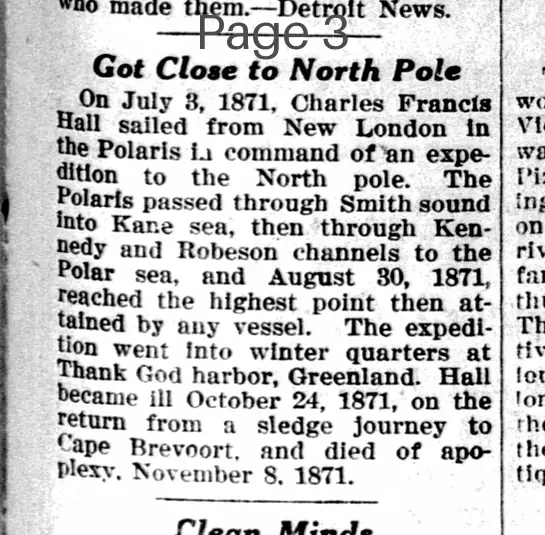
On July 3, 1871, Charles Francis Hall sailed from New London in the Polaris in command of an expedition to the North pole. The Polaris passed through Smith sound into Kane sea, then through Kennedy and Robeson channels to the Polar sea, and August 30, 1871, reached the highest point then attained by any vessel. The expedition went into winter quarters at Thank God harbor, Greenland. Hall became ill October 24, 1871, on the return from a sledge journey to Cape Brevoort, and died of apoplexy, November 8, 1871.
What sub-type of article is it?
What themes does it cover?
What keywords are associated?
What entities or persons were involved?
Where did it happen?
Story Details
Key Persons
Location
North Pole, Greenland, Smith Sound, Kane Sea, Kennedy Channel, Robeson Channel, Thank God Harbor, Cape Brevoort
Event Date
July 3, 1871 To November 8, 1871
Story Details
Charles Francis Hall commanded the Polaris expedition sailing from New London on July 3, 1871, reaching the farthest northern point on August 30, 1871, wintering at Thank God Harbor, Greenland; Hall fell ill on October 24 after a sledge journey and died of apoplexy on November 8.