Thank you for visiting SNEWPapers!
Sign up free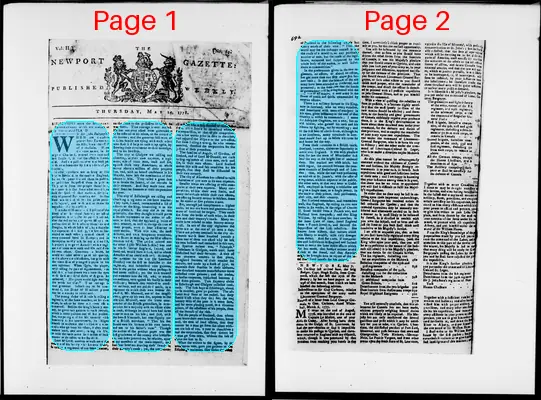
The Newport Gazette
Newport, Newport County, Rhode Island
What is this article about?
Reflections on voluntary military preparations in Scotland for the British cause in America after Burgoyne's defeat, with nobles like the Duke of Hamilton and cities like Glasgow and Edinburgh raising and funding regiments of 1000 men each, demonstrating national zeal and unity.
Merged-components note: This is a continuation of the article on reflections regarding military preparations in Scotland for the American war; the second component's editorial label is incorrect as it is part of the same foreign news reporting.
Clippings
1 of 2
OCR Quality
Full Text
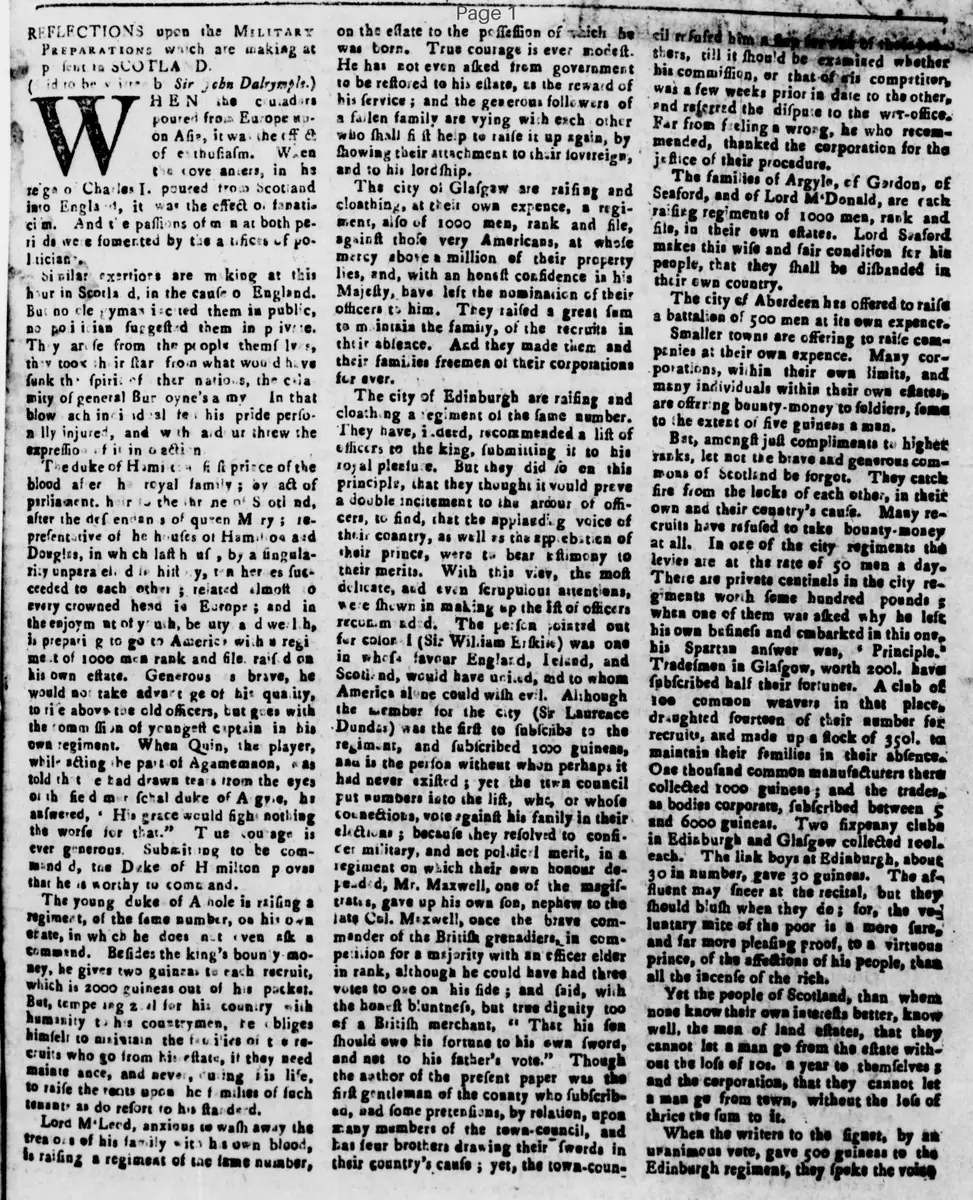
Preparations which are making at
present in SCOTLAND.
When the crusaders
poured from Europe upon
Asia, it was the effect
of enthusiasm. When
the covenanters, in his
reign of Charles I. poured thro' Scotland
into England, it was the effect of fanaticism.
And the pains of men at both periods were fomented by the artifices of politicians
Similar exertions are making at this
hour in Scotland, in the cause of England.
But no clergyman incited them in public,
no politician suggested them in private.
They are from the people themselves,
they took their start from what would have
Sunk the spirits of their nation. The calamity of general Burgoyne's army In that
blow each individual felt a stab to his pride personally injured, and with ardour threw the
expression of it into action
The duke of Hamilton, a prince of the
blood after his royal family; by act of
parliament, he is the heir of SCOTLAND,
after the descendants of queen Mary; representative of the houses of Hamilton and
Douglas, in which last house, by a singularity unparalleled in history, ten heirs succeeded to each other: related almost to
every crowned head in Europe; and in
the enjoyment of youth, beauty and wealth,
is preparing to go to America: with a regiment of 1000 men rank and file. raised on
his own estate. Generous & brave, he
would not take advantage of his quality,
to rise above the old officers, but goes with
the commission of youngest captain in his
own regiment. When Quin, the player,
whilst acting the part of Agamemnon, as
told that he had drawn tears from the eyes
of the field marshal duke of Argyle, he
answered, His grace would fight nothing
the worse for that. True courage is
ever generous. Submitting to be commanded, the Duke of Hamilton proves
that he is worthy to command.
The young duke of Athole is raising a
regiment, of the same number, on his own
estate, in which he does not even ask a
commission. Besides the king's bounty-money, he gives two guineas to each recruit,
which is 2000 guineas out of his pocket.
But, tempering zeal for his country with
humanity to his countrymen, obliges
himself to augment the families of the recruits who go from his estate, if they need
maintenance, and never, during his life,
to raise the rents upon the families of such
tenants as do refuse to his standard.
Lord M'Leod, anxious to wash away the
treason of his family in his own blood,
is raising a regiment of the same number,
on the estate to the possession of which he
was born. True courage is ever modest.
He has not even asked from government
to be restored to his estate, as the reward of
his service; and the generous followers of
a fallen family are vying with each other
who shall first help to raise it up again, by
showing their attachment to their sovereign,
and to his lordship.
The city of Glasgow are raising and
cloathing, at their own expence, a regiment, also of 1000 men, rank and file,
against those very Americans, at whose
mercy above a million of their property
lies, and, with an honest confidence in his
Majesty, have left the nomination of theirofficers to him. They raised a great sum
to maintain the family, of the recruits in
their absence. And they made them and
their families freemen of their corporations
for ever.
The city of Edinburgh are raising and
cloathing a regiment of the same number.
They have, indeed, recommended a list of
officers to the king, submitting it to his
royal pleasure. But they did so on this
principle, that they thought it would prove
a double incitement to the ardour of officers, to find, that the approving voice of
their country, as well as the approbation of
their prince, were to bear testimony to
their merits. With this view, the most
delicate, and even scrupulous attentions,
were shewn in making up the list of officers
recommended. The person pointed out
for colonel (Sir William Erskine) was one
in whose favour England, Ireland, and
Scotland. would have united, and to whom
America alone could wish evil. Although
the member for the city (Sir Laurence
Dundas) was the first to subscribe to the
regiment, and subscribed 1000 guineas,
and is the person without whom perhaps it
had never existed: yet the town council
put numbers into the list, who, or whose
connexions, voted against his family in their
elections: because they resolved to consider military, and not political merit, in a
regiment on which their own honour depended; Mr. Maxwell, one of the magistrates, gave up his own son, nephew to the
late Col. Maxwell, once the brave commander of the British grenadiers, in competition for a majority with an officer elder
in rank, although he could have had three
votes to one on his side; and said, with
the honest bluntness, but true dignity too
of a British merchant, That his son
Should owe his fortune to his own sword,
and not to his father's vote. Though
the author of the present paper was the
first gentleman of the county who subscribed, and some pretensions, by relation, upon
many members of the town-council, and
has four brothers drawing their swords in
their country's cause; yet, the town-council refused him
others, till it should be examined whether
his commission, or that of his competitor
was a few weeks prior in date to the other.
and referred the dispute to the war-office.
Far from feeling a wrong, he who recommended, thanked the corporation for that
justice of their procedure.
The families of Argyle, of Gordon, of
Seaford, and of Lord M Donald, are each
raising regiments of 1000 men, rank and
file, in their own estates. Lord Seaford
makes this wise and fair condition for his
people, that they shall be disbanded in
their own country.
The city of Aberdeen has offered to raise
a battalion of 500 men at its own expence.
Smaller towns are offering to raise companies at their own expence.
Many corporations, within their own limits, and
many individuals within their own estates.
are offering bounty-money to soldiers, some
to the extent of five guineas a man.
But, amongst just compliments to higher
ranks, let not the brave and generous commons of Scotland be forgot. They catch
fire from the looks of each other. in their
own and their country's cause. Many recruits have refused to take bounty-money
at all. In one of the city regiments the
levies are at the rate of 50 men a day.
There are private centinels in the city regiments worth one hundred pounds s
when one of them was asked why he left
his own business and embarked in this enterprise.
his Spartan answer was, ' Principle.'
Tradesmen in Glasgow, worth 200l. have
subscribed half their fortune. A club of
100
common weavers in that place.
draughted fourteen of their number for
recruits, and made up a stock of 35l. to
maintain their families in their absence.
One thousand common manufacturers there
collected 1000 guineas: and the trades
as bodies corporate, subscribed between 5
and 6000 guineas. Two sixpenny clubs
in Edinburgh and Glasgow collected 100l.
each. The link boys at Edinburgh, about
30 in number, gave 30 guineas. The affluent may sneer at the recital, but they
should blush when they do: for, the voluntary mite of the poor is a more sure,
and far more pleasing proof, to a virtuous
prince, of the affections of his people, than
all the incense of the rich.
Yet the people of Scotland, than whom
none know their own interests better. know
well, the men of land estates, that they
cannot let a man go from the estate without the loss of 10s. a year to themselves;
and the corporation, that they cannot let
a man go from town, without the loss of
thrice the sum to it.
When the writers to the signet, by an
unanimous vote, gave 200 guineas to the
Edinburgh regiment, they spoke the voice
Of Scotland in the following simple but manly words of their vote: "That the world may see the unhappy contest is not the cause of a ministry, or any particular member of men, but the cause of the legislature, animated and supported by the whole body of the nation, as well individuals as communities."
In the preferments given in the new regiments, no officer, or almost no officer, has got more than one step above his former rank; so that the interest of the old army have been attended to, preserved, and promoted; at the same time that the bands of government will be strengthened with the flower of all armies, a new army in the flower of youth and spirit, commanded by veteran officers.
There is a military servant to the King, now in Scotland, who on every occasion, and sometimes with tears of transport in his eyes, gives testimony to the zeal of that country in which he commands; I mean Sir Adolphus Oughton, not a new, but an old soldier, who gained his rank and his ribbon by fighting, not by recruiting; and at the first beat of whose drum, although he is no Scotsman, many thousands in Scotland would start up to follow wherever and honor led the way.
From these exertions in a British cause, Scotland, however, claims no superiority in merit over England. It was with pleasure that she saw the town of Manchester first lead the way in the right line of national duty. She marked not with insult, but with regret, the contrast between the common councils of Edinburgh and of London; that, while the one were presenting an address at St. James's, with the offer of a regiment, without expense to the public, the other were, at that very hour at Guildhall, employed in framing a resolution not to give a single man, or a single penny, in the cause of their prince, their parliament, their city, and their country.
But Scotland remembers, and remembers well, that England, by raising 22,000 new levies in six weeks, in the reign of Charles II. saved herself from a French war, and Holland from conquests; and that King William, by raising the same number, in the same space of time, saved England from a French invasion, and secured the suppression of the Irish rebellion. She knows from history, that nations which join liberty to wealth, arise easily stronger from defeat. And she trusts, if communities and individuals in England and Ireland were to make the same noble efforts which she has made, that foreign nations would shrink at the sound, and that America might be brought soon to repent of the fatal short-lived laurels she has gained.
What sub-type of article is it?
What keywords are associated?
What entities or persons were involved?
Where did it happen?
Foreign News Details
Primary Location
Scotland
Key Persons
Outcome
multiple regiments of 1000 men raised by nobles and cities at own expense; additional battalions and companies offered; financial support from various groups; preparations to strengthen british forces in america.
Event Details
Spontaneous efforts by Scottish nobles, cities, and common people to raise and fund regiments for service in America following the defeat of General Burgoyne's army, driven by national pride and loyalty to the king, with specific examples of generosity and merit-based officer selections.