Thank you for visiting SNEWPapers!
Sign up free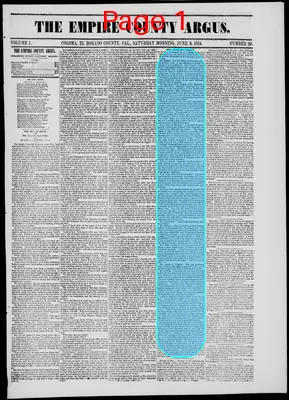
The Empire County Argus
Coloma, El Dorado County, California
What is this article about?
Mr. Latham of California speaks in the U.S. House in favor of a bill to improve and expedite mail service from New Orleans to San Francisco via competitive routes, arguing it would make the Post Office self-sustaining. He proposes amendments and moves to postpone for three weeks.
Clipping

OCR Quality
Full Text
On the Bill to empower the Post Master General to contract for the transportation of the United States Mail from New Orleans to San Francisco, according to time.
Mr. Speaker: The bill which the House has under consideration now, is one affecting so vitally the interests of my constituents, that I cannot consent it shall be disposed of without having an opportunity of expressing what I deem are the interests, not only of the State of California, but of the General Government, in the matter. I am not prepared to say that I am in favor of the bill before the House in its details, because I think there might be a substitute introduced which would more effectually carry out what is intended.
The gentleman from Virginia, [Mr. McMullin,] in his remarks on yesterday, upon this bill, took occasion to call the attention of the House to the fact that the Post Office Department is not now a self-sustaining branch of the government: but that, on the contrary, it is a tax upon the Treasury, and there has to be an annual appropriation in order to meet the necessary expenditures.
However true that may be—and I am prepared to endorse all of the sentiments he expressed—I say, that one of the reasons why that very state of things exists, so far as the mail between the Atlantic and Pacific coasts is concerned, originates in the law now in existence. The principle of this bill is intended to remedy this defect: and, if it is adopted by Congress, it will be found that it will effect the very result which the gentleman desires, to wit: that the Post Office Department shall be a self-sustaining branch of the Government.
Now, what are the facts? At present the mail is carried between the cities of New York and San Francisco for $850,000 per annum The average length of time by the Panama route—by which route the mail is carried—is about thirty days. It has been done in twenty-five days; but the average time will be found to be thirty days. There are two large express companies, Adams & Co. and Wells, Fargo & Co., which carry mail matter by Nicaragua, charging from twenty-five to fifty cents on a letter; and the trip is made in twenty-two and twenty-three days. The result is, that all commercial men throughout the country avail themselves of these facilities, as the most expeditious and best calculated to carry out their purpose, to wit: to expedite them in the delivery of messages which materially affect their interests.
The mail matter, therefore, which is carried by these express companies, amounts to about one-third of the regular United States mails; and thus the Department is cut off from about one-third of its revenue, which goes to the maintenance of these large express companies.
Now, what does this bill propose? It proposes that when the Government ascertains that a mail can be carried by any other route than the one established, in a more expeditious manner, its contract shall terminate with the existing route, and shall be given to that route which will carry it more expeditiously.
There are four routes between the Atlantic and the Pacific now occupying the attention of men of capital—the Panama route, the Nicaragua route, the Tehuantepec route, and the route between New Orleans, Vera Cruz, and Acapulco. I have no doubt in my own mind that the mails will be eventually carried in fifteen days. I believe that the mail between New Orleans and San Francisco can be carried safely by the Vera Cruz and Acapulco route in fifteen days. But I do not believe it will ever be carried in ten days, at a cost to the Government, under this bill, of $1,600,000, which seems to be the greatest objection of many gentlemen to the bill.
You now pay $850,000 to carry the mails in from twenty-seven to thirty days.
Mr. Churchwell. Nine hundred and sixty thousand dollars
Mr. Latham. Nine hundred and sixty thousand dollars, the gentleman from Tennessee says. This bill proposes that the mail shall be carried in twenty-five days for $1,000,000. And if the time is reduced to fifteen days—which in my opinion is the lowest possible limit that it can be carried—it will cost $1,000,000, or but little over what the Government is now paying for the transportation of the mail by the Panama route in twenty-seven to thirty days.
Now what I desire to call the attention of the House to more particularly, is, that the principles of this bill are right. If the Government desires to relieve itself from the burden of taxation in carrying and keeping up the mail between the Atlantic and Pacific coast, it must adopt this principle, or it cannot possibly relieve itself from a large burden of taxation laid upon its shoulders. I wish to say further
Mr. Smith of Virginia. Will the gentleman from California allow me to say that I have not received a single letter from California for months.
Mr. Latham. That is the true condition of things; and so far do I know such delay in receiving letters from California to be true, that the really important matter which comes to me as a member of this body I receive regularly by the express companies, and it reaches me some five or six days before the mail reaches me. And this is the case in the experience of the commercial men of the country. It is these express companies which relieve the Post Office Department of that income which it should properly receive, and which should go towards sustaining the route that is at any time established.
I wish to call the attention of the House to this fact. If you send this bill to the Committee of the Whole on the state of the Union, the result will be that the bill will never be reached, and this Congress will adjourn without being able to obtain any action whatever upon it, whether it contains merits or not. If the consideration of the bill is postponed for three weeks, why then the Committee on the Post Office and Post Roads can investigate this matter; they can see whether this bill is capable of being amended in its details—and, for one, I think it is—and the bill can then be properly reached.
The committee can amend the bill so as to relieve the Government from debt, and obviate the very objection which the gentlemen from Virginia [Mr. McMullin] has expressed against the bill, and which I know are entertained by other gentlemen upon this floor. When it comes up for consideration at the expiration of three weeks, the Committee on the Post Office and Post Roads can report a substitute and amendments, and then it can be discussed fully by the House, and the result will be that the Government can carry out the principle, which we all know will tend to relieve the Post Office Department from that burden of taxation which is now imposed upon it. I now renew the motion made by the gentleman from South Carolina, [Mr. Orr,] that the consideration of the bill be postponed for three weeks.
What sub-type of article is it?
What keywords are associated?
What entities or persons were involved?
Domestic News Details
Key Persons
Outcome
motion to postpone the bill for three weeks to allow committee review and amendments.
Event Details
Mr. Latham delivers a speech supporting the principles of a bill to enable the Postmaster General to contract for faster mail transportation from New Orleans to San Francisco via competitive routes, arguing it would make the Post Office self-sustaining by reducing reliance on slower government routes and competing express companies. He suggests amendments and renews a motion to postpone consideration for three weeks.