Thank you for visiting SNEWPapers!
Sign up free
Fowle's New Hampshire Gazette And General Advertiser
Portsmouth, Rockingham County, New Hampshire
What is this article about?
A letter to the New-Hampshire Gazette corrects and expands on a prior account of mineral springs near Saratoga, explaining their chemical properties including fixed air, calcareous substances, and iron content, and compares them to European spas like Pyrmont and Seltzer. Signed S.T. from Exeter, September 19, 1785.
Clipping
OCR Quality
Full Text
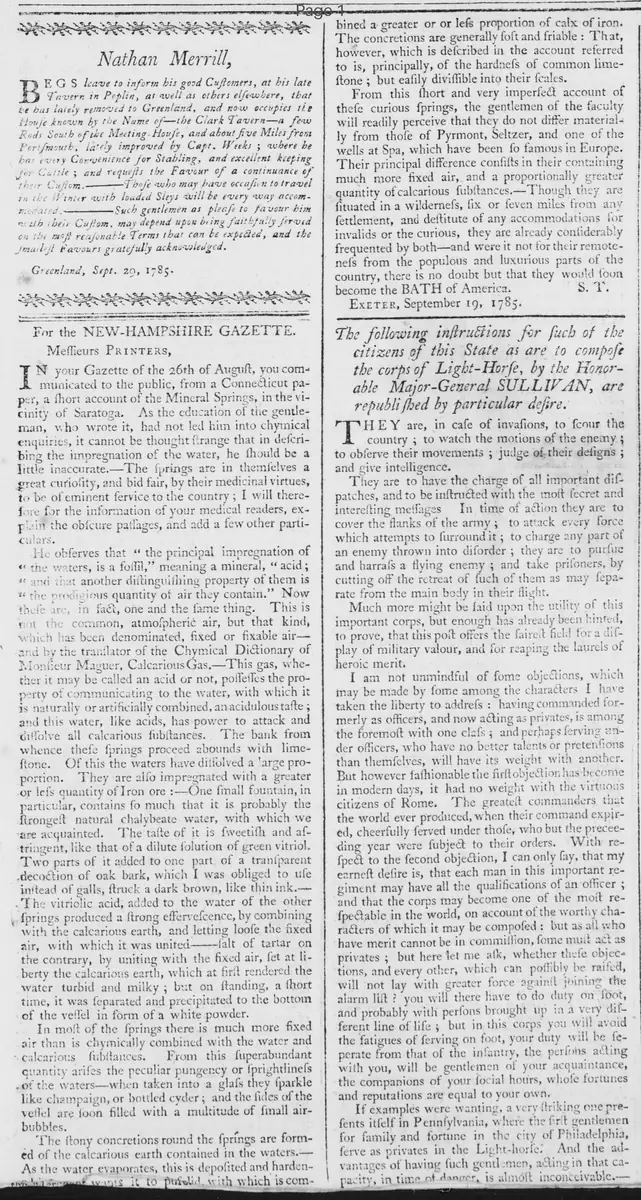
Messieurs PRINTERS,
In your Gazette of the 26th of August, you communicated to the public, from a Connecticut paper, a short account of the Mineral Springs, in the vicinity of Saratoga. As the education of the gentleman, who wrote it, had not led him into chemical enquiries, it cannot be thought strange that in describing the impregnation of the water, he should be a little inaccurate.—The springs are in themselves a great curiosity, and bid fair, by their medicinal virtues, to be of eminent service to the country; I will therefore for the information of your medical readers, explain the obscure passages, and add a few other particulars.
He observes that "the principal impregnation of the waters, is a fossil," meaning a mineral, "acid; and that another distinguishing property of them is the prodigious quantity of air they contain." Now these are, in fact, one and the same thing. This is not the common, atmospheric air, but that kind, which has been denominated fixed or fixable air—and by the translator of the Chemical Dictionary of Monsieur Maguer, Calcarious Gas.—This gas, whether it may be called an acid or not, possesses the property of communicating to the water, with which it is naturally or artificially combined, an acidulous taste; and this water, like acids, has power to attack and dissolve all calcarious substances. The bank from whence these springs proceed abounds with limestone. Of this the waters have dissolved a large proportion. They are also impregnated with a greater or less quantity of Iron ore:—One small fountain, in particular, contains so much that it is probably the strongest natural chalybeate water, with which we are acquainted. The taste of it is sweetish and astringent, like that of a dilute solution of green vitriol. Two parts of it added to one part of a transparent decoction of oak bark, which I was obliged to use instead of galls, struck a dark brown, like thin ink.—The vitriolic acid added to the water of the other springs produced a strong effervescence, by combining with the calcarious earth, and letting loose the fixed air, with which it was united—salt of tartar on the contrary, by uniting with the fixed air, set at liberty the calcarious earth, which at first rendered the water turbid and milky; but on standing, a short time, it was separated and precipitated to the bottom of the vessel in form of a white powder.
In most of the springs there is much more fixed air than is chemically combined with the water and calcarious substances. From this superabundant quantity arises the peculiar pungency or sprightliness of the waters—when taken into a glass they sparkle like champagne, or bottled cyder; and the sides of the vessel are soon filled with a multitude of small air-bubbles.
The stony concretions round the springs are formed of the calcarious earth contained in the waters.—As the water evaporates, this is deposited and hardens it to pudding-stone, with which is combined a greater or less proportion of calx of iron. The concretions are generally soft and friable: That, however, which is described in the account referred to is, principally, of the hardness of common limestone; but easily divisible into thin scales.
From this short and very imperfect account of these curious springs, the gentlemen of the faculty will readily perceive that they do not differ materially from those of Pyrmont, Seltzer, and one of the wells at Spa, which have been so famous in Europe. Their principal difference consists in their containing much more fixed air, and a proportionally greater quantity of calcarious substances.—Though they are situated in a wilderness, six or seven miles from any settlement, and destitute of any accommodations for invalids or the curious, they are already considerably frequented by both—and were it not for their remoteness from the populous and luxurious parts of the country, there is no doubt but that they would soon become the BATH of America.
S. T.
EXETER, September 19, 1785.
What sub-type of article is it?
What themes does it cover?
What keywords are associated?
What entities or persons were involved?
Letter to Editor Details
Author
S. T.
Recipient
Messieurs Printers
Main Argument
the letter corrects inaccuracies in a prior description of saratoga's mineral springs, explaining that their principal impregnation is fixed air (calcarious gas) which gives an acidulous taste and dissolves calcareous substances, with additional iron in some, making them medicinally valuable like european spas.
Notable Details