Thank you for visiting SNEWPapers!
Sign up free
Litchfield Enquirer
Litchfield, Litchfield County, Connecticut
What is this article about?
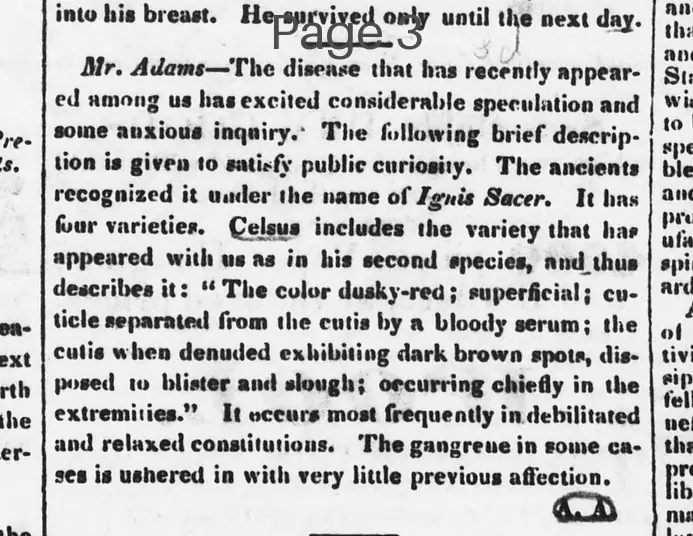
A recent disease outbreak, identified as Ignis Sacer or a form of gangrene, is described, exciting public curiosity; it matches Celsus's second species, occurring in debilitated constitutions with dusky-red color, blistering, and sloughing in extremities.
Clipping
OCR Quality
Full Text
What sub-type of article is it?
What keywords are associated?
What entities or persons were involved?
Domestic News Details
Event Date
Recently
Key Persons
Event Details
The disease that has recently appeared among us has excited considerable speculation and some anxious inquiry. The ancients recognized it under the name of Ignis Sacer. It has four varieties. Celsus includes the variety that has appeared with us as in his second species, and thus describes it: 'The color dusky-red; superficial; cuticle separated from the cutis by a bloody serum; the cutis when denuded exhibiting dark brown spots, disposed to blister and slough; occurring chiefly in the extremities.' It occurs most frequently in debilitated and relaxed constitutions. The gangrene in some cases is ushered in with very little previous affection.