Thank you for visiting SNEWPapers!
Sign up free
Literary
February 7, 1861
The Sun
New York, New York County, New York
What is this article about?
In this excerpt from 'Life of a Spinster,' Owen discusses his plans to support himself and his son in London, refusing Honora's farming offer due to social and personal reasons. He reveals family secrets, including Humfrey Randolf's engagement and inheritance claim. Honora grapples with moral dilemmas, ultimately recognizing Randolf as heir. Owen experiences a religious reawakening.
Clipping
OCR Quality
95%
Excellent
Full Text
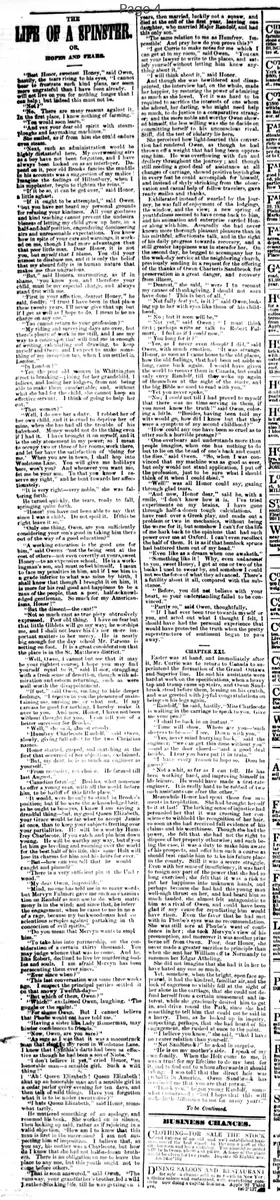
Life of a Spinster
Or, Hopes and Fears.
"Best Honor, sweetest Honey," said Owen, hastily, the tears rising to his eyes, "I cannot bear to frustrate such kind plans, nor seem more ungrateful than I have been already. I will not live on you for nothing longer than I can help; but indeed this must not be."
"Not?"
"No. There are many reasons against it. In the first place, I know nothing of farming."
"You would soon learn."
"And vex your dear old spirit with steam-ploughs and haymaking machines."
She smiled, as if from him she could endure even steam.
"Next, such an administration would be highly distasteful here. My overweening airs as boy have not been forgotten, and I have always been looked on as an interloper. Depend on it, poor old Brooks fancies the muddle in his accounts was a suggestion of my malice—his supplanter, begin to tighten the reins."
"If it be so, it can be got over," said Honor, a little aghast.
"If it ought to be attempted," said Owen; "but you have not heard my personal grounds for refusing your kindness." All your goodness and kind teaching cannot prevent the undesirableness of letting my child grow up here, in a half-and-half position, engendering domineering airs and unreasonable expectations. You know how, in spite of your care and warnings, it worked on me, though I had more advantages than that poor little man. Dear Honor, it is not almost to disabuse me, and it is only the belief that my absurd folly is in human nature that makes me thus ungracious.
"But," said Honora, murmuring, as if in shame, "you know you, and therefore your child, must be my especial charge, and always stand first with me."
"First in your affection, dearest Honey," he said, fondly; "I trust I have been in that place these twenty years. I'll never give that up; but if I get as well as I hope to do, I mean to be no charge on any one."
"You cannot return to your profession?"
"My riding and surveying days are over, but there's plenty of work in me still, and I see my way to a correspondence that will find me in enough of writing, calculating and drawing, to keep myself and Owen, and I expect to make something of my invention too, when I am settled in London."
"In London?"
"Yes; the poor old woman in Whittington street is breaking-up for her grandchild. I believe, and losing her lodgers, from not being able to make them comfortable; and, without what she had for the child, she cannot keep an effective servant. I think of going to help her out."
"That woman:"
"Well, I do owe her a duty. I robbed her of her own child, and it is cruel to deprive her of mine, when she has had all the trouble of his babyhood. Money would not do the thing even if I had it. I have brought it on myself, and it is the only atonement in my power; so I mean to occupy two or three of her rooms, work there, and let her have the satisfaction of 'doing for me.' When you are in town, I shall hop into Woolstone Lane. You will give me holidays here, won't you? And whenever you want me, let me be your son. To that you know I reserve my right," and he bent towards her affectionately.
"It is very—very noble," she was faltering forth.
He turned quickly, the tears, ready to fall, springing quite forth.
"Honora! you have not been able to say that since I was a child. Do not spoil it. If this be right leave it so."
"Only one thing, Owen, are you sufficiently considering your son's good in taking him there out of the way of a good education?"
"A working education is the good one for him," said Owen; "not the thing sent at the cost of others—not even covertly at yours, sweet Honey—to an expensive school. He is a workingman's son, and must so feel himself. I mean to face my penalties in him, and if I see him in a grade inferior to what was mine by birth, I shall know that though I brought it on him, it is more for his real good and happiness to be a man of the people, than a poor, half-acknowledged gentleman. So much for my Americanisms, Honor!"
"But the dissent—the cant!"
"Not so much cant as true piety obtrusively expressed. Poor old thing. I have no fear but that little Giblets will go my way; he worships me, and I shall not leave his h's nor more important matters to her mercy. He is nearly big enough for the day school Mr. Parsons is setting on foot. It is a great consideration that the place is in the St. Matthews district."
"Well, Owen, I cannot but see that it may be your rightest course; I hope you may find yourself equal to it," said Honora, struggling with a fresh sense of desertion, though with admiration and esteem returning, such as were well worth the disappointment.
"If not," said Owen, smiling to hide deeper feelings, "I reserve to you the pleasure of maintaining me, nursing me, or what not. If my carcass be good for nothing, I hereby make it over to you. And now, Honor, I have not been without thought for you. I can tell you of a better successor for Brooks."
"Well," she said, almost crossly.
"Humfrey Charlecote Randolf," said Owen, slowly, giving full life to the two Christian names.
Honor started, gasped, and snatching at the first that occurred of her objections, exclaimed.
"But, my dear, he is as much an engineer as yourself."
"From necessity, not choice. He farmed till last August."
"Canadian farming! Besides, what nonsense to offer a young man, with all the world before him, to be bailiff of this little place."
"It would, were he only to stand in Brooks's position; but if he were the acknowledged heir, as he ought to be—yes, I know I am saying a dreadful thing—but, my good Queen Elizabeth, your Grace would be far wiser to accept Jamie at once, than to keep your subjects fretting over your partialities. He will be a worthy Humfrey Charlecote, if you catch and pin him down young. He will be worthy any way, but if you let him go leveling and roaming over the world for the best half of his life, this same Holt will lose its charms for him and his heirs for ever."
"But—how can you tell that he would"
"caught and pinned?"
"There is a very sufficient pin at the Under wood."
"My dear Owen, impossible."
"Mind, no one has told me in so many words, but Mervyn Fulmort gave me such an examination on Randolf as men use to do when matrimony is in the wind; and since that, he inferred the engagement, when he came to me in a rage, because my backwoodsman had conscientious scruples against partaking in the concoction of evil spirits."
"Do you mean that Mervyn wants to employ him."
"To take him into partnership, on the consideration of a certain thirty thousand. You may judge whence that was to come. And he, like Robert, declined to live by murdering bodies and souls. I am afraid Mervyn has been persecuting them ever since."
"Ever since when?"
"This last conversation was some three weeks ago. I suspect the principal parties settled it on that snowy Twelfth-day—"
"But which of them, Owen?"
"Which!" exclaimed Owen, laughing. "The goggle or the squint."
"For shame, Owen. But I cannot believe that Phoebe would not have told me."
"Having a sister like Lady Bannerman, may hinder confidences to friends."
"Now, Owen, are you sure?"
"As sure as I was that it was a moonstruck Swan that slept in my room in Woolstone Lane. I knew that Cynthia's darts had been as effective as though he had been a son of Niobe."
"I don't believe it yet," cried Honor, "an honorable man—a sensible girl. Such a wild thing!"
"Ah! Queen Elizabeth! Queen Elizabeth! shut up an honorable man and a sensible girl in a cedar parlor every evening for ten days, and then talk of wild things. Have you forgotten what it is to be under twenty-five?"
"I hate Queen Elizabeth," said Honora, somewhat tartly.
He muttered something of an apology, and resumed his book. She worked on in silence, then looking up said, rather as if rejoicing in a valid objection, "How am I to know that this man is first in the succession? I am not suspecting him of imposition. I believe that, as you say, his mother was a Charlecote, but how do I know that she had not half-a-dozen brothers. There is no obligation on me to leave the place to any one, but this youth ought not to come before others."
"That is soon answered," said Owen. "The run away, your grandfather's brother, led a wild Leather-Stocking life, till he was getting on in years, then married, luckily not a squaw, and died at the end of the first year, leaving one daughter, who married Major Randolf, and had this only son."
"The same relation to me as Humfrey, impossible! And pray how do you prove this?"
"I got Currie to make notes for me which I can get at in my room," said Owen. "You can set your lawyer to write to the places, and satisfy yourself without letting him know anything about it."
"I will think about it," said Honor.
And though she was bewildered and disappointed, the interview had, on the whole, made her happier, by restoring the power of admiring as much as she loved. Yet it was hard to be required to sacrifice the interests of one whom she adored, her darling, who might need help so much, to do justice to a comparative stranger: and the more noble and worthy Owen showed himself, the less willing was she to decide on committing herself to his unconscious rival.
Still, did the test of idolatry lie here.
She perceived how light-hearted this conversation had rendered Owen, as though he had thrown off a weight that had long been oppressing him. He was overflowing with fun and drollery throughout the journey: and though still needing a good deal of assistance at all changes of carriage, showed positive boyish glee in every feat he could accomplish for himself, and instead of shyly shrinking from the observation and casual help of fellow travelers, gave ready smiles and thanks.
Exhilarated instead of wearied by the journey, he was full of enjoyment of the lodgings, the window, and the view; a new spring of youthfulness seemed to have come back to him, and his animation and enterprise carried Honora along with him. Assuredly she had never known more thorough pleasant pleasure than in his mirthful, affectionate talk, and in the sight of his daily progress towards recovery, and a still greater happiness was in store for her. On the second day, he begged to accompany her to the week-day service at the neighboring church, previously sending in a request for the offering of the thanks of Owen Charteris Sandbrook for preservation in a great danger, and recovery from illness.
"Dearest," she said, "were I to recount my causes of thanksgiving, I should not soon have done! This is best of all."
"Not fully best yet, is it?" said Owen, looking up to her with eyes like those of his childhood.
"No; but it soon will be."
"Not yet," said Owen; "I must think first: perhaps write or talk to Robert Fulmort. I feel as if I could now."
"You long for it?"
"Yes, as I never even thought I did," said Owen, with much emotion. "It was strange, Honor, as soon as I came home to the old places, how the old feelings, that had been set aside so long, came back again. I would have given the world to recover them in Canada, but could only envy Randolf, till they woke up again of themselves at the sight of the study, and the big Bible we used to read with you."
"Yet you never spoke."
"No: I could not till I had proved to myself that there was no time-serving in them, if you must know the truth!" said Owen, coloring a little. "Besides, having been told my wits would go, how did I know but that they were a symptom of my second childhood?"
"How could any one have been so cruel as to utter such a horrible presage?"
"One overhears and understands more than people imagine, when one has nothing to do but to lie on the broad of one's back and count the flies," said Owen. "So, when I was convinced that my machine was as good as ever, but only would not stand application, I put off the profession, just to be sure what I should think of it when I could think."
"Well!" was all Honor could say, gazing through glad tears.
"And now, Honor dear," said he, with a smile, "I don't know how it is. I've tried experiments on my brains. I have gone through half-a dozen tough calculations, have read over a Greek play, and made out a problem or two in mechanics, without being the worse for it; but somehow I can't for the life of me hark back to the opinions that had such power over me at Oxford. I can't even recollect the half of them. It is as if that hemlock spruce had battered them out of my head."
"Even like as a dream when one awaketh."
"Something like it! Why, even unknown to you, sweet Honey, I got at one or two of the books I used to swear by, and somehow I could not see the force of what they advanced. There's a futility about it all, compared with the substance."
"Before, you did not believe with your heart, so your understanding failed to be convinced."
"Partly so," said Owen, thoughtfully, "If I had ever been true towards myself or you, and acted out what I thought I felt, I should have had the personal experience that would have protected the truth when the pretty superstructure of sentiment began to pass away."
Easter was at hand, and immediately after it, Mr. Currie was to return to Canada to superintend the formation of the Grand Ottawa and Superior line. He and his assistants were hard at work on the specifications, when a heavy tap and tramp came up stairs, and Owen Sandbrook stood before them, leaning on his crutch, and was greeted with joyful congratulations on being on his legs again.
"Randolf," he said, hastily, "Miss Charlecote is waiting in the carriage to speak to you. Give me your pen?"
"I shall be back in an instant."
"Time will show. Where are you—such surveyors to be—I see. Down with you. Yes: never mind hurrying back," said the engineer; "we can get this done without you"—and as the door closed—"and a good deal beside. I hear you have put it in train."
"I have every reason to hope so. Does he guess?"
"Not a whit, as far as I can tell. He has been working hard, and improving himself in his leisure. He would have made a first-rate engineer. It is really hard to be robbed of two such assistants one after the other."
Meanwhile Honor had spent those few moments in trepidation. She had brought herself to it at last! The lurking sense of injustice had persuaded her that it was crossing her conscience to withhold the recognition of her heir, so soon as she had received full evidence of his claims and his worthiness. Though she had the power, she felt that she had not the right to dispose of her property otherwise; and such being the case, it was a duty to make him aware of his prospects, and offer him such a course as should best enable him to take his future place in the county. Still it was a severe struggle. Even with her sense of insufficiency, it was hard to resign any part of the power that she had so long exercised; she felt that it was a risk to put her happiness into unknown hands, and perhaps because she had had this young man well-nigh thrust on her, and had heard him so much lauded, she almost felt antagonistic to him as a rival of Owen, and could have been glad if any cause for repudiating him would have risen. Even the favor that he had met with in Phoebe's eyes was no recommendation. She was still sore at Phoebe's want of confidence in her; she took Mervyn's view of his presumption, and moreover it was another prize borne off from Owen. Poor, dear Honor, she never made a greater sacrifice to principle than when she sent her William off to "Normandy to summon her Edgar Atheling."
She did not imagine that she had it in her to have hated any one so much.
Yet, somehow, when the bright, open face appeared at the window, it had the kindred, familiar air, and the look of eagerness so visibly fell at the sight of her alone in the carriage, that she could not defend herself from a certain amusement and interest, while she graciously desired him to get in, and drive round the Park, since she had something to tell him that could not be said in a hurry." Then, as he looked up in inquiry, suspecting, perhaps, that she had heard of his engagement, she rushed at once to the point.
"I believe you know," she said, "that I have no nearer relation than yourself."
"Not Sandbrook?" he asked in surprise.
"He is on my mother's side. I speak of my own family. When the Holt came to me, it was a trust for my lifetime to do my best for it, and to find out to whom afterwards it should belong. I was told that the direct heir was lost, probably in America. Owen Sandbrook has convinced me that you are that person."
"Thank you," began young Randolf, somewhat embarrassed; "but I hope that this will make little difference to me for many years."
To be Continued.
Or, Hopes and Fears.
"Best Honor, sweetest Honey," said Owen, hastily, the tears rising to his eyes, "I cannot bear to frustrate such kind plans, nor seem more ungrateful than I have been already. I will not live on you for nothing longer than I can help; but indeed this must not be."
"Not?"
"No. There are many reasons against it. In the first place, I know nothing of farming."
"You would soon learn."
"And vex your dear old spirit with steam-ploughs and haymaking machines."
She smiled, as if from him she could endure even steam.
"Next, such an administration would be highly distasteful here. My overweening airs as boy have not been forgotten, and I have always been looked on as an interloper. Depend on it, poor old Brooks fancies the muddle in his accounts was a suggestion of my malice—his supplanter, begin to tighten the reins."
"If it be so, it can be got over," said Honor, a little aghast.
"If it ought to be attempted," said Owen; "but you have not heard my personal grounds for refusing your kindness." All your goodness and kind teaching cannot prevent the undesirableness of letting my child grow up here, in a half-and-half position, engendering domineering airs and unreasonable expectations. You know how, in spite of your care and warnings, it worked on me, though I had more advantages than that poor little man. Dear Honor, it is not almost to disabuse me, and it is only the belief that my absurd folly is in human nature that makes me thus ungracious.
"But," said Honora, murmuring, as if in shame, "you know you, and therefore your child, must be my especial charge, and always stand first with me."
"First in your affection, dearest Honey," he said, fondly; "I trust I have been in that place these twenty years. I'll never give that up; but if I get as well as I hope to do, I mean to be no charge on any one."
"You cannot return to your profession?"
"My riding and surveying days are over, but there's plenty of work in me still, and I see my way to a correspondence that will find me in enough of writing, calculating and drawing, to keep myself and Owen, and I expect to make something of my invention too, when I am settled in London."
"In London?"
"Yes; the poor old woman in Whittington street is breaking-up for her grandchild. I believe, and losing her lodgers, from not being able to make them comfortable; and, without what she had for the child, she cannot keep an effective servant. I think of going to help her out."
"That woman:"
"Well, I do owe her a duty. I robbed her of her own child, and it is cruel to deprive her of mine, when she has had all the trouble of his babyhood. Money would not do the thing even if I had it. I have brought it on myself, and it is the only atonement in my power; so I mean to occupy two or three of her rooms, work there, and let her have the satisfaction of 'doing for me.' When you are in town, I shall hop into Woolstone Lane. You will give me holidays here, won't you? And whenever you want me, let me be your son. To that you know I reserve my right," and he bent towards her affectionately.
"It is very—very noble," she was faltering forth.
He turned quickly, the tears, ready to fall, springing quite forth.
"Honora! you have not been able to say that since I was a child. Do not spoil it. If this be right leave it so."
"Only one thing, Owen, are you sufficiently considering your son's good in taking him there out of the way of a good education?"
"A working education is the good one for him," said Owen; "not the thing sent at the cost of others—not even covertly at yours, sweet Honey—to an expensive school. He is a workingman's son, and must so feel himself. I mean to face my penalties in him, and if I see him in a grade inferior to what was mine by birth, I shall know that though I brought it on him, it is more for his real good and happiness to be a man of the people, than a poor, half-acknowledged gentleman. So much for my Americanisms, Honor!"
"But the dissent—the cant!"
"Not so much cant as true piety obtrusively expressed. Poor old thing. I have no fear but that little Giblets will go my way; he worships me, and I shall not leave his h's nor more important matters to her mercy. He is nearly big enough for the day school Mr. Parsons is setting on foot. It is a great consideration that the place is in the St. Matthews district."
"Well, Owen, I cannot but see that it may be your rightest course; I hope you may find yourself equal to it," said Honora, struggling with a fresh sense of desertion, though with admiration and esteem returning, such as were well worth the disappointment.
"If not," said Owen, smiling to hide deeper feelings, "I reserve to you the pleasure of maintaining me, nursing me, or what not. If my carcass be good for nothing, I hereby make it over to you. And now, Honor, I have not been without thought for you. I can tell you of a better successor for Brooks."
"Well," she said, almost crossly.
"Humfrey Charlecote Randolf," said Owen, slowly, giving full life to the two Christian names.
Honor started, gasped, and snatching at the first that occurred of her objections, exclaimed.
"But, my dear, he is as much an engineer as yourself."
"From necessity, not choice. He farmed till last August."
"Canadian farming! Besides, what nonsense to offer a young man, with all the world before him, to be bailiff of this little place."
"It would, were he only to stand in Brooks's position; but if he were the acknowledged heir, as he ought to be—yes, I know I am saying a dreadful thing—but, my good Queen Elizabeth, your Grace would be far wiser to accept Jamie at once, than to keep your subjects fretting over your partialities. He will be a worthy Humfrey Charlecote, if you catch and pin him down young. He will be worthy any way, but if you let him go leveling and roaming over the world for the best half of his life, this same Holt will lose its charms for him and his heirs for ever."
"But—how can you tell that he would"
"caught and pinned?"
"There is a very sufficient pin at the Under wood."
"My dear Owen, impossible."
"Mind, no one has told me in so many words, but Mervyn Fulmort gave me such an examination on Randolf as men use to do when matrimony is in the wind; and since that, he inferred the engagement, when he came to me in a rage, because my backwoodsman had conscientious scruples against partaking in the concoction of evil spirits."
"Do you mean that Mervyn wants to employ him."
"To take him into partnership, on the consideration of a certain thirty thousand. You may judge whence that was to come. And he, like Robert, declined to live by murdering bodies and souls. I am afraid Mervyn has been persecuting them ever since."
"Ever since when?"
"This last conversation was some three weeks ago. I suspect the principal parties settled it on that snowy Twelfth-day—"
"But which of them, Owen?"
"Which!" exclaimed Owen, laughing. "The goggle or the squint."
"For shame, Owen. But I cannot believe that Phoebe would not have told me."
"Having a sister like Lady Bannerman, may hinder confidences to friends."
"Now, Owen, are you sure?"
"As sure as I was that it was a moonstruck Swan that slept in my room in Woolstone Lane. I knew that Cynthia's darts had been as effective as though he had been a son of Niobe."
"I don't believe it yet," cried Honor, "an honorable man—a sensible girl. Such a wild thing!"
"Ah! Queen Elizabeth! Queen Elizabeth! shut up an honorable man and a sensible girl in a cedar parlor every evening for ten days, and then talk of wild things. Have you forgotten what it is to be under twenty-five?"
"I hate Queen Elizabeth," said Honora, somewhat tartly.
He muttered something of an apology, and resumed his book. She worked on in silence, then looking up said, rather as if rejoicing in a valid objection, "How am I to know that this man is first in the succession? I am not suspecting him of imposition. I believe that, as you say, his mother was a Charlecote, but how do I know that she had not half-a-dozen brothers. There is no obligation on me to leave the place to any one, but this youth ought not to come before others."
"That is soon answered," said Owen. "The run away, your grandfather's brother, led a wild Leather-Stocking life, till he was getting on in years, then married, luckily not a squaw, and died at the end of the first year, leaving one daughter, who married Major Randolf, and had this only son."
"The same relation to me as Humfrey, impossible! And pray how do you prove this?"
"I got Currie to make notes for me which I can get at in my room," said Owen. "You can set your lawyer to write to the places, and satisfy yourself without letting him know anything about it."
"I will think about it," said Honor.
And though she was bewildered and disappointed, the interview had, on the whole, made her happier, by restoring the power of admiring as much as she loved. Yet it was hard to be required to sacrifice the interests of one whom she adored, her darling, who might need help so much, to do justice to a comparative stranger: and the more noble and worthy Owen showed himself, the less willing was she to decide on committing herself to his unconscious rival.
Still, did the test of idolatry lie here.
She perceived how light-hearted this conversation had rendered Owen, as though he had thrown off a weight that had long been oppressing him. He was overflowing with fun and drollery throughout the journey: and though still needing a good deal of assistance at all changes of carriage, showed positive boyish glee in every feat he could accomplish for himself, and instead of shyly shrinking from the observation and casual help of fellow travelers, gave ready smiles and thanks.
Exhilarated instead of wearied by the journey, he was full of enjoyment of the lodgings, the window, and the view; a new spring of youthfulness seemed to have come back to him, and his animation and enterprise carried Honora along with him. Assuredly she had never known more thorough pleasant pleasure than in his mirthful, affectionate talk, and in the sight of his daily progress towards recovery, and a still greater happiness was in store for her. On the second day, he begged to accompany her to the week-day service at the neighboring church, previously sending in a request for the offering of the thanks of Owen Charteris Sandbrook for preservation in a great danger, and recovery from illness.
"Dearest," she said, "were I to recount my causes of thanksgiving, I should not soon have done! This is best of all."
"Not fully best yet, is it?" said Owen, looking up to her with eyes like those of his childhood.
"No; but it soon will be."
"Not yet," said Owen; "I must think first: perhaps write or talk to Robert Fulmort. I feel as if I could now."
"You long for it?"
"Yes, as I never even thought I did," said Owen, with much emotion. "It was strange, Honor, as soon as I came home to the old places, how the old feelings, that had been set aside so long, came back again. I would have given the world to recover them in Canada, but could only envy Randolf, till they woke up again of themselves at the sight of the study, and the big Bible we used to read with you."
"Yet you never spoke."
"No: I could not till I had proved to myself that there was no time-serving in them, if you must know the truth!" said Owen, coloring a little. "Besides, having been told my wits would go, how did I know but that they were a symptom of my second childhood?"
"How could any one have been so cruel as to utter such a horrible presage?"
"One overhears and understands more than people imagine, when one has nothing to do but to lie on the broad of one's back and count the flies," said Owen. "So, when I was convinced that my machine was as good as ever, but only would not stand application, I put off the profession, just to be sure what I should think of it when I could think."
"Well!" was all Honor could say, gazing through glad tears.
"And now, Honor dear," said he, with a smile, "I don't know how it is. I've tried experiments on my brains. I have gone through half-a dozen tough calculations, have read over a Greek play, and made out a problem or two in mechanics, without being the worse for it; but somehow I can't for the life of me hark back to the opinions that had such power over me at Oxford. I can't even recollect the half of them. It is as if that hemlock spruce had battered them out of my head."
"Even like as a dream when one awaketh."
"Something like it! Why, even unknown to you, sweet Honey, I got at one or two of the books I used to swear by, and somehow I could not see the force of what they advanced. There's a futility about it all, compared with the substance."
"Before, you did not believe with your heart, so your understanding failed to be convinced."
"Partly so," said Owen, thoughtfully, "If I had ever been true towards myself or you, and acted out what I thought I felt, I should have had the personal experience that would have protected the truth when the pretty superstructure of sentiment began to pass away."
Easter was at hand, and immediately after it, Mr. Currie was to return to Canada to superintend the formation of the Grand Ottawa and Superior line. He and his assistants were hard at work on the specifications, when a heavy tap and tramp came up stairs, and Owen Sandbrook stood before them, leaning on his crutch, and was greeted with joyful congratulations on being on his legs again.
"Randolf," he said, hastily, "Miss Charlecote is waiting in the carriage to speak to you. Give me your pen?"
"I shall be back in an instant."
"Time will show. Where are you—such surveyors to be—I see. Down with you. Yes: never mind hurrying back," said the engineer; "we can get this done without you"—and as the door closed—"and a good deal beside. I hear you have put it in train."
"I have every reason to hope so. Does he guess?"
"Not a whit, as far as I can tell. He has been working hard, and improving himself in his leisure. He would have made a first-rate engineer. It is really hard to be robbed of two such assistants one after the other."
Meanwhile Honor had spent those few moments in trepidation. She had brought herself to it at last! The lurking sense of injustice had persuaded her that it was crossing her conscience to withhold the recognition of her heir, so soon as she had received full evidence of his claims and his worthiness. Though she had the power, she felt that she had not the right to dispose of her property otherwise; and such being the case, it was a duty to make him aware of his prospects, and offer him such a course as should best enable him to take his future place in the county. Still it was a severe struggle. Even with her sense of insufficiency, it was hard to resign any part of the power that she had so long exercised; she felt that it was a risk to put her happiness into unknown hands, and perhaps because she had had this young man well-nigh thrust on her, and had heard him so much lauded, she almost felt antagonistic to him as a rival of Owen, and could have been glad if any cause for repudiating him would have risen. Even the favor that he had met with in Phoebe's eyes was no recommendation. She was still sore at Phoebe's want of confidence in her; she took Mervyn's view of his presumption, and moreover it was another prize borne off from Owen. Poor, dear Honor, she never made a greater sacrifice to principle than when she sent her William off to "Normandy to summon her Edgar Atheling."
She did not imagine that she had it in her to have hated any one so much.
Yet, somehow, when the bright, open face appeared at the window, it had the kindred, familiar air, and the look of eagerness so visibly fell at the sight of her alone in the carriage, that she could not defend herself from a certain amusement and interest, while she graciously desired him to get in, and drive round the Park, since she had something to tell him that could not be said in a hurry." Then, as he looked up in inquiry, suspecting, perhaps, that she had heard of his engagement, she rushed at once to the point.
"I believe you know," she said, "that I have no nearer relation than yourself."
"Not Sandbrook?" he asked in surprise.
"He is on my mother's side. I speak of my own family. When the Holt came to me, it was a trust for my lifetime to do my best for it, and to find out to whom afterwards it should belong. I was told that the direct heir was lost, probably in America. Owen Sandbrook has convinced me that you are that person."
"Thank you," began young Randolf, somewhat embarrassed; "but I hope that this will make little difference to me for many years."
To be Continued.
What sub-type of article is it?
Prose Fiction
What themes does it cover?
Moral Virtue
Social Manners
Religious
What keywords are associated?
Inheritance
Family Duty
Moral Sacrifice
Religious Reawakening
Social Class
Heir Recognition
Literary Details
Title
Life Of A Spinster Or, Hopes And Fears.
Key Lines
"A Working Education Is The Good One For Him," Said Owen; "Not The Thing Sent At The Cost Of Others—Not Even Covertly At Yours, Sweet Honey—To An Expensive School. He Is A Workingman's Son, And Must So Feel Himself."
"It Is Very—Very Noble," She Was Faltering Forth.
"Even Like As A Dream When One Awaketh."
"I Believe You Know," She Said, "That I Have No Nearer Relation Than Yourself."