Thank you for visiting SNEWPapers!
Sign up free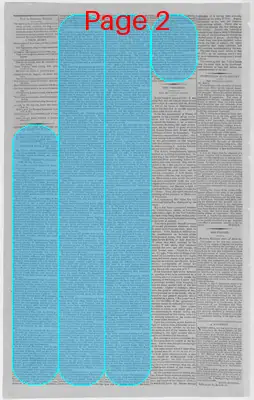
Editorial
April 26, 1815
Daily National Intelligencer
Washington, District Of Columbia
What is this article about?
Republican members of the New York Legislature, in an April 1815 address to electors, review British impressment, orders in council, and aggressions leading to the War of 1812. They praise American naval and land victories, criticize Federalist opposition and Hartford Convention, and call for continued Republican support to uphold national honor and independence.
Clipping
OCR Quality
95%
Excellent
Full Text
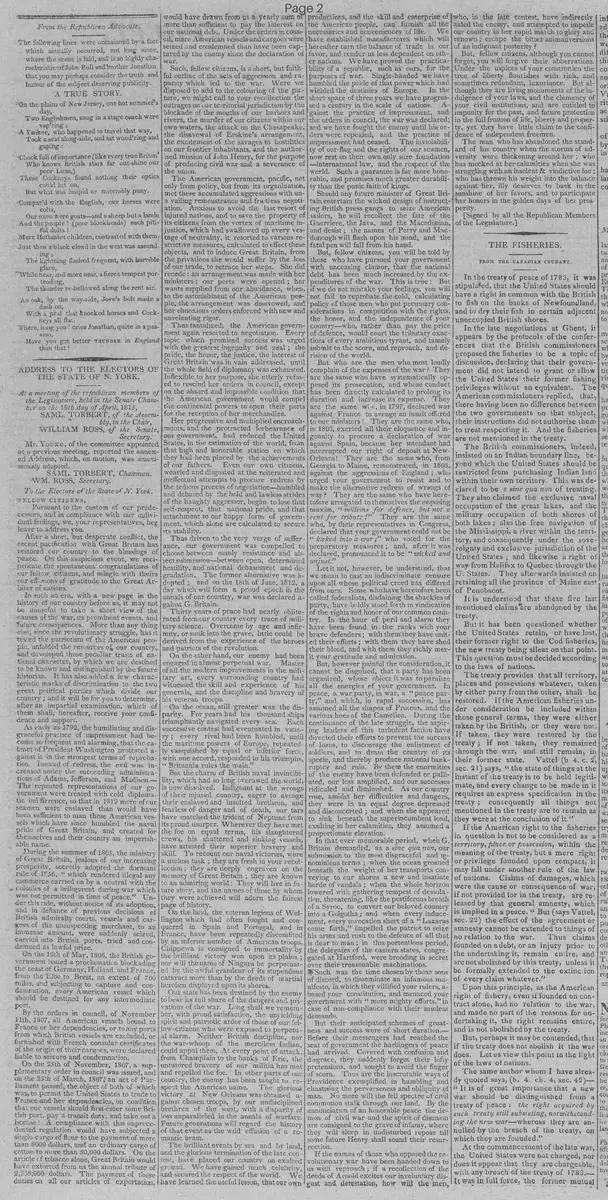
ADDRESS TO THE ELECTORS OF THE STATE OF N. YORK.
At a meeting of the republican members of the Legislature, held in the Senate Chamber on the 19th day of April, 1815.
SAML. TORBERT, of the Assembly, in the Chair,
WILLIAM ROSS, of the Senate, Secretary.
Mr. YOUNG, of the committee appointed at a previous meeting, reported the annexed Address, which, on motion, was unanimously adopted.
SAML. TORBERT, Chairman.
WM. ROSS, Secretary.
To the Electors of the State of N. York
FELLOW CITIZENS,
Pursuant to the custom of our predecessors, and in compliance with our individual feelings, we, your representatives, beg leave to address you.
After a short, but desperate conflict, the recent pacification with Great Britain has restored our country to the blessings of peace. On this auspicious event, we reciprocate the spontaneous congratulations of our fellow citizens, and mingle with theirs our effusions of gratitude to the Great Arbiter of nations.
In such an era, with a new page in the history of our country before us, it may not be unuseful to take a short view of the causes of the war, its prominent events, and future consequences. More than any thing else, since the revolutionary struggle, has it tested the patriotism of the American people, unfolded the resources of our country, and developed those peculiar traits of national character by which we are destined to be known and distinguished by the future historian. It has also added a few characteristic marks of discrimination to the two great political parties which divide our country; and it will be for you to determine, after an impartial examination, which of them shall, hereafter, receive your confidence and support.
As early as 1792, the humiliating and disgraceful practice of impressment had become so frequent and alarming, that the cabinet of President Washington protested against it in the strongest terms of reprebation. Instead of redress, the evil was increased under the succceding administrations of Adams, Jefferson, and Madison. The repeated representations of our government were treated with cold diplomatic indifference, so that in 1812 more of our seamen were enslaved than would have been sufficient to man those American vessels which have since humbled the naval pride of Great Britain, and created for themselves and their country an imperishable name.
During the summer of 1805, the ministry of Great Britain, jealous of our increasing prosperity, secretly adopted the dormant rule of 1756, "which rendered illegal any commerce carried on by a neutral with the colonies of a belligerent during war which was not permitted in time of peace." Under this rule, without notice of its adoption, and in defiance of previous decisions of British admiralty courts, vessels and cargoes of the unsuspecting merchant, to an immense amount, were suddenly seized, carried into British ports, tried and condemned as lawful prize.
On the 16th of May, 1806, the British government issued a proclamation blockading the coast of Germany, Holland, and France, from the Elbe to Brest, an extent of 700 miles, and subjecting to capture and condemnation, every American vessel which should be destined for any intermediate port.
By the orders in council, of November 11th, 1807, all American vessels bound to France or her dependencies, or to any ports from which British vessels are excluded, or furnished with French consular certificates of the origin of their cargoes, were declared liable to seizure and condemnation.
On the 25th of November, 1807, a supplementary order in council was issued, and on the 25th of March, 1807, an act of Parliament passed, the object of both of which was, to permit the United States to trade to France and her dependencies, on condition that our vessels should first enter some British port, pay a transit duty, and take out a license! A compliance with this unprecedented regulation would have subjected a single cargo of flour to the payment of more than 8000 dollars, and an ordinary cargo of cotton to more than 50,000 dollars. On the article of tobacco alone, Great Britain would have extorted from us the annual tribute of 2,338,000 dollars. The payment of these duties on all our articles of exportation, would have drawn from us a yearly sum of more than sufficient to pay the interest on our national debt. Under the orders in council, more American vessels and cargoes were seized and condemned than have been captured by the enemy since the declaration of war
Such, fellow citizens, is a short, but faithful outline of the acts of aggression and rapacity which led to the war. Were we disposed to add to the colouring of the picture, we might call to your recollection the outrages on our territorial jurisdiction by the blockade of the mouths of our harbors and rivers, the murder of our citizens within our own waters, the attack on the Chesapeake, the disavowal of Erskine's arrangement, the excitement of the savages to hostilities on our frontier inhabitants, and the authorised mission of John Henry, for the purpose of producing civil war and a severance of the union.
The American government, pacific, not only from policy, but from its organization, met these accumulated aggressions with unavailing remonstrance and fruitless negotiation. Anxious to avoid the last resort of injured nations, and to save the property of its citizens from the vortex of maritime injustice, which had swallowed up every vestige of neutrality, it resorted to various restrictive measures, calculated to effect these objects, and to induce Great Britain, from the privations she would suffer by the loss of our trade, to retrace her steps. She did recede: an arrangement was made with her ministers; our ports were opened; her wants supplied from our abundance, when, to the astonishment of the American people, the arrangement was disavowed, and her obnoxious orders enforced with new and unrelenting rigor.
Thus tantalized, the American government again resorted to negotiation. Every topic which promised success was urged with the greatest ingenuity and zeal; the pride, the honor, the justice, the interest of Great Britain was in vain addressed, until the whole field of diplomacy was exhausted. Inflexible to her purpose, she utterly refused to rescind her orders in council, except on the absurd and impossible condition that the American government would compel the continental powers to open their ports for the reception of her merchandize.
Her progressive and multiplied encroachments, and the protracted forbearance of our government, had reduced the United States, in the estimation of the world, from that high and honorable station on which they had been placed by the achievements of our fathers. Even our own citizens, wearied and disgusted at the reiterated and ineffectual attempts to procure redress by the tedious process of negotiation—humbled and debased by the bold and lawless strides of the haughty aggressor, began to lose that self-respect, that national pride, and that attachment to our happy form of government, which alone are calculated to secure its stability.
Thus driven to the very verge of sufferance, our government was compelled to choose between manly resistance and abject submission—between open, determined hostility, and national debasement and degradation. The former alternative was adopted; and on the 18th of June, 1812, a day which will form a proud epoch in the annals of our country, war was declared against G. Britain.
Thirty years of peace had nearly obliterated from our country every trace of military science. Overcome by age and infirmity, or sunk into the grave, little could be derived from the experience of the heroes and patriots of the revolution.
On the other hand, our enemy had been engaged in almost perpetual war. Master of all the modern improvements in the military art, every surrounding country had witnessed the skill and experience of his generals, and the discipline and bravery of his veteran troops.
On the ocean, still greater was the disparity. For years had his thousand ships triumphantly navigated every sea. Each successive contest had eventuated in victory; every rival had been humbled, until the maritime powers of Europe, repeatedly vanquished by equal or inferior force, with one accord, responded to his triumphs, " Britannia rules the main."
But the charm of British naval invincibility, which had so long overawed the world, is now dissolved. Indignant at the wrongs of their injured country, eager to avenge their enslaved and insulted brethren, and fearless of danger and of death, our tars have snatched the trident of Neptune from its proud usurper. Wherever they have met the foe on equal terms, his slaughtered crews, his shattered and sinking vessels, have attested their superior bravery and skill. To recount our naval victories, were a useless task; they are fresh in your recollection; they are deeply engraven on the memory of Great Britain; they are known to an admiring world: They will live in future story, and the names of those by whom they were achieved will adorn the fairest page of history.
On the land, the veteran legions of Wellington which had often fought and conquered in Spain and Portugal, and in France, have been repeatedly discomfited by an inferior number of American troops. Chippewa is consigned to immortality by the brilliant victory won upon its plains; nor will the name of Niagara be perpetuated by the awful grandeur of its stupendous cataract more than by the deeds of martial heroism displayed upon its shores.
Our state has been destined by the enemy to bear its full share of the dangers and privations of the war. Long shall we remember, with proud satisfaction, the unyielding spirit and patriotic ardor of those of our fellow-citizens who were exposed to perpetual alarm. Neither British discipline, nor the war-whoop of the merciless Indian, could appal them. At every point of attack, from Champlain to the banks of Erie, the untutored bravery of our militia has met and repelled the foe. In other parts of our country, the enemy has been taught to respect the American name. The glorious victory at New Orleans was obtained against chosen troops, by our undisciplined brethren of the west, with a disparity of loss unparalleled in the annals of warfare. Future generations will regard the history of that event as the wild effusion of a romantic brain.
The brilliant events by sea and by land, and the glorious termination of the late contest, have placed our country on exalted ground. We have gained much celebrity, and secured the respect of the world. We have learned the useful lesson, that our own productions, and the skill and enterprise of the American people, can furnish all the necessaries and conveniences of life. We have established manufactures which will hereafter turn the balance of trade in our favor, and render us less dependent on other nations. We have proved the practicability of a republic, such as ours, for the purposes of war. Single-handed we have humbled the pride of that power which had wielded the destinies of Europe. In the short space of three years we have progressed a century in the scale of nations. Against the practice of impressment, and the orders in council, the war was declared; and we have fought the enemy until his orders were repealed, and the practice of impressment had ceased. The inviolability of our flag and the rights of our seamen, now rest on their own only sure foundation —international law, and the respect of the world. Such a guarantee is far more honorable, and promises much greater durability than the punic faith of kings.
Should any future minister of Great Britain entertain the wicked design of instructing British press gangs to seize American sailors, he will recollect the fate of the Guerriere, the Java, and the Macedonian and desist: the names of Perry and Macdonough will flash upon his mind, and the fatal pen will fall from his hand.
But, fellow citizens, you will be told by those who have pursued your government with unceasing clamor, that the national debt has been much increased,by the expenditures of the war. This is true: But if we do not mistake your feelings, you will not fail to reprobate the cold, calculating policy of those men who put pecuniary considerations in competition with the rights, the honor, and the independence of your country—who, rather than pay the price of defence, would court the tributary exactions of every ambitious tyrant, and tamely submit to the scorn, and reproach, and derision of the world.
But who are the men who most loudly complain of the expenses of the war? They are the same who have systematically opposed its prosecution, and whose conduct has been directly calculated to prolong its duration and increase its expense. They are the same who, in 1797, declared war against France to avenge an insult offered to our ministers! They are the same who, in 1803, exerted all their eloquence and ingenuity to procure a declaration of war against Spain, because her intendant had interrupted our right of deposit at New Orleans! They are the same who, from Georgia to Maine, remonstrated, in 1805, against the aggressions of England; who urged your government to resist and to make the alternative redress of wrongs of war? They are the same who have heretofore arrogated to themselves the imposing maxim, " millions for defence, but not a cent for tribute!"
They are the same who, by their representatives in Congress, declared that your government could not be " kicked into a war:" who voted for the preparatory measures; and, after it was declared, pronounced it to be " wicked and unjust."
Let it not, however, be understood, that we mean to cast an indiscriminate censure upon all whose political creed has differed from ours. Some who have heretofore been called federalists, disdaining the shackles of party, have boldly stood forth in vindication of the rights and honor of our common country. In the hour of peril and alarm they have been found in the ranks with your brave defenders; with them they have united their efforts: with them they have shed their blood, and with them they richly merit your gratitude and admiration.
But, however painful the consideration, it cannot be disguised, that a party has been organized, whose object it was to paralize all the energies of your government. In peace, a war party, in war, a "peace party," and which, in rapid succession, has assumed all the shapes of Proteus, and the various hues of the Camelion. During the continuance of the late struggle, the aspiring leaders of this turbulent faction have directed their efforts to prevent the success of loans, to discourage the enlistment of soldiers, and to drain the country of its specie, and thereby produce national bankruptcy and ruin. By them the enormities of the enemy have been defended or palliated, our loss amplified, and our successes ridiculed and diminished. As our country rose, amidst her difficulties and dangers, they were in an equal degree depressed and disconcerted; and when she appeared to sink beneath the superincumbent load, exulting in her calamities, they assumed a proportionate elevation.
In that ever memorable period, when G Britain demanded, as a sine qua non, our submission to the most disgraceful and ignominious terms; when the ocean groaned beneath the weight of her transports conveying to our shores a new and insatiate horde of vandals; when the whole horizon lowered with gathering tempest of desolation, threatening, like the pestiferous breath of a Siroc, to convert our beloved country into a Golgotha; and when every inducement, every invocation short of a " Lazarus come forth," impelled the patriot to seize his arms and rush to the defence of all that is dear to man; in this portentous period, the delegates of the eastern states, congregated at Hartford, were brooding in secret over their treasonable machinations.
Such was the time chosen by those sons of discord, to disseminate an infamous manifesto, in which they villified your rulers, abused your constitution, and menaced your government with " more mighty efforts," in case of non-compliance with their insolent demands.
But their anticipated schemes of greatness and success were of short duration. Before their messengers had reached the seat of government the harbingers of peace had arrived. Covered with confusion and disgrace, they suddenly forgot their lofty pretensions, and sought to avoid the finger of scorn. Thus are the inscrutable ways of Providence exemplified in humbling and chastising the perverseness and obliguity of man. No more will the fell spectre of civil commotion stalk through our land. By the annunciation of an honorable peace the demon of civil war and the spirit of disunion are consigned to the grave of infamy, where they will sleep in undisturbed repose till some future Henry shall sound their resurrection.
If the names of those who opposed the revolutionary war have been handed down to us with reproach; if a recollection of the deeds of Arnold excites our involuntary disgust and detestation, how will the men, who, in the late contest, have indirectly aided the enemy, and attempted to impede our country in her rapid march to glory and renown; escape the bitter animadversions of an indignant posterity?
But, fellow citizens, although you cannot forget, you will forgive their abberrations. Under the auspices of your constitution the tree of liberty flourishes with rich, and sometimes redundant, luxuriance. But although they are living monuments of the indulgence of your laws, and the clemency of your civil institutions, and are entitled to impunity for the past, and future protection in the full fruition of life, liberty and property, yet they have little claim to the confidence of independent freemen.
The man who has abandoned the standard of his country when the storms of adversity were thickening around her; who has mocked at her calamities when she was struggling with an insolent & vindictive foe; who has thrown his weight into the balance against her, ill deserves to bask in the sunshine of her favors, and to participate her honors in the golden days of her prosperity.
Signed by all the Republican Members of the Legislature.
At a meeting of the republican members of the Legislature, held in the Senate Chamber on the 19th day of April, 1815.
SAML. TORBERT, of the Assembly, in the Chair,
WILLIAM ROSS, of the Senate, Secretary.
Mr. YOUNG, of the committee appointed at a previous meeting, reported the annexed Address, which, on motion, was unanimously adopted.
SAML. TORBERT, Chairman.
WM. ROSS, Secretary.
To the Electors of the State of N. York
FELLOW CITIZENS,
Pursuant to the custom of our predecessors, and in compliance with our individual feelings, we, your representatives, beg leave to address you.
After a short, but desperate conflict, the recent pacification with Great Britain has restored our country to the blessings of peace. On this auspicious event, we reciprocate the spontaneous congratulations of our fellow citizens, and mingle with theirs our effusions of gratitude to the Great Arbiter of nations.
In such an era, with a new page in the history of our country before us, it may not be unuseful to take a short view of the causes of the war, its prominent events, and future consequences. More than any thing else, since the revolutionary struggle, has it tested the patriotism of the American people, unfolded the resources of our country, and developed those peculiar traits of national character by which we are destined to be known and distinguished by the future historian. It has also added a few characteristic marks of discrimination to the two great political parties which divide our country; and it will be for you to determine, after an impartial examination, which of them shall, hereafter, receive your confidence and support.
As early as 1792, the humiliating and disgraceful practice of impressment had become so frequent and alarming, that the cabinet of President Washington protested against it in the strongest terms of reprebation. Instead of redress, the evil was increased under the succceding administrations of Adams, Jefferson, and Madison. The repeated representations of our government were treated with cold diplomatic indifference, so that in 1812 more of our seamen were enslaved than would have been sufficient to man those American vessels which have since humbled the naval pride of Great Britain, and created for themselves and their country an imperishable name.
During the summer of 1805, the ministry of Great Britain, jealous of our increasing prosperity, secretly adopted the dormant rule of 1756, "which rendered illegal any commerce carried on by a neutral with the colonies of a belligerent during war which was not permitted in time of peace." Under this rule, without notice of its adoption, and in defiance of previous decisions of British admiralty courts, vessels and cargoes of the unsuspecting merchant, to an immense amount, were suddenly seized, carried into British ports, tried and condemned as lawful prize.
On the 16th of May, 1806, the British government issued a proclamation blockading the coast of Germany, Holland, and France, from the Elbe to Brest, an extent of 700 miles, and subjecting to capture and condemnation, every American vessel which should be destined for any intermediate port.
By the orders in council, of November 11th, 1807, all American vessels bound to France or her dependencies, or to any ports from which British vessels are excluded, or furnished with French consular certificates of the origin of their cargoes, were declared liable to seizure and condemnation.
On the 25th of November, 1807, a supplementary order in council was issued, and on the 25th of March, 1807, an act of Parliament passed, the object of both of which was, to permit the United States to trade to France and her dependencies, on condition that our vessels should first enter some British port, pay a transit duty, and take out a license! A compliance with this unprecedented regulation would have subjected a single cargo of flour to the payment of more than 8000 dollars, and an ordinary cargo of cotton to more than 50,000 dollars. On the article of tobacco alone, Great Britain would have extorted from us the annual tribute of 2,338,000 dollars. The payment of these duties on all our articles of exportation, would have drawn from us a yearly sum of more than sufficient to pay the interest on our national debt. Under the orders in council, more American vessels and cargoes were seized and condemned than have been captured by the enemy since the declaration of war
Such, fellow citizens, is a short, but faithful outline of the acts of aggression and rapacity which led to the war. Were we disposed to add to the colouring of the picture, we might call to your recollection the outrages on our territorial jurisdiction by the blockade of the mouths of our harbors and rivers, the murder of our citizens within our own waters, the attack on the Chesapeake, the disavowal of Erskine's arrangement, the excitement of the savages to hostilities on our frontier inhabitants, and the authorised mission of John Henry, for the purpose of producing civil war and a severance of the union.
The American government, pacific, not only from policy, but from its organization, met these accumulated aggressions with unavailing remonstrance and fruitless negotiation. Anxious to avoid the last resort of injured nations, and to save the property of its citizens from the vortex of maritime injustice, which had swallowed up every vestige of neutrality, it resorted to various restrictive measures, calculated to effect these objects, and to induce Great Britain, from the privations she would suffer by the loss of our trade, to retrace her steps. She did recede: an arrangement was made with her ministers; our ports were opened; her wants supplied from our abundance, when, to the astonishment of the American people, the arrangement was disavowed, and her obnoxious orders enforced with new and unrelenting rigor.
Thus tantalized, the American government again resorted to negotiation. Every topic which promised success was urged with the greatest ingenuity and zeal; the pride, the honor, the justice, the interest of Great Britain was in vain addressed, until the whole field of diplomacy was exhausted. Inflexible to her purpose, she utterly refused to rescind her orders in council, except on the absurd and impossible condition that the American government would compel the continental powers to open their ports for the reception of her merchandize.
Her progressive and multiplied encroachments, and the protracted forbearance of our government, had reduced the United States, in the estimation of the world, from that high and honorable station on which they had been placed by the achievements of our fathers. Even our own citizens, wearied and disgusted at the reiterated and ineffectual attempts to procure redress by the tedious process of negotiation—humbled and debased by the bold and lawless strides of the haughty aggressor, began to lose that self-respect, that national pride, and that attachment to our happy form of government, which alone are calculated to secure its stability.
Thus driven to the very verge of sufferance, our government was compelled to choose between manly resistance and abject submission—between open, determined hostility, and national debasement and degradation. The former alternative was adopted; and on the 18th of June, 1812, a day which will form a proud epoch in the annals of our country, war was declared against G. Britain.
Thirty years of peace had nearly obliterated from our country every trace of military science. Overcome by age and infirmity, or sunk into the grave, little could be derived from the experience of the heroes and patriots of the revolution.
On the other hand, our enemy had been engaged in almost perpetual war. Master of all the modern improvements in the military art, every surrounding country had witnessed the skill and experience of his generals, and the discipline and bravery of his veteran troops.
On the ocean, still greater was the disparity. For years had his thousand ships triumphantly navigated every sea. Each successive contest had eventuated in victory; every rival had been humbled, until the maritime powers of Europe, repeatedly vanquished by equal or inferior force, with one accord, responded to his triumphs, " Britannia rules the main."
But the charm of British naval invincibility, which had so long overawed the world, is now dissolved. Indignant at the wrongs of their injured country, eager to avenge their enslaved and insulted brethren, and fearless of danger and of death, our tars have snatched the trident of Neptune from its proud usurper. Wherever they have met the foe on equal terms, his slaughtered crews, his shattered and sinking vessels, have attested their superior bravery and skill. To recount our naval victories, were a useless task; they are fresh in your recollection; they are deeply engraven on the memory of Great Britain; they are known to an admiring world: They will live in future story, and the names of those by whom they were achieved will adorn the fairest page of history.
On the land, the veteran legions of Wellington which had often fought and conquered in Spain and Portugal, and in France, have been repeatedly discomfited by an inferior number of American troops. Chippewa is consigned to immortality by the brilliant victory won upon its plains; nor will the name of Niagara be perpetuated by the awful grandeur of its stupendous cataract more than by the deeds of martial heroism displayed upon its shores.
Our state has been destined by the enemy to bear its full share of the dangers and privations of the war. Long shall we remember, with proud satisfaction, the unyielding spirit and patriotic ardor of those of our fellow-citizens who were exposed to perpetual alarm. Neither British discipline, nor the war-whoop of the merciless Indian, could appal them. At every point of attack, from Champlain to the banks of Erie, the untutored bravery of our militia has met and repelled the foe. In other parts of our country, the enemy has been taught to respect the American name. The glorious victory at New Orleans was obtained against chosen troops, by our undisciplined brethren of the west, with a disparity of loss unparalleled in the annals of warfare. Future generations will regard the history of that event as the wild effusion of a romantic brain.
The brilliant events by sea and by land, and the glorious termination of the late contest, have placed our country on exalted ground. We have gained much celebrity, and secured the respect of the world. We have learned the useful lesson, that our own productions, and the skill and enterprise of the American people, can furnish all the necessaries and conveniences of life. We have established manufactures which will hereafter turn the balance of trade in our favor, and render us less dependent on other nations. We have proved the practicability of a republic, such as ours, for the purposes of war. Single-handed we have humbled the pride of that power which had wielded the destinies of Europe. In the short space of three years we have progressed a century in the scale of nations. Against the practice of impressment, and the orders in council, the war was declared; and we have fought the enemy until his orders were repealed, and the practice of impressment had ceased. The inviolability of our flag and the rights of our seamen, now rest on their own only sure foundation —international law, and the respect of the world. Such a guarantee is far more honorable, and promises much greater durability than the punic faith of kings.
Should any future minister of Great Britain entertain the wicked design of instructing British press gangs to seize American sailors, he will recollect the fate of the Guerriere, the Java, and the Macedonian and desist: the names of Perry and Macdonough will flash upon his mind, and the fatal pen will fall from his hand.
But, fellow citizens, you will be told by those who have pursued your government with unceasing clamor, that the national debt has been much increased,by the expenditures of the war. This is true: But if we do not mistake your feelings, you will not fail to reprobate the cold, calculating policy of those men who put pecuniary considerations in competition with the rights, the honor, and the independence of your country—who, rather than pay the price of defence, would court the tributary exactions of every ambitious tyrant, and tamely submit to the scorn, and reproach, and derision of the world.
But who are the men who most loudly complain of the expenses of the war? They are the same who have systematically opposed its prosecution, and whose conduct has been directly calculated to prolong its duration and increase its expense. They are the same who, in 1797, declared war against France to avenge an insult offered to our ministers! They are the same who, in 1803, exerted all their eloquence and ingenuity to procure a declaration of war against Spain, because her intendant had interrupted our right of deposit at New Orleans! They are the same who, from Georgia to Maine, remonstrated, in 1805, against the aggressions of England; who urged your government to resist and to make the alternative redress of wrongs of war? They are the same who have heretofore arrogated to themselves the imposing maxim, " millions for defence, but not a cent for tribute!"
They are the same who, by their representatives in Congress, declared that your government could not be " kicked into a war:" who voted for the preparatory measures; and, after it was declared, pronounced it to be " wicked and unjust."
Let it not, however, be understood, that we mean to cast an indiscriminate censure upon all whose political creed has differed from ours. Some who have heretofore been called federalists, disdaining the shackles of party, have boldly stood forth in vindication of the rights and honor of our common country. In the hour of peril and alarm they have been found in the ranks with your brave defenders; with them they have united their efforts: with them they have shed their blood, and with them they richly merit your gratitude and admiration.
But, however painful the consideration, it cannot be disguised, that a party has been organized, whose object it was to paralize all the energies of your government. In peace, a war party, in war, a "peace party," and which, in rapid succession, has assumed all the shapes of Proteus, and the various hues of the Camelion. During the continuance of the late struggle, the aspiring leaders of this turbulent faction have directed their efforts to prevent the success of loans, to discourage the enlistment of soldiers, and to drain the country of its specie, and thereby produce national bankruptcy and ruin. By them the enormities of the enemy have been defended or palliated, our loss amplified, and our successes ridiculed and diminished. As our country rose, amidst her difficulties and dangers, they were in an equal degree depressed and disconcerted; and when she appeared to sink beneath the superincumbent load, exulting in her calamities, they assumed a proportionate elevation.
In that ever memorable period, when G Britain demanded, as a sine qua non, our submission to the most disgraceful and ignominious terms; when the ocean groaned beneath the weight of her transports conveying to our shores a new and insatiate horde of vandals; when the whole horizon lowered with gathering tempest of desolation, threatening, like the pestiferous breath of a Siroc, to convert our beloved country into a Golgotha; and when every inducement, every invocation short of a " Lazarus come forth," impelled the patriot to seize his arms and rush to the defence of all that is dear to man; in this portentous period, the delegates of the eastern states, congregated at Hartford, were brooding in secret over their treasonable machinations.
Such was the time chosen by those sons of discord, to disseminate an infamous manifesto, in which they villified your rulers, abused your constitution, and menaced your government with " more mighty efforts," in case of non-compliance with their insolent demands.
But their anticipated schemes of greatness and success were of short duration. Before their messengers had reached the seat of government the harbingers of peace had arrived. Covered with confusion and disgrace, they suddenly forgot their lofty pretensions, and sought to avoid the finger of scorn. Thus are the inscrutable ways of Providence exemplified in humbling and chastising the perverseness and obliguity of man. No more will the fell spectre of civil commotion stalk through our land. By the annunciation of an honorable peace the demon of civil war and the spirit of disunion are consigned to the grave of infamy, where they will sleep in undisturbed repose till some future Henry shall sound their resurrection.
If the names of those who opposed the revolutionary war have been handed down to us with reproach; if a recollection of the deeds of Arnold excites our involuntary disgust and detestation, how will the men, who, in the late contest, have indirectly aided the enemy, and attempted to impede our country in her rapid march to glory and renown; escape the bitter animadversions of an indignant posterity?
But, fellow citizens, although you cannot forget, you will forgive their abberrations. Under the auspices of your constitution the tree of liberty flourishes with rich, and sometimes redundant, luxuriance. But although they are living monuments of the indulgence of your laws, and the clemency of your civil institutions, and are entitled to impunity for the past, and future protection in the full fruition of life, liberty and property, yet they have little claim to the confidence of independent freemen.
The man who has abandoned the standard of his country when the storms of adversity were thickening around her; who has mocked at her calamities when she was struggling with an insolent & vindictive foe; who has thrown his weight into the balance against her, ill deserves to bask in the sunshine of her favors, and to participate her honors in the golden days of her prosperity.
Signed by all the Republican Members of the Legislature.
What sub-type of article is it?
Partisan Politics
War Or Peace
Foreign Affairs
What keywords are associated?
War Of 1812
British Aggressions
Impressment
Orders In Council
Republican Address
Federalist Opposition
Hartford Convention
American Victories
What entities or persons were involved?
Great Britain
President Washington
Adams
Jefferson
Madison
Wellington
Perry
Macdonough
Republicans
Federalists
Hartford Convention Delegates
Editorial Details
Primary Topic
Defense Of War Of 1812 And Republican Patriotism Against Federalist Opposition
Stance / Tone
Strongly Pro Republican, Patriotic, Anti Federalist
Key Figures
Great Britain
President Washington
Adams
Jefferson
Madison
Wellington
Perry
Macdonough
Republicans
Federalists
Hartford Convention Delegates
Key Arguments
British Impressment And Orders In Council Justified The War
American Naval And Land Victories Proved National Strength
Federalists Opposed The War, Prolonged It, And Threatened Disunion
War Achieved Repeal Of British Aggressions And Respect For Us Rights
Electors Should Support Republicans For Honoring National Independence
Peace Restores Prosperity; Federalist Actions Risked Civil War