Thank you for visiting SNEWPapers!
Sign up free
Editorial
August 10, 1833
New Hampshire Statesman And State Journal
Concord, Merrimack County, New Hampshire
What is this article about?
An editorial observes the trend of increasingly large newspapers on both sides of the Atlantic, discusses advancements in printing presses and paper production, and expresses hope that the 'fever' for oversized papers has peaked, advocating for quality over size.
Clipping
OCR Quality
96%
Excellent
Full Text
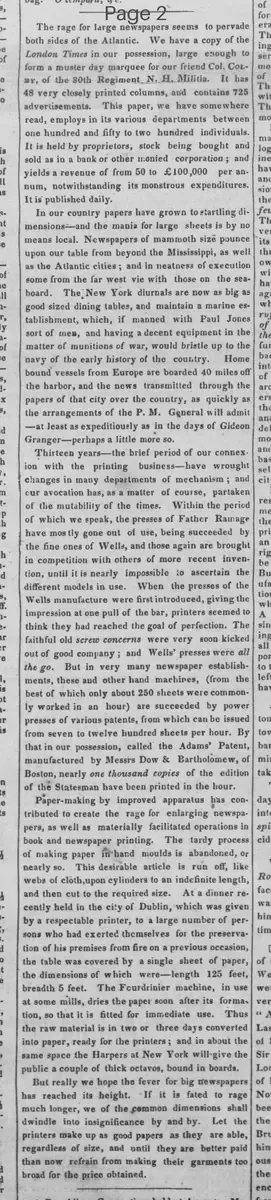
The rage for large newspapers seems to pervade both sides of the Atlantic. We have a copy of the London Times in our possession, large enough to form a muster day marquee for our friend Col. Colbr. of the 30th Regiment N. H. Militia. It has 48 very closely printed columns, and contains 725 advertisements. This paper, we have somewhere read, employs in its various departments between one hundred and fifty to two hundred individuals. It is held by proprietors, stock being bought and sold as in a bank or other monied corporation; and yields a revenue of from £50 to £100,000 per annum, notwithstanding its monstrous expenditures. It is published daily.
In our country papers have grown to startling dimensions—and the mania for large sheets is by no means local. Newspapers of mammoth size pounce upon our table from beyond the Mississippi, as well as the Atlantic cities; and in neatness of execution some from the far west vie with those on the sea-board. The New York diurnals are now as big as good sized dining tables, and maintain a marine establishment, which, if manned with Paul Jones sort of men, and having a decent equipment in the matter of munitions of war, would bristle up to the navy of the early history of the country. Home bound vessels from Europe are boarded 40 miles off the harbor, and the news transmitted through the papers of that city over the country, as quickly as the arrangements of the P. M. General will admit—at least as expeditiously as in the days of Gideon Granger—perhaps a little more so.
Thirteen years—the brief period of our connexion with the printing business—have wrought changes in many departments of mechanism; and our avocation has, as a matter of course, partaken of the mutability of the times. Within the period of which we speak, the presses of Father Ramage have mostly gone out of use, being succeeded by the fine ones of Wells, and those again are brought in competition with others of more recent invention, until it is nearly impossible to ascertain the different models in use. When the presses of the Wells manufacture were first introduced, giving the impression at one pull of the bar, printers seemed to think they had reached the goal of perfection. The faithful old screw concerns were very soon kicked out of good company; and Wells' presses were all the go. But in very many newspaper establishments, these and other hand machines, (from the best of which only about 250 sheets were commonly worked in an hour) are succeeded by power presses of various patents, from which can be issued from seven to twelve hundred sheets per hour. By that in our possession, called the Adams' Patent, manufactured by Messrs Dow & Bartholomew, of Boston, nearly one thousand copies of the edition of the Statesman have been printed in the hour.
Paper-making by improved apparatus has contributed to create the rage for enlarging newspapers, as well as materially facilitated operations in book and newspaper printing. The tardy process of making paper in hand moulds is abandoned, or nearly so. This desirable article is run off, like webs of cloth, upon cylinders to an indefinite length, and then cut to the required size. At a dinner recently held in the city of Dublin, which was given by a respectable printer, to a large number of persons who had exerted themselves for the preservation of his premises from fire on a previous occasion, the table was covered by a single sheet of paper, the dimensions of which were—length 125 feet, breadth 5 feet. The Fourdrinier machine, in use at some mills, dries the paper soon after its formation, so that it is fitted for immediate use. Thus the raw material is in two or three days converted into paper, ready for the printers; and in about the same space the Harpers at New York will give the public a couple of thick octavos, bound in boards.
But really we hope the fever for big newspapers has reached its height. If it is fated to rage much longer, we of the common dimensions shall dwindle into insignificance by and by. Let the printers make up as good papers as they are able, regardless of size, and until they are better paid than now refrain from making their garments too broad for the price obtained.
In our country papers have grown to startling dimensions—and the mania for large sheets is by no means local. Newspapers of mammoth size pounce upon our table from beyond the Mississippi, as well as the Atlantic cities; and in neatness of execution some from the far west vie with those on the sea-board. The New York diurnals are now as big as good sized dining tables, and maintain a marine establishment, which, if manned with Paul Jones sort of men, and having a decent equipment in the matter of munitions of war, would bristle up to the navy of the early history of the country. Home bound vessels from Europe are boarded 40 miles off the harbor, and the news transmitted through the papers of that city over the country, as quickly as the arrangements of the P. M. General will admit—at least as expeditiously as in the days of Gideon Granger—perhaps a little more so.
Thirteen years—the brief period of our connexion with the printing business—have wrought changes in many departments of mechanism; and our avocation has, as a matter of course, partaken of the mutability of the times. Within the period of which we speak, the presses of Father Ramage have mostly gone out of use, being succeeded by the fine ones of Wells, and those again are brought in competition with others of more recent invention, until it is nearly impossible to ascertain the different models in use. When the presses of the Wells manufacture were first introduced, giving the impression at one pull of the bar, printers seemed to think they had reached the goal of perfection. The faithful old screw concerns were very soon kicked out of good company; and Wells' presses were all the go. But in very many newspaper establishments, these and other hand machines, (from the best of which only about 250 sheets were commonly worked in an hour) are succeeded by power presses of various patents, from which can be issued from seven to twelve hundred sheets per hour. By that in our possession, called the Adams' Patent, manufactured by Messrs Dow & Bartholomew, of Boston, nearly one thousand copies of the edition of the Statesman have been printed in the hour.
Paper-making by improved apparatus has contributed to create the rage for enlarging newspapers, as well as materially facilitated operations in book and newspaper printing. The tardy process of making paper in hand moulds is abandoned, or nearly so. This desirable article is run off, like webs of cloth, upon cylinders to an indefinite length, and then cut to the required size. At a dinner recently held in the city of Dublin, which was given by a respectable printer, to a large number of persons who had exerted themselves for the preservation of his premises from fire on a previous occasion, the table was covered by a single sheet of paper, the dimensions of which were—length 125 feet, breadth 5 feet. The Fourdrinier machine, in use at some mills, dries the paper soon after its formation, so that it is fitted for immediate use. Thus the raw material is in two or three days converted into paper, ready for the printers; and in about the same space the Harpers at New York will give the public a couple of thick octavos, bound in boards.
But really we hope the fever for big newspapers has reached its height. If it is fated to rage much longer, we of the common dimensions shall dwindle into insignificance by and by. Let the printers make up as good papers as they are able, regardless of size, and until they are better paid than now refrain from making their garments too broad for the price obtained.
What sub-type of article is it?
Newspaper Industry
Printing Technology
What keywords are associated?
Large Newspapers
Printing Presses
Paper Production
Technological Changes
Newspaper Revenue
News Transmission
What entities or persons were involved?
London Times
Col. Colbr.
30th Regiment N. H. Militia
Paul Jones
Gideon Granger
Father Ramage
Wells
Adams' Patent
Dow & Bartholomew
Harpers
Fourdrinier Machine
Editorial Details
Primary Topic
Growth Of Large Newspapers And Printing Advancements
Stance / Tone
Observational With Caution Against Excessive Size
Key Figures
London Times
Col. Colbr.
30th Regiment N. H. Militia
Paul Jones
Gideon Granger
Father Ramage
Wells
Adams' Patent
Dow & Bartholomew
Harpers
Fourdrinier Machine
Key Arguments
Large Newspapers Like The London Times Employ Many And Generate High Revenue
American Newspapers Have Grown Massively In Size And Reach News Quickly
Printing Presses Have Evolved From Ramage And Wells To Power Presses Printing Up To 1200 Sheets Per Hour
Improved Paper Making Machines Enable Faster Production And Larger Sheets
Hope That The Trend For Oversized Newspapers Stops To Focus On Quality Over Size