Thank you for visiting SNEWPapers!
Sign up free
Southern Telegraph
Rodney, Jefferson County, Mississippi
What is this article about?
Thomas J. Johnston of Rodney, MS, defends against accusations in a prior letter of political flip-flopping from Whig to Van Buren supporter. He explains his 1832 vote for Clay and 1836 vote for Van Buren due to changed national issues, critiques Harrison's emancipation views threatening Southern slavery, and asserts political independence.
Clipping
OCR Quality
Full Text
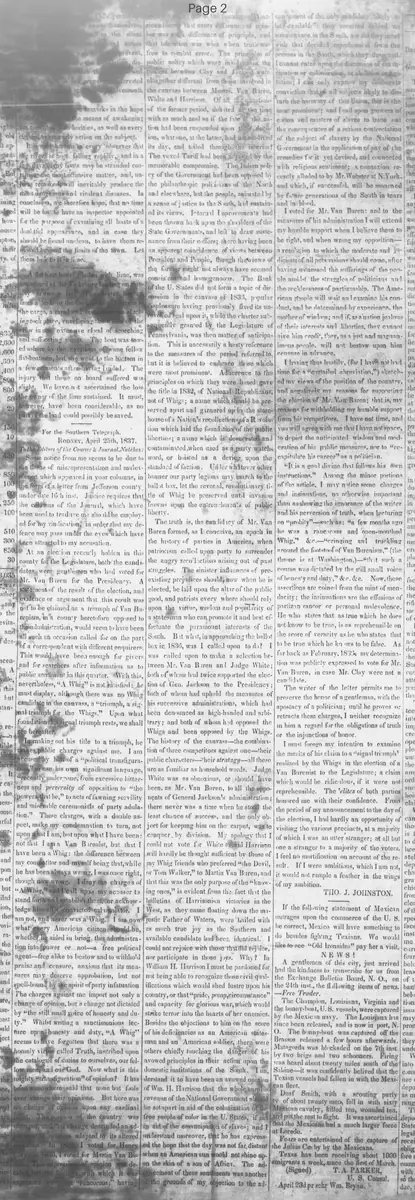
Rodney, April 25th, 1837.
To the Editors of the Courier & Journal, Natchez:
Some notice from me seems to be due to the tissue of misrepresentation and malevolence which appeared in your columns, in the form of a letter from Jefferson county under date 16th inst. Justice requires that the columns of the Journal, which have been used to traduce me should be employed for my vindication, in order that my defence may pass under the eyes which have been attracted to my accusation.
At an election recently holden in this county for the Legislature, both the candidates were gentlemen who had voted for Mr. Van Buren for the Presidency. A statement of the result of the election, and evidence or argument that this result was not to be claimed as a triumph of Van Burenism, in a county heretofore opposed to the administration, would seem to have been all such an occasion called for on the part of a correspondent with different enquirers. This would have been enough for givers and for searchers after information as to public sentiment in this quarter. With this, nevertheless, "A Whig" is not satisfied: he must display, although there was no Whig candidate in the canvass, a "triumph, a signal triumph for the Whigs." Upon what foundation this signal triumph rests, we shall see hereafter.
In making out his title to a triumph, he makes public charges against me. I am accused by him of a "political transfiguration," to use his own significant language. "recently undergone, from excessive bitterness and perversity of opposition to "the powers that be," to acts of fawning servility and miserable ceremonials of party adulation." These charges, with a double aspect, make my condemnation to turn, not upon what I am, but upon what I have been: not that I am a Van Burenist, but that I have been a Whig: the difference between my competitor and myself being that, while he has been always wrong, I was once right, though now wrong. I deny the charges of "A Whig," and will upon my accuser to stand forth and establish them, or acknowledge himself a convicted calumniator. I am not, and never was a Whig. I am now what every American citizen should be, whether he aided in bringing this administration into power or not—a free political agent—free alike to bestow and to withhold praise and censure, anxious that its measures may deserve approbation, but not spell-bound by the spirit of party infatuation. The charges against me import not only a change of opinion, but a change not dictated by "the still small voice of honesty and duty." Whilst writing a sanctimonious lecture upon honesty and duty, "A Whig" seems to have forgotten that there was a homely virtue called Truth, inscribed upon the catalogue of duties to ourselves, our fellow men, and our God. Now what is this mighty "transfiguration" of opinion? It has been somewhere said that none but fools ever change their opinions. But here was no change of opinion upon any cardinal truth. The position of the country was changed, and that change demanded an adjustment of opinions adopted to its altered condition. In '32, I voted for Henry Clay; in 1836, I voted for Martin Van Buren. This expression of opinion was decided, but the feelings with which it was expressed were not "rancorous;" having American liberty that every difference of opinion was a difference of principle, and that toleration was wise when truth was free to combat error. The principles of public policy which were involved in the contest between Clay and Jackson were altogether different from those involved in the canvass between Messrs. Van Buren, White and Harrison. Of all the questions of the former period, debated at the time with as much zeal as if the fate of the nation had been suspended upon their decision, what one, at the latter, had not out-lived its day, and toiled through the inerrancy? The vexed Tariff had been adjusted by the memorable compromise. The Indian policy of the Government had been opposed by the philanthropic politicians of the North and elsewhere, but the people, animated by a sense of justice to the South, had sustained its views. Internal Improvements had been thrown back upon the shoulders of the State Governments, and left to draw sustenance from their coffers; there having been an apparent coincidence of views between President and People, though the views of the former might not always have seemed consistent and homogeneous. The Bank of the U. States did not form a topic of discussion in the canvass of 1836, popular displeasure having previously fixed its irrevocable seal upon it, while the charter subsequently granted by the Legislature of Pennsylvania, was then matter of anticipation. This is necessarily a hasty reference to the measures of the period referred to. But it is believed to embrace those which were most prominent. Adherence to the principles on which they were based gave the title in 1832, of National Republicans, not of Whigs; a name which should be preserved apart and garnered up in the store-house of a Nation's recollections of a Revolution which laid the foundation of the public liberties; a name which is desecrated and contaminated when used as a party watch-word, or hoisted as a device upon the standard of faction. Under whatever other banner our party legions may march to the ballot box, let the revered, revolutionary title of Whig be preserved until invasion frowns upon the entrenchments of public liberty.
The truth is, the candidacy of Mr. Van Buren formed, as I conceive, an epoch in the history of parties in America, when patriotism called upon party to surrender the angry recollections arising out of past struggles. The sinister influences of pre-existing prejudices should, now when he is elected, be laid upon the altar of the public good, and patriots everywhere should rely upon the virtue, wisdom and popularity of a statesman who can promote it and best effectuate the paramount interests of the South. But what, in approaching the ballot box in 1836, was I called upon to do? I was called upon to make a selection between Mr. Van Buren and Judge White: both of whom had twice supported the election of Gen. Jackson to the Presidency; both of whom had upheld the measures of his successive administrations, which had been denounced as high-handed and arbitrary; and both of whom had opposed the Whigs and been opposed by the Whigs. The history of the canvass—the combination of three competitors against one—their public characters—their strategy—all these are as familiar as household words. Judge White was as obnoxious, or should have been, as Mr. Van Buren, to all the opponents of General Jackson's administration; there never was a time when he stood the least chance of success, and the only object for keeping him on the carpet, was to conquer by division. My apology that I could not vote for White to aid Harrison will hardly be thought sufficient by those of my Whig friends who preferred "the Devil, or Tom Walker," to Martin Van Buren, and that this was the only purpose of the "knowing ones," is evident from the fact that the bulletins of Harrisonian victories in the West, as they came floating down the majestic Father of Waters, were hailed with as much true joy as the Southern and available candidate had been identical. I could not rejoice with those that did rejoice, nor participate in those joys. Why? In William H. Harrison I must be pardoned for not being able to recognize those civil qualifications which would shed lustre upon his country, or that "pride, pomp, circumstance" and capacity for glorious war, which would strike terror into the hearts of her enemies. Besides the objections to him on the score of his deficiencies as an American statesman and an American soldier, there were others chiefly touching the danger of his avowed principles in their action upon the domestic institutions of the South. I understand it to have been an avowed opinion of Wm. H. Harrison that the whole surplus revenue of the National Government should be set apart in aid of the colonization of the free people of color in the U. States, if not in aid of the emancipation of slaves; and I understand moreover, that he has expressed the hope that the day was not far distant when an American sun would not shine upon the skin of a son of Africa. The avowed incitement of these sentiments was another of the grounds of my objection to the advancement of the only candidate thought to be available; they received indeed no countenance in the South, nor did they meet with that decided reprehension from the presses in the South, which they deserved. I cannot enter upon the discussion of emancipation or colonization, of abolition or agitation; I can only express my deliberate conviction that of all subjects likely to disturb the harmony of this Union, this is the most prominent; and I call upon growers of cotton and masters of slaves to trace out the consequences of a serious agitation of the subject of slavery by the National Government in the application of any of the remedies yet devised, and connected with religious sentiment; a connexion recently alluded to by Mr. Webster at N. York, and which, if successful, will be mourned by future generations of the South in tears and in blood.
I voted for Mr. Van Buren: and to the measures of his administration I will extend my humble support when I believe them to be right, and when wrong my opposition—a resolution to which the moderate and judicious of all persuasions should come, after having witnessed the sufferings of the people amidst the struggles of politicians and the recklessness of partizanship. The American people will wait and examine his conduct, and be determined by experience, the mother of wisdom; and if, as a nation jealous of their interests and liberties, they cannot give him credit, they, as a just and magnanimous people, will not bestow upon him censure in advance.
In having thus hastily (for I have not had time for a "curtailed abrevitation.") sketched my views of the position of the country, and negatively my reasons for supporting the election of Mr. Van Buren: that is, my reasons for withholding my humble support from his competitors. I have not time, and you will agree with me that I have not space, to depict the anticipated wisdom and moderation of his public measures, nor to "recapitulate his career" as a politician. "It is a good divine that follows his own instructions." Among the minor portions of the article, I may notice some charges and insinuations, no otherwise important than as showing the ignorance of the writer and his perversion of truth, when lecturing on "probity"—such as: "a few months ago he was a rancorous and open-mouthed Whig," &c.—"cringing and trickling around the footstool of Van Burenism." (the throne is at Washington.)—"that such a course was dictated by the still small voice of honesty and duty," &c. &c. Now, these assertions are coined from the mint of mendacity; the insinuations are the effusions of partizan rancor or personal malevolence. He who states that as true which he does not know to be true, is as reprehensible on the score of veracity as he who states that to be true which he knows to be false. As far back as February, 1836 my determination was publicly expressed to vote for Mr. Van Buren, in case Mr. Clay were not a candidate.
The writer of the letter permits me to preserve the honor of a gentleman, with the apostacy of a politician; until he proves or retracts these charges, I neither recognize in him a regard for the obligations of truth or the injunctions of honor.
I must forego my intention to examine the merits of his claim to a "signal triumph" realized by the Whigs in the election of a Van Burenist to the Legislature: a claim which would be ridiculous, if it were not reprehensible. The elites of both parties honored me with their confidence. From the period of my announcement to the day of the election, I had hardly an opportunity of visiting the various precincts, at a majority of which I was an utter stranger; at all but one a stranger to a majority of the voters. I feel no mortification on account of the result. If I were ambitious, which I am not, it would not rumple a feather in the wings of my ambition.
THOS. J. JOHNSTON.
What sub-type of article is it?
What themes does it cover?
What keywords are associated?
What entities or persons were involved?
Letter to Editor Details
Author
Thos. J. Johnston
Recipient
To The Editors Of The Courier & Journal, Natchez
Main Argument
the author denies accusations of political transfiguration from whig to van buren supporter, explaining his votes for clay in 1832 and van buren in 1836 as adjustments to changed national conditions rather than betrayal, and opposes harrison due to his views on emancipation and colonization that endanger southern institutions.
Notable Details