Thank you for visiting SNEWPapers!
Sign up free
The Madisonian
Washington, District Of Columbia
What is this article about?
Proceedings in the US House of Representatives and Senate on Wednesday, covering deferrals and debates on the Bankrupt bill, commercial intercourse resolution, tariff duties, Poindexter report printing, Revenue bill; Senate actions on Benjamin Murphy's claim, Maine militia accounts, Navy pension, Army Appropriation bill referral, and Apportionment bill with amendments and votes on district elections.
Merged-components note: The congressional proceedings report includes the apportionment table at the end, forming a single domestic news component on legislative matters.
Clipping
OCR Quality
Full Text
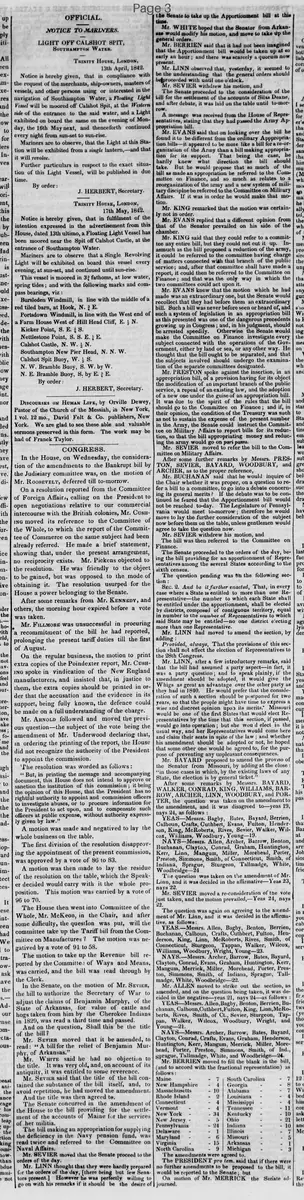
In the House, on Wednesday, the consideration of the amendments to the Bankrupt bill by the Judiciary committee was, on the motion of Mr. ROOSEVELT, deferred till to-morrow.
On a resolution reported from the Committee of Foreign Affairs, calling on the President to open negotiations relative to our commercial intercourse with the British colonies, Mr. CUSHING moved its reference to the Committee of the Whole, to which the report of the Committee of Commerce on the same subject had been already referred. He made a brief statement, showing that, under the present arrangement, no reciprocity exists. Mr. PICKENS objected to the resolution. He was friendly to the object to be gained, but was opposed to the mode of obtaining it. The resolution usurped for the House a power belonging to the Senate. After some remarks from Mr. KENNEDY, and others, the morning hour expired before a vote was taken.
Mr. FILLMORE was unsuccessful in procuring a recommitment of the bill he had reported, prolonging the present tariff duties till the first of August.
On the regular business, the motion to print extra copies of the Poindexter report, Mr. CUSHING spoke in vindication of the New England manufacturers, and insisted that, in justice to them, the extra copies should be printed in order that the accusation and the evidence in its support, being fully known, the defence could be made on a full understanding of the charge. Mr. ARNOLD followed and moved the previous question—the subject of the vote being the amendment of Mr. UNDERWOOD declaring that, in ordering the printing of the report, the House did not recognize the authority of the President to appoint the commission.
The resolution was worded as follows:
"But, in printing the message and accompanying document, this House does not intend to approve or sanction the institution of this commission; it being the opinion of this House, that the President has no rightful authority to appoint and commission officers to investigate abuses, or to procure information for the President to act upon, and to compensate such officers at public expense, without authority expressly given by law."
A motion was made and negatived to lay the whole business on the table.
The first division of the resolution disapproving the appointment of the present commission, was approved by a vote of 86 to 83.
A motion was then made to lay the residue of the resolution on the table, which the Speaker decided would carry with it the whole proposition. This motion was carried by a vote of 96 to 70.
The House then went into Committee of the Whole, Mr. McKEON, in the Chair, and after some difficulty, the question was put, will the committee take up the Tariff bill from the Committee on Manufactures? The motion was negatived by a vote of 91 to 58.
The motion to take up the Revenue bill reported by the Committee of Ways and Means, was carried, and the bill was read through by the Clerk.
In the Senate, on the motion of Mr. SEVIER, the bill to authorize the Secretary of War to adjust the claims of Benjamin Murphy, of the State of Arkansas, for value of cattle and hogs taken from him by the Cherokee Indians in 1829, was read a third time and passed.
And on the question, Shall this be the title of the bill?
Mr. SEVIER moved that it be amended, to read: "A bill for the relief of Benjamin Murphy, of Arkansas."
Mr. WHITE said he had no objection to the title. It was very old, and, on account of its antiquity, it was entitled to some reverence.
Mr. SEVIER said that the title of the bill contained the substance of the bill itself, and, to avoid repetition, he had moved the amendment.
And the title was then agreed to.
The Senate concurred in the amendment of the House to the bill providing for the settlement of the accounts of Maine for the services of her militia.
The bill making an appropriation for supplying the deficiency in the Navy pension fund, was read twice and referred to the Committee on Naval Affairs.
Mr. SEVIER moved that the Senate proceed to the orders of the day.
Mr. LINN thought that they were hardly prepared for the orders of the day, there being but few Senators present. However he was perfectly willing to go on with his remarks if it should be the desire of the Senate to take up the Apportionment bill at this time.
Mr. WHITE hoped that the Senator from Arkansas would modify his motion, and move to take up the general orders.
Mr. BERRIEN said that it had not been imagined that the Apportionment bill would be taken up at so early an hour; and there was scarcely a quorum now present.
Mr. LINN observed that, yesterday, it seemed to be the understanding that the general orders should be proceeded with until one o'clock.
Mr. SEVIER withdrew his motion, and the Senate proceeded to the consideration of the bill for the settlement of the accounts of Silas Deane, and after debate, it was laid on the table until to-morrow.
A message was received from the House of Representatives, stating that they had passed the Army Appropriation bill.
Mr. EVANS said that on looking over the bill he found it to be different from the ordinary Appropriation bills—it appeared to be more like a bill for a re-organization of the Army than a bill making appropriation for its support. That being the case, he hardly knew what direction the bill should take. But he would propose that so much of the bill as made an appropriation be referred to the Committee on Finance, and so much as relates to a reorganization of the army and a new system of military discipline be referred to the Committee on Military Affairs. If it was in order he would make that motion.
Mr. KING remarked that the motion was certainly not in order.
Mr. EVANS replied that a different opinion from that of the Senator prevailed on his side of the chamber.
Mr. KING said that they could refer to a committee any entire bill, but they could not cut it up. Inasmuch as the bill proposed a reduction of the army, it could be referred to the committee having charge of matters connected with that branch of the public service; and, after that committee shall have made a report, it could then be referred to the Committee on Finance; and that was the only way in which the two committees could act upon it.
Mr. EVANS knew that the motion which he had made was an extraordinary one, but the Senate would recollect that they had before them an extraordinary bill. Such a bill was never before seen or heard of, and such a system of legislation in an appropriation bill as this presented was one of the dangerous precedents growing up in Congress; and, in his judgment, should be arrested speedily. Otherwise the Senate would make the Committee on Finance investigate every subject connected with the operations of the Government, either by land or sea, or any other way. He thought that the bill ought to be separated, and that the subjects involved should undergo the examination of the separate committees designated.
Mr. PRESTON spoke against the insertion, in an appropriation bill, of a provision having for its object the modification of an important branch of the public service, a repeal of an existing law, and the adoption of a new one under the guise of an appropriation bill. It was due to the spirit of the rules that the bill should go to the Committee on Finance; and if, in their opinion, the condition of the Treasury was such as not to sustain the expense of the present number in the Army, the Senate could instruct the Committee on Military Affairs to report bills for its reduction, so that the bill appropriating money and reducing the army would go on pari passu.
Mr. SEVIER moved to refer the bill to the Committee on Military Affairs.
After some further remarks by Messrs. PRESTON, SEVIER, BAYARD, WOODBURY, and ARCHER, as to the proper reference,
Mr. BUCHANAN said that he would inquire of the Chair whether it was proper, on a question to refer a bill to a committee, to go into a debate concerning its general merits? If the debate was to be continued he feared that the Apportionment bill would not be reached to-day. The Legislature of Pennsylvania would meet to-morrow; therefore he would move to lay the further consideration of the subject now before them on the table, unless gentlemen would agree to take the question now.
Mr. SEVIER withdrew his motion, and the bill was then referred to the Committee on Finance.
The Senate proceeded to the orders of the day, being the bill providing for an apportionment of Representatives among the several States according to the sixth census.
The question pending was on the following section:
Sec. 2. And be it further enacted, That, in every case where a State is entitled to more than one Representative—the number to which each State shall be entitled under the apportionment, shall be elected by districts, composed of contiguous territory, equal in number to the number of Representatives to which said State may be entitled—no one district electing more than one Representative.
Mr. LINN had moved to amend the section, by adding:
Provided, always, That the provisions of this section shall not affect the election of Representatives to the 28th Congress.
Mr. LINN, after a few introductory remarks, said that the bill had assumed a party aspect—in fact, it was a party question; and to speak plainly, if the amendment should be adopted, it would give the Whigs as great an advantage over the other party as they had in 1840. He would prefer that the consideration of such a section should be postponed for two years, so that the people might have time to express a wise and discreet opinion upon its merits. Missouri would be one of the first States that would elect Representatives by the time that this section, if passed, would go into operation; but she would elect in the usual way, and her Representatives would come here and claim their seats in spite of the law; and whether his amendment should be adopted or not, he hoped that some other one would be agreed to, for the purpose of preventing any unpleasant consequences.
Mr. BAYARD proposed to amend the proviso of the Senator from Missouri, by adding at the close:
"in those cases in which, by the existing laws of any State, the election is by general ticket."
After some remarks by Messrs. BAYARD, WALKER, CONRAD, KING, WILLIAMS, BARROW, ARCHER, LINN, WOODBURY, and PORTER, the question was taken on the amendment to the amendment, and it was disagreed to—yeas 19, nays 24, as follows:
YEAS—Messrs. Bagby, Bates, Bayard, Berrien, Calhoun, Crafts, Cuthbert, Evans, Fulton, Henderson, King, McRoberts, Rives, Sevier, Walker, Wilcox, Williams, Woodbury, Young—19.
NAYS—Messrs. Allen, Archer, Barrow, Benton, Buchanan, Clayton, Conrad, Graham, Huntington, Kerr, Linn, Mangum, Miller, Morehead, Porter, Preston, Simmons, Smith, of Connecticut, Smith, of Indiana, Sprague, Sturgeon, Tallmadge, White, Woodbridge—24.
The question was taken on the amendment of Mr. Linn, and it was decided in the affirmative—Yeas 23, nays 22.
Mr. SEVIER moved a re-consideration of the vote just taken, and the motion prevailed,—Yeas 24, nays 32.
The question was again on agreeing to the amendment of Mr. Linn, and it was decided in the affirmative, as follows:
YEAS.—Messrs. Allen, Bagby, Benton, Berrien, Buchanan, Calhoun, Crafts, Cuthbert, Fulton, Henderson, King, Linn, McRoberts, Rives, Smith, of Connecticut, Sturgeon, Tappan, Walker, Wilcox, Williams, Woodbury, Wright, Young—23.
NAYS.—Messrs. Archer, Barrow, Bates, Bayard, Clayton, Conrad, Evans, Graham, Huntington, Kerr, Mangum, Merrick, Miller, Morehead, Porter, Preston, Simmons, Smith, of Indiana, Sprague, Tallmadge, White, Woodbridge—22.
Mr. ALLEN moved to strike out the section, as amended, and on the question being taken, it was decided in the negative—yeas 21, nays 24—as follows:
YEAS—Messrs. Allen, Bagby, Benton, Berrien, Buchanan, Calhoun, Cuthbert, Fulton, King, Linn, McRoberts, Rives, Smith, of Ct., Sevier, Sturgeon, Tappan, Walker, Wilcox, Woodbury, Wright, and Young—21.
NAYS—Messrs. Archer, Barrow, Bates, Bayard, Clayton, Conrad, Crafts, Evans, Graham, Henderson, Huntington, Kerr, Mangum, Merrick, Miller, Morehead, Porter, Preston, Simmons, Smith, of Ind., Sprague, Tallmadge, White, and Woodbridge—24.
Mr. BERRIEN moved to fill the blank in the bill, (and to accord with the fractional representation) as follows:
The amendments were agreed to.
The PRESIDENT pro tem. said that if there were no further amendments to be proposed to the bill, it would be reported to the Senate; but
On motion of Mr. MERRICK the Senate adjourned.
| Maine | - | - | 7 | South Carolina | - | 7 |
| New Hampshire | - | 4 | Georgia | - | - | 8 |
| Massachusetts | - | 10 | Alabama | - | - | 7 |
| Rhode Island | - | 2 | Louisiana | - | - | 4 |
| Connecticut | - | 4 | Mississippi | - | - | 4 |
| Vermont | - | 4 | Tennessee | - | - | 11 |
| New York | - | 34 | Kentucky | - | - | 10 |
| New Jersey | - | 5 | Ohio | - | - | 21 |
| Pennsylvania | - | 24 | Indiana | - | - | 10 |
| Delaware | - | 1 | Illinois | - | - | 7 |
| Maryland | - | 6 | Missouri | - | - | 5 |
| Virginia | - | 15 | Arkansas | - | - | 1 |
| North Carolina | - | 9 | Michigan | - | - | 3 |
What sub-type of article is it?
What keywords are associated?
What entities or persons were involved?
Domestic News Details
Event Date
Wednesday
Key Persons
Outcome
house deferred bankrupt bill amendments; resolution on commercial intercourse not voted; tariff recommitment failed; poindexter report printing approved with disapproval of commission (86-83, then 96-70); tariff bill not taken up (91-58); revenue bill taken up. senate passed benjamin murphy relief bill; concurred on maine militia; referred navy pension and army appropriation to committees; apportionment bill amendment on districts passed after reconsideration (23-22); section strike failed (21-24); amendments agreed; adjourned.
Event Details
Detailed report of debates, motions, and votes in the House on Bankrupt bill, commercial intercourse with British colonies, tariff duties extension, printing of Poindexter report with resolution disapproving presidential commission, and taking up Revenue bill over Tariff bill. In Senate, passage of bill for Benjamin Murphy's Cherokee-related claims, title amendment, concurrence on Maine militia accounts, referral of Navy pension bill, debate on Army Appropriation bill referral leading to Finance Committee, and consideration of Apportionment bill with amendment on district elections not affecting 28th Congress, sub-amendment rejected (19-24), main amendment passed (23-22) after reconsideration, strike motion failed (21-24), further amendments agreed, then adjourned. Includes vote tallies and state apportionment table.