Thank you for visiting SNEWPapers!
Sign up free
The Massachusetts Spy, And Worcester County Advertiser
Worcester, Worcester County, Massachusetts
What is this article about?
Philip S. Markley's address refutes Gen. Jackson's corruption charges against Mr. Clay, denies involvement in overtures, details a 1824 conversation with Mr. Buchanan on supporting Jackson and potential Clay appointment, and expresses surprise at Buchanan's later public account.
Merged-components note: Cross-page continuation (reading orders 40 and 42) of the editorial on Mr. Markley's Address from Boston Daily Advertiser.
Clippings
1 of 2
OCR Quality
Full Text
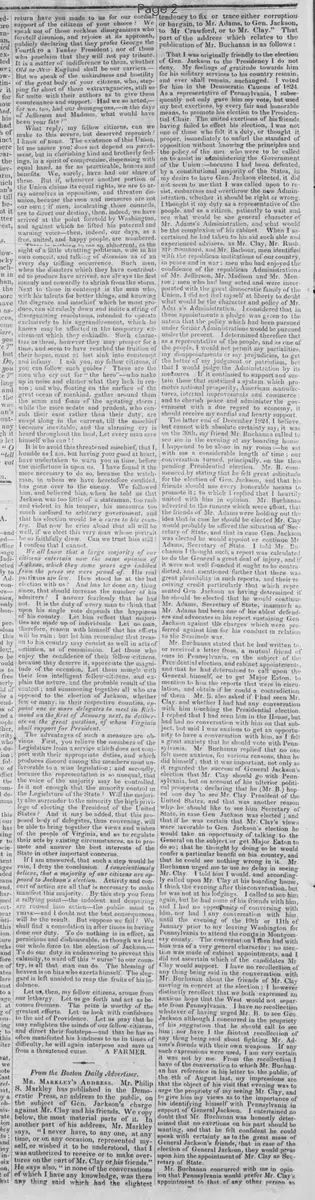
MR. Markley's Address.
Mr. Philip S. Markley has published in the Democratic Press, an address to the public, on the subject of Gen. Jackson's charge against Mr. Clay and his friends. We copy below, the most material parts of it.
In another part of his address, Mr. Markley says, "I never have, to any one, at any time, or on any occasion, represented myself, or wished it to be understood, that I was authorized to receive or to make overtures on the part of Mr. Clay or his friends." He says also, "in none of the conversations of which I have any knowledge, was there any thing said which had the slightest tendency to fix or trace either corruption or bargain, to Mr. Adams, to Gen. Jackson, to Mr. Crawford, or to Mr. Clay."
That part of the address which relates to the publication of Mr. Buchanan is as follows:
That I was originally friendly to the election of Gen. Jackson to the Presidency I do not deny. My feelings of gratitude towards him for his military services to his country remain, and ever shall remain, unchanged. I voted for him in the Democratic Caucus of 1824. As a representative of Pennsylvania, I subsequently not only gave him my vote, but used my best exertions, by every fair and honorable means, to promote his election to the Presidential Chair.
The united exertions of his friends having failed to effect his election, I was not one of those who felt it a duty, or thought it proper, immediately to unfurl the standard of opposition without knowing the principles and the policy of the men who were to be called on to assist in administering the Government of the Union:- because I had been defeated by a constitutional majority of the States, in my desire to have Gen. Jackson elected, it did not seem to me that I was called upon to resist, embarrass and overthrow the new Administration, whether it should be right or wrong. I thought it my duty as a representative of the people, and as a citizen, patiently to wait and see what would be the general character of Mr. Adams's Administration, and what would be the complexion of his cabinet.
When I ascertained he had taken to his aid such able and experienced advisers, as Mr. Clay, Mr. Rush Mr. Southard, and Mr. Barbour, men identified with the republican institutions of our country, in peace and in war; men who had enjoyed the confidence of the republican Administrations of Mr. Jefferson, Mr. Madison and Mr. Monroe; men who had long acted and were incorporated with the great democratic family of the Union. I did not feel myself at liberty to doubt what would be the character and policy of Mr. Adams's Administration. I considered that in these appointments a pledge was given to the nation that the policy which had been pursued under former Administrations would be pursued under the present.
I determined therefore that as a representative of the people, and as one of the people, I would not permit my partialities, my disappointments or my prejudices, to get the better of my judgment or patriotism, but that I would judge the Administration by its measures If it continued to support and sustain those that sustained a system which promotes national prosperity, American manufactures, internal improvements and commerce; and to cherish peace and administer the government with a due regard to economy, it should receive my cordial and hearty support.
The latter end of December 1824, I believe but cannot with absolute certainty say, it was on the 30th, my friend Mr. Buchanan called to see me in the evening at my boarding house I happened to be alone in my room:- he sat with me a considerable length of time; our conversation turned, principally, on the then pending Presidential election.
Mr. B. commenced by stating that he felt great solicitude for the election of Gen. Jackson, and that his friends should use every honorable means to promote it; to which I replied that I heartily united with him in opinion.
Mr. Buchanan adverted to the rumors which were afloat, that the friends of Mr. Adams were holding out the idea that in case he should be elected Mr. Clay would probably be offered the situation of Secretary of State, and that in case Gen. Jackson was elected he would appoint or continue Mr Adams, Secretary of State. I told Mr. Buchanan I thought such a report was calculated to do the General a great deal of injury, and if it were not well founded it ought to be contradicted, and mentioned further that there was great plausibility in such reports, and their receiving credit particularly that which represented Gen Jackson as having determined if he should be elected that he would continue Mr. Adams. Secretary of State, inasmuch as Mr. Adams had been one of his ablest defenders and advocates in his report sustaining Gen Jackson against the charges which were preferred against him for his conduct in relation to the Seminole war.
Mr. Buchanan stated that he had written to, or received a letter from, a mutual friend of ours in Pennsylvania, on the subject of the Presidential election.and cabinet appointments, and that he had determined to call 'upon the General himself, or to get Major Eaton, to mention to him the reports that were in circulation, and obtain if he could a contradiction of them Mr. B. also asked if I had seen Mr. Clay. and whether I had had any conversation with him touching the Presidential election. I replied that I had seen him in the House, but had had no conversation with him on that subject, but said I was anxious to get an opportunity to have a conversation with him, as I felt a great anxiety that he should vote with Pennsylvania.
Mr Buchanan replied that no one felt more anxious, for various reasons, than he did himself: that it was important, not only as it regarded the success of General Jackson's election that Mr. Clay should go with Pennsylvania, but on account of his ulterior political prospects : declaring that he (Mr. B.) hoped one day to see Mr. Clay President of the United States, and that was another reason why he should like to see him Secretary of State, in case Gen Jackson was elected ; and that if he was certain that Mr. Clay's views were favorable to Gen. Jackson's election he would take an opportunity of talking to the General on the subject or get Major Eaton to do so; that he thought by doing so he would confer a particular benefit on his country, and that he could see nothing wrong in it.
Mr. Buchanan urged me to use no delay in seeing Mr. Clay. I told him I would, and accordingly called upon Mr. Clay at his boarding house, I think the evening after this conversation, but he was not at his lodgings. I called to see him again, but he had some of his friends with him, and I had no opportunity of conversing with him, nor had I any conversation with him. until the evening of the 10th or 11th of January prior to my leaving Washington for Pennsylvania to attend the courts in Montgomery county.
The conversation I then had with him was of a very general character ; no mention was made of cabinet appointments, and I did not ascertain which of the candidates Mr Clay would support.
I have no recollection of any thing being said in the conversation with Mr. Buchanan about the friends of Mr. Clay moving in concert at the election; I however distinctly recollect that we both expressed an anxious hope that the West would not separate from Pennsylvania.
I have no recollection whatever of having urged Mr. B. to see Gen Jackson although I concurred in the propriety of his suggestion that he should call to see him; nor have I the faintest recollection of any thing being said about fighting Mr. Adams's friends with their own weapons. If any such expressions were used, I am very certain it was not by me.
From the recollection I have of the conversation to which Mr. Buchanan has reference in his letter to the public, of the 5th of August last, my impressions are that the object of his visit that evening was to urge the propriety of my seeing Mr. Clay, and to give him my views as to the importance of his identifying himself with Pennsylvania in support of General Jackson.
I entertained no doubt that Mr. Buchanan was honestly determined that no exertions on his part should be wanting, and that he felt confident he could speak with certainty as to the great mass of General Jackson's friends, that in case of the election of General Jackson, they would press upon him the appointment of Mr. Clay as Secretary of State.
Mr. Buchanan concurred with me in opinion that Pennsylvania would prefer Mr. Clay's appointment to that of any other person as the General was under to Pennsylvania, that he would go far to gratify her wishes, and that therefore he believed the General, if elected, would appoint Mr. Clay.
I have thus given the conversation substantially as it took place, as the one Mr. B. has reference to in his letter to the public of the 6th of August last. It was a conversation of rather a general and promiscuous character in which we both participated.
It is upwards of two years since that conversation took place, and considering it of a private and confidential character, made no minute of it, nor did I ever expect it would have been given to the public.
It is somewhat remarkable, that two years and more should have elapsed, Mr. Buchanan and myself boarding together at the same house during the two last sessions of Congress, during which period we had many conversations on the subject of the Presidential election, as well as on public and private matters, yet not once, in all that time did my friend Mr. Buchanan ever advert to the conversation with which he has recently thought himself called upon to give as having taken place between us.
I cannot avoid thinking it somewhat singular that Mr. B. should have been so reserved towards me, particularly as Duff Green had been furnished with a statement in October, 1826, of what had passed between General Jackson and himself and that a statement had also been furnished to him by Major Eaton in August, 1826, as to the purport of the conversation between himself and Mr. Buchanan.
That these movements should have taken place, and that there should have been no concert improperly to drag me into this business, and yet that under all these circumstances, Mr. B. should have been silent towards me, and that he should think proper, to introduce to the public a detailed conversation in which he makes me say all, and himself little or nothing; a conversation totally unnecessary for the purpose of sustaining an individual acting, as he protests he always acted, on his own authority-does to me, and probably will to the public, seem somewhat unaccountable.
It gives me pain to think of these things, especially as having emanated from a person to whom I feel obligations of friendship for acts of kindness, and in whose friendship I reposed the most unlimited confidence.
What sub-type of article is it?
What keywords are associated?
What entities or persons were involved?
Editorial Details
Primary Topic
Defense Against Charges Of Bargain And Corruption In 1824 Presidential Election
Stance / Tone
Defensive Refutation Of Accusations And Clarification Of Private Conversations
Key Figures
Key Arguments