Thank you for visiting SNEWPapers!
Sign up free
Potosi Journal
Potosi, Washington County, Missouri
What is this article about?
Collection of short Republican editorials and syndicated pieces criticizing Democrats and Bryan on elections, trusts, silver coinage, expansion, Goebel assassination, and Missouri politics, highlighting partisan tactics and economic contrasts. Includes satire and local notes.
Merged-components note: Text content continues seamlessly from the first component to the second due to OCR parsing split; overall coherent editorial opinion piece with appended short commentary and news briefs.
Clipping
OCR Quality
Full Text
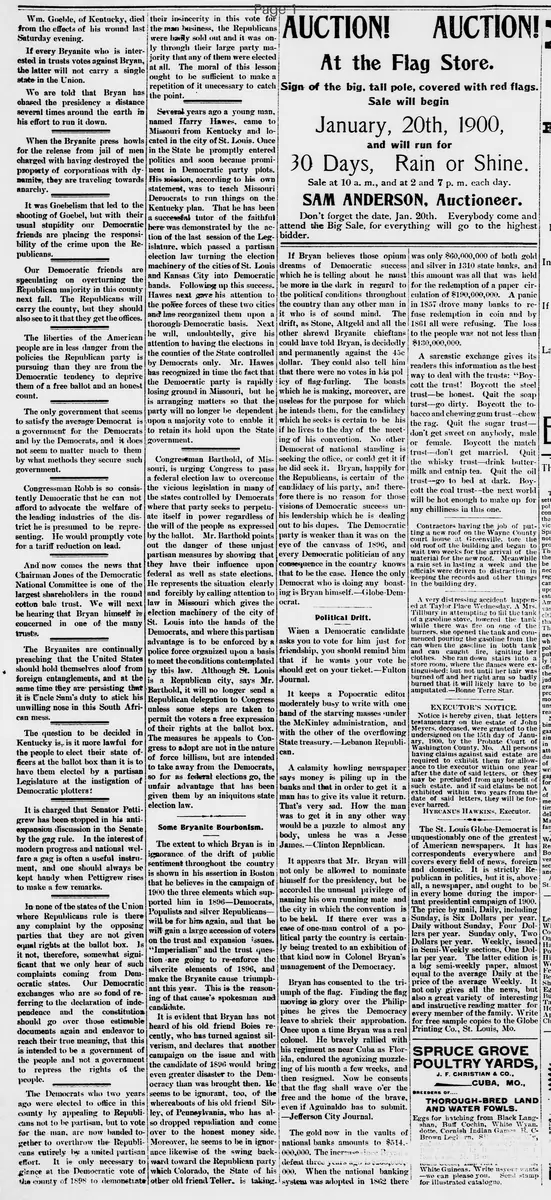
If every Bryanite who is interested in trusts votes against Bryan, the latter will not carry a single state in the Union.
We are told that Bryan has based the presidency a distance several times around the earth in his effort to run it down.
When the Bryanite press howls for the release from jail of men charged with having destroyed the property of corporations with dynamite; they are traveling towards anarchy.
It was Goebelism that led to the shooting of Goebel, but with their usual stupidity our Democratic friends are placing the responsibility of the crime upon the Republicans.
Our Democratic friends are speculating on overturning the Republican majority in this county next fall. The Republicans will carry the county, but they should also see to it that they get the offices.
The liberties of the American people are in less danger from the policies the Republican party is pursuing than they are from the Democratic tendency to deprive them of a free ballot and an honest count.
The only government that seems to satisfy the average Democrat is a government for the Democrats and by the Democrats, and it does not seem to matter much to them by what methods they secure such government.
Congressman Robb is so consistently Democratic that he can not afford to advocate the welfare of the leading industries of the district he is presumed to be representing. He would promptly vote for a tariff reduction on lead.
And now comes the news that Chairman Jones of the Democratic National Committee is one of the largest shareholders in the round cotton bale trust. We will next be hearing that Bryan himself is concerned in one of the many trusts.
The Bryanites are continually preaching that the United States should hold themselves aloof from foreign entanglements, and at the same time they are persisting that it is Uncle Sam's duty to stick his unwilling nose in this South African mess.
The question to be decided in Kentucky is, is it more lawful for the people to elect their state officers at the ballot box than it is to have them elected by a partisan Legislature at the instigation of Democratic plotters?
It is charged that Senator Pettigrew has been stopped in his anti-expansion discussion in the Senate by the gag rule. In the interest of modern progress and national welfare a gag is often a useful instrument, and one should always be kept handy when Pettigrew rises to make a few remarks.
In none of the states of the Union where Republicans rule is there any complaint by the opposing parties that they are not given equal rights at the ballot box. Is it not, therefore, somewhat significant that we only hear of such complaints coming from Democratic states. Our Democratic exchanges who are so fond of referring to the declaration of independence and the constitution should go over those estimable documents again and endeavor to reach their true meaning, that this is intended to be a government of the people and not a government to repress the rights of the people.
The Democrats who two years ago were elected to office in this county by appealing to Republicans not to be partisan, but to vote for the man, are now banded together to overthrow the Republicans entirely by a united partisan effort. It is only necessary to glance at the Democratic vote of the county of 1898 to demonstrate their insincerity in this vote for the man business, the Republicans were badly sold out and it was only through their large party majority that any of them were elected at all. The moral of this lesson ought to be sufficient to make a repetition of it unnecessary to catch the point.
Several years ago a young man, named Harry Hawes, came to Missouri from Kentucky and located in the city of St. Louis. Once in the State he promptly entered politics and soon became prominent in Democratic party plots. His mission, according to his own statement, was to teach Missouri Democrats to run things on the Kentucky plan. That he has been a successful tutor of the faithful here was demonstrated by the action of the last session of the Legislature, which passed a partisan election law turning the election machinery of the cities of St. Louis and Kansas City into Democratic hands. Following up this success, Hawes next gave his attention to the police forces of these two cities and has reorganized them upon a thorough Democratic basis. Next he will, undoubtedly, give his attention to having the elections in the counties of the State controlled by Democrats only. Mr. Hawes has recognized in time the fact that the Democratic party is rapidly losing ground in Missouri, but he is arranging matters so that the party will no longer be dependent upon a majority vote to enable it to retain its hold upon the State government.
Congressman Barthold, of Missouri, is urging Congress to pass a federal election law to overcome the vicious legislation in many of the states controlled by Democrats where that party seeks to perpetuate itself in power regardless of the will of the people as expressed by the ballot. Mr. Barthold points out the danger of these unjust partisan measures by showing that they have their influence upon federal as well as state elections. He represents the situation clearly and forcibly by calling attention to law in Missouri which gives the election machinery of the city of St. Louis into the hands of the Democrats, and where this partisan advantage is to be enforced by a police force organized upon a basis to meet the conditions contemplated by this law. Although St. Louis is a Republican city, says Mr. Barthold, it will no longer send a Republican delegation to Congress unless some steps are taken to permit the voters a free expression of their rights at the ballot box. The measures he appeals to Congress to adopt are not in the nature of force billism, but are intended to take away from the Democrats, so far as federal elections go, the unfair advantage that has been given them by an iniquitous state election law.
Some Bryanite Bourbonism.
The extent to which Bryan is in ignorance of the drift of public sentiment throughout the country is shown in his assertion in Boston that he believes in the campaign of 1900 the three elements which supported him in 1896—Democrats, Populists and silver Republicans—will be for him again, and that he will gain a large accession of voters on the trust and expansion issues. "Imperialism" and the trust question are going to re-enforce the silverite elements of 1896, and make the Bryanite cause triumphant this year. This is the reasoning of that cause's spokesman and candidate.
It is evident that Bryan has not heard of his old friend Boies recently, who has turned against silverism, and declares that another campaign on the issue and with the candidate of 1896 would bring even greater disaster to the Democracy than was brought then. He seems to be ignorant, too, of the whereabouts of his old friend Sibley, of Pennsylvania, who has also dropped repudiation and come over to the honest money side. Moreover, he seems to be in ignorance likewise of the swing backward toward the Republican party which Colorado, the State of his other old friend Teller, is taking.
If Bryan believes those opium dreams of Democratic success which he is telling about he must be more in the dark in regard to the political conditions throughout the country than any other man in it who is of sound mind. The drift, as Stone, Altgeld and all the other shrewd Bryanite chieftains could have told Bryan, is decidedly and permanently against the 45c dollar. They could also tell him that there were no votes in his policy of flag-furling. The boasts which he is making, moreover, are useless for the purpose for which he intends them, for the candidacy which he seeks is certain to be his if he lives to the day of the meeting of his convention. No other Democrat of national standing is seeking the office, or could get it if he did seek it. Bryan, happily for the Republicans, is certain of the candidacy of his party, and therefore there is no reason for those visions of Democratic success under his leadership which he is dealing out to his dupes. The Democratic party is weaker than it was on the eve of the canvass of 1896, and every Democratic politician of any consequence in the country knows that to be the case. Hence the only Democrat who is doing any boasting is Bryan himself.—Globe-Democrat.
Political Drift.
When a Democratic candidate asks you to vote for him just for friendship, you should remind him that if he wants your vote he should get on your ticket.—Fulton Journal.
It keeps a Popocratic editor moderately busy to write with one hand of the starving masses under the McKinley administration, and with the other of the overflowing State treasury.—Lebanon Republican.
A calamity howling newspaper says money is piling up in the banks and that in order to get it a man has to give its value in return. That's very sad. How the man was to get it in any other way would be a puzzle to almost anybody, unless he was a Jesse James.—Clinton Republican.
It appears that Mr. Bryan will not only be allowed to nominate himself for the presidency, but be accorded the unusual privilege of naming his own running mate and the city in which the convention is to be held. If there ever was a case of one-man control of a political party the country is certainly being treated to an exhibition of that kind now in Colonel Bryan's management of the Democracy.
Bryan has consented to the triumph of the flag. Finding the flag moving in glory over the Philippines he gives the Democracy leave to shriek their approbation. Once upon a time Bryan was a real colonel. He bravely rallied with his regiment as near Cuba as Florida, endured the agonizing muzzleing of his mouth a few weeks, and then resigned. Now he consents that the flag shall wave o'er the free and the home of the brave, even if Aguinaldo has to submit. —Jefferson City Journal.
The gold now in the vaults of national banks amounts to $514,000,000. The increase since Bryan defeat three years ago is $200,000,000.
When the national banking system was adopted in 1862 there was only $60,000,000 of both gold and silver in 1310 state banks, and this amount was all that was held for the redemption of a paper circulation of $190,000,000. A panic in 1857 drove many banks to refuse redemption in coin and by 1861 all were refusing. The loss to the people was not less than $130,000,000.
A sarcastic exchange gives its readers this information as the best way to deal with the trusts: "Boycott the trust! Boycott the steel trust—be honest. Quit the soap trust—go dirty. Boycott the tobacco and chewing gum trust—chew the rag. Quit the sugar trust—don't get sweet on anybody, male or female. Boycott the match trust—don't get married. Quit the whisky trust—drink buttermilk and catnip tea. Quit the oil trust—go to bed at dark. Boycott the coal trust—the next world will be hot enough to make up for any chilliness in this one."
Contractors having the job of putting a new roof on the Wayne County court house at Greenville, tore the old roof off the building and began to wait two weeks for the arrival of the material for the new roof. Meanwhile a rain set in lasting a week and the officials were driven to distraction in keeping the records and other things in the building dry.
A very distressing accident happened at Taylor Place Wednesday. A Mrs. Tillbury in attempting to fill the tank of a gasoline stove, lowered the tank while there was fire on one of the burners. She opened the tank and commenced pouring the gasoline from the can when the gasoline in both tank and can caught fire, igniting her clothes. She ran down stairs into a store room, where the flames were extinguished; but not until her hair was burned off and her right arm so badly burned that it will likely have to be amputated.—Bonne Terre Star.
What sub-type of article is it?
What keywords are associated?
What entities or persons were involved?
Editorial Details
Primary Topic
Republican Critique Of Democratic Party Tactics, William Jennings Bryan, And Related Issues Like Trusts And Expansion
Stance / Tone
Strongly Pro Republican And Anti Democratic
Key Figures
Key Arguments