Thank you for visiting SNEWPapers!
Sign up free
Editorial
September 26, 1815
The Rhode Island American, And General Advertiser
Providence, Providence County, Rhode Island
What is this article about?
Editorial from Boston Weekly Messenger denounces democracy as a sacrilegious force that corrupts religion, education, and society for partisan gain, citing historical figures like Sacheverel, Cloots, Voltaire, and Condorcet, and French revolutionary atheism.
Clipping
OCR Quality
98%
Excellent
Full Text
Political.
FROM THE BOSTON WEEKLY MESSENGER.
PORTRAIT OF DEMOCRACY.
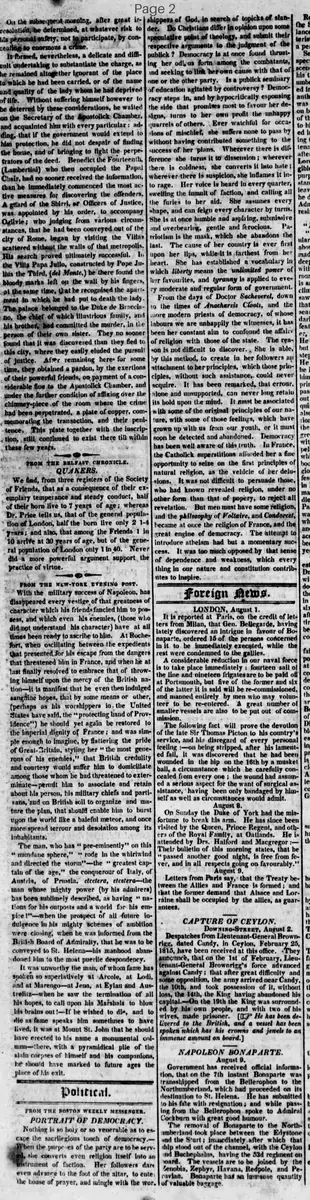
Nothing is so holy or so venerable as to escape the sacrilegious touch of democracy.—When the purposes of the party are to be served, she converts even religion itself into an instrument of faction. Her followers dare even advance to the foot of the altar, to enter the house of prayer, and mingle with the worshippers of God, in search of topics of slander. Do Christians differ in opinion upon some speculative point of theology, and submit their respective arguments to the judgment of the publick? Democracy is at once found thrusting her odious form among the combatants, and seeking to link her own cause with that of one or the other party. Is a publick seminary of education agitated by controversy? Democracy steps in, and by hypocritically espousing the side that promises most to favour her designs, turns to her own profit the unhappy quarrels of others. Ever watchful for occasions of mischief, she suffers none to pass by without having contributed something to the success of her plans. Wherever there is difference she turns it to dissension; wherever there is coldness, she converts it into hate; wherever there is suspicion, she inflames it into rage. Her voice is heard in every quarter, swelling the tumult of faction, and calling all the furies to her aid. She assumes every shape, and can feign every character by turns. She is at once humble and aspiring, submissive and overbearing, gentle and ferocious. Patriotism is the mask, which she abandons the last. The cause of her country is ever first upon her lips, while it is farthest from her heart. She has established a vocabulary in which liberty means the unlimited power of her favourites, and tyranny is applied to every moderate and regular form of government. From the days of Doctor Sacheverel, down to the times of Anacharsis Cloots, and the more modern priests of democracy, of whose labours we are unhappily the witnesses, it has been her constant aim to confound the affairs of religion with those of the state. The reason is not difficult to discover. She is able, by this method, to create in her followers an attachment to her principles, which those principles, without such assistance, could never acquire. It has been remarked, that error, alone and unsupported, can never long retain its hold upon the mind. It must be associated with some of the original principles of our nature, with some of those feelings, which have grown up with us from our youth, or it must soon be detected and abandoned. Democracy has been well aware of this truth. In France, the Catholick superstitions afforded her a fine opportunity to seize on the first principles of natural religion, as the vehicle of her delusions. It was not difficult to persuade those, who had known revealed religion, under no other form than that of popery, to reject all revelation. But men must have some religion, and the philosophy of Voltaire, and Condorcet, became at once the religion of France, and the great engine of democracy. The attempt to introduce atheism had but a momentary success. It was too much opposed by that sense of dependence and weakness, which every thing in our nature and constitution contributes to inspire.
FROM THE BOSTON WEEKLY MESSENGER.
PORTRAIT OF DEMOCRACY.
Nothing is so holy or so venerable as to escape the sacrilegious touch of democracy.—When the purposes of the party are to be served, she converts even religion itself into an instrument of faction. Her followers dare even advance to the foot of the altar, to enter the house of prayer, and mingle with the worshippers of God, in search of topics of slander. Do Christians differ in opinion upon some speculative point of theology, and submit their respective arguments to the judgment of the publick? Democracy is at once found thrusting her odious form among the combatants, and seeking to link her own cause with that of one or the other party. Is a publick seminary of education agitated by controversy? Democracy steps in, and by hypocritically espousing the side that promises most to favour her designs, turns to her own profit the unhappy quarrels of others. Ever watchful for occasions of mischief, she suffers none to pass by without having contributed something to the success of her plans. Wherever there is difference she turns it to dissension; wherever there is coldness, she converts it into hate; wherever there is suspicion, she inflames it into rage. Her voice is heard in every quarter, swelling the tumult of faction, and calling all the furies to her aid. She assumes every shape, and can feign every character by turns. She is at once humble and aspiring, submissive and overbearing, gentle and ferocious. Patriotism is the mask, which she abandons the last. The cause of her country is ever first upon her lips, while it is farthest from her heart. She has established a vocabulary in which liberty means the unlimited power of her favourites, and tyranny is applied to every moderate and regular form of government. From the days of Doctor Sacheverel, down to the times of Anacharsis Cloots, and the more modern priests of democracy, of whose labours we are unhappily the witnesses, it has been her constant aim to confound the affairs of religion with those of the state. The reason is not difficult to discover. She is able, by this method, to create in her followers an attachment to her principles, which those principles, without such assistance, could never acquire. It has been remarked, that error, alone and unsupported, can never long retain its hold upon the mind. It must be associated with some of the original principles of our nature, with some of those feelings, which have grown up with us from our youth, or it must soon be detected and abandoned. Democracy has been well aware of this truth. In France, the Catholick superstitions afforded her a fine opportunity to seize on the first principles of natural religion, as the vehicle of her delusions. It was not difficult to persuade those, who had known revealed religion, under no other form than that of popery, to reject all revelation. But men must have some religion, and the philosophy of Voltaire, and Condorcet, became at once the religion of France, and the great engine of democracy. The attempt to introduce atheism had but a momentary success. It was too much opposed by that sense of dependence and weakness, which every thing in our nature and constitution contributes to inspire.
What sub-type of article is it?
Partisan Politics
Moral Or Religious
What keywords are associated?
Democracy Critique
Religion Politics
Factionalism
French Revolution
Moral Corruption
What entities or persons were involved?
Doctor Sacheverel
Anacharsis Cloots
Voltaire
Condorcet
Editorial Details
Primary Topic
Critique Of Democracy's Corruption Of Religion And Society
Stance / Tone
Strongly Anti Democratic Invective
Key Figures
Doctor Sacheverel
Anacharsis Cloots
Voltaire
Condorcet
Key Arguments
Democracy Converts Religion Into An Instrument Of Faction
Democracy Infiltrates Theological Debates To Link With One Side
Democracy Exploits Educational Controversies For Its Designs
Democracy Turns Differences Into Dissension, Coldness Into Hate, Suspicion Into Rage
Democracy Feigns Various Characters, Using Patriotism As A Mask
Democracy Defines Liberty As Power For Its Favorites And Tyranny As Regular Government
Democracy Confounds Religion With State Affairs To Attach Followers To Its Principles
In France, Democracy Used Catholic Superstitions To Promote Atheism And Voltaire's Philosophy As New Religion