Thank you for visiting SNEWPapers!
Sign up free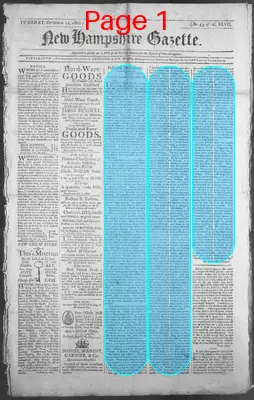
Letter to Editor
October 12, 1802
The New Hampshire Gazette
Portsmouth, Rockingham County, New Hampshire
What is this article about?
A critical letter to John Adams accusing him of favoring a mixed monarchy with hereditary nobility like Britain's over the American representative democracy, arguing it contradicts his definition of a republic and exposes aristocratic leanings.
Clipping
OCR Quality
95%
Excellent
Full Text
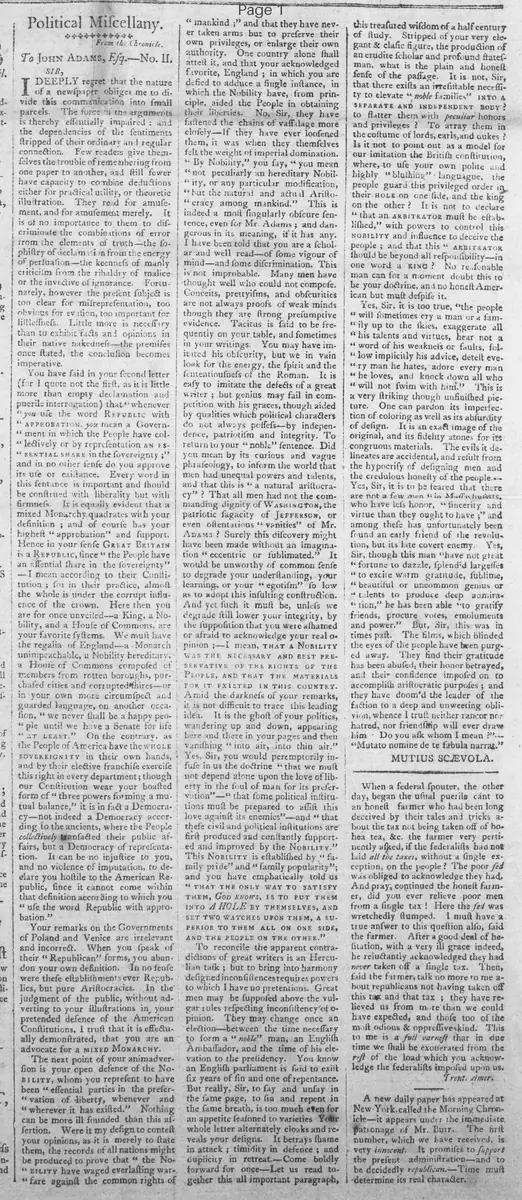
Political Miscellany.
From the Chronicle.
To JOHN ADAMS, Esq.--No. II.
SIR,
DEEPLY regret that the nature of a newspaper obliges me to divide this communication into small parcels. The force of the arguments is thereby essentially impaired: and the dependencies of the sentiments stripped of their ordinary and regular connection. Few readers give themselves the trouble of remembering from one paper to another, and still fewer have capacity to combine deductions either for practical utility, or theoretic illustration. They read for amusement, and for amusement merely. It is of no importance to them to discriminate the combinations of error from the elements of truth—the sophistry of declamation from the energy of persuasion—the keenness of manly criticism from the ribaldry of malice or the invective of ignorance. Fortunately, however the present subject is too clear for misrepresentation, too obvious for evasion, too important for littleness. Little more is necessary than to exhibit facts and opinions in their native nakedness—the premises once stated. the conclusion becomes imperative.
You have said in your second letter (for I quote not the first, as it is little more than empty declamation and puerile interrogation) that "whenever you use the word Republic with APPROBATION, you mean a Government in which the People have collectively or by representation an ESSENTIAL SHARE in the sovereignty;" and in no other sense do you approve its use or existence. Every word in this sentence is important and should be construed with liberality but with firmness. It is equally evident that a mixed Monarchy quadrates with your definition; and of course has your highest "approbation" and support. Hence in your sense GREAT BRITAIN is a Republic, since "the People have an essential share in the sovereignty"—I mean according to their Constitution: for in their practice, almost the whole is under the corrupt influence of the crown. Here then you are for once unveiled—a King, a Nobility, and a House of Commons, are your favorite systems. We must have the regalia of England—a Monarch unimpeachable, a Nobility hereditary. a House of Commons composed of members from rotten boroughs, purchased cities and corrupted shires—or in your own more circumspect and guarded language, on another occasion, "we never shall be a happy people until we have a Senate for life AT LEAST." On the contrary, as the People of America have the WHOLE SOVEREIGNTY in their own hands, and by their elective franchise exercise this right in every department; though our Constitution wear your boasted form of "three powers forming a mutual balance," it is in fact a Democracy—not indeed a Democracy according to the ancients, where the People collectively transacted their public affairs, but a Democracy of representation. It can be no injustice to you, and no violence of imputation, to declare you hostile to the American Republic, since it cannot come within that definition according to which you "use the word Republic with approbation."
Your remarks on the Governments of Poland and Venice are irrelevant and incorrect. When you speak of their "Republican" forms, you abandon your own definition. In no sense were these establishments ever Republics, but pure Aristocracies. In the judgment of the public, without adverting to your illustrations in your pretended defence of the American Constitutions. I trust that it is effectually demonstrated, that you are an advocate for a MIXED MONARCHY.
The next point of your animadversion is your open defence of the NOBILITY, whom you represent to have been "essential parties in the preservation of liberty, wherever and whenever it has existed." Nothing can be more ill founded than this assertion. Were it my design to contest your opinions, as it is merely to state them, the records of all nations might be produced to prove that "the NOBILITY have waged everlasting war-fare against the common rights of mankind;" and that they have never taken arms but to preserve their own privileges, or enlarge their own authority. One country alone shall attest it, and that your acknowledged favorite, England; in which you are defied to adduce a single instance, in which the Nobility have, from principle, aided the People in obtaining their liberties. No, Sir, they have fastened the chains of vassalage more closely—If they have ever loosened them, it was when they themselves felt the weight of imperial domination.
"By Nobility," you say, "you mean not peculiarly an hereditary Nobility, or any particular modification, but the natural and actual Aristocracy among mankind." This is indeed a most singularly obscure sentence, even for Mr. Adams: and dangerous in its meaning, if it has any. I have been told that you are a scholar and well read—of some vigour of mind—and some discrimination. This is not improbable. Many men have thought well who could not compose. Conceits, prettyisms, and obscurities are not always proofs of weak minds though they are strong presumptive evidence. Tacitus is said to be frequently on your table, and sometimes in your writings. You may have imitated his obscurity, but we in vain look for the energy, the spirit and the sententiousness of the Roman. It is easy to imitate the defects of a great writer; but genius may fail in competition with his graces, though aided by qualities which political characters do not always possess—by independence, patriotism and integrity. To return to your "noble" sentence. Did you mean by its curious and vague phraseology, to inform the world that men had unequal powers and talents, and that this is "a natural aristocracy"? That all men had not the commanding dignity of Washington, the patriotic sagacity of Jefferson, or even ostentatious "vanities" of Mr. Adams? Surely this discovery might have been made without an imagination "eccentric or sublimated." It would be unworthy of common sense to degrade your understanding, your learning, or your "egotism" so low as to adopt this insulting construction. And yet such it must be, unless we degrade still lower your integrity, by the supposition that you were ashamed or afraid to acknowledge your real opinion ;—I mean, THAT A NOBILITY WAS THE NECESSARY AND BEST PRESERVATIVE OF THE RIGHTS OF THE PEOPLE, AND THAT THE MATERIALS FOR IT EXISTED IN THIS COUNTRY.
Amid the darkness of your remarks, it is not difficult to trace this leading idea. It is the ghost of your politics, wandering up and down, appearing here and there in your pages and then vanishing "into air, into thin air."
Yes, Sir, you would peremptorily infuse in us the doctrine "that we must not depend alone upon the love of liberty in the soul of man or its preservation"" that some political institutions must be prepared to assist this love against its enemies"-and "that these civil and political institutions are first produced and constantly supported and improved by the Nobility."
This Nobility is established by "family pride" and "family popularity" and you have emphatically told us "THAT THE ONLY WAY TO SATISFY THEM, GOD KNOWS, IS TO PUT THEM INTO A HOLE BY THEMSELVES, AND SET TWO WATCHES UPON THEM, A SUPERIOR TO THEM ALL ON ONE SIDE, AND THE PEOPLE ON THE OTHER."
To reconcile the apparent contradictions of great writers is an Herculean task; but to bring into harmony designed inconsistencies requires powers to which I have no pretensions. Great men may be supposed above the vulgar rules respecting inconsistency of opinion. They may change once an election-between the time necessary to form a "noble" man, an English Ambassador, and the time of his elevation to the presidency. You know an English parliament is said to exist six years of sin and one of repentance. But really, Sir, to say and unsay in the same page, to sin and repent in the same breath, is too much even for an appetite seasoned to varieties Your whole letter alternately cloaks and reveals your designs. It betrays shame in attack; timidity in defence; and duplicity in retreat.-Come boldly forward for once—Let us read together this all important paragraph, this treasured wisdom of a half century of study. Stripped of your very elegant & classic figure, the production of an erudite scholar and profound statesman, what is the plain and honest sense of the passage. It is not, Sir. that there exists an irresistible necessity to elevate "noble families" INTO A SEPARATE AND INDEPENDENT BODY? to flatter them with peculiar honors and privileges? To array them in the costume of lords, earls,and dukes? Is it not to point out as a model for our imitation the British constitution, where, to use your own polite and highly "blushing" language, the people guard this privileged order in their Hole on one side, and the king on the other? It is not to declare "that an ARBITRATOR must be established," with powers to control this NOBILITY and influence to deceive the people; and that this "ARBITRATOR should be beyond all responsibility-in one word a king? No reasonable man can for a moment doubt this to be your doctrine, and no honest American but must despise it.
Yes, Sir, it is too true, "the people will sometimes cry a man or a family up to the skies, exaggerate all his talents and virtues, hear not a word of his weakness or faults, fol-low implicitly his advice, detest every man he hates, adore every man he loves, and knock down all who will not swim with him." This is a very striking though unfinished pie-ture. One can pardon its imperfection of coloring as well as its absurdity of design. It is an exact image of the original, and its fidelity atones for its incongruous materials. The evils it delineates are accidental, and result from the hypocrisy of designing men and the credulous honesty of the people..
Yes, Sir, it is to be feared that there are not a few men "in Massachusetts. who have less honor, "sincerity and virtue than they ought to have;" and among these has unfortunately been found an early friend of the revolu-tion, but its late covert enemy. Yes, Sir, though this man "have not great fortune to dazzle, splendid largesses to excite warm gratitude, sublime, beautiful or uncommon genius or talents to produce deep admira-tion," he has been able "to gratify friends, procure votes, emoluments and power." But, Sir, this was in times past. The films, which blinded the eyes of the people have been purged away. They find their gratitude has been abused, their honor betrayed, and their confidence imposed on to accomplish aristocratic purposes: and they have doomed the leader of the faction to a deep and unweeting oblivion, whence I trust neither rancor nor hatred, nor friendship will ever draw him Do you ask whom I mean ?"..
"Mutato nomine de te fabula narrat."
MUTIUS SCEVOLA.
From the Chronicle.
To JOHN ADAMS, Esq.--No. II.
SIR,
DEEPLY regret that the nature of a newspaper obliges me to divide this communication into small parcels. The force of the arguments is thereby essentially impaired: and the dependencies of the sentiments stripped of their ordinary and regular connection. Few readers give themselves the trouble of remembering from one paper to another, and still fewer have capacity to combine deductions either for practical utility, or theoretic illustration. They read for amusement, and for amusement merely. It is of no importance to them to discriminate the combinations of error from the elements of truth—the sophistry of declamation from the energy of persuasion—the keenness of manly criticism from the ribaldry of malice or the invective of ignorance. Fortunately, however the present subject is too clear for misrepresentation, too obvious for evasion, too important for littleness. Little more is necessary than to exhibit facts and opinions in their native nakedness—the premises once stated. the conclusion becomes imperative.
You have said in your second letter (for I quote not the first, as it is little more than empty declamation and puerile interrogation) that "whenever you use the word Republic with APPROBATION, you mean a Government in which the People have collectively or by representation an ESSENTIAL SHARE in the sovereignty;" and in no other sense do you approve its use or existence. Every word in this sentence is important and should be construed with liberality but with firmness. It is equally evident that a mixed Monarchy quadrates with your definition; and of course has your highest "approbation" and support. Hence in your sense GREAT BRITAIN is a Republic, since "the People have an essential share in the sovereignty"—I mean according to their Constitution: for in their practice, almost the whole is under the corrupt influence of the crown. Here then you are for once unveiled—a King, a Nobility, and a House of Commons, are your favorite systems. We must have the regalia of England—a Monarch unimpeachable, a Nobility hereditary. a House of Commons composed of members from rotten boroughs, purchased cities and corrupted shires—or in your own more circumspect and guarded language, on another occasion, "we never shall be a happy people until we have a Senate for life AT LEAST." On the contrary, as the People of America have the WHOLE SOVEREIGNTY in their own hands, and by their elective franchise exercise this right in every department; though our Constitution wear your boasted form of "three powers forming a mutual balance," it is in fact a Democracy—not indeed a Democracy according to the ancients, where the People collectively transacted their public affairs, but a Democracy of representation. It can be no injustice to you, and no violence of imputation, to declare you hostile to the American Republic, since it cannot come within that definition according to which you "use the word Republic with approbation."
Your remarks on the Governments of Poland and Venice are irrelevant and incorrect. When you speak of their "Republican" forms, you abandon your own definition. In no sense were these establishments ever Republics, but pure Aristocracies. In the judgment of the public, without adverting to your illustrations in your pretended defence of the American Constitutions. I trust that it is effectually demonstrated, that you are an advocate for a MIXED MONARCHY.
The next point of your animadversion is your open defence of the NOBILITY, whom you represent to have been "essential parties in the preservation of liberty, wherever and whenever it has existed." Nothing can be more ill founded than this assertion. Were it my design to contest your opinions, as it is merely to state them, the records of all nations might be produced to prove that "the NOBILITY have waged everlasting war-fare against the common rights of mankind;" and that they have never taken arms but to preserve their own privileges, or enlarge their own authority. One country alone shall attest it, and that your acknowledged favorite, England; in which you are defied to adduce a single instance, in which the Nobility have, from principle, aided the People in obtaining their liberties. No, Sir, they have fastened the chains of vassalage more closely—If they have ever loosened them, it was when they themselves felt the weight of imperial domination.
"By Nobility," you say, "you mean not peculiarly an hereditary Nobility, or any particular modification, but the natural and actual Aristocracy among mankind." This is indeed a most singularly obscure sentence, even for Mr. Adams: and dangerous in its meaning, if it has any. I have been told that you are a scholar and well read—of some vigour of mind—and some discrimination. This is not improbable. Many men have thought well who could not compose. Conceits, prettyisms, and obscurities are not always proofs of weak minds though they are strong presumptive evidence. Tacitus is said to be frequently on your table, and sometimes in your writings. You may have imitated his obscurity, but we in vain look for the energy, the spirit and the sententiousness of the Roman. It is easy to imitate the defects of a great writer; but genius may fail in competition with his graces, though aided by qualities which political characters do not always possess—by independence, patriotism and integrity. To return to your "noble" sentence. Did you mean by its curious and vague phraseology, to inform the world that men had unequal powers and talents, and that this is "a natural aristocracy"? That all men had not the commanding dignity of Washington, the patriotic sagacity of Jefferson, or even ostentatious "vanities" of Mr. Adams? Surely this discovery might have been made without an imagination "eccentric or sublimated." It would be unworthy of common sense to degrade your understanding, your learning, or your "egotism" so low as to adopt this insulting construction. And yet such it must be, unless we degrade still lower your integrity, by the supposition that you were ashamed or afraid to acknowledge your real opinion ;—I mean, THAT A NOBILITY WAS THE NECESSARY AND BEST PRESERVATIVE OF THE RIGHTS OF THE PEOPLE, AND THAT THE MATERIALS FOR IT EXISTED IN THIS COUNTRY.
Amid the darkness of your remarks, it is not difficult to trace this leading idea. It is the ghost of your politics, wandering up and down, appearing here and there in your pages and then vanishing "into air, into thin air."
Yes, Sir, you would peremptorily infuse in us the doctrine "that we must not depend alone upon the love of liberty in the soul of man or its preservation"" that some political institutions must be prepared to assist this love against its enemies"-and "that these civil and political institutions are first produced and constantly supported and improved by the Nobility."
This Nobility is established by "family pride" and "family popularity" and you have emphatically told us "THAT THE ONLY WAY TO SATISFY THEM, GOD KNOWS, IS TO PUT THEM INTO A HOLE BY THEMSELVES, AND SET TWO WATCHES UPON THEM, A SUPERIOR TO THEM ALL ON ONE SIDE, AND THE PEOPLE ON THE OTHER."
To reconcile the apparent contradictions of great writers is an Herculean task; but to bring into harmony designed inconsistencies requires powers to which I have no pretensions. Great men may be supposed above the vulgar rules respecting inconsistency of opinion. They may change once an election-between the time necessary to form a "noble" man, an English Ambassador, and the time of his elevation to the presidency. You know an English parliament is said to exist six years of sin and one of repentance. But really, Sir, to say and unsay in the same page, to sin and repent in the same breath, is too much even for an appetite seasoned to varieties Your whole letter alternately cloaks and reveals your designs. It betrays shame in attack; timidity in defence; and duplicity in retreat.-Come boldly forward for once—Let us read together this all important paragraph, this treasured wisdom of a half century of study. Stripped of your very elegant & classic figure, the production of an erudite scholar and profound statesman, what is the plain and honest sense of the passage. It is not, Sir. that there exists an irresistible necessity to elevate "noble families" INTO A SEPARATE AND INDEPENDENT BODY? to flatter them with peculiar honors and privileges? To array them in the costume of lords, earls,and dukes? Is it not to point out as a model for our imitation the British constitution, where, to use your own polite and highly "blushing" language, the people guard this privileged order in their Hole on one side, and the king on the other? It is not to declare "that an ARBITRATOR must be established," with powers to control this NOBILITY and influence to deceive the people; and that this "ARBITRATOR should be beyond all responsibility-in one word a king? No reasonable man can for a moment doubt this to be your doctrine, and no honest American but must despise it.
Yes, Sir, it is too true, "the people will sometimes cry a man or a family up to the skies, exaggerate all his talents and virtues, hear not a word of his weakness or faults, fol-low implicitly his advice, detest every man he hates, adore every man he loves, and knock down all who will not swim with him." This is a very striking though unfinished pie-ture. One can pardon its imperfection of coloring as well as its absurdity of design. It is an exact image of the original, and its fidelity atones for its incongruous materials. The evils it delineates are accidental, and result from the hypocrisy of designing men and the credulous honesty of the people..
Yes, Sir, it is to be feared that there are not a few men "in Massachusetts. who have less honor, "sincerity and virtue than they ought to have;" and among these has unfortunately been found an early friend of the revolu-tion, but its late covert enemy. Yes, Sir, though this man "have not great fortune to dazzle, splendid largesses to excite warm gratitude, sublime, beautiful or uncommon genius or talents to produce deep admira-tion," he has been able "to gratify friends, procure votes, emoluments and power." But, Sir, this was in times past. The films, which blinded the eyes of the people have been purged away. They find their gratitude has been abused, their honor betrayed, and their confidence imposed on to accomplish aristocratic purposes: and they have doomed the leader of the faction to a deep and unweeting oblivion, whence I trust neither rancor nor hatred, nor friendship will ever draw him Do you ask whom I mean ?"..
"Mutato nomine de te fabula narrat."
MUTIUS SCEVOLA.
What sub-type of article is it?
Persuasive
Political
Provocative
What themes does it cover?
Politics
Constitutional Rights
Morality
What keywords are associated?
John Adams
Mixed Monarchy
Nobility
American Republic
British Constitution
Aristocracy
Democracy
Sovereignty
What entities or persons were involved?
Mutius Scevola
John Adams, Esq.
Letter to Editor Details
Author
Mutius Scevola
Recipient
John Adams, Esq.
Main Argument
john adams is accused of advocating for a mixed monarchy with nobility and a king, similar to britain's, which contradicts his approved definition of a republic and makes him hostile to the american democratic system.
Notable Details
Quotes Adams' Definition Of Republic
Critiques Views On Poland And Venice As Aristocracies
References English Nobility's Role In History
Alludes To Tacitus
Mentions Washington And Jefferson
Latin Quote: 'Mutato Nomine De Te Fabula Narrat'