Thank you for visiting SNEWPapers!
Sign up free
Phenix Gazette
Alexandria, Virginia
What is this article about?
Travel article from National Gazette extolling Virginia's attractions: mild spring climate east of Blue Ridge, renowned mineral springs in Bath, Monroe, Greenbrier counties, refined society, historical significance, and sites like Monticello, urging Northern tourists to visit.
Merged-components note: Merged continuation of the story on Virginia mineral springs and travel.
Clipping
OCR Quality
Full Text
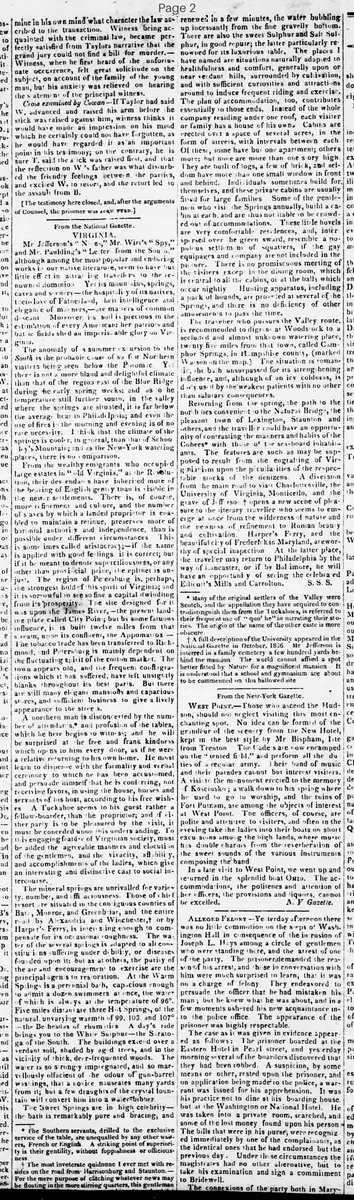
VIRGINIA.
Mr. Jefferson's "Notes," Mr. Wirt's "Spy,"
and Mr. Paulding's "Letter from the South,"
although among the most popular and enduring
works in our native literature, seem to have but
little effect in attracting travellers to the renowned
dominion. Yet its mountains, springs,
caves and scenery—the hospitality of its natives,
their love of Fatherland, their intelligence and
elegance of manners,—are matters of common
descent. Moreover, its soil is precious in the
estimation of every American: her patriots and
battle fields shed an imperishable glory on Vir-
ginia.
The anomaly of a summer excursion to the
South is the probable cause of so few Northern
visitors being seen below the Potomac. Yet
there is not a more bland and delightful climate
than that of the region east of the Blue Ridge
during the early spring weeks: and as to the
temperature still further south, in the valley
where the springs are situated, it is far below
the average heat in Philadelphia; and even the
use of fires in the morning and evening is of no
rare necessity. I think that the climate of the
springs is cooler, in general, than that of Schooley's Mountain; and as to the New-York watering
places, there is no comparison.
From the wealthy emigrants who occupied
large estates in "old Virginia," at the Revolution,
their descendants have inherited more of
the bearing of English gentry than is visible in
the new settlements. There is, of course,
more refinement and culture, and the number
of slaves by which a landed proprietor is ena-
bled to maintain a retinue, preserves more of
baronial authority and independence, than is
possible under different circumstances. This
is—sometimes called aristocracy;—if the name
is applied with good feelings, it is correct; but
if it be meant to denote superciliousness, or any
other than provincial pride, the epithet is un-
just. The region of Petersburg is, perhaps,
the strongest hold of this spirit of Virginia; and
it is sorrowful to see so fine a capital dwindling
from its prosperity. The site designed for it
was upon the James River,—the present land-
ing place called City Point; but by some fatuous
influence, it is built twelve miles from that
stream, upon its confluent, the Appomattox~
The tobacco trade has been transferred to Rich-
mond, and Petersburg is mainly dependent on
the fluctuating spirit of the cotton market. The
town appears old, and the frequent conflagra-
tions which it has suffered, have left unsightly
blanks throughout its best parts. But there
are still many elegant mansions and capacious
stores, and sufficient business to give a lively
appearance to the streets.
A northern man is disconcerted by the num-
ber of attendants,* and profusion of the tables.
which he here begins to witness; and he will
be surprised at the free and frank kindness
which opens to him every door, as if he were
a relative returning to his own home. He must
learn to dispense with the formality and verbal
ceremony to which he has been accustomed.
and persuade himself that he is conferring, not
receiving favors, in using the house, horses and
servants of his host, according to his free wish-
es. A Tuckahoe seems to his guest rather a
fellow-boarder, than the proprietor; and if ei-
ther party is to be pleased by the visit, it
must be conceded upon this understanding. To
this engaging feature of Virginian society, must
be added the agreeable manners and elocution
of the gentlemen, and the vivacity, affability.
and accomplishments of the ladies, which give
an interesting and distinctive cast to social in-
tercourse.
The mineral springs are unrivalled for varie-
ty, number, and efficaciousness. Those of chief
resort are situated in the contiguous counties of
Bath, Monroe, and Greenbrier, and the entire
road by Alexandria and Winchester, or by
Harper's Ferry, is interesting enough to com-
penate for its occasional roughness. The wa-
ter of the several springs is adapted to all con-
stitutions suffering under debility, or diseases
founded upon it: but as at others, the purity of
the air and encouragement to exercise are the
principal agents to restoration. At the Warm
Springs is a perennial bath, capacious enough
to admit a dozen swimmers at once, the water
of which is always at the temperature of 96°.
Five miles distant are three Hot Springs, of the
natural, unvarying warmth of 99, 103, and 107°
—the Bethesdas of rheumatics. A day's ride
brings you to the White Sulphur—the Sarato-
ga of the South. The buildings extend over a
verdant soil, shaded by old trees, and in the
vicinity of thick, deer-frequented woods. The
water is so strongly impregnated, and so mar-
vellously olfactory of the odour of gun-barrel
washings, that a novice nauseates many yards
from it; but a few draughts of the crystal foun-
tain will convert him into a water-bibber.
The Sweet Springs are in high celebrity—
the bath is remarkably pure and bracing, and
the Southern servants, drilled to the exclusive
service of the table, are unequalled by any other waiters, French or English. A striking point of superiority is their gentility, without foppishness or officiousness.*
The most inveterate quidnunc I ever met with re-
sides on the road from Harrisonburg and Staunton.—
For the mere purpose of catching whatever news may
be floating in the more stirring quarters, this gentleman
The water bubbling
up incessantly from the fine gravelly bottom.
There are also the sweet Sulphur and Salt Sul-
phur, in good repute; the latter particularly re-
nowned for its luxurious table. The places I
have named are situations naturally adapted to
healthfulness and comfort, generally upon or
near vacant hills, surrounded by cultivation,
and with sufficient curiosities and attractions
around to induce frequent riding and exercise.
The plan of accommodation, too, contributes
essentially to those ends. Instead of the whole
company residing under one roof, each visitor
or family has a house of his own. Cabins are
erected over a space of several acres, in the
form of streets, with intervals between each.
Of these, some have but one apartment; others
more: but none are more than one story high.
They are built of logs, a few of brick, and sel-
dom have more than one small window in front
and behind. Individuals sometimes build for
themselves, and these private cabins are usually
used for large families. Some of the gentle-
men who visit the Springs annually, build a ca-
bin at each, and are thus not liable to be crowd-
ed out of accommodations. These little hovels
are very comfortable residences, and, inter-
spursed over the green sward, resemble a no-
pulous settlement of squatters, if the gay
equipages and company are not included in the
picture. There is no promiscuous meeting of
the visitors except in the dining room, which
is central to all the cabins, or at the balls which
occur nightly. Hunting apparatus, including
a pack of hounds, are provided at several of the
Springs, and there is no deficiency of other
amusements to pass the time.
The traveller who pursues the Valley route,
is recommended to digress at Woodstock to a
secluded and almost unknown watering place,
twenty five miles from that town, called Cam-
phor Springs, in Hampshire county, (marked
Larson on the map.) The situation is roman-
tic, the bath unsurpassed for its strengthening
influence, and, although of an icy coldness, is
daily used by the weakest patients with no other
than salutary consequences.
Returning from the spring, the path to the
north lies convenient to the Natural Bridge, the
pleasant town of Lexington, Staunton and
others, and the traveller could have an opportu-
nity of contrasting the manners and habits of the
Cohees* with those of the sea-board inhabi-
tants. The features are such as may be sup-
posed to result from the engrafting of Vir-
ginianism upon the peculiarities of the respec-
table stocks of the denizens. A division
from the main road to visit Charlottesville, the
University of Virginia, Monticello, and the
grave of Jefferson opens a new scene of plea-
sure to the literary traveller who seems to em-
erge at once from the wilderness of nature and
the rudeness of refinement to Roman beauty
and cultivation. Harper's Ferry, and the
beautiful city of Frederick in Maryland, are wor-
thy of special inspection. At the latter place,
the traveller may return to Philadelphia by the
way of Lancaster, or if by Baltimore, he will
have an opportunity of seeing the celebrated
Ellicott's Mills and Carrolton.
Many of the original settlers of the Valley were
Scotch, and the appellation they have acquired to con-
tradistinguish them from the Tuckahoes, is referred to
their frequent use of "quo' he" in narrating their sto-
ries. The origin of the name of the other caste is more
obscure.
A full description of the University appeared in the
National Gazette in October, 1826. Mr. Jefferson is
interred in a family cemetery a few hundred yards be-
hind the mansion. The world cannot afford a spot
better fitted by Nature for a magnificent mansion. It
is understood that a school and gymnasium are about
to be commenced on this hallowed site.
What sub-type of article is it?
What themes does it cover?
What keywords are associated?
What entities or persons were involved?
Where did it happen?
Story Details
Key Persons
Location
Virginia, Including Bath, Monroe, Greenbrier Counties, Petersburg, Natural Bridge, Charlottesville, Monticello
Event Date
Early 19th Century
Story Details
A travelogue promoting Virginia's mild climate, hospitable society, mineral springs like Warm Springs, Hot Springs, White Sulphur, and historical sites such as Monticello and Jefferson's grave, encouraging Northern visitors despite summer heat perceptions.