Thank you for visiting SNEWPapers!
Sign up free
Literary
August 2, 1877
The Elk County Advocate
Ridgway, Elk County, Pennsylvania
What is this article about?
In 1876 London, bachelor Lord Featherstone falls in love at first sight with innocent Keziah 'Kiss' Legh. After rescuing her from a drunken coachman and escorting her home, he proposes marriage to quell gossip. Initially refused due to haste, their romance culminates in mutual affection despite social scrutiny.
Clipping
OCR Quality
95%
Excellent
Full Text
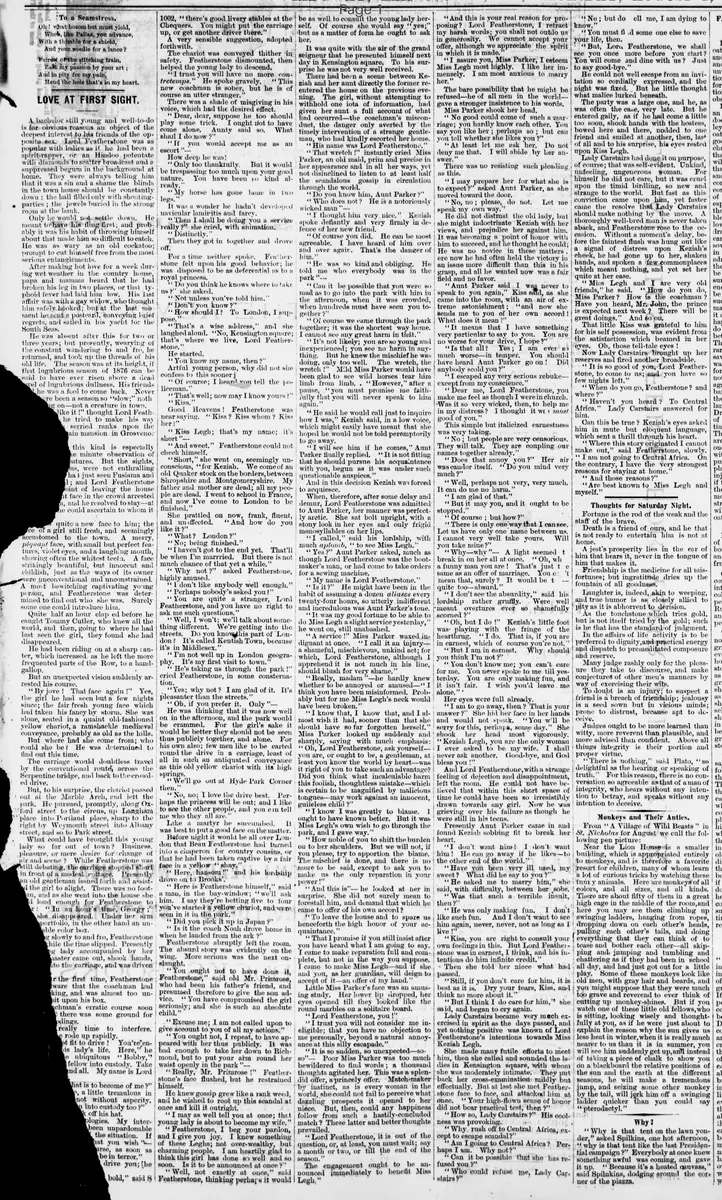
LOVE AT FIRST SIGHT.
A bachelor still young and well-to-do is for obvious reasons an object of the deepest interest to his friends of the opposite sex. Lord Featherstone was as popular with ladies as if he had been a spirit-rapper, or an Hindoo potentate with diamonds to scatter broadcast and a suppressed begum in the background at home. They were always telling him that it was a sin and a shame the blinds in the town house should be constantly down: the hall filled only with shooting-parties; the jewels buried in the strong room at the bank.
Only he would not settle down. He meant to have his fling first; and probably it was his habit of throwing himself about that made him so difficult to catch. He was as wary as an old cockatoo prompt to cut himself free from the most serious entanglements.
After making hot love for a week during wet weather in the country house, papa and mamma heard that he had broken his leg in two places, or that typhoid fever had laid him low. His last affair was with a gay widow, who thought him safely hooked: but at the last moment he sent a postcard, conveying brief regrets, and sailed in his yacht for the South Seas.
He was absent after this for two or three years; but presently, wearying of the constant wandering to and fro, he returned, and took up the threads of his old life. The season was at its height, if that lugubrious season of 1876 can be said to have ever risen above a dead level of lugubrious dullness. His friends told him he was a fool to come back. Never had there been a season so "slow:" nothing going on—not a creature in town. "Like it!" thought Lord Featherstone; he tried to make his way through the serried ranks upon the grand staircase of the Pain mansion in Grosvenor square. This kind is especially subject to minute observation of features. But the sights, alas, were not enthralling. "I have just seen Fusiyama and Honolulu; and Lord Featherstone was on the point of leaving the house when a bright face in the crowd arrested him, and he resolved to stay—at least until he could ascertain to whom it belonged.
It was quite a new face to him: the face of a girl still fresh, and seemingly unaccustomed to the town. A merry, piquant face, with small but perfect features, violet eyes, and a laughing mouth, showing often the whitest teeth. A face strikingly beautiful, but innocent and childish, just as the ways of its owner were unconventional and unconstrained.
A most bewitching, captivating young person, and Featherstone was determined to find out who she was. Surely some one could introduce him. Quite half an hour elapsed before he caught Tommy Cutler, who knew all the world, and then, going to where he had last seen the girl, they found she had disappeared.
He had been riding on at a sharp canter, which increased, as he left the more frequented parts of the Row, to a hand-gallop.
But an unexpected vision suddenly arrested his course. "By Jove! That face again!" Yes, the girl he had seen but a few nights since; the fair, fresh young face which had taken his fancy by storm. She was alone, seated in a quaint old-fashioned yellow chariot, a ramshackle mediaeval conveyance, probably as old as the hills.
But where had she come from: who could she be? He was determined to find out this time.
The carriage would doubtless travel by the conventional route, across the Serpentine bridge, and back to the crowded drive.
But, to his surprise, the chariot passed out at the Marble Arch, and left the park. He pursued, promptly, along Oxford street to the circus, up Langham place into Portland place, sharp to the right by Weymouth street into Albany street, and so to Park street.
What could have brought this young lady so far out of town? Business, pleasure, or mere desire for change of air and scene? While Featherstone was still debating, the carriage stopped short in front of a modest cottage. Presently an old gentleman issued forth and assisted the girl to alight. There was no footman, and as she went into the house she said loud enough for Featherstone to hear: "In an hour's time, Georgy;" she disappeared. Under her arm a portfolio, in the other hand an umbrella color box.
Pacing slowly to and fro, Featherstone marked the time slipped. Presently the young lady accompanied by her companion came out, shook hands, got into the carriage, and was driven rapidly away for the first time. Featherstone became aware that the coachman had been drinking, and was almost too unsteady to sit upon his box.
The coachman's erratic course soon brought them to a place where there was some ground for foreboding. It was really time to interfere. He rode up rapidly. "Not fit to drive! You're endangering this lady's life. Here, the ubiquitous 'Bobby,' take this fellow into custody. Take him and all. My name is Lord Featherstone."
"What is to become of me?" she asked, a little tremulous in voice, but not without asperity. "Am I to be run into custody too?"
He doffed his hat. "Apologies. My interference has been unpardonable in the situation. If you wish to drive, as soon as possible, I will see that you have a safe driver. Do not be in terror."
"Drive you; the bold," said she.
"There's good livery stables at the Chequers. You might put the carriage up, or get another driver there."
A very sensible suggestion, adopted forthwith.
The chariot was conveyed thither in safety. Featherstone dismounted, then helped the young lady to descend.
"I trust you will have no more contretemps."
He spoke gravely.
"This new coachman is sober, but he is of course an utter stranger."
There was a shade of misgiving in his voice, which had the desired effect.
"Dear, dear, suppose he too should play some trick. I ought not to have come alone. Aunty said so. What shall I do now?"
"If you would accept me as an escort—"
How deep he was!
"Only too thankfully. But it would be trespassing too much upon your good nature. You have been so kind already."
"My horse has gone lame in two legs. It was a wonder he hadn't developed navicular laminitis and farcy."
"Then I shall be doing you a service really?" she cried, with animation.
"Distinctly."
Then they got in together and drove off.
For a time neither spoke. Featherstone felt upon his good behavior; he was disposed to be as deferential as to a royal princess.
"Do you think he knows where to take us?" she asked.
"Not unless you've told him."
"Don't you know?"
"How should I? To London, I suppose."
"That's a wide address," and she laughed aloud. "No, Kensington square; that's where we live. Lord Featherstone."
He started.
"You know my name, then?"
Artful young person, why did not she confess to this sooner?
"Of course: I heard you tell the policeman."
"That's well; now may I know yours?"
"Kiss."
Good Heavens! Featherstone was near saying.
"Kiss? Kiss whom? Kiss her?"
"Kiss Legh; that's my name; it's short."
"And sweet." Featherstone could not check himself.
"Short," she went on, seemingly unconscious, "for Keziah. We come of an old Quaker stock on the borders, between Shropshire and Montgomeryshire. My father and mother are dead; all my people are dead. I went to school in France, and now I've come to London to be finished."
She prattled on now, frank, fluent, and unaffected. "And how do you like it?"
"What? London?"
"No: being finished."
"I haven't got to the end yet. That'll be when I'm married. But there is not much chance of that yet a while."
"Why not?" asked Featherstone, highly amused.
"I don't like anybody well enough."
"Perhaps nobody's asked you?"
"You are quite a stranger, Lord Featherstone, and you have no right to ask me such questions."
"Well, I won't; we'll talk about something different. We're getting into the streets. Do you know this part of London? It's called Kentish Town, because it's in Middlesex."
"I'm not well up in London geography. It's my first visit to town."
"He's taking us through the park!" cried Featherstone, in some consternation.
"Yes: why not? I am glad of it. It's pleasanter than the streets."
"Oh, if you prefer it. Only—"
He was thinking that it was now well on in the afternoon, and the park would be crammed. For the girl's sake it would be better they should not be seen thus publicly together, and alone. For his own also; few men like to be carted round the drive in a carriage, least of all in such an antiquated conveyance as this old yellow chariot with its high springs.
"We'll go out at Hyde Park Corner then."
"No, no; I love the drive best. Perhaps the princess will be out; and I like to see the other people, and you can tell me who they all are."
Like a martyr he succumbed.
It was best to put a good face on the matter. Before night it would be all over London that Beau Featherstone had turned into a chaperon for country cousins, or that he had been taken captive by a fair face in a yellow "shay."
"Here, hansom and his lordship drove on to Brooks'."
"Here is Featherstone himself," said a man, in the bay-window; "we'll ask him. I say they're betting five to four you've started a yellow chariot, and were seen in it in the park."
"Did you pick it up in Japan?"
"Is it the coach Noah drove home in when he landed from the ark?"
Featherstone abruptly left the room.
The absurd story was evidently on the wing. More serious was the next onslaught.
"You ought not to have done it, Featherstone," said old Mr. Primrose, who had been his father's friend, and presumed therefore to give the son advice. "You have compromised the girl seriously; and she is such an absolute child."
"Excuse me; I am not called upon to give account to you of all my actions."
"You ought not, I repeat, to have appeared with her thus publicly. It was bad enough to take her down to Richmond, but to put your arm round her waist openly in the park—"
"Really, Mr. Primrose!" Featherstone's face flushed, but he restrained himself.
He knew gossip grew like a rank weed, and he wished to root up this scandal at once and kill it outright.
"I may as well tell you at once; that young lady is about to become my wife."
"Featherstone, I beg your pardon, and I give you joy. I knew something of these Leghs; not over-wealthy, but charming people. I am heartily glad to think this girl has done so well and so soon. Is it to be announced at once?"
"Well, not exactly at once," said Featherstone, thinking perhaps it would be as well to consult the young lady herself. Of course she would say "yes;" but as a matter of form he ought to ask her.
It was quite with the air of the grand seigneur that he presented himself next day in Kensington square. To his surprise he was not very well received.
There had been a scene between Keziah and her aunt directly the former re-entered the house on the previous evening. The girl, without attempting to withhold one iota of information, had given her aunt a full account of what had occurred—the coachman's misconduct, the danger only averted by the timely intervention of a strange gentleman, who had kindly escorted her home.
"His name was Lord Featherstone."
"That wretch!" instantly cried Miss Parker, an old maid, prim and precise in her appearance and in all her ways, yet not disinclined to listen to at least half the scandalous gossip in circulation through the world.
"Do you know him, Aunt Parker?"
"Who does not? He is a notoriously wicked man."
"I thought him very nice." Keziah spoke defiantly and very firmly in defense of her new friend.
"Of course you did. He can be most agreeable. I have heard of him over and over again. That's the danger of him."
"He was so kind and obliging. He told me who everybody was in the park—"
"Can it be possible that you were so mad as to go into the park with him in the afternoon, when it was crowded, when hundreds must have seen you together?"
"Of course we came through the park together: it was the shortest way home. I cannot see any great harm in that."
"It's not likely; you are so young and inexperienced; you see no harm in anything. But he knew the mischief he was doing, only too well. The wretch, the wretch!" Mild Miss Parker would have been glad to see wild horses tear him limb from limb. "However," after a pause, "you must promise me faithfully that you will never speak to him again."
"He said he would call just to inquire how I was." Keziah said, in a low voice, which might easily have meant that she hoped he would not be told peremptorily to go away.
"I will see him if he comes." Aunt Parker finally replied. "It is not fitting that he should pursue his acquaintance with you, begun as it was under such questionable auspices."
And in this decision Keziah was forced to acquiesce.
When, therefore, after some delay and demur, Lord Featherstone was admitted to Aunt Parker, her manner was perfectly arctic. She sat bolt upright, with a stony look in her eyes and only frigid monosyllables on her lips.
"I called," said his lordship, with much aplomb, "to see Miss Legh."
"Yes?" Aunt Parker asked, much as though Lord Featherstone was the bootmaker's man, or had come to take orders for a sewing machine.
"My name is Lord Featherstone."
"Is it?" He might have been in the habit of assuming a dozen aliases every twenty-four hours, so utterly indifferent and incredulous was Aunt Parker's tone.
"It was my good fortune to be able to do Miss Legh a slight service yesterday,"
he went on, still unabashed,
"A service!" Miss Parker waxed indignant at once. "I call it an injury—a shameful, mischievous, unkind act; for which, Lord Featherstone, although I apprehend it is not much in his line, should blush for very shame."
"Really, madam"—he hardly knew whether to be annoyed or amused—"I think you have been misinformed. Probably but for me Miss Legh's neck would have been broken."
"I know that, I know that, and I almost wish it had, sooner than that she should have so far forgotten herself."
Miss Parker looked up suddenly and sharply, saying with much emphasis:
"Oh, Lord Featherstone, ask yourself—you are, or ought to be, a gentleman, at least you know the world by heart—was it right of you to take such an advantage? Did you think what incalculable harm this foolish, thoughtless mistake—which is certain to be magnified by malicious tongues—may work against an innocent, guileless child?"
"I know I was greatly to blame. I ought to have known better. But it was Miss Legh's own wish to go through the park, and I gave way."
"How noble of you to shift the burden on to her shoulders. But we will not, if you please, try to apportion the blame. The mischief is done, and there is no more to be said, except to ask you to make us the only reparation in your power!"
"And this is"—he looked at her in surprise. She did not surely mean to forestall him, and demand that which he came to offer of his own accord?
"To leave the house and to spare us henceforth the high honor of your acquaintance."
"That I promise if you still insist after you have heard what I am going to say. I came to make reparation full and complete, but not in the way you suppose. I came to make Miss Legh—and if she and you, as her guardian, will deign to accept of it—an offer of my hand."
Little Miss Parker's face was an amusing study. Her lower lip dropped, her eyes opened till they looked like the round marbles on a solitaire board.
"Lord Featherstone, you!"
"I trust you will not consider me ineligible; that you have no objection to me personally, beyond a natural annoyance at this silly escapade."
"It is so sudden, so unexpected—so—" Poor Miss Parker was too much bewildered to find words: a thousand thoughts agitated her. This was a splendid offer, a princely offer. Match-maker by instinct, as is every woman in the world, she could not fail to perceive what dazzling prospects it opened to her niece. But, then, could any happiness follow from such a hastily-concluded match? These latter and better thoughts prevailed.
"Lord Featherstone, it is out of the question, or, at least, you must wait; say a month or two, or till the end of the season. The engagement ought to be announced immediately to benefit Miss Legh,"
"And this is your real reason for proposing? Lord Featherstone, I retract my harsh words; you shall not outdo us in generosity. We cannot accept your offer, although we appreciate the spirit in which it is made."
"I assure you, Miss Parker, I esteem Miss Legh most highly. I like her immensely. I am most anxious to marry her."
The bare possibility that he might be refused—he of all men in the world—gave a stronger insistence to his words.
Miss Parker shook her head.
"No good could come of such a marriage; you hardly know each other. You say you like her; perhaps so; but can you tell whether she likes you?"
"At least let me ask her. Do not deny me that. I will abide by her answer."
There was no resisting such pleading as this.
"I may prepare her for what she is to expect?" asked Aunt Parker, as she moved toward the door.
"No, no; please, do not. Let me speak my own way."
He did not distrust the old lady, but she might indoctrinate Keziah with her views, and prejudice her against him.
It was becoming a point of honor with him to succeed, and he thought he could: He was no novice in these matters. Ere now he had often held the victory in an issue more difficult than this in his grasp, and all he wanted now was a fair field and no favor.
"Aunt Parker said I was never to speak to you again," Kiss said, as she came into the room, with an air of extreme astonishment; "and now she sends me to you of her own accord. What does it mean?"
"It means that I have something very particular to say to you. You are no worse for your drive, I hope?"
"Is that all? Yes: I am ever so much worse—in temper. You should have heard Aunt Parker go on! Did anybody scold you?"
"I escaped any very serious rebuke—except from my conscience."
"Dear me, Lord Featherstone, you make me feel as though I were in church. Was it so very wicked, then, to help me in my distress? I thought it was most good of you."
This simple but italicized earnestness was very taking.
"No: but people are very censorious. They will talk. They are coupling our names together already."
"Does that annoy you?" Her air was candor itself.
"Do you mind very much?"
"Well, perhaps not very, very much. It can do me no harm."
"I am glad of that."
"But it may you, and it ought to be stopped."
"Of course: but how?"
"There is only one way that I can see. Let us have only one name between us. I cannot very well take yours. Will you take mine?"
"Why—why—" A light seemed to break in on her all at once. "Oh, what a funny man you are! That's just the same as an offer of marriage. You can't mean that, surely? It would be quite too—absurd."
"I don't see the absurdity," said his lordship rather gruffly. Were well-meant overtures ever so shamefully scorned?
"Oh, but I do!" Keziah's little foot was playing with the fringe of the hearthrug.
"I do. That is, if you are in earnest, which of course you're not."
"But I am in earnest. Why should you think I'm not?"
"You don't know me; you can't care for me. You never spoke to me till yesterday. You are only making fun, and it isn't fair. I wish you'd leave me alone."
Her eyes were full already.
"I am to go away, then? That is your answer?" She hid her face in her hands and would not speak. "You will be sorry for this, perhaps, some day." She shook her head most vigorously.
"Keziah Legh, you are the only woman I ever asked to be my wife. I shall never ask another. Good-bye, and God bless you!"
And Lord Featherstone, with a strange feeling of dejection and disappointment, left the room. He could not have believed that within this short space of time he could have been so irresistibly drawn towards any girl. Now he was grieving over his failure as though he were still in his teens.
Presently Aunt Parker came in and found Keziah sobbing fit to break her heart.
"I don't want him! I don't want him! He can go away if he likes—to the other end of the world."
"Have you been very ill used, my sweet? What did he say to you?"
"He asked me to marry him," she said, with difficulty, between her sobs.
"Was that such a terrible insult, then?"
"He was only making fun. I don't like such fun. And I don't want to see him again, never, never, not as long as I live!"
"Kiss, you are right to consult your own feelings in this. But Lord Featherstone was in earnest, I think, and his intentions do him infinite credit."
Then she told her niece what had passed.
"Still, if you don't care for him, it is best as it is. Dry your tears, Kiss, and think no more about it."
"But I think I do care for him," she said, and began to cry again.
Lady Carstairs became very much exercised in spirit as the days passed, and yet nothing positive was known of Lord Featherstone's intentions towards Miss Keziah Legh.
She made many futile efforts to meet him, then she called and sounded the ladies in Kensington square, with whom she was moderately intimate. They put back her cross-examination mildly but effectually. But at last she met Featherstone face to face, and attacked him at once.
"Your high-flown sense of honor did not bear practical test, then?"
"How so, Lady Carstairs?" His coolness was provoking.
"Why rush off to Central Africa, except to escape scandal?"
"Am I going to Central Africa? Perhaps I am. Why not?"
"Can it be possible that she has refused you?"
"Who could refuse me, Lady Carstairs?"
"No; but do tell me, I am dying to know. You must find some one else to save your life, then."
"But, Lord Featherstone, we shall see you once more before you start? You will come and dine with us? Just to say good-bye."
He could not well escape from an invitation so cordially expressed, and the night was fixed. But he little thought what malice lurked beneath.
The party was a large one, and he, as was often the case, very late. But he entered gaily, as if he had come a little too soon, shook hands with the hostess, bowed here and there, nodded to one friend and smiled at another, then, last of all and to his surprise, his eyes rested upon Kiss Legh.
Lady Carstairs had done it on purpose, of course; that was self-evident. Unkind, unfeeling, ungenerous woman.
For himself he did not care, but it was cruel upon the timid birdling, so new and strange to the world. But fast as this conviction came upon him, yet faster came the resolve that Lady Carstairs should make nothing by the move. A thoroughly well-bred man is never taken aback, and Featherstone rose to the occasion. Without a moment's delay, before the faintest flush was hung out like a signal of distress upon Keziah's cheek, he had gone up to her, shaken hands, and spoken a few commonplaces which meant nothing, and yet set her quite at her ease.
"Miss Legh and I are very old friends," he said. "How do you do, Miss Parker? How is the coachman? Have you heard, Mr. John, the prince is expected next week? There will be great doings." And so on.
That little Kiss was grateful to him for his self-possession, was evident from the satisfaction which beamed in her eyes. Oh, those tell-tale eyes!
Now Lady Carstairs brought up her reserves and fired another broadside.
"It is so good of you, Lord Featherstone, to come to us; and you have so few nights left."
"When do you go, Featherstone? and where?"
"Haven't you heard? To Central Africa."
Lady Carstairs answered for him.
Can this be true? Keziah's eyes asked him in mute but eloquent language, which sent a thrill through his heart.
"Where this story originated I cannot make out," said Featherstone, slowly. "I am not going to Central Africa. On the contrary, I have the very strongest reasons for staying at home."
"And those reasons?"
"Are best known to Miss Legh and myself."
A bachelor still young and well-to-do is for obvious reasons an object of the deepest interest to his friends of the opposite sex. Lord Featherstone was as popular with ladies as if he had been a spirit-rapper, or an Hindoo potentate with diamonds to scatter broadcast and a suppressed begum in the background at home. They were always telling him that it was a sin and a shame the blinds in the town house should be constantly down: the hall filled only with shooting-parties; the jewels buried in the strong room at the bank.
Only he would not settle down. He meant to have his fling first; and probably it was his habit of throwing himself about that made him so difficult to catch. He was as wary as an old cockatoo prompt to cut himself free from the most serious entanglements.
After making hot love for a week during wet weather in the country house, papa and mamma heard that he had broken his leg in two places, or that typhoid fever had laid him low. His last affair was with a gay widow, who thought him safely hooked: but at the last moment he sent a postcard, conveying brief regrets, and sailed in his yacht for the South Seas.
He was absent after this for two or three years; but presently, wearying of the constant wandering to and fro, he returned, and took up the threads of his old life. The season was at its height, if that lugubrious season of 1876 can be said to have ever risen above a dead level of lugubrious dullness. His friends told him he was a fool to come back. Never had there been a season so "slow:" nothing going on—not a creature in town. "Like it!" thought Lord Featherstone; he tried to make his way through the serried ranks upon the grand staircase of the Pain mansion in Grosvenor square. This kind is especially subject to minute observation of features. But the sights, alas, were not enthralling. "I have just seen Fusiyama and Honolulu; and Lord Featherstone was on the point of leaving the house when a bright face in the crowd arrested him, and he resolved to stay—at least until he could ascertain to whom it belonged.
It was quite a new face to him: the face of a girl still fresh, and seemingly unaccustomed to the town. A merry, piquant face, with small but perfect features, violet eyes, and a laughing mouth, showing often the whitest teeth. A face strikingly beautiful, but innocent and childish, just as the ways of its owner were unconventional and unconstrained.
A most bewitching, captivating young person, and Featherstone was determined to find out who she was. Surely some one could introduce him. Quite half an hour elapsed before he caught Tommy Cutler, who knew all the world, and then, going to where he had last seen the girl, they found she had disappeared.
He had been riding on at a sharp canter, which increased, as he left the more frequented parts of the Row, to a hand-gallop.
But an unexpected vision suddenly arrested his course. "By Jove! That face again!" Yes, the girl he had seen but a few nights since; the fair, fresh young face which had taken his fancy by storm. She was alone, seated in a quaint old-fashioned yellow chariot, a ramshackle mediaeval conveyance, probably as old as the hills.
But where had she come from: who could she be? He was determined to find out this time.
The carriage would doubtless travel by the conventional route, across the Serpentine bridge, and back to the crowded drive.
But, to his surprise, the chariot passed out at the Marble Arch, and left the park. He pursued, promptly, along Oxford street to the circus, up Langham place into Portland place, sharp to the right by Weymouth street into Albany street, and so to Park street.
What could have brought this young lady so far out of town? Business, pleasure, or mere desire for change of air and scene? While Featherstone was still debating, the carriage stopped short in front of a modest cottage. Presently an old gentleman issued forth and assisted the girl to alight. There was no footman, and as she went into the house she said loud enough for Featherstone to hear: "In an hour's time, Georgy;" she disappeared. Under her arm a portfolio, in the other hand an umbrella color box.
Pacing slowly to and fro, Featherstone marked the time slipped. Presently the young lady accompanied by her companion came out, shook hands, got into the carriage, and was driven rapidly away for the first time. Featherstone became aware that the coachman had been drinking, and was almost too unsteady to sit upon his box.
The coachman's erratic course soon brought them to a place where there was some ground for foreboding. It was really time to interfere. He rode up rapidly. "Not fit to drive! You're endangering this lady's life. Here, the ubiquitous 'Bobby,' take this fellow into custody. Take him and all. My name is Lord Featherstone."
"What is to become of me?" she asked, a little tremulous in voice, but not without asperity. "Am I to be run into custody too?"
He doffed his hat. "Apologies. My interference has been unpardonable in the situation. If you wish to drive, as soon as possible, I will see that you have a safe driver. Do not be in terror."
"Drive you; the bold," said she.
"There's good livery stables at the Chequers. You might put the carriage up, or get another driver there."
A very sensible suggestion, adopted forthwith.
The chariot was conveyed thither in safety. Featherstone dismounted, then helped the young lady to descend.
"I trust you will have no more contretemps."
He spoke gravely.
"This new coachman is sober, but he is of course an utter stranger."
There was a shade of misgiving in his voice, which had the desired effect.
"Dear, dear, suppose he too should play some trick. I ought not to have come alone. Aunty said so. What shall I do now?"
"If you would accept me as an escort—"
How deep he was!
"Only too thankfully. But it would be trespassing too much upon your good nature. You have been so kind already."
"My horse has gone lame in two legs. It was a wonder he hadn't developed navicular laminitis and farcy."
"Then I shall be doing you a service really?" she cried, with animation.
"Distinctly."
Then they got in together and drove off.
For a time neither spoke. Featherstone felt upon his good behavior; he was disposed to be as deferential as to a royal princess.
"Do you think he knows where to take us?" she asked.
"Not unless you've told him."
"Don't you know?"
"How should I? To London, I suppose."
"That's a wide address," and she laughed aloud. "No, Kensington square; that's where we live. Lord Featherstone."
He started.
"You know my name, then?"
Artful young person, why did not she confess to this sooner?
"Of course: I heard you tell the policeman."
"That's well; now may I know yours?"
"Kiss."
Good Heavens! Featherstone was near saying.
"Kiss? Kiss whom? Kiss her?"
"Kiss Legh; that's my name; it's short."
"And sweet." Featherstone could not check himself.
"Short," she went on, seemingly unconscious, "for Keziah. We come of an old Quaker stock on the borders, between Shropshire and Montgomeryshire. My father and mother are dead; all my people are dead. I went to school in France, and now I've come to London to be finished."
She prattled on now, frank, fluent, and unaffected. "And how do you like it?"
"What? London?"
"No: being finished."
"I haven't got to the end yet. That'll be when I'm married. But there is not much chance of that yet a while."
"Why not?" asked Featherstone, highly amused.
"I don't like anybody well enough."
"Perhaps nobody's asked you?"
"You are quite a stranger, Lord Featherstone, and you have no right to ask me such questions."
"Well, I won't; we'll talk about something different. We're getting into the streets. Do you know this part of London? It's called Kentish Town, because it's in Middlesex."
"I'm not well up in London geography. It's my first visit to town."
"He's taking us through the park!" cried Featherstone, in some consternation.
"Yes: why not? I am glad of it. It's pleasanter than the streets."
"Oh, if you prefer it. Only—"
He was thinking that it was now well on in the afternoon, and the park would be crammed. For the girl's sake it would be better they should not be seen thus publicly together, and alone. For his own also; few men like to be carted round the drive in a carriage, least of all in such an antiquated conveyance as this old yellow chariot with its high springs.
"We'll go out at Hyde Park Corner then."
"No, no; I love the drive best. Perhaps the princess will be out; and I like to see the other people, and you can tell me who they all are."
Like a martyr he succumbed.
It was best to put a good face on the matter. Before night it would be all over London that Beau Featherstone had turned into a chaperon for country cousins, or that he had been taken captive by a fair face in a yellow "shay."
"Here, hansom and his lordship drove on to Brooks'."
"Here is Featherstone himself," said a man, in the bay-window; "we'll ask him. I say they're betting five to four you've started a yellow chariot, and were seen in it in the park."
"Did you pick it up in Japan?"
"Is it the coach Noah drove home in when he landed from the ark?"
Featherstone abruptly left the room.
The absurd story was evidently on the wing. More serious was the next onslaught.
"You ought not to have done it, Featherstone," said old Mr. Primrose, who had been his father's friend, and presumed therefore to give the son advice. "You have compromised the girl seriously; and she is such an absolute child."
"Excuse me; I am not called upon to give account to you of all my actions."
"You ought not, I repeat, to have appeared with her thus publicly. It was bad enough to take her down to Richmond, but to put your arm round her waist openly in the park—"
"Really, Mr. Primrose!" Featherstone's face flushed, but he restrained himself.
He knew gossip grew like a rank weed, and he wished to root up this scandal at once and kill it outright.
"I may as well tell you at once; that young lady is about to become my wife."
"Featherstone, I beg your pardon, and I give you joy. I knew something of these Leghs; not over-wealthy, but charming people. I am heartily glad to think this girl has done so well and so soon. Is it to be announced at once?"
"Well, not exactly at once," said Featherstone, thinking perhaps it would be as well to consult the young lady herself. Of course she would say "yes;" but as a matter of form he ought to ask her.
It was quite with the air of the grand seigneur that he presented himself next day in Kensington square. To his surprise he was not very well received.
There had been a scene between Keziah and her aunt directly the former re-entered the house on the previous evening. The girl, without attempting to withhold one iota of information, had given her aunt a full account of what had occurred—the coachman's misconduct, the danger only averted by the timely intervention of a strange gentleman, who had kindly escorted her home.
"His name was Lord Featherstone."
"That wretch!" instantly cried Miss Parker, an old maid, prim and precise in her appearance and in all her ways, yet not disinclined to listen to at least half the scandalous gossip in circulation through the world.
"Do you know him, Aunt Parker?"
"Who does not? He is a notoriously wicked man."
"I thought him very nice." Keziah spoke defiantly and very firmly in defense of her new friend.
"Of course you did. He can be most agreeable. I have heard of him over and over again. That's the danger of him."
"He was so kind and obliging. He told me who everybody was in the park—"
"Can it be possible that you were so mad as to go into the park with him in the afternoon, when it was crowded, when hundreds must have seen you together?"
"Of course we came through the park together: it was the shortest way home. I cannot see any great harm in that."
"It's not likely; you are so young and inexperienced; you see no harm in anything. But he knew the mischief he was doing, only too well. The wretch, the wretch!" Mild Miss Parker would have been glad to see wild horses tear him limb from limb. "However," after a pause, "you must promise me faithfully that you will never speak to him again."
"He said he would call just to inquire how I was." Keziah said, in a low voice, which might easily have meant that she hoped he would not be told peremptorily to go away.
"I will see him if he comes." Aunt Parker finally replied. "It is not fitting that he should pursue his acquaintance with you, begun as it was under such questionable auspices."
And in this decision Keziah was forced to acquiesce.
When, therefore, after some delay and demur, Lord Featherstone was admitted to Aunt Parker, her manner was perfectly arctic. She sat bolt upright, with a stony look in her eyes and only frigid monosyllables on her lips.
"I called," said his lordship, with much aplomb, "to see Miss Legh."
"Yes?" Aunt Parker asked, much as though Lord Featherstone was the bootmaker's man, or had come to take orders for a sewing machine.
"My name is Lord Featherstone."
"Is it?" He might have been in the habit of assuming a dozen aliases every twenty-four hours, so utterly indifferent and incredulous was Aunt Parker's tone.
"It was my good fortune to be able to do Miss Legh a slight service yesterday,"
he went on, still unabashed,
"A service!" Miss Parker waxed indignant at once. "I call it an injury—a shameful, mischievous, unkind act; for which, Lord Featherstone, although I apprehend it is not much in his line, should blush for very shame."
"Really, madam"—he hardly knew whether to be annoyed or amused—"I think you have been misinformed. Probably but for me Miss Legh's neck would have been broken."
"I know that, I know that, and I almost wish it had, sooner than that she should have so far forgotten herself."
Miss Parker looked up suddenly and sharply, saying with much emphasis:
"Oh, Lord Featherstone, ask yourself—you are, or ought to be, a gentleman, at least you know the world by heart—was it right of you to take such an advantage? Did you think what incalculable harm this foolish, thoughtless mistake—which is certain to be magnified by malicious tongues—may work against an innocent, guileless child?"
"I know I was greatly to blame. I ought to have known better. But it was Miss Legh's own wish to go through the park, and I gave way."
"How noble of you to shift the burden on to her shoulders. But we will not, if you please, try to apportion the blame. The mischief is done, and there is no more to be said, except to ask you to make us the only reparation in your power!"
"And this is"—he looked at her in surprise. She did not surely mean to forestall him, and demand that which he came to offer of his own accord?
"To leave the house and to spare us henceforth the high honor of your acquaintance."
"That I promise if you still insist after you have heard what I am going to say. I came to make reparation full and complete, but not in the way you suppose. I came to make Miss Legh—and if she and you, as her guardian, will deign to accept of it—an offer of my hand."
Little Miss Parker's face was an amusing study. Her lower lip dropped, her eyes opened till they looked like the round marbles on a solitaire board.
"Lord Featherstone, you!"
"I trust you will not consider me ineligible; that you have no objection to me personally, beyond a natural annoyance at this silly escapade."
"It is so sudden, so unexpected—so—" Poor Miss Parker was too much bewildered to find words: a thousand thoughts agitated her. This was a splendid offer, a princely offer. Match-maker by instinct, as is every woman in the world, she could not fail to perceive what dazzling prospects it opened to her niece. But, then, could any happiness follow from such a hastily-concluded match? These latter and better thoughts prevailed.
"Lord Featherstone, it is out of the question, or, at least, you must wait; say a month or two, or till the end of the season. The engagement ought to be announced immediately to benefit Miss Legh,"
"And this is your real reason for proposing? Lord Featherstone, I retract my harsh words; you shall not outdo us in generosity. We cannot accept your offer, although we appreciate the spirit in which it is made."
"I assure you, Miss Parker, I esteem Miss Legh most highly. I like her immensely. I am most anxious to marry her."
The bare possibility that he might be refused—he of all men in the world—gave a stronger insistence to his words.
Miss Parker shook her head.
"No good could come of such a marriage; you hardly know each other. You say you like her; perhaps so; but can you tell whether she likes you?"
"At least let me ask her. Do not deny me that. I will abide by her answer."
There was no resisting such pleading as this.
"I may prepare her for what she is to expect?" asked Aunt Parker, as she moved toward the door.
"No, no; please, do not. Let me speak my own way."
He did not distrust the old lady, but she might indoctrinate Keziah with her views, and prejudice her against him.
It was becoming a point of honor with him to succeed, and he thought he could: He was no novice in these matters. Ere now he had often held the victory in an issue more difficult than this in his grasp, and all he wanted now was a fair field and no favor.
"Aunt Parker said I was never to speak to you again," Kiss said, as she came into the room, with an air of extreme astonishment; "and now she sends me to you of her own accord. What does it mean?"
"It means that I have something very particular to say to you. You are no worse for your drive, I hope?"
"Is that all? Yes: I am ever so much worse—in temper. You should have heard Aunt Parker go on! Did anybody scold you?"
"I escaped any very serious rebuke—except from my conscience."
"Dear me, Lord Featherstone, you make me feel as though I were in church. Was it so very wicked, then, to help me in my distress? I thought it was most good of you."
This simple but italicized earnestness was very taking.
"No: but people are very censorious. They will talk. They are coupling our names together already."
"Does that annoy you?" Her air was candor itself.
"Do you mind very much?"
"Well, perhaps not very, very much. It can do me no harm."
"I am glad of that."
"But it may you, and it ought to be stopped."
"Of course: but how?"
"There is only one way that I can see. Let us have only one name between us. I cannot very well take yours. Will you take mine?"
"Why—why—" A light seemed to break in on her all at once. "Oh, what a funny man you are! That's just the same as an offer of marriage. You can't mean that, surely? It would be quite too—absurd."
"I don't see the absurdity," said his lordship rather gruffly. Were well-meant overtures ever so shamefully scorned?
"Oh, but I do!" Keziah's little foot was playing with the fringe of the hearthrug.
"I do. That is, if you are in earnest, which of course you're not."
"But I am in earnest. Why should you think I'm not?"
"You don't know me; you can't care for me. You never spoke to me till yesterday. You are only making fun, and it isn't fair. I wish you'd leave me alone."
Her eyes were full already.
"I am to go away, then? That is your answer?" She hid her face in her hands and would not speak. "You will be sorry for this, perhaps, some day." She shook her head most vigorously.
"Keziah Legh, you are the only woman I ever asked to be my wife. I shall never ask another. Good-bye, and God bless you!"
And Lord Featherstone, with a strange feeling of dejection and disappointment, left the room. He could not have believed that within this short space of time he could have been so irresistibly drawn towards any girl. Now he was grieving over his failure as though he were still in his teens.
Presently Aunt Parker came in and found Keziah sobbing fit to break her heart.
"I don't want him! I don't want him! He can go away if he likes—to the other end of the world."
"Have you been very ill used, my sweet? What did he say to you?"
"He asked me to marry him," she said, with difficulty, between her sobs.
"Was that such a terrible insult, then?"
"He was only making fun. I don't like such fun. And I don't want to see him again, never, never, not as long as I live!"
"Kiss, you are right to consult your own feelings in this. But Lord Featherstone was in earnest, I think, and his intentions do him infinite credit."
Then she told her niece what had passed.
"Still, if you don't care for him, it is best as it is. Dry your tears, Kiss, and think no more about it."
"But I think I do care for him," she said, and began to cry again.
Lady Carstairs became very much exercised in spirit as the days passed, and yet nothing positive was known of Lord Featherstone's intentions towards Miss Keziah Legh.
She made many futile efforts to meet him, then she called and sounded the ladies in Kensington square, with whom she was moderately intimate. They put back her cross-examination mildly but effectually. But at last she met Featherstone face to face, and attacked him at once.
"Your high-flown sense of honor did not bear practical test, then?"
"How so, Lady Carstairs?" His coolness was provoking.
"Why rush off to Central Africa, except to escape scandal?"
"Am I going to Central Africa? Perhaps I am. Why not?"
"Can it be possible that she has refused you?"
"Who could refuse me, Lady Carstairs?"
"No; but do tell me, I am dying to know. You must find some one else to save your life, then."
"But, Lord Featherstone, we shall see you once more before you start? You will come and dine with us? Just to say good-bye."
He could not well escape from an invitation so cordially expressed, and the night was fixed. But he little thought what malice lurked beneath.
The party was a large one, and he, as was often the case, very late. But he entered gaily, as if he had come a little too soon, shook hands with the hostess, bowed here and there, nodded to one friend and smiled at another, then, last of all and to his surprise, his eyes rested upon Kiss Legh.
Lady Carstairs had done it on purpose, of course; that was self-evident. Unkind, unfeeling, ungenerous woman.
For himself he did not care, but it was cruel upon the timid birdling, so new and strange to the world. But fast as this conviction came upon him, yet faster came the resolve that Lady Carstairs should make nothing by the move. A thoroughly well-bred man is never taken aback, and Featherstone rose to the occasion. Without a moment's delay, before the faintest flush was hung out like a signal of distress upon Keziah's cheek, he had gone up to her, shaken hands, and spoken a few commonplaces which meant nothing, and yet set her quite at her ease.
"Miss Legh and I are very old friends," he said. "How do you do, Miss Parker? How is the coachman? Have you heard, Mr. John, the prince is expected next week? There will be great doings." And so on.
That little Kiss was grateful to him for his self-possession, was evident from the satisfaction which beamed in her eyes. Oh, those tell-tale eyes!
Now Lady Carstairs brought up her reserves and fired another broadside.
"It is so good of you, Lord Featherstone, to come to us; and you have so few nights left."
"When do you go, Featherstone? and where?"
"Haven't you heard? To Central Africa."
Lady Carstairs answered for him.
Can this be true? Keziah's eyes asked him in mute but eloquent language, which sent a thrill through his heart.
"Where this story originated I cannot make out," said Featherstone, slowly. "I am not going to Central Africa. On the contrary, I have the very strongest reasons for staying at home."
"And those reasons?"
"Are best known to Miss Legh and myself."
What sub-type of article is it?
Prose Fiction
What themes does it cover?
Love Romance
Social Manners
What keywords are associated?
Love At First Sight
Lord Featherstone
Keziah Legh
Marriage Proposal
London Society
Gossip
Romantic Escort
Literary Details
Title
Love At First Sight.