Thank you for visiting SNEWPapers!
Sign up free
Literary
July 7, 1881
The Cheyenne Daily Leader
Cheyenne, Laramie County, Wyoming
What is this article about?
Lesley, eager to please friends, faces consequences: injured in a wild horse ride after yielding to peers, then enables a fatal balloon accident by procuring whiskey for nervous friend Curran, learning true friendship requires upholding principles.
Clipping
OCR Quality
98%
Excellent
Full Text
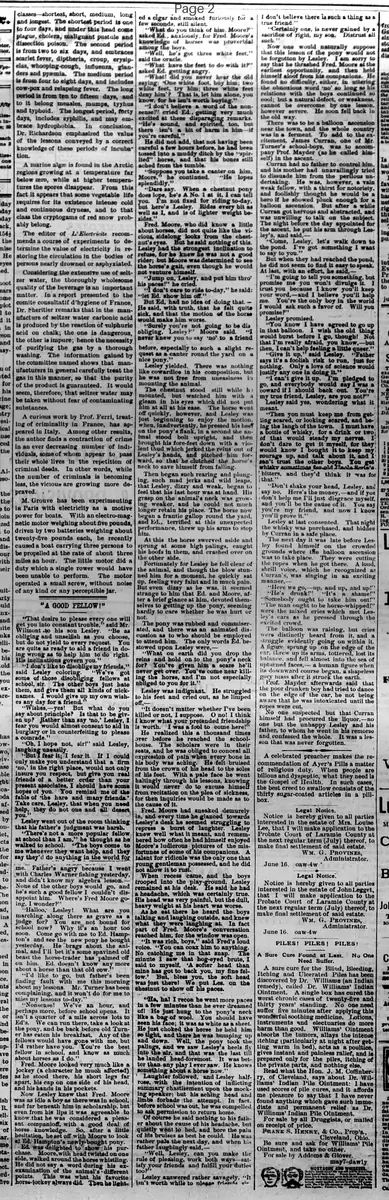
"A GOOD FELLOW!"
"That desire to please every one will get you into constant trouble," said Mr. Wilmont to his son Lesley. "Be as obliging and unselfish as you choose, but do not yield to every request. You are quite as ready to aid a friend in doing wrong as to help him to do right. His inclinations govern you."
"I don't like to disoblige my friends," said Lesley coloring. "We've got some of those disobliging fellows at school, sir. The other boys just hate them, and give them all kinds of nicknames. I would give up my own wishes any day for a friend."
"Wishes,—yes! But what do you say about principle? Is that to be given up? Rather than say 'no,' Lesley, I fear you would almost consent to aid in burglary or in counterfeiting to please a comrade."
"Oh, I hope not, sir!" said Lesley, laughing uneasily. "But I fear it: I fear it. If I could only make you understand that a firm 'no,' in the right place, would not only insure you respect, but give you real friends of a better order than your present associates, I should have some hopes of you. You remind me of the fable of the hare and many friends. Take care, Lesley, that when you need help, they do not one and all desert you."
Lesley went out of the room thinking that his father's judgment was harsh. "There's not a more popular fellow at school than I am," he thought as he walked to school. "The boys come to me whenever they want help, and they say they'd do anything in the world for me. Father's angry because I went with Charles Warner fishing yesterday, and didn't know my algebra lesson. None of the other boys would go, and he's such a good fellow I couldn't disappoint him. Where's Fred Moore going, I wonder?"
"Halloo, Lesley! What are you marching along there as grave as a judge for? You are not bound for school now? Why it's an hour too soon. Come go with me to Ed. Hampton's and see the new pony he bought yesterday. He brags about the animal, and I'll bet it's some spavined old beast the horse-trader has palmed off on him. Ed. doesn't know any more about a horse than that old cow."
"I'd like to go, but father's been finding fault with me this morning about my lessons. Mr. Turner has been complaining, and it won't do for me to miss my lessons to-day."
"Nonsense! We've an hour, and perhaps more, before school opens. It isn't a quarter of a mile across lots to Ed's. We can run there, take a look at the pony, and be back before old Turner has eaten his breakfast. Any of the fellows would have gone with me, but I'd rather have you. You're the best fellow in school, and know as much about horses as I do."
Fred. Moore looked very much like a jockey (a character he much affected) as he stood there, his short legs far apart, his cap on one side of his head, and his hands in his pockets.
Now Lesley knew that Fred. Moore was as idle a boy as there was in school, and far beneath him in scholarship, but even from his lips it was agreeable to know that he was considered a pleasant companion, with a good deal of horse knowledge. So, after a little hesitation, he set off with Moore to look at Ed. Hampton's newly-bought pony.
Ed was delighted to show his purchase. Moore, with head twisted on one side, walked around the horse whistling. He did not say a word during his examination of the animal's different points. This was what his favorite horse-jockey always did. Then he lighted a cigar and smoked furiously for a few seconds, still silent.
"What do you think of him, Moore?" asked Ed, anxiously; for Fred Moore's knowledge of horses was proverbial among the boys.
"Well, he's got three white feet," said the oracle.
"What have the feet to do with it?" asked Ed, getting angry. "What! did you never hear the old saying: One white foot, buy him; two white feet, try him; three white feet, deny him'? That is, let him alone, you know, for he isn't worth buying."
"I don't believe a word of the nonsense!" cried Ed., getting very much excited at these disparaging remarks. "He's sound, and spirited, too, but there isn't a bit of harm in him if you're careful."
He did not add, that not having been careful a few hours before, he had been tossed into a muddy ditch by the "spirited" horse, and that his bones still ached from the tumble.
"Suppose you take a canter on him, Moore," he continued. "He lopes splendidly."
"Dare say. When a chestnut pony does lope, he's A No. 1 at it, I can tell you. I'm not fixed for riding to-day, but here's Lesley. Rides every bit as well as I, and is of lighter weight besides."
Fred. Moore, who did know a little about horses, did not quite like the vicious, sidelong looks from the chestnut's eyes. But he said nothing of this.
Lesley had the strongest inclination to refuse, for he knew he was not a good rider; but Moore was determined to see the horse's gait, even though he would not venture himself.
"Jump on, Lesley, and put him through his paces!" he cried.
"I don't care to ride to-day," he said; "let Ed. show him off."
But Ed. had no idea of doing that. He said, with truth, that he felt quite sick, and that the motion of the horse would make him worse.
"Surely you're not going to be disobliging, Lesley?" Moore said. "I never knew you to say 'no' to a friend before, especially to such a slight request as a canter round the yard on a nice pony."
Lesley yielded. There was nothing like cowardice in his composition, but he was not free from uneasiness in mounting the animal.
The chestnut stood still while he mounted, but watched him with a gleam in his eyes which did not put him at all at his ease. The horse went off quickly, however, and Lesley was just beginning to enjoy the motion, when, inadvertently, he pressed his heel on the pony's flank. In a second the animal stood bolt upright, and then brought his fore-feet down with a violent thud which jerked the reins out of Lesley's hands, and pitched him forward, so that he clutched the horse's neck to save himself from falling.
Then began such rearing and plunging, such mad jerks and wild leaps, that Lesley, dizzy and weak, began to feel that his last hour was at hand. His grasp on the animal's neck was growing weaker, and he could not much longer retain his place. The horse now began a frantic gallop round the yard, and Ed., terrified at this unexpected performance, threw up his arms to stop him.
At this the horse swerved aside and sprung at some high palings, caught his hoofs in them, and crashed over on the other side.
Fortunately for Lesley he fell clear of the animal, and though the blow stunned him for a moment, he quickly sat up, feeling very faint and in much pain. But even dizzy as he was, it seemed strange to him that Ed. and Moore, after a brief glance at him, devoted themselves to getting up the pony, seeming hardly to care whether he was hurt or not.
The pony was rubbed and commiserated, and there was an animated discussion as to who should be employed to attend him. The only words Ed. bestowed upon Lesley were,
"What on earth did you drop the reins and hold on to the pony's neck for? You've given him a scare he'll never get over. You've come near killing the horse, and I'm not especially obliged to you for it."
Lesley was indignant. He struggled to his feet and cried out, as he limped off,
"It doesn't matter whether I've been killed or not, I suppose. Oh no! I think I know what your pretended friendship is worth. I was a fool to come here!"
He realized this a thousand times over before he reached the school-house. The scholars were in their seats, and he was obliged to conceal all expression of pain when every bone in his body was aching. He felt bruised from the crown of his head to the soles of his feet. With a pale face he went haltingly through his lessons, knowing it would never do to excuse himself from recitation on the plea of sickness, for then inquiries would be made as to the cause of it.
Fred. Moore had sneaked demurely in, and every time he glanced towards Lesley's desk he seemed struggling to repress a burst of laughter. Lesley knew well what it meant, and remembered how often he had himself enjoyed Moore's ludicrous pictures of the misfortunes of some of his companions. A talent for ridicule was the only one that young gentleman possessed, and he did not allow it to rust.
When recess came, and the boys trooped into the play-ground, Lesley remained at his desk. He said he had a headache, which was certainly true. His head was very painful, but the dull, heavy weight at his heart was worse.
As he sat there he heard the boys talking and laughing outside, and knew what they were laughing at. In fact part of Fred. Moore's conversation reached him, for the window was open.
"It was rich, boys," said Fred's loud voice. "You can coax him to anything. No catching me in that snap. The minute I saw that hog-eyed brute, I said to myself, 'A softer head than mine has got to back you, my fine fellow.' But, bless you, the soft head was just there! We put Les. on the chestnut to show off his paces."
"Ha, ha! I reckon he went more paces in a few minutes than he ever dreamed of. He just hung to the pony's neck like a bag of wool. You should have seen his face: it was as white as a sheet. He just choked the horse he held him so tight, and there he was bumping up and down. Well, the pony took the palings, and we saw Lesley's heels fly into the air, and that was the last till he landed head-foremost. It was better than any play I ever saw. He knows something about a horse now."
Laughter followed, and Lesley half-rose, with the intention of inflicting summary chastisement upon the mocking speaker; but his aching head and limbs forbade the attempt. In fact, before school was out, he was compelled to ask permission to return home.
Of course he said nothing to his father about the cause of his headache, but quietly went to bed, and bore the pain of his bruises as best he could. He was rather pale the next day, and when his father laughingly said,
"Well, Lesley, can you make the rule of pleasing work both ways—satisfy your friends and fulfil your duties too?"
Lesley answered rather savagely, "It isn't worth while to please friends either. I don't believe there is such a thing as a true friend."
"Certainly one is never gained by a sacrifice of right, my son. Distrust all such."
Now one would naturally suppose that this lesson of the pony would not be forgotten by Lesley. I'm sorry to say that he thrashed Fred. Moore at the earliest opportunity, and then held himself aloof from his companions. He found no difficulty, either, in uttering the obnoxious word 'no' so long as his relations with the boys continued so cool; but a natural defect, or weakness, cannot be overcome by one lesson, however severe. He soon fell back in the old way.
There was to be a balloon ascension near the town, and the whole country was in a ferment. To add to the excitement, James Curran, one of Mr. Turner's school-boys, was to accompany Prof. Mayder (as he called himself) in the ascent.
Curran had no father to control him, and his mother had unavailingly tried to dissuade him from the perilous undertaking. He was, however, a vain weak fellow, with a thirst for notoriety, and foolishly thought he would be a hero if he showed pluck enough for a balloon ascension. But after a while Curran got nervous and abstracted, and was unwilling to talk on the subject.
The night before the day appointed for the ascent, he put his arm through Lesley's, and said,—
"Come, Lesley, let's walk down to the pond. I've got something I want to say to you."
But when they had reached the pond he did not seem to find it easy to speak. At last, with an effort, he said,—
"I'm going to tell you something, but promise me you won't divulge it. I trust you because I know you'll keep your word,—and I believe you'll help me. You're the only boy in the world I would ask such a favor of. Will you promise?"
Lesley promised.
"You know I have agreed to go up in that balloon. I wish the old thing would burst before I go, though! Not that I'm really afraid, you know,—but then, I can't help feeling a little queer."
"Give it up," said Lesley. "Father says it's a foolish risk to run, just for nothing. Only a love of science would justify any one in doing it."
"I can't give it up. I'm pledged to go, and everybody would say I was a coward if I should back out. You're my true friend, Lesley, are you not?"
Lesley said yes, wondering what it meant.
"Then you must keep me from getting scared, or looking scared, and being the laugh of the town. I must have a bottle of whisky, for a drink or two of that would steady my nerves. I don't dare to get it myself, for they would know I bought it to keep my courage up, and talk about it, and I can't trust the other boys. You get whisky sometimes for old Hank Sorin's bitters, and they'd think it was for that."
"Don't shake your head, Lesley, and say no. Here's the money,—and if you don't help me I'll just disgrace myself and you'll be the cause of it. You say you're my friend, and now I know you'll prove it."
Lesley at last consented. That night the whisky was purchased, and hidden by Curran in a safe place.
The next day it was late before Lesley found himself on the crowded grounds where the balloon ascension was to take place. They were cutting the ropes when he got there. A loud, shrill voice, which he recognized as Curran's, was singing in an exciting manner,—
"Here we go,—up, and up, and up!"
"He's drunk!" "It's a shame!" "Somebody ought to take him out!" "The man ought to be horse-whipped!" were the mixed cries which met Lesley's ears as he pressed through the excited crowd.
The balloon was rising, but cries were distinctly heard from it, and a struggle evidently going on within it. A figure sprung up on the edge of the car, threw up its arms, tottered, lost its balance, and fell almost into the sea of upturned faces,—a human figure when its downward course began, a shapeless gory mass after it struck the earth.
Prof. Mayder afterwards said that the poor drunken boy had tried to dance on the edge of the car, he not being aware that he was intoxicated until the ropes were cut.
No one suspected but that Curran himself had procured the liquor,—no one but the unhappy Lesley and his father, to whom he went in his remorse and confessed the whole. It was a lesson that was never forgotten.
"That desire to please every one will get you into constant trouble," said Mr. Wilmont to his son Lesley. "Be as obliging and unselfish as you choose, but do not yield to every request. You are quite as ready to aid a friend in doing wrong as to help him to do right. His inclinations govern you."
"I don't like to disoblige my friends," said Lesley coloring. "We've got some of those disobliging fellows at school, sir. The other boys just hate them, and give them all kinds of nicknames. I would give up my own wishes any day for a friend."
"Wishes,—yes! But what do you say about principle? Is that to be given up? Rather than say 'no,' Lesley, I fear you would almost consent to aid in burglary or in counterfeiting to please a comrade."
"Oh, I hope not, sir!" said Lesley, laughing uneasily. "But I fear it: I fear it. If I could only make you understand that a firm 'no,' in the right place, would not only insure you respect, but give you real friends of a better order than your present associates, I should have some hopes of you. You remind me of the fable of the hare and many friends. Take care, Lesley, that when you need help, they do not one and all desert you."
Lesley went out of the room thinking that his father's judgment was harsh. "There's not a more popular fellow at school than I am," he thought as he walked to school. "The boys come to me whenever they want help, and they say they'd do anything in the world for me. Father's angry because I went with Charles Warner fishing yesterday, and didn't know my algebra lesson. None of the other boys would go, and he's such a good fellow I couldn't disappoint him. Where's Fred Moore going, I wonder?"
"Halloo, Lesley! What are you marching along there as grave as a judge for? You are not bound for school now? Why it's an hour too soon. Come go with me to Ed. Hampton's and see the new pony he bought yesterday. He brags about the animal, and I'll bet it's some spavined old beast the horse-trader has palmed off on him. Ed. doesn't know any more about a horse than that old cow."
"I'd like to go, but father's been finding fault with me this morning about my lessons. Mr. Turner has been complaining, and it won't do for me to miss my lessons to-day."
"Nonsense! We've an hour, and perhaps more, before school opens. It isn't a quarter of a mile across lots to Ed's. We can run there, take a look at the pony, and be back before old Turner has eaten his breakfast. Any of the fellows would have gone with me, but I'd rather have you. You're the best fellow in school, and know as much about horses as I do."
Fred. Moore looked very much like a jockey (a character he much affected) as he stood there, his short legs far apart, his cap on one side of his head, and his hands in his pockets.
Now Lesley knew that Fred. Moore was as idle a boy as there was in school, and far beneath him in scholarship, but even from his lips it was agreeable to know that he was considered a pleasant companion, with a good deal of horse knowledge. So, after a little hesitation, he set off with Moore to look at Ed. Hampton's newly-bought pony.
Ed was delighted to show his purchase. Moore, with head twisted on one side, walked around the horse whistling. He did not say a word during his examination of the animal's different points. This was what his favorite horse-jockey always did. Then he lighted a cigar and smoked furiously for a few seconds, still silent.
"What do you think of him, Moore?" asked Ed, anxiously; for Fred Moore's knowledge of horses was proverbial among the boys.
"Well, he's got three white feet," said the oracle.
"What have the feet to do with it?" asked Ed, getting angry. "What! did you never hear the old saying: One white foot, buy him; two white feet, try him; three white feet, deny him'? That is, let him alone, you know, for he isn't worth buying."
"I don't believe a word of the nonsense!" cried Ed., getting very much excited at these disparaging remarks. "He's sound, and spirited, too, but there isn't a bit of harm in him if you're careful."
He did not add, that not having been careful a few hours before, he had been tossed into a muddy ditch by the "spirited" horse, and that his bones still ached from the tumble.
"Suppose you take a canter on him, Moore," he continued. "He lopes splendidly."
"Dare say. When a chestnut pony does lope, he's A No. 1 at it, I can tell you. I'm not fixed for riding to-day, but here's Lesley. Rides every bit as well as I, and is of lighter weight besides."
Fred. Moore, who did know a little about horses, did not quite like the vicious, sidelong looks from the chestnut's eyes. But he said nothing of this.
Lesley had the strongest inclination to refuse, for he knew he was not a good rider; but Moore was determined to see the horse's gait, even though he would not venture himself.
"Jump on, Lesley, and put him through his paces!" he cried.
"I don't care to ride to-day," he said; "let Ed. show him off."
But Ed. had no idea of doing that. He said, with truth, that he felt quite sick, and that the motion of the horse would make him worse.
"Surely you're not going to be disobliging, Lesley?" Moore said. "I never knew you to say 'no' to a friend before, especially to such a slight request as a canter round the yard on a nice pony."
Lesley yielded. There was nothing like cowardice in his composition, but he was not free from uneasiness in mounting the animal.
The chestnut stood still while he mounted, but watched him with a gleam in his eyes which did not put him at all at his ease. The horse went off quickly, however, and Lesley was just beginning to enjoy the motion, when, inadvertently, he pressed his heel on the pony's flank. In a second the animal stood bolt upright, and then brought his fore-feet down with a violent thud which jerked the reins out of Lesley's hands, and pitched him forward, so that he clutched the horse's neck to save himself from falling.
Then began such rearing and plunging, such mad jerks and wild leaps, that Lesley, dizzy and weak, began to feel that his last hour was at hand. His grasp on the animal's neck was growing weaker, and he could not much longer retain his place. The horse now began a frantic gallop round the yard, and Ed., terrified at this unexpected performance, threw up his arms to stop him.
At this the horse swerved aside and sprung at some high palings, caught his hoofs in them, and crashed over on the other side.
Fortunately for Lesley he fell clear of the animal, and though the blow stunned him for a moment, he quickly sat up, feeling very faint and in much pain. But even dizzy as he was, it seemed strange to him that Ed. and Moore, after a brief glance at him, devoted themselves to getting up the pony, seeming hardly to care whether he was hurt or not.
The pony was rubbed and commiserated, and there was an animated discussion as to who should be employed to attend him. The only words Ed. bestowed upon Lesley were,
"What on earth did you drop the reins and hold on to the pony's neck for? You've given him a scare he'll never get over. You've come near killing the horse, and I'm not especially obliged to you for it."
Lesley was indignant. He struggled to his feet and cried out, as he limped off,
"It doesn't matter whether I've been killed or not, I suppose. Oh no! I think I know what your pretended friendship is worth. I was a fool to come here!"
He realized this a thousand times over before he reached the school-house. The scholars were in their seats, and he was obliged to conceal all expression of pain when every bone in his body was aching. He felt bruised from the crown of his head to the soles of his feet. With a pale face he went haltingly through his lessons, knowing it would never do to excuse himself from recitation on the plea of sickness, for then inquiries would be made as to the cause of it.
Fred. Moore had sneaked demurely in, and every time he glanced towards Lesley's desk he seemed struggling to repress a burst of laughter. Lesley knew well what it meant, and remembered how often he had himself enjoyed Moore's ludicrous pictures of the misfortunes of some of his companions. A talent for ridicule was the only one that young gentleman possessed, and he did not allow it to rust.
When recess came, and the boys trooped into the play-ground, Lesley remained at his desk. He said he had a headache, which was certainly true. His head was very painful, but the dull, heavy weight at his heart was worse.
As he sat there he heard the boys talking and laughing outside, and knew what they were laughing at. In fact part of Fred. Moore's conversation reached him, for the window was open.
"It was rich, boys," said Fred's loud voice. "You can coax him to anything. No catching me in that snap. The minute I saw that hog-eyed brute, I said to myself, 'A softer head than mine has got to back you, my fine fellow.' But, bless you, the soft head was just there! We put Les. on the chestnut to show off his paces."
"Ha, ha! I reckon he went more paces in a few minutes than he ever dreamed of. He just hung to the pony's neck like a bag of wool. You should have seen his face: it was as white as a sheet. He just choked the horse he held him so tight, and there he was bumping up and down. Well, the pony took the palings, and we saw Lesley's heels fly into the air, and that was the last till he landed head-foremost. It was better than any play I ever saw. He knows something about a horse now."
Laughter followed, and Lesley half-rose, with the intention of inflicting summary chastisement upon the mocking speaker; but his aching head and limbs forbade the attempt. In fact, before school was out, he was compelled to ask permission to return home.
Of course he said nothing to his father about the cause of his headache, but quietly went to bed, and bore the pain of his bruises as best he could. He was rather pale the next day, and when his father laughingly said,
"Well, Lesley, can you make the rule of pleasing work both ways—satisfy your friends and fulfil your duties too?"
Lesley answered rather savagely, "It isn't worth while to please friends either. I don't believe there is such a thing as a true friend."
"Certainly one is never gained by a sacrifice of right, my son. Distrust all such."
Now one would naturally suppose that this lesson of the pony would not be forgotten by Lesley. I'm sorry to say that he thrashed Fred. Moore at the earliest opportunity, and then held himself aloof from his companions. He found no difficulty, either, in uttering the obnoxious word 'no' so long as his relations with the boys continued so cool; but a natural defect, or weakness, cannot be overcome by one lesson, however severe. He soon fell back in the old way.
There was to be a balloon ascension near the town, and the whole country was in a ferment. To add to the excitement, James Curran, one of Mr. Turner's school-boys, was to accompany Prof. Mayder (as he called himself) in the ascent.
Curran had no father to control him, and his mother had unavailingly tried to dissuade him from the perilous undertaking. He was, however, a vain weak fellow, with a thirst for notoriety, and foolishly thought he would be a hero if he showed pluck enough for a balloon ascension. But after a while Curran got nervous and abstracted, and was unwilling to talk on the subject.
The night before the day appointed for the ascent, he put his arm through Lesley's, and said,—
"Come, Lesley, let's walk down to the pond. I've got something I want to say to you."
But when they had reached the pond he did not seem to find it easy to speak. At last, with an effort, he said,—
"I'm going to tell you something, but promise me you won't divulge it. I trust you because I know you'll keep your word,—and I believe you'll help me. You're the only boy in the world I would ask such a favor of. Will you promise?"
Lesley promised.
"You know I have agreed to go up in that balloon. I wish the old thing would burst before I go, though! Not that I'm really afraid, you know,—but then, I can't help feeling a little queer."
"Give it up," said Lesley. "Father says it's a foolish risk to run, just for nothing. Only a love of science would justify any one in doing it."
"I can't give it up. I'm pledged to go, and everybody would say I was a coward if I should back out. You're my true friend, Lesley, are you not?"
Lesley said yes, wondering what it meant.
"Then you must keep me from getting scared, or looking scared, and being the laugh of the town. I must have a bottle of whisky, for a drink or two of that would steady my nerves. I don't dare to get it myself, for they would know I bought it to keep my courage up, and talk about it, and I can't trust the other boys. You get whisky sometimes for old Hank Sorin's bitters, and they'd think it was for that."
"Don't shake your head, Lesley, and say no. Here's the money,—and if you don't help me I'll just disgrace myself and you'll be the cause of it. You say you're my friend, and now I know you'll prove it."
Lesley at last consented. That night the whisky was purchased, and hidden by Curran in a safe place.
The next day it was late before Lesley found himself on the crowded grounds where the balloon ascension was to take place. They were cutting the ropes when he got there. A loud, shrill voice, which he recognized as Curran's, was singing in an exciting manner,—
"Here we go,—up, and up, and up!"
"He's drunk!" "It's a shame!" "Somebody ought to take him out!" "The man ought to be horse-whipped!" were the mixed cries which met Lesley's ears as he pressed through the excited crowd.
The balloon was rising, but cries were distinctly heard from it, and a struggle evidently going on within it. A figure sprung up on the edge of the car, threw up its arms, tottered, lost its balance, and fell almost into the sea of upturned faces,—a human figure when its downward course began, a shapeless gory mass after it struck the earth.
Prof. Mayder afterwards said that the poor drunken boy had tried to dance on the edge of the car, he not being aware that he was intoxicated until the ropes were cut.
No one suspected but that Curran himself had procured the liquor,—no one but the unhappy Lesley and his father, to whom he went in his remorse and confessed the whole. It was a lesson that was never forgotten.
What sub-type of article is it?
Prose Fiction
What themes does it cover?
Moral Virtue
Friendship
What keywords are associated?
False Friendship
Moral Lesson
Boyhood Misadventures
Principle
Dangerous Yielding
Literary Details
Title
A Good Fellow!
Key Lines
"That Desire To Please Every One Will Get You Into Constant Trouble," Said Mr. Wilmont To His Son Lesley. "Be As Obliging And Unselfish As You Choose, But Do Not Yield To Every Request. You Are Quite As Ready To Aid A Friend In Doing Wrong As To Help Him To Do Right. His Inclinations Govern You."
"Certainly One Is Never Gained By A Sacrifice Of Right, My Son. Distrust All Such."
It Was A Lesson That Was Never Forgotten.