Thank you for visiting SNEWPapers!
Sign up free
Alexandria Gazette & Daily Advertiser
Alexandria, Virginia
What is this article about?
Franz Joseph Haydn, aged 78, died in Vienna on May 31, 1809, during the French bombardment of the city amid the Austria-France war. The account details his final days, religious faith, and refusal to leave his home despite the invasion.
Clipping
OCR Quality
Full Text
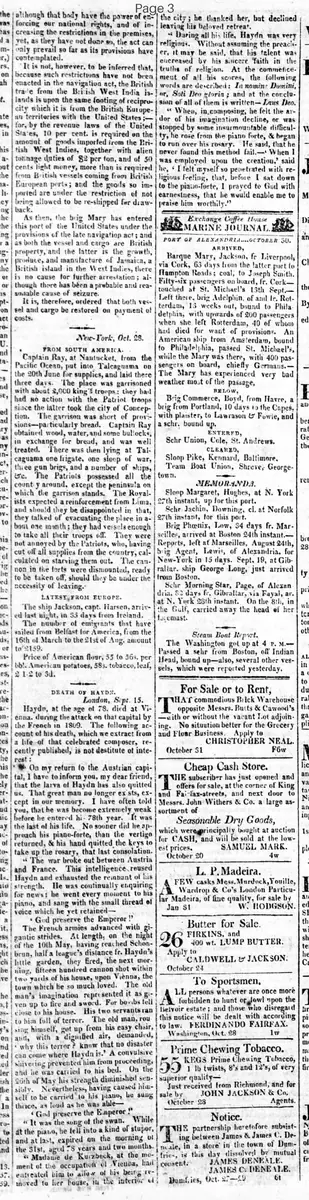
London, Sept. 15.
Haydn, at the age of 78, died at Vienna, during the attack on that capital by the French in 1809. The following account of his death, which we extract from a life of that celebrated composer, recently published, is not destitute of interest:
On my return to the Austrian capital, I have to inform you, my dear friend, that the larva of Haydn has also quitted us. That great man no longer exists, except in our memory. I have often told you, that he was become extremely weak before he entered his 78th year. It was the last of his life. No sooner did he approach his piano-forte, than the vertigo returned, & his hand quitted the keys to take up the rosary, that last consolation.
The war broke out between Austria and France. This intelligence roused Haydn and exhausted the remnant of his strength. He was continually enquiring for news; he went every moment to his piano, and sang with the small thread of voice which he yet retained--
'God preserve the Emperor!'
The French armies advanced with gigantic strides. At length, on the night of the 10th May, having reached Schonbrunn, half a league's distance from Haydn's little garden, they fired, the next morning, fifteen hundred cannon shot within two hours of his house, upon Vienna, the town which he so much loved. The old man's imagination represented it as given up to fire and sword. For bombs fell close to his house. His two servants ran to him full of terror. The old man, rousing himself, got up from his easy chair, and, with a dignified air, demanded,
'why this terror? know that no disaster can come where Haydn is.' A convulsive shivering prevented him from proceeding, and he was carried to his bed. On the 26th of May his strength diminished sensibly. Nevertheless, having caused himself to be carried to his piano, he sung thrice, as loud as he was able--
'God preserve the Emperor!'
It was the song of the swan. While at the piano, he fell into a kind of stupor, and at last, expired on the morning of the 31st, aged 78 years and two months.
Madame de Kurzbeck, at the moment of the occupation of Vienna, had entreated him to allow of his being removed to her house, in the interior of the city; he thanked her, but declined leaving his beloved retreat.
During all his life, Haydn was very religious. Without assuming the preacher, it may be said, that his talent was increased by his sincere faith in the truths of religion. At the commencement of all his scores, the following words are described: In nomine Domini, or, Soli Deo gloria: and at the conclusion of all of them is written--Laus Deo.
When, in composing, he felt the ardor of his imagination decline, or was stopped by some insurmountable difficulty, he rose from the piano forte, & began to run over his rosary. He said, that he never found this method fail.--'When I was employed upon the creation,' said he, 'I felt myself so penetrated with religious feeling, that, before I sat down to the piano-forte, I prayed to God with earnestness, that he would enable me to praise him worthily.'
What sub-type of article is it?
What keywords are associated?
What entities or persons were involved?
Where did it happen?
Foreign News Details
Primary Location
Vienna
Event Date
1809 05 31
Key Persons
Outcome
haydn died aged 78 years and two months during the french bombardment of vienna.
Event Details
Haydn, weakened and religious, spent his final days in Vienna amid the 1809 Austria-France war. He inquired about news, sang 'God preserve the Emperor!' at his piano, and refused to flee the bombardment from Schonbrunn. On May 26, he sang the anthem thrice before falling into stupor and dying on May 31.