Thank you for visiting SNEWPapers!
Sign up free
The Bismarck Tribune
Bismarck, Mandan, Burleigh County, Morton County, North Dakota
What is this article about?
Review of Count Felix von Luckner's talk on his WWI South Seas raider adventures, depicted as thrilling, bloodless exploits akin to pirate tales, with no fatalities and luxurious treatment of prisoners. He draws parallels to his boyhood idol Buffalo Bill, now embodying similar heroism. Presented to women's club in Bismarck.
Clipping
OCR Quality
Full Text
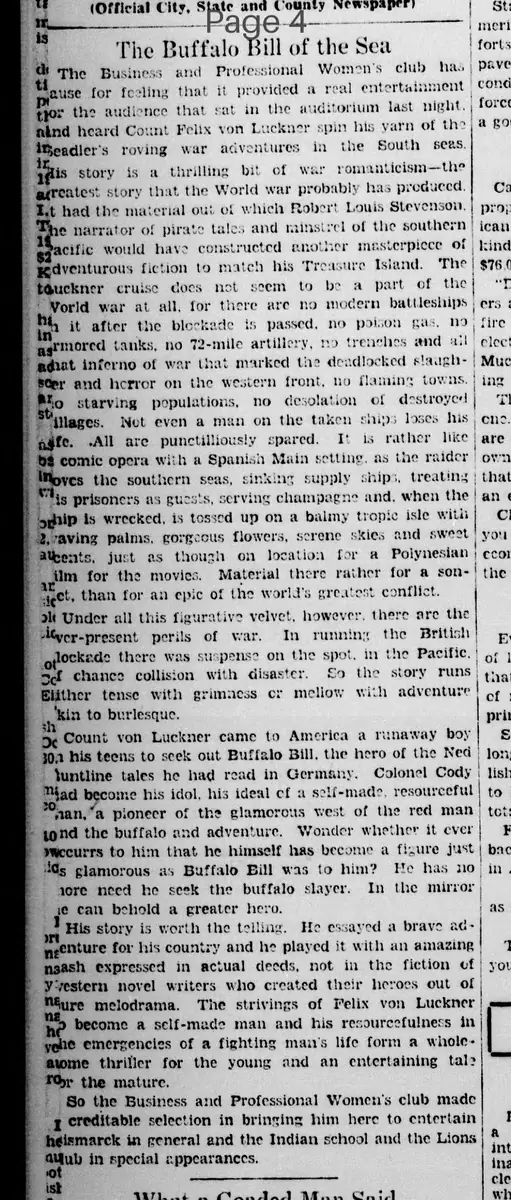
The Business and Professional Women's club has cause for feeling that it provided a real entertainment for the audience that sat in the auditorium last night. Men heard Count Felix von Luckner spin his yarn of the raider's roving war adventures in the South seas. His story is a thrilling bit of war romanticism-the greatest story that the World war probably has produced. It had the material out of which Robert Louis Stevenson, the narrator of pirate tales and minstrel of the southern adventurous fiction to match his Treasure Island. The Pacific would have constructed another masterpiece out of Luckner cruise does not seem to be a part of the World war at all, for there are no modern battleships which it after the blockade is passed, no poison gas, no armored tanks, no 72-mile artillery, no trenches and all that inferno of war that marked the deadlocked slaughter scene and horror on the western front, no flaming towns, no starving populations, no desolation of destroyed villages. Not even a man on the taken ships loses his life. All are punctiliously spared. It is rather like a comic opera with a Spanish Main setting, as the raider moves the southern seas, sinking supply ships, treating its prisoners as guests, serving champagne and, when the ship is wrecked, is tossed up on a balmy tropic isle with waving palms, gorgeous flowers, serene skies and sweet accents, just as though on location for a Polynesian film for the movies. Material there rather for a sonnet, than for an epic of the world's greatest conflict. But under all this figurative velvet, however, there are the ever-present perils of war. In running the British blockade there was suspense on the spot, in the Pacific, a chance collision with disaster. So the story runs either tense with grimness or mellow with adventure akin to burlesque.
Count von Luckner came to America a runaway boy in his teens to seek out Buffalo Bill, the hero of the Ned Buntline tales he had read in Germany. Colonel Cody had become his idol, his ideal of a self-made, resourceful man, a pioneer of the glamorous west of the red man and the buffalo and adventure. Wonder whether it ever occurs to him that he himself has become a figure just as glamorous as Buffalo Bill was to him? He has no more need he seek the buffalo slayer. In the mirror he can behold a greater hero.
His story is worth the telling. He essayed a brave adventure for his country and he played it with an amazing dash expressed in actual deeds, not in the fiction of western novel writers who created their heroes out of pure melodrama. The strivings of Felix von Luckner to become a self-made man and his resourcefulness in the emergencies of a fighting man's life form a wholesome thriller for the young and an entertaining tale for the mature.
So the Business and Professional Women's club made a creditable selection in bringing him here to entertain Bismarck in general and the Indian school and the Lions club in special appearances.
What sub-type of article is it?
What themes does it cover?
What keywords are associated?
What entities or persons were involved?
Where did it happen?
Story Details
Key Persons
Location
South Seas, Pacific, Bismarck
Event Date
World War
Story Details
Count Felix von Luckner recounts his thrilling WWI raider adventures in the South Seas, portrayed as romantic and bloodless like a comic opera, with no lives lost and prisoners treated as guests. Inspired by Buffalo Bill as a boy, he becomes a glamorous hero himself through daring deeds and resourcefulness.