Thank you for visiting SNEWPapers!
Sign up free
The National Intelligencer And Washington Advertiser
Washington, District Of Columbia
What is this article about?
On May 22, 1803, in Tullamore, Ireland, a brawl erupted between Irish militia and German soldiers after a militia-man attacked a German, leading to armed clashes. Cavalry intervention ended the affray, with casualties on both sides.
Clipping
OCR Quality
Full Text
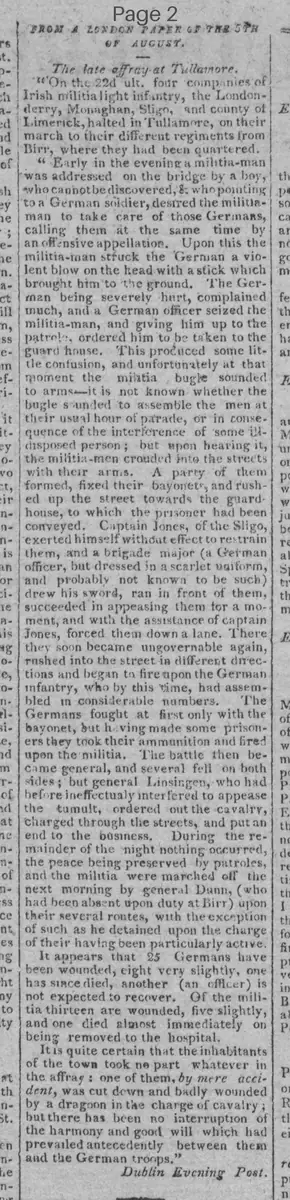
The late affray at Tullamore.
On the 22d ult. four companies of Irish militia light infantry, the Londonderry, Monaghan, Sligo, and county of Limerick, halted in Tullamore, on their march to their different regiments from Birr, where they had been quartered.
Early in the evening a militia-man was addressed on the bridge by a boy, who cannot be discovered, & who pointing to a German soldier, desired the militia-man to take care of those Germans, calling them at the same time by an offensive appellation. Upon this the militia-man struck the German a violent blow on the head with a stick which brought him to the ground. The German being severely hurt, complained much, and a German officer seized the militia-man, and giving him up to the patrol, ordered him to be taken to the guard house. This produced some little confusion, and unfortunately at that moment the militia bugle sounded to arms—it is not known whether the bugle sounded to assemble the men at their usual hour of parade, or in consequence of the interference of some ill-disposed person; but upon hearing it, the militia-men crowded into the streets with their arms. A party of them formed, fixed their bayonets, and rushed up the street towards the guard house, to which the prisoner had been conveyed. Captain Jones, of the Sligo, exerted himself without effect to restrain them, and a brigade major (a German officer, but dressed in a scarlet uniform, and probably not known to be such) drew his sword, ran in front of them, succeeded in appeasing them for a moment, and with the assistance of captain Jones, forced them down a lane. There they soon became ungovernable again, rushed into the street in different directions and began to fire upon the German infantry, who by this time, had assembled in considerable numbers. The Germans fought at first only with the bayonet, but having made some prisoners they took their ammunition and fired upon the militia. The battle then became general, and several fell on both sides; but general Linsingen, who had before ineffectually interfered to appease the tumult, ordered out the cavalry, charged through the streets, and put an end to the business. During the remainder of the night nothing occurred, the peace being preserved by patrols, and the militia were marched off the next morning by general Dann, (who had been absent upon duty at Birr) upon their several routes, with the exception of such as he detained upon the charge of their having been particularly active.
It appears that 25 Germans have been wounded, eight very slightly, one has since died, another (an officer) is not expected to recover. Of the militia thirteen are wounded, five slightly, and one died almost immediately on being removed to the hospital.
It is quite certain that the inhabitants of the town took no part whatever in the affray : one of them, by mere accident, was cut down and badly wounded by a dragoon in the charge of cavalry; but there has been no interruption of the harmony and good will which had prevailed antecedently between them and the German troops."
Dublin Evening Post.
What sub-type of article is it?
What keywords are associated?
What entities or persons were involved?
Where did it happen?
Foreign News Details
Primary Location
Tullamore
Event Date
22d Ult.
Key Persons
Outcome
25 germans wounded (eight slightly), one german died, one german officer not expected to recover; 13 militia wounded (five slightly), one militia died; affray ended by cavalry charge, militia marched off next morning with some detained.
Event Details
Four companies of Irish militia (Londonderry, Monaghan, Sligo, county of Limerick) halted in Tullamore on march from Birr. A militia-man, provoked by a boy, struck a German soldier. German officer arrested the militia-man, leading to confusion. Militia bugle sounded, men armed and rushed guard house. Captain Jones and brigade major (German officer) tried to restrain them unsuccessfully. Militia fired on assembled Germans, who responded with bayonets then gunfire after capturing ammunition. General Linsingen ordered cavalry to charge and end the battle. Inhabitants uninvolved except one accidentally wounded.