Thank you for visiting SNEWPapers!
Sign up free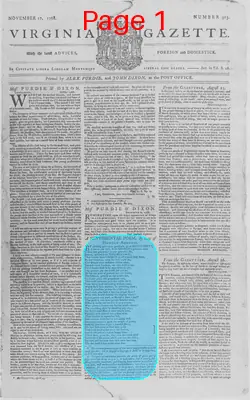
Poem
November 17, 1768
The Virginia Gazette
Richmond, Williamsburg, Richmond County, Virginia
What is this article about?
A poetic address to a 'great Sir' from Virginia, urging Britain under George to avoid taxing colonies, arguing that planters support British manufacturers and that freedom and love bind parent-child nations, warning against coercive rule.
Clipping
OCR Quality
95%
Excellent
Full Text
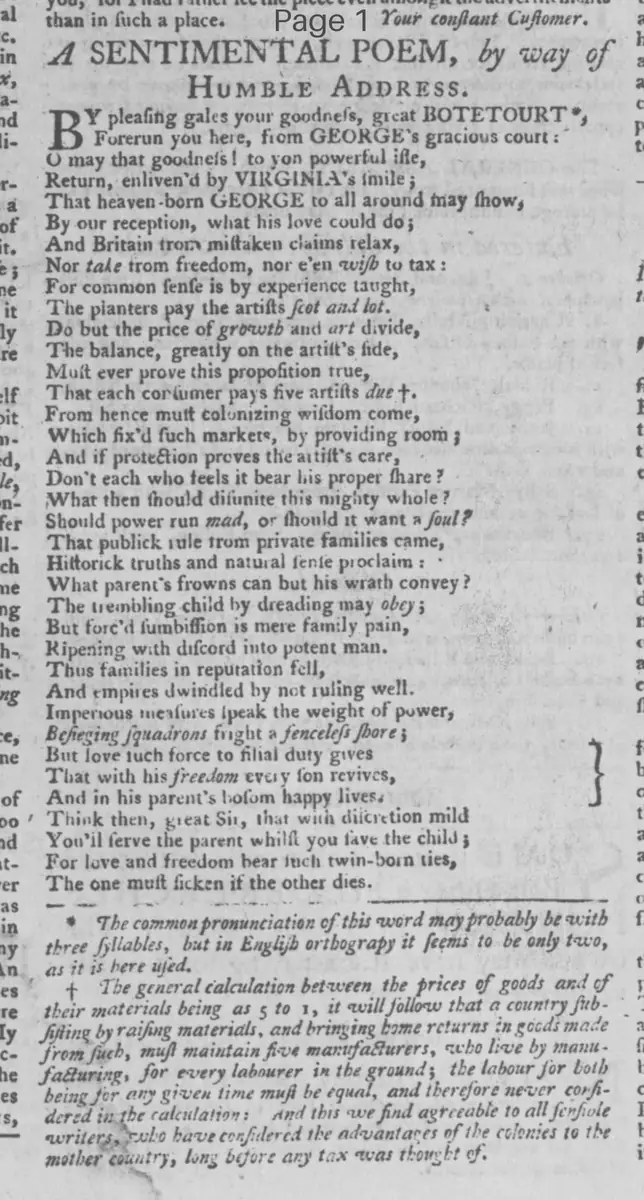
A SENTIMENTAL POEM, by Way of
Humble Address.
By pleasing gales your goodness, great Sir, to our
Forerun you here, from GEORGE's gracious court:
O may that goodness! to yon powerful wife,
Return, enliven'd by VIRGINIA's smile;
That heaven-born GEORGE to all around may show,
By our reception, what his love could do;
And Britain from mistaken claims relax,
Nor take from freedom, nor e'en wish to tax:
For common sense is by experience taught,
The planters pay the artists cot and lot.
Do but the price of growth and art divide,
The balance, greatly on the artist's side,
Must ever prove this proposition true,
That each consumer pays five artists due
From hence must colonizing wisdom come,
Which fix'd such markets, by providing room;
And if protection proves the artist's care,
Don't each who feels it bear his proper share?
What then should disunite this mighty whole?
Should power run mad, or should it want a soul?
That publick rule from private families came,
Historick truths and natural sense proclaim:
What parent's frowns can but his wrath convey?
The trembling child by dreading may obey;
But forc'd submission is mere family pain,
Ripening with discord into potent man.
Thus families in reputation fell,
And empires dwindled by not ruling well.
Imperious measures speak the weight of power
Beseiging squadrons fright a senseles shore;
But love such force to filial duty gives
That with his freedom every son revives,
And in his parent's bosom happy lives.
Think then, great Sir, that with discretion mild
You'll serve the parent whilst you save the child;
For love and freedom bear such twin-born ties,
The one must sicken if the other dies.
The common pronunciation of this word may probably be with three syllables, but in English orthography it seems to be only two, as it is here used.
The general calculation between the prices of goods and of their materials being as 5 to 1, it will follow that a country subsisting by raising materials, and bringing home returns in goods made from such, must maintain five manufacturers, who live by manufacturing, for every labourer in the ground; the labour for both being for any given time must be equal, and therefore never considered in the calculation: And this we find agreeable to all sensible writers, who have considered the advantages of the colonies to the mother country, long before any tax was thought of.
Humble Address.
By pleasing gales your goodness, great Sir, to our
Forerun you here, from GEORGE's gracious court:
O may that goodness! to yon powerful wife,
Return, enliven'd by VIRGINIA's smile;
That heaven-born GEORGE to all around may show,
By our reception, what his love could do;
And Britain from mistaken claims relax,
Nor take from freedom, nor e'en wish to tax:
For common sense is by experience taught,
The planters pay the artists cot and lot.
Do but the price of growth and art divide,
The balance, greatly on the artist's side,
Must ever prove this proposition true,
That each consumer pays five artists due
From hence must colonizing wisdom come,
Which fix'd such markets, by providing room;
And if protection proves the artist's care,
Don't each who feels it bear his proper share?
What then should disunite this mighty whole?
Should power run mad, or should it want a soul?
That publick rule from private families came,
Historick truths and natural sense proclaim:
What parent's frowns can but his wrath convey?
The trembling child by dreading may obey;
But forc'd submission is mere family pain,
Ripening with discord into potent man.
Thus families in reputation fell,
And empires dwindled by not ruling well.
Imperious measures speak the weight of power
Beseiging squadrons fright a senseles shore;
But love such force to filial duty gives
That with his freedom every son revives,
And in his parent's bosom happy lives.
Think then, great Sir, that with discretion mild
You'll serve the parent whilst you save the child;
For love and freedom bear such twin-born ties,
The one must sicken if the other dies.
The common pronunciation of this word may probably be with three syllables, but in English orthography it seems to be only two, as it is here used.
The general calculation between the prices of goods and of their materials being as 5 to 1, it will follow that a country subsisting by raising materials, and bringing home returns in goods made from such, must maintain five manufacturers, who live by manufacturing, for every labourer in the ground; the labour for both being for any given time must be equal, and therefore never considered in the calculation: And this we find agreeable to all sensible writers, who have considered the advantages of the colonies to the mother country, long before any tax was thought of.
What sub-type of article is it?
Verse Letter
Satire
What themes does it cover?
Political
Taxation Tyranny
Liberty Independence
What keywords are associated?
Colonial Taxation
British Empire
Virginia Planters
Freedom Liberty
Economic Argument
George Court
Poem Details
Title
A Sentimental Poem, By Way Of Humble Address.
Subject
Humble Address On Colonial Taxation And Freedom
Form / Style
Rhymed Couplets
Key Lines
By Pleasing Gales Your Goodness, Great Sir, To Our
Forerun You Here, From George's Gracious Court:
Nor Take From Freedom, Nor E'en Wish To Tax:
The Planters Pay The Artists Cot And Lot.
Think Then, Great Sir, That With Discretion Mild
You'll Serve The Parent Whilst You Save The Child;
For Love And Freedom Bear Such Twin Born Ties,
The One Must Sicken If The Other Dies.