Thank you for visiting SNEWPapers!
Sign up free
Gazette Of The United States
New York, New York County, New York
What is this article about?
Proceedings of the U.S. House of Representatives from January 10 to 14, focusing on debate over the officer to act as President in case of vacancy in President and Vice-President offices, alongside petitions, bills on lands, spirits duties, Kentucky admission, and other legislative matters.
Merged-components note: Sequential reading order and text continuation of congressional proceedings report across pages
Clippings
1 of 2
OCR Quality
Full Text
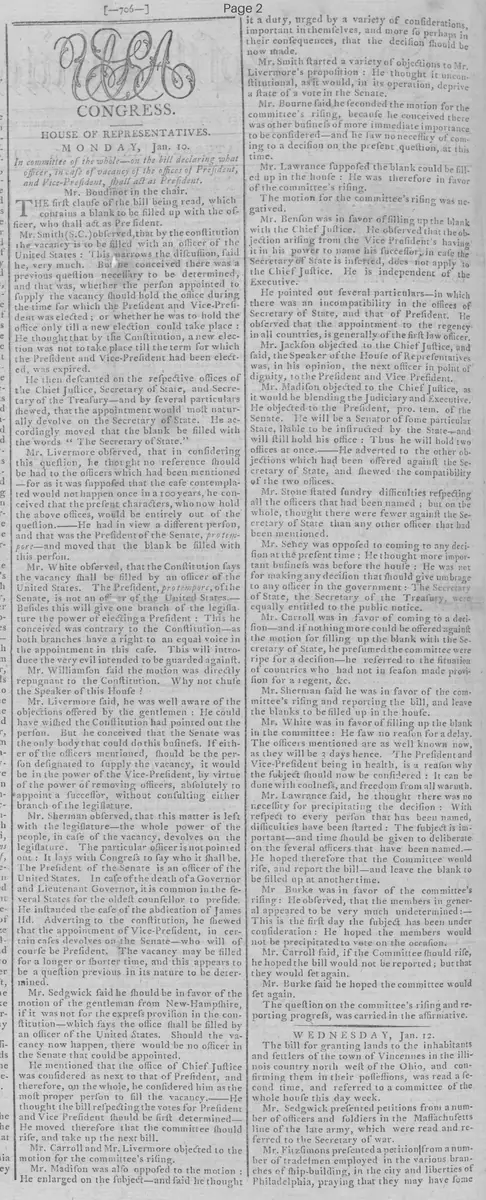
HOUSE OF REPRESENTATIVES.
MONDAY, Jan. 10.
In committee of the whole on the bill declaring what officer, in case of vacancy of the offices of President, and Vice-President, shall act as President.
Mr. Boudinot in the chair.
The first clause of the bill being read, which contains a blank to be filled up with the officer, who shall act as President.
Mr. Smith (S.C.) observed, that by the constitution the vacancy is to be filled with an officer of the United States: This narrows the discussion, said he, very much. But he conceived there was a previous question necessary to be determined, and that was, whether the person appointed to supply the vacancy should hold the office during the time for which the President and Vice-President was elected; or whether he was to hold the office only till a new election could take place: He thought that by the Constitution, a new election was not to take place till the term for which the President and Vice-President had been elected, was expired.
He then descanted on the respective offices of the Chief Justice, Secretary of State, and Secretary of the Treasury—and by several particulars shewed, that the appointment would most naturally devolve on the Secretary of State. He accordingly moved that the blank be filled with the words "The Secretary of State."
Mr. Livermore observed, that in considering this question, he thought no reference should be had to the officers which had been mentioned—for as it was supposed that the case contemplated would not happen once in 100 years, he conceived that the present characters, who now hold the above offices, would be entirely out of the question.—He had in view a different person, and that was the President of the Senate, pro tempore—and moved that the blank be filled with this person.
Mr. White observed, that the Constitution says the vacancy shall be filled by an officer of the United States. The President, pro tempore, of the Senate, is not an officer of the United States.—Besides this will give one branch of the legislature the power of electing a President: This he conceived was contrary to the Constitution—as both branches have a right to an equal voice in the appointment in this case. This will introduce the very evil intended to be guarded against.
Mr. Williamson said the motion was directly repugnant to the Constitution. Why not choose the Speaker of this House?
Mr. Livermore said, he was well aware of the objections offered by the gentlemen: He could have wished the Constitution had pointed out the person. But he conceived that the Senate was the only body that could do this business. If either of the officers mentioned, should be the person designated to supply the vacancy, it would be in the power of the Vice-President, by virtue of the power of removing officers, absolutely to appoint a successor, without consulting either branch of the legislature.
Mr. Sherman observed, that this matter is left with the legislature—the whole power of the people, in case of the vacancy, devolves on the legislature. The particular officer is not pointed out: It lays with Congress to say who it shall be. The President of the Senate is an officer of the United States. In case of the death of a Governor and Lieutenant Governor, it is common in the several States for the oldest councillor to preside. He instanced the case of the abdication of James II. Adverting to the constitution, he shewed that the appointment of Vice-President, in certain cases devolves on the Senate—who will of course be President. The vacancy may be filled for a longer or shorter time, and this appears to be a question previous in its nature to be determined.
Mr. Sedgwick said he should be in favor of the motion of the gentleman from New-Hampshire, if it was not for the express provision in the constitution—which says the office shall be filled by an officer of the United States. Should the vacancy now happen, there would be no officer in the Senate that could be appointed.
He mentioned that the office of Chief Justice was considered as next to that of President, and therefore, on the whole, he considered him as the most proper person to fill the vacancy.—He thought the bill respecting the votes for President and Vice President should be first determined—He moved therefore that the committee should rise, and take up the next bill.
Mr. Carroll and Mr. Livermore objected to the motion for the committee's rising.
Mr. Madison was also opposed to the motion: He enlarged on the subject—and said he thought it a duty, urged by a variety of considerations important in themselves, and more so perhaps in their consequences, that the decision should be now made.
Mr. Smith started a variety of objections to Mr. Livermore's proposition: He thought it unconstitutional, as it would, in its operation, deprive a state of a vote in the Senate.
Mr. Bourne said he seconded the motion for the committee's rising, because he conceived there was other business of more immediate importance to be considered—and he saw no necessity of coming to a decision on the present question, at this time.
Mr. Lawrence supposed the blank could be filled up in the house: He was therefore in favor of the committee's rising.
The motion for the committee's rising was negatived.
Mr. Benson was in favor of filling up the blank with the Chief Justice. He observed that the objection arising from the Vice President's having it in his power to name his successor, in case the Secretary of State is inserted, does not apply to the Chief Justice. He is independent of the Executive.
He pointed out several particulars—in which there was an incompatibility in the offices of Secretary of State, and that of President. He observed that the appointment to the regency in all countries, is generally of the first law officer.
Mr. Jackson objected to the Chief Justice, and said, the Speaker of the House of Representatives was, in his opinion, the next officer in point of dignity, to the President and Vice President.
Mr. Madison objected to the Chief Justice, as it would be blending the Judiciary and Executive. He objected to the President, pro. tem. of the Senate. He will be a Senator of some particular State, liable to be instructed by the State—and will still hold his office: Thus he will hold two offices at once.—He adverted to the other objections which had been offered against the Secretary of State, and shewed the compatibility of the two offices.
Mr. Stone stated sundry difficulties respecting all the officers that had been named; but on the whole, thought there were fewer against the Secretary of State than any other officer that had been mentioned.
Mr. Gerry was opposed to coming to any decision at the present time: He thought more important business was before the house: He was not for making any decision that should give umbrage to any officer in the government: The Secretary of State, the Secretary of the Treasury, were equally entitled to the public notice.
Mr. Carroll was in favor of coming to a decision—and if nothing more could be offered against the motion for filling up the blank with the Secretary of State, he presumed the committee were ripe for a decision—he referred to the situation of countries who had not in season made provision for a regent, &c.
Mr. Sherman said he was in favor of the committee's rising and reporting the bill, and leave the blanks to be filled up in the house.
Mr. White was in favor of filling up the blank in the committee: He saw no reason for a delay. The officers mentioned are as well known now, as they will be 3 days hence. The President and Vice-President being in health, is a reason why the subject should now be considered: It can be done with coolness, and freedom from all warmth.
Mr. Lawrence said, he thought there was no necessity for precipitating the decision: With respect to every person that has been named, difficulties have been started: The subject is important and time should be given to deliberate on the several officers that have been named.—He hoped therefore that the Committee would rise, and report the bill—and leave the blank to be filled up at another time.
Mr. Burke was in favor of the committee's rising: He observed, that the members in general appeared to be very much undetermined:—This is the first day the subject has been under consideration: He hoped the members would not be precipitated to vote on the occasion.
Mr. Carroll said, if the Committee should rise, he hoped the bill would not be reported; but that they would sit again.
Mr. Burke said he hoped the committee would sit again.
The question on the committee's rising and reporting progress, was carried in the affirmative.
WEDNESDAY, Jan. 12.
The bill for granting lands to the inhabitants and settlers of the town of Vincennes in the Illinois country north west of the Ohio, and confirming them in their possessions, was read a second time, and referred to a committee of the whole house this day week.
Mr. Sedgwick presented petitions from a number of officers and soldiers in the Massachusetts line of the late army, which were read and referred to the Secretary of war.
Mr. Fitzsimons presented a petition from a number of tradesmen employed in the various branches of ship-building, in the city and liberties of Philadelphia, praying that they may have some
A speedy remedy for recovery of their debts in those branches of business by instituting suits in the federal courts, which was read and laid on the table.
Also a petition from Joshua Barney, late a captain in the navy of the United States, praying to be reimbursed his expenses, while a prisoner with the enemy; and that he may be put on the same footing with the other officers in the late American navy.
Also a petition of sundry officers of the late American navy, praying compensation for services, &c. The two last petitions were read, and referred to a select committee of five members.
Mr. Cadwallader presented a petition from the public creditors of Monmouth county, state of New-Jersey, praying an alteration in the funding system, which was read and laid on the table.
Mr. Williamson moved that the rule of the house in these words "that no bill amended by the Senate shall be committed" may be expunged, which was agreed to by the house.
A message was received from the Senate, informing that they have passed a bill for erecting that part of the state of Virginia, called the district of Kentucky, into a separate state, and for admitting the same as a member of the union to which they desire the concurrence of the house.
In committee of the whole on the bill repealing after the last day of next, the duties heretofore laid on distilled and other spirits imported from abroad, and laying others in their stead.
The committee proceeded in the discussion as far as the 45th section.
Adjourned.
THURSDAY, Jan. 13.
The bill for the admission of the district of Kentucky into the union, was read the second time, and made the order of the day for Monday next.
Mr. Sedgwick laid the following motions on the table:—That a committee be appointed to bring in a bill, to authorize the President of the United States to cause the principal of the debt, due to foreign officers, the interest whereof is now payable in Paris, at the rate of six per cent. per annum, to be discharged.
That as it will be impracticable, during the present session, to consider and decide on the report of the Attorney-General respecting the judiciary system with that deliberation which the importance of the subject demands, the consideration of the said report be postponed.
Also that the Attorney-General be directed to report to this house a bill, making a temporary provision for the clerks, jurors, and other officers of the federal courts—and that he also report to the next session, a bill, making a general provision for the officers, and jurors of said courts.
In committee of the whole on the bill repealing after the last day of next, the duties heretofore laid on distilled spirits—and laying others in their stead.
The discussion of the remaining sections was finished—and the bill, with the several amendments, reported by the chairman to the house.
On motion of Mr. Carroll, it was voted, that the consideration of the bill with the amendments be postponed, and made the order of the day for Monday next.
In committee of the whole, on the bill declaring the officer, who, in case of vacancy in the office of President, and Vice-President, shall exercise the office of President of the United States.
Mr. Boudinot in the chair.
Mr. Smith's (S. C.) motion for filling up the blank with "the Secretary of state for the time being," was read—which occasioned a renewal of the debate on the subject.—The committee appeared to be much divided, as before—and a motion being made for their rising, it was carried in the affirmative.—The committee therefore rose and reported progress.
Mr. Livermore gave notice, that he should move for leave to bring in a bill to alter the time of the annual meeting of Congress.
The house then went into committee on the bill declaring the time when the electors of president and Vice-President of the United States shall be chosen; also when they shall meet and give in their votes.
Mr. Boudinot in the chair.
Some time was spent in discussing the first section of this bill; but the committee rose without coming to any decision.
Mr. Ames' motion respecting further compensation to the commissioners of loans, for extra services, was referred, on motion of that gentleman, to the Secretary of the Treasury.
On motion of Mr. Boudinot, Mr. Bourne was added to the committee on the navigation act.
Adjourned.
FRIDAY, Jan. 14.
Sundry petitions were read and referred.
A memorial of Andrew Brown was read, purporting that he intends publishing a correct edition of the Laws and Resolutions of the Legislature of the United States, beginning with the first session of Congress, and solicits the countenance of Congress to the publication.
Mr. White, of the committee appointed for the purpose, reported a bill for establishing a land-office for the sale of the unappropriated lands in the Western Territory—read the first and second time, and referred to a committee of the whole house on Thursday next.
Ordered, That 100 copies be printed.
Mr. Fitzsimons, of the committee to which was referred the petition of sundry officers of the navy, brought in a report, which was—That the prayer of said petition cannot be granted, and that the petitioners have leave to withdraw their petition. This report was accepted by the house.
Mr. Sedgwick's motion for appointing a committee to bring in a bill providing for the payment of the debt due to foreign officers, was taken up, and referred to a committee, consisting of Messrs. Sedgwick, Benson and Seney.
Mr. Madison laid before the house a memorial and three resolutions of the legislature of the State of Virginia, on the subject of the funding law, which were read and laid on the table.
In committee of the whole on the bill determining the time when the Electors of President and Vice-President shall be chosen and when they shall meet and give in their votes.
The committee finished the discussion of this bill and agreed to sundry amendments, which were reported to the house—the house took the same into consideration, and adopted them with some additional amendments; it was then ordered that the bill should lie on the table till Monday.
Adjourned till Monday.
What sub-type of article is it?
What themes does it cover?
What keywords are associated?
What entities or persons were involved?
Where did it happen?
Story Details
Key Persons
Location
House Of Representatives
Event Date
January 10 To 14
Story Details
Debate in committee on bill for officer to act as President in vacancy of President and Vice-President, with proposals for Secretary of State, President of Senate pro tempore, Chief Justice, and Speaker; objections on constitutionality and compatibility; committee rises without decision. Other business includes petitions from soldiers, tradesmen, navy officers, public creditors; bills on Vincennes lands, Kentucky admission, spirits duties, land office, electors' time; motions and referrals.