Thank you for visiting SNEWPapers!
Sign up free
The New Hampshire Gazette And General Advertiser
Portsmouth, Exeter, Rockingham County, New Hampshire
What is this article about?
A 'True Republican' critiques the proposed New Hampshire state constitution, objecting to property qualifications for officials, county-based representation eroding town instructions, governor's unilateral fortification powers, and term limits restricting voter choice. Proposes amendments for annual elections without limits, proportional representation, and legislative oversight.
Merged-components note: Continuation of the same letter to the editor across pages 1 and 2, as the text flows directly from one to the other.
Clippings
1 of 2
OCR Quality
Full Text
NEW-HAMPSHIRE
Brethren and Fellow Citizens,
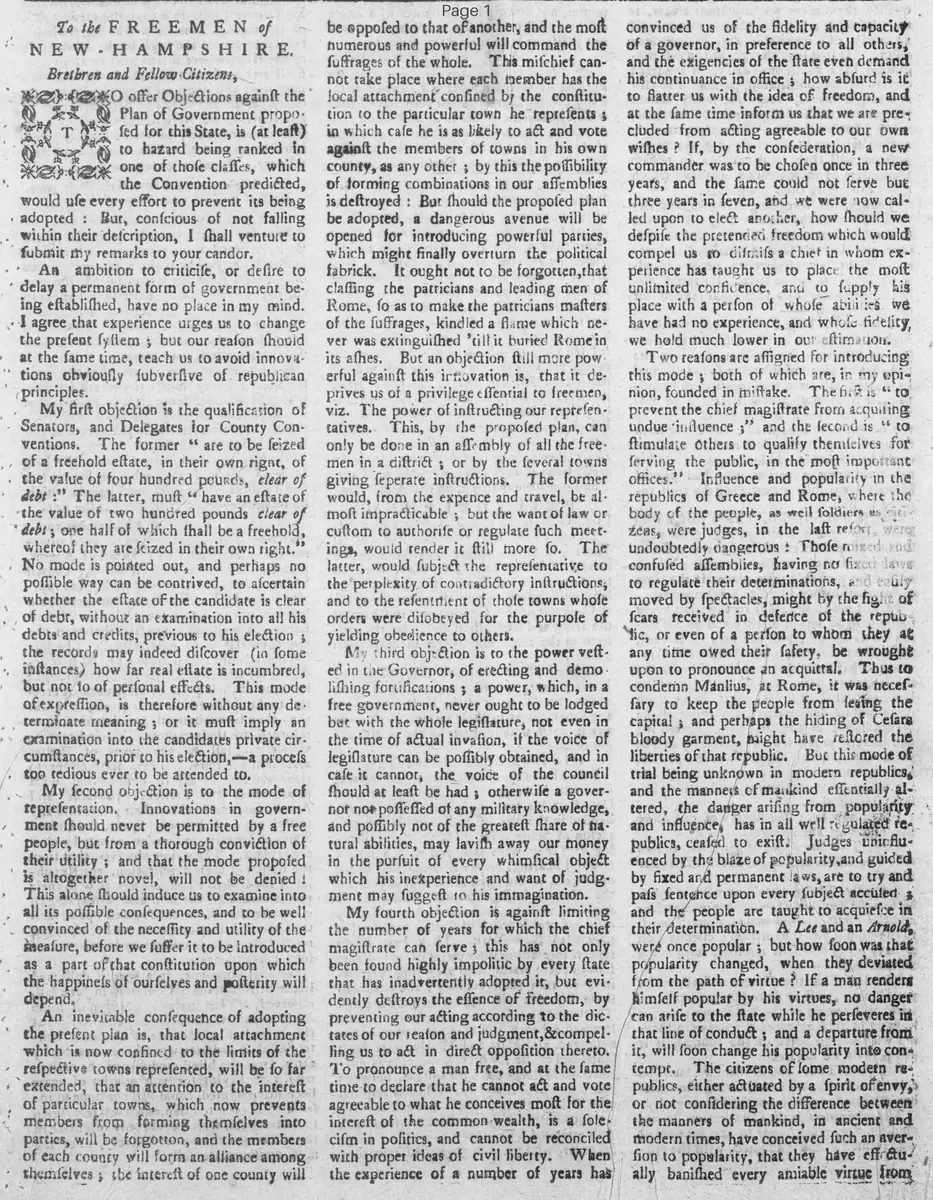
We offer Objections against the
Plan of Government proposed
for this State. It is (at least)
to hazard being ranked in
one of those classes, which
the Convention predicted,
would use every effort to prevent its being
adopted: But, conscious of not falling
within their description, I shall venture to
submit my remarks to your candor.
An ambition to criticize, or desire to
delay a permanent form of government be-
ing established, have no place in my mind.
I agree that experience urges us to change
the present system; but our reason should
at the same time, teach us to avoid innova-
tions obviously subversive of republican
principles.
My first objection is the qualification of
Senators, and Delegates for County Con-
ventions. The former "are to be seized
of a freehold estate, in their own right, of
the value of four hundred pounds, clear of
debt:" The latter, must "have an estate of
the value of two hundred pounds clear of
debt; one half of which shall be a freehold,
whereof they are seized in their own right."
No mode is pointed out, and perhaps no
possible way can be contrived, to ascertain
whether the estate of the candidate is clear
of debt, without an examination into all his
debts and credits, previous to his election;
the records may indeed discover (in some
instances) how far real estate is encumbered,
but not so of personal effects. This mode
of expression, is therefore without any de-
terminate meaning; or it must imply an
examination into the candidates private cir-
cumstances, prior to his election, a process
too tedious ever to be attended to.
My second objection is to the mode of
representation. Innovations in govern-
ment should never be permitted by a free
people, but from a thorough conviction of
their utility; and that the mode proposed
is altogether novel, will not be denied:
This alone should induce us to examine into
all its possible consequences, and to be well
convinced of the necessity and utility of the
measure, before we suffer it to be introduced
as a part of that constitution upon which
the happiness of ourselves and posterity will
depend.
An inevitable consequence of adopting
the present plan is, that local attachment
which is now confined to the limits of the
respective towns represented, will be so far
extended, that an attention to the interest
of particular towns, which now prevents
members from forming themselves into
parties, will be forgotten, and the members
of each county will form an alliance among
themselves; the interest of one county will
be opposed to that of another, and the most
numerous and powerful will command the
suffrages of the whole. This mischief can-
not take place where each member has the
local attachment confined by the constitu-
tion to the particular town he represents;
in which case he is as likely to act and vote
against the members of towns in his own
county, as any other; by this the possibility
of forming combinations in our assemblies
is destroyed: But should the proposed plan
be adopted, a dangerous avenue will be
opened for introducing powerful parties,
which might finally overturn the political
fabric. It ought not to be forgotten, that
classing the patricians and leading men of
Rome, so as to make the patricians masters
of the suffrages, kindled a flame which ne-
ver was extinguished 'till it buried Rome in
its ashes. But an objection still more pow-
erful against this innovation is, that it de-
prives us of a privilege essential to freemen,
viz. The power of instructing our represen-
tatives. This, by the proposed plan, can
only be done in an assembly of all the free-
men in a district; or by the several towns
giving separate instructions. The former
would, from the expense and travel, be al-
most impracticable; but the want of law or
custom to authorize or regulate such meet-
ings, would render it still more so. The
latter, would subject the representative to
the perplexity of contradictory instructions;
and to the resentment of those towns whose
orders were disobeyed for the purpose of
yielding obedience to others.
My third objection is to the power vest-
ed in the Governor, of erecting and demo-
lishing fortifications; a power, which, in a
free government, never ought to be lodged
but with the whole legislature, not even in
the time of actual invasion, if the voice of
legislature can possibly be obtained, and in
case it cannot, the voice of the council
should at least be had: otherwise a gover-
nor not possessed of any military knowledge,
and possibly not of the greatest share of na-
tural abilities, may lavish away our money
in the pursuit of every whimsical object
which his inexperience and want of judg-
ment may suggest to his imagination.
My fourth objection is against limiting
the number of years for which the chief
magistrate can serve; this has not only
been found highly impolitic by every state
that has inadvertently adopted it, but evi-
dently destroys the essence of freedom, by
preventing our acting according to the dic-
tates of our reason and judgment, &compel-
ling us to act in direct opposition thereto.
To pronounce a man free, and at the same
time to declare that he cannot act and vote
agreeable to what he conceives most for the
interest of the common-wealth, is a sole-
cism in politics, and cannot be reconciled
with proper ideas of civil liberty. When
the experience of a number of years has
convinced us of the fidelity and capacity
of a governor, in preference to all others,
and the exigencies of the state even demand
his continuance in office: how absurd is it
to flatter us with the idea of freedom, and
at the same time inform us that we are pre-
cluded from acting agreeable to our own
wishes? If, by the confederation, a new
commander was to be chosen once in three
years, and the same could not serve but
three years in seven, and we were now cal-
led upon to elect another, how should we
despise the pretended freedom which would
compel us to dismiss a chief in whom ex-
perience has taught us to place the most
unlimited confidence, and to supply his
place with a person of whose abilities, we
have had no experience, and whose fidelity,
we hold much lower in our estimation.
Two reasons are assigned for introducing
this mode: both of which are, in my opi-
nion, founded in mistake. The first is "to
prevent the chief magistrate from acquiring
undue influence;" and the second is "to
stimulate others to qualify themselves for
serving the public, in the most important
offices." Influence and popularity in the
republics of Greece and Rome, where the
body of the people, as well soldiers as citi-
zens, were judges, in the last resort, were
undoubtedly dangerous: Those noisy and
confused assemblies, having no fixed laws
to regulate their determinations, and easily
moved by spectacles, might by the sight of
scars received in defense of the repub-
lic, or even of a person to whom they at
any time owed their safety, be wrought
upon to pronounce an acquittal. Thus to
condemn Manlius, at Rome, it was neces-
sary to keep the people from seeing the
capital; and perhaps the hiding of Caesar's
bloody garment, might have restored the
liberties of that republic. But this mode of
trial being unknown in modern republics,
and the manners of mankind essentially al-
tered, the danger arising from popularity
and influence has in all well regulated re-
publics, ceased to exist: Judges uninfllu-
enced by the blaze of popularity, and guided
by fixed and permanent laws, are to try and
pass sentence upon every subject accused
and the people are taught to acquiesce in
their determination. A Lee and an Arnold,
were once popular; but how soon was that
popularity changed, when they deviated
from the path of virtue? If a man renders
himself popular by his virtues, no danger
can arise to the state while he perseveres in
that line of conduct; and a departure from
it, will soon change his popularity into con-
tempt. The citizens of some modern re-
publics, either actuated by a spirit of envy,
or not considering the difference between
the manners of mankind, in ancient and
modern times, have conceived such an aver-
sion to popularity, that they have effectu-
ally banished every amiable virtue from
Their territories: Of this the republic of Venice, furnishes a striking example. It is the policy of that nation, to discountenance all that are eminent and remarkable for their virtues of any kind whatsoever. A brave man is sure to be brow-beaten; and if a person is a little more hospitable or charitable than his neighbours, he is in danger of the state inquisition, lest these virtues, or the appearance of them, should render him more popular. This has effectually destroyed that spirit of enterprize & emulation, which instead of being discountenanced, should receive every possible encouragement; and which I trust will ever be cherished in the American empire.
The intention of stimulating persons to qualify themselves for important offices, is truly laudable: but this plan of rotation (if adopted) will inevitably have the contrary effect. If frequent changes of the first magistrate in a commonwealth, is rendered certain by the constitution, persons of moderate acquirements, may rationally flatter themselves with the prospect of advancement; but if superior abilities form the only avenue leading to the chair of government, persons will then be stimulated to possess themselves of those eminent qualities which alone can insure their promotion.
Though the foregoing remarks must demonstrate that the reasons assigned by the Honorable Convention, are founded in mistake, and that the plan of rotation (if adopted) will, in its consequences, prove exceedingly injurious to the state, I cannot forbear mentioning two additional reasons for disapproving it.
The first is, That a person who stands so high in the esteem or friendship of the people, as to obtain an election, and is in the first part of his administration found unequal to the task, will from tenderness, from friendship, or from motives less laudable, be suffered to continue until the period fixed by the constitution is expired: but if the term for continuing in office was not limited, there could be no possible inducement or excuse for continuing a person who had proved himself incapable of executing the trust reposed in him.
The second reason is, That a person who knows his term is expiring, may grow neglectful of public affairs, and leave them in a deranged state to his successor: which would not probably take place, if the time of his continuance in office was uncertain.
Permit me to add, that by this plan every incitement to acts of fidelity and public virtue are destroyed; and the idea of reward for eminent services, totally lost. The Convention that framed the constitution for the Massachusetts state, though they adopted the same plan at their first meeting, being upon more mature deliberation, convinced of the inexpediency of the measure, rejected it; and thereby prevented the possibility of the public interest, the judgment of the people, and sentiments of equity and gratitude, being sacrificed to an arbitrary and anti-republican constitution.
I shall now take the liberty of proposing the following amendments.
First. That the estate of Senators, and all others be visible estate, instead of estate clear of debt.
Secondly, That a certain number of inhabitants, shall entitle a town to representation; and the number of members, proportioned, to the number of inhabitants; classing such as have not a sufficient number, with some adjacent town.
Thirdly. That the Governor shall not be permitted to erect or demolish fortifications without the voice of the legislature; except in cases of great emergency; and even then, not without the voice of the council, if it can possibly be obtained.
Fourthly, That the Governor shall be elected annually, without limiting the number of years for which he shall be eligible.
The other parts of the Constitution, in my opinion, does great honor to the gentlemen who framed it, and if adopted, with the proposed amendments, will, I trust, make us a free and a happy people. I flatter myself that the gentlemen who formed the plan of government, will have candor enough to excuse the freedom of these remarks, as I can assure them, that no reflection is intended, in any observations which I have made: I am not insensible that the Confederation seems to countenance the rotation which I have endeavored to prove subversive of republican principles. Time alone can discover the wisdom of that regulation, but tho' good policy may warrant such an attempt, to prevent those dangerous combinations among members, which too often flow from that connection and intimacy which length of time might permit them to form, the same reason, not holding in the choice of a single officer; that part of the confederation will not justify us in adopting the measure.
A TRUE REPUBLICAN.
What sub-type of article is it?
What themes does it cover?
What keywords are associated?
What entities or persons were involved?
Letter to Editor Details
Author
A True Republican
Recipient
To The Free Men Of New Hampshire
Main Argument
the proposed new hampshire constitution undermines republican principles through unclear property qualifications, county representation fostering factions and limiting instructions, excessive gubernatorial power over fortifications, and term limits restricting free choice; amendments are suggested to rectify these.
Notable Details