Thank you for visiting SNEWPapers!
Sign up free
Literary
October 21, 1840
Republican Herald
Providence, Providence County, Rhode Island
What is this article about?
A historical fiction sketch set in Nero's Rome. An aged Goth, Majesticus, fights a gladiator in the arena to avenge his family. His daughter intervenes and is killed, sparking rebellion. Later, Nero is assassinated by the Goth's son, Vindicus, disguised as a slave, amid a popular uprising led by Vindex.
Clipping
OCR Quality
78%
Good
Full Text
MISCELLANEOUS.
From Burton's Gentleman's Magazine.
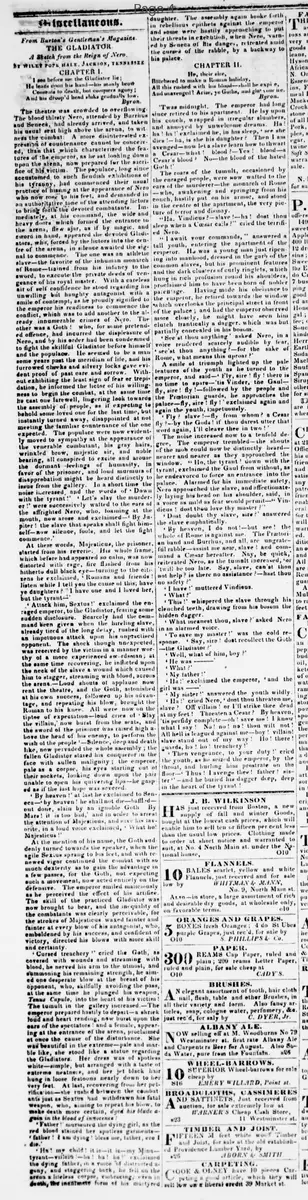
THE GLADIATOR.
A Sketch from the Reign of Nero,
BY WILEY POPE HALE, JACKSON, TENNESSEE.
CHAPTER I.
I see before me the Gladiator lie;
He leans down his hand—his manly brow
Consents to death, but conquers agony;
And his droop'd head sinks gradually low.
Byron.
The theatre was crowded to overflowing. The blood thirsty Nero, attended by Burrhus and Seneca, had already arrived, and taken his usual seat high above the arena, to witness the combat: A more disinterested expression of countenance cannot be conceived, than that which characterized the features of the emperor, as he sat looking down upon the arena, now prepared for the sacrifice of his victim. The populace, long since accustomed to such fiendish exhibitions of his tyranny, had commenced their usual practice of hissing at the appearance of Nero; an authoritative tone of the attending lictors who now rose to his feet, and demanded them to bring forth the devoted combatants. Immediately, at his command, the wide and heavy doors which formed the entrance to the arena, flew ajar, as if by magic, and gladiators, who, forced by the lictors into the centre of the arena, in silence awaited the signal to commence. The one was an athletic slave—the favorite of the inhuman monarch of Rome—trained from his infancy to the sword, to execute the private deeds of vengeance of his royal master. With a careless air of self confidence he stood regarding his unwilling but haughty antagonist with a smile of contempt, as he proudly signified to the emperor his readiness to commence the conflict, which was to add another to the already innumerable crimes of Nero. The other was a Goth! who, for some pretended offence, had incurred the displeasure of Nero, and by his order had been condemned to fight the skillful Gladiator before himself and the populace. He seemed to be a man some years past the meridian of life, and his furrowed cheeks and silvery locks gave evident proof of past care and sorrow. Without exhibiting the least sign of fear or trepidation, he informed the lictor of his willingness to begin the combat, at the same time he cast one farewell, lingering look towards the assembly of people, as if expecting to behold some loved one for the last time, but instantly turned away, disappointed at not meeting the familiar countenance of the one expected. The populace were now evidently moved to sympathy at the appearance of the venerable combatant, his gray hairs, wrinkled brow, majestic air, and noble bearing, all conspired to excite and arouse the dormant feelings of humanity, in favor of the prisoner, and loud murmurs of disapprobation might be heard distinctly to issue from the gallery. In a short time the noise increased, and the words of 'Down with the tyrant!' 'Let's slay the murderer!' were successively wafted to the ears of the affrighted Nero, who, foaming at the mouth, now arose and exclaimed—'By Jupiter! the slave that speaks shall fight himself—now silence, fools, and let the fight commence.'
At these words, Majesticus, the prisoner, started from his reverie. His whole frame, which before had appeared so calm, was now distorted with rage, fire flashed from his hitherto dull black eye—turning to the citizens he exclaimed, Romans and friends! listen while I tell you the cause of this; have ye daughters? I have one and I loved her, but the tyrant
'Attack him, Sextus!' exclaimed the enraged emperor, to the Gladiator, fearing some sudden disclosure. Scarcely had the command been given when the hireling slave, already tired of the long delay, rushed with an impetuous attack upon his unpractised opponent. The shock though unexpected, was received by the victim in a manner worthy of a more experienced swordsman; at the same time recovering, he inflicted upon the neck of the slave a wound which caused him to stagger, streaming with blood, across the arena. Loud shouts of applause now rent the theatre, and the Goth, astonished at his own success, followed up his advantage, and repeating his blow, brought the Roman to his knee. All were now on the tiptoe of expectation—loud cries of 'Slay the villain,' now burst from the seats, and the sword of the prisoner was raised high above the head of his enemy, to perform the wish of the people—'Silence, deep and death like, now pervaded the whole assembly; the fallen Gladiator eyed his conqueror in the face with sullen malignity; the emperor pale as a corpse, his eyes starting out of their sockets, looking down upon the pair unable to open his quivering lips—he gasped as if the last hope was severed.
'By heaven!' at last he exclaimed to Seneca—'by heaven! he shall not die—baffled—out done, slain by an ignoble Goth! By Mars! it is too bad,' and in order to arrest the attention of Majesticus, and save his favorite, in a loud voice exclaimed, 'What ho! Majesticus!'
At the mention of his name, the Goth suddenly turned towards the speaker, when the agile Sextus sprang to his feet, and with renewed vigor continued the combat with so much dexterity as to gain the advantage in a few passes, for the Goth, not expecting such a movement, now acted entirely on the defensive. The emperor smiled maliciously as he perceived the effect of his artifice. The skill of the practiced Gladiator was now brought to bear, and the inequality of the combatants was clearly perceivable, for the strokes of Majesticus waxed fainter and fainter at every blow of his antagonist, who, emboldened by his success, and confident of victory, directed his blows with more skill and certainty.
'Cursed treachery!' cried the Goth, as covered with wounds and streaming with blood, he nerved his arm to the utmost, and summoning his remaining strength, he aimed one desperate blow at the breast of his opponent, who, skilfully avoiding the pass, at the same time he plunged his weapon, Venus Capulo, into the heart of his victim! The tumult in the gallery increased. The emperor prepared hastily to depart—a shriek loud and heart rending, now burst upon the ears of the spectators: and a female, appearing at the entrance of the arena, proclaimed at once the cause of the disturbance. She was beautiful in the extreme—pale and marble-like, she stood like a statue regarding the Gladiators. Her dress was of spotless white—simple, but arranged with a taste of extreme neatness, and her jet black hair hung in loose festoons nearly down to her very feet. At last, recovering from her petrifaction—she rushed between the combatants just as Sextus had withdrawn his fatal weapon, who, aiming to repeat his blow, to make death more certain, dyed his blade a second time in the blood of innocence!
'Father!' murmured the dying girl, as the red blood stained her spotless garments—'father! I am dying—bless me, father, ere I die.'
'Ha! my child: it is—it is—my Mina—tyrant—villain:—ha! ha! ha!' exclaimed the dying father, in a voice of distracted agony, and staggering back, he fell on the arena a lifeless corpse, embracing, even in death, the innocent form of his martyred daughter. The assembly again broke forth in rebellious epithets against the emperor and some were hastily approaching to put their threats in execution, when Nero, warned by Seneca of his danger, retreated amid their threats to his palace.
CHAPTER II.
He, their sire,
Butchered to make a Roman holiday,
All this rushed with his blood—chill he expired,
And unavenged? Arise, ye Goths, and glut your ire.
Byron.
'Twas midnight. The emperor had long since retired to his apartment. He lay upon his couch, wrapped in irregular slumbers, and annoyed by unwelcome dreams. Ha! ha! ha!' exclaimed he, in his sleep, 'see she dies!—ha, is she his daughter? Then I am avenged—now let a slave learn how to thwart a Cesar's blood? No—the blood of the hated Cesar—what! blood?—Yes! blood—a Goth!'
The roars of the tumult, occasioned by the enraged people, were now wafted to the ears of the murderer—the monarch of Rome—who, awakening and springing from his couch, hastily put on his armor, and stood in the centre of the apartment, the very picture of terror and dismay.
'Ha. Vindicus?—slave!—ha! dost thou sleep when a Cesar calls?' cried the terrified Nero.
'I await your commands,' answered a tall youth, entering the apartment of the emperor. He was a young man just ripening into manhood, dressed in the garb of the common slaves, but his prominent features and the dark clusters of curly ringlets, which hung in rich profusion round his shoulders, proclaimed him to have been born of nobler parentage. Having made his obeisance to the emperor, he retired towards the window which overlooks the principal street in front of the palace; and had the emperor observed more closely, he might have seen him clutch frantically a dagger, which was but partially concealed in his bosom.
'See'st thou anything?' asked Nero, in a voice rendered scarcely audible by fear, 'see'st thou anything?—for the sake of Rome, what means this uproar?'
A smile of triumph lighted up the pale features of the youth as he turned to the emperor, and said—'Fly, sire! fly! there is no time to spare—'tis Vindex, the Gaul—fly, sire! fly!—followed by the people and the Prætorian guards, he approaches the palace—fly, sire! fly!' exclaimed again and again the youth, impetuously.
'Fly? slave!—fly from whom? a Cesar fly?—by the Gods! if thou darest utter that word again, I'll cleave thee in two!'
The noise increased now to a tenfold degree. The emperor trembled—the shouts of the mob could now be distinctly heard—nearer and nearer as they approached the window. 'Ho, the tyrant! down with the tyrant!' exclaimed the Gaul from without, as he endeavored to force an entrance into the palace. Alarmed for his immediate safety, Nero approached the slave, and affectionately laying his head on his shoulder, said, in a voice as mild as fear would permit—'Vindicus! dost thou love thy master?'
'Dost doubt thy slave, sire?' answered the slave emphatically.
'By heaven, I do not!—but see! the whole of Rome is against me. The Prætorian band and Burrhus, and all, are ungrateful rabble—assist me now, slave! and command a Caesar hereafter. Nay, be quick,' reiterated Nero, as the tumult increased, 'or 'twill be too late. Say, slave, can'st thou not help? is there no assistance?—hast thou no safety?'
'I have!' muttered Vindicus.
'What?'
'This!' whispered the slave through his clenched teeth, drawing from his bosom the hidden dagger.
'What meanest thou, slave?' asked Nero in an alarmed voice.
'To save my master!' was the cold response.
'Say, sire! dost recollect the Goth—the Gladiator?'
'Well, what of him, boy?'
'He was—'
'What?'
'My father!'
'Ha!' exclaimed the emperor, 'and the girl was—'
'My sister!' answered the youth wildly.
'Ha!' cried Nero, 'dost thou threaten me, slave? Off villain! or I'll strike thee dead at my feet! Threaten a Cesar? By heaven, 'tis perfidy complete—oh! save me! I know what I say! No! no! no! thou wilt not! All hell is leagued against me—boy! villain! slave stand out of my way! Ho! there! guards, ho! ho! treachery!'
'Then vengeance, to your duty!' cried the youth, as he seized the emperor, by the throat, and hurling him prostrate on the floor—'Thus! I avenge thee! father! sister!'—and he buried his dagger deep, deep in the heart of the tyrant!
J. B. WILKINSON
From Burton's Gentleman's Magazine.
THE GLADIATOR.
A Sketch from the Reign of Nero,
BY WILEY POPE HALE, JACKSON, TENNESSEE.
CHAPTER I.
I see before me the Gladiator lie;
He leans down his hand—his manly brow
Consents to death, but conquers agony;
And his droop'd head sinks gradually low.
Byron.
The theatre was crowded to overflowing. The blood thirsty Nero, attended by Burrhus and Seneca, had already arrived, and taken his usual seat high above the arena, to witness the combat: A more disinterested expression of countenance cannot be conceived, than that which characterized the features of the emperor, as he sat looking down upon the arena, now prepared for the sacrifice of his victim. The populace, long since accustomed to such fiendish exhibitions of his tyranny, had commenced their usual practice of hissing at the appearance of Nero; an authoritative tone of the attending lictors who now rose to his feet, and demanded them to bring forth the devoted combatants. Immediately, at his command, the wide and heavy doors which formed the entrance to the arena, flew ajar, as if by magic, and gladiators, who, forced by the lictors into the centre of the arena, in silence awaited the signal to commence. The one was an athletic slave—the favorite of the inhuman monarch of Rome—trained from his infancy to the sword, to execute the private deeds of vengeance of his royal master. With a careless air of self confidence he stood regarding his unwilling but haughty antagonist with a smile of contempt, as he proudly signified to the emperor his readiness to commence the conflict, which was to add another to the already innumerable crimes of Nero. The other was a Goth! who, for some pretended offence, had incurred the displeasure of Nero, and by his order had been condemned to fight the skillful Gladiator before himself and the populace. He seemed to be a man some years past the meridian of life, and his furrowed cheeks and silvery locks gave evident proof of past care and sorrow. Without exhibiting the least sign of fear or trepidation, he informed the lictor of his willingness to begin the combat, at the same time he cast one farewell, lingering look towards the assembly of people, as if expecting to behold some loved one for the last time, but instantly turned away, disappointed at not meeting the familiar countenance of the one expected. The populace were now evidently moved to sympathy at the appearance of the venerable combatant, his gray hairs, wrinkled brow, majestic air, and noble bearing, all conspired to excite and arouse the dormant feelings of humanity, in favor of the prisoner, and loud murmurs of disapprobation might be heard distinctly to issue from the gallery. In a short time the noise increased, and the words of 'Down with the tyrant!' 'Let's slay the murderer!' were successively wafted to the ears of the affrighted Nero, who, foaming at the mouth, now arose and exclaimed—'By Jupiter! the slave that speaks shall fight himself—now silence, fools, and let the fight commence.'
At these words, Majesticus, the prisoner, started from his reverie. His whole frame, which before had appeared so calm, was now distorted with rage, fire flashed from his hitherto dull black eye—turning to the citizens he exclaimed, Romans and friends! listen while I tell you the cause of this; have ye daughters? I have one and I loved her, but the tyrant
'Attack him, Sextus!' exclaimed the enraged emperor, to the Gladiator, fearing some sudden disclosure. Scarcely had the command been given when the hireling slave, already tired of the long delay, rushed with an impetuous attack upon his unpractised opponent. The shock though unexpected, was received by the victim in a manner worthy of a more experienced swordsman; at the same time recovering, he inflicted upon the neck of the slave a wound which caused him to stagger, streaming with blood, across the arena. Loud shouts of applause now rent the theatre, and the Goth, astonished at his own success, followed up his advantage, and repeating his blow, brought the Roman to his knee. All were now on the tiptoe of expectation—loud cries of 'Slay the villain,' now burst from the seats, and the sword of the prisoner was raised high above the head of his enemy, to perform the wish of the people—'Silence, deep and death like, now pervaded the whole assembly; the fallen Gladiator eyed his conqueror in the face with sullen malignity; the emperor pale as a corpse, his eyes starting out of their sockets, looking down upon the pair unable to open his quivering lips—he gasped as if the last hope was severed.
'By heaven!' at last he exclaimed to Seneca—'by heaven! he shall not die—baffled—out done, slain by an ignoble Goth! By Mars! it is too bad,' and in order to arrest the attention of Majesticus, and save his favorite, in a loud voice exclaimed, 'What ho! Majesticus!'
At the mention of his name, the Goth suddenly turned towards the speaker, when the agile Sextus sprang to his feet, and with renewed vigor continued the combat with so much dexterity as to gain the advantage in a few passes, for the Goth, not expecting such a movement, now acted entirely on the defensive. The emperor smiled maliciously as he perceived the effect of his artifice. The skill of the practiced Gladiator was now brought to bear, and the inequality of the combatants was clearly perceivable, for the strokes of Majesticus waxed fainter and fainter at every blow of his antagonist, who, emboldened by his success, and confident of victory, directed his blows with more skill and certainty.
'Cursed treachery!' cried the Goth, as covered with wounds and streaming with blood, he nerved his arm to the utmost, and summoning his remaining strength, he aimed one desperate blow at the breast of his opponent, who, skilfully avoiding the pass, at the same time he plunged his weapon, Venus Capulo, into the heart of his victim! The tumult in the gallery increased. The emperor prepared hastily to depart—a shriek loud and heart rending, now burst upon the ears of the spectators: and a female, appearing at the entrance of the arena, proclaimed at once the cause of the disturbance. She was beautiful in the extreme—pale and marble-like, she stood like a statue regarding the Gladiators. Her dress was of spotless white—simple, but arranged with a taste of extreme neatness, and her jet black hair hung in loose festoons nearly down to her very feet. At last, recovering from her petrifaction—she rushed between the combatants just as Sextus had withdrawn his fatal weapon, who, aiming to repeat his blow, to make death more certain, dyed his blade a second time in the blood of innocence!
'Father!' murmured the dying girl, as the red blood stained her spotless garments—'father! I am dying—bless me, father, ere I die.'
'Ha! my child: it is—it is—my Mina—tyrant—villain:—ha! ha! ha!' exclaimed the dying father, in a voice of distracted agony, and staggering back, he fell on the arena a lifeless corpse, embracing, even in death, the innocent form of his martyred daughter. The assembly again broke forth in rebellious epithets against the emperor and some were hastily approaching to put their threats in execution, when Nero, warned by Seneca of his danger, retreated amid their threats to his palace.
CHAPTER II.
He, their sire,
Butchered to make a Roman holiday,
All this rushed with his blood—chill he expired,
And unavenged? Arise, ye Goths, and glut your ire.
Byron.
'Twas midnight. The emperor had long since retired to his apartment. He lay upon his couch, wrapped in irregular slumbers, and annoyed by unwelcome dreams. Ha! ha! ha!' exclaimed he, in his sleep, 'see she dies!—ha, is she his daughter? Then I am avenged—now let a slave learn how to thwart a Cesar's blood? No—the blood of the hated Cesar—what! blood?—Yes! blood—a Goth!'
The roars of the tumult, occasioned by the enraged people, were now wafted to the ears of the murderer—the monarch of Rome—who, awakening and springing from his couch, hastily put on his armor, and stood in the centre of the apartment, the very picture of terror and dismay.
'Ha. Vindicus?—slave!—ha! dost thou sleep when a Cesar calls?' cried the terrified Nero.
'I await your commands,' answered a tall youth, entering the apartment of the emperor. He was a young man just ripening into manhood, dressed in the garb of the common slaves, but his prominent features and the dark clusters of curly ringlets, which hung in rich profusion round his shoulders, proclaimed him to have been born of nobler parentage. Having made his obeisance to the emperor, he retired towards the window which overlooks the principal street in front of the palace; and had the emperor observed more closely, he might have seen him clutch frantically a dagger, which was but partially concealed in his bosom.
'See'st thou anything?' asked Nero, in a voice rendered scarcely audible by fear, 'see'st thou anything?—for the sake of Rome, what means this uproar?'
A smile of triumph lighted up the pale features of the youth as he turned to the emperor, and said—'Fly, sire! fly! there is no time to spare—'tis Vindex, the Gaul—fly, sire! fly!—followed by the people and the Prætorian guards, he approaches the palace—fly, sire! fly!' exclaimed again and again the youth, impetuously.
'Fly? slave!—fly from whom? a Cesar fly?—by the Gods! if thou darest utter that word again, I'll cleave thee in two!'
The noise increased now to a tenfold degree. The emperor trembled—the shouts of the mob could now be distinctly heard—nearer and nearer as they approached the window. 'Ho, the tyrant! down with the tyrant!' exclaimed the Gaul from without, as he endeavored to force an entrance into the palace. Alarmed for his immediate safety, Nero approached the slave, and affectionately laying his head on his shoulder, said, in a voice as mild as fear would permit—'Vindicus! dost thou love thy master?'
'Dost doubt thy slave, sire?' answered the slave emphatically.
'By heaven, I do not!—but see! the whole of Rome is against me. The Prætorian band and Burrhus, and all, are ungrateful rabble—assist me now, slave! and command a Caesar hereafter. Nay, be quick,' reiterated Nero, as the tumult increased, 'or 'twill be too late. Say, slave, can'st thou not help? is there no assistance?—hast thou no safety?'
'I have!' muttered Vindicus.
'What?'
'This!' whispered the slave through his clenched teeth, drawing from his bosom the hidden dagger.
'What meanest thou, slave?' asked Nero in an alarmed voice.
'To save my master!' was the cold response.
'Say, sire! dost recollect the Goth—the Gladiator?'
'Well, what of him, boy?'
'He was—'
'What?'
'My father!'
'Ha!' exclaimed the emperor, 'and the girl was—'
'My sister!' answered the youth wildly.
'Ha!' cried Nero, 'dost thou threaten me, slave? Off villain! or I'll strike thee dead at my feet! Threaten a Cesar? By heaven, 'tis perfidy complete—oh! save me! I know what I say! No! no! no! thou wilt not! All hell is leagued against me—boy! villain! slave stand out of my way! Ho! there! guards, ho! ho! treachery!'
'Then vengeance, to your duty!' cried the youth, as he seized the emperor, by the throat, and hurling him prostrate on the floor—'Thus! I avenge thee! father! sister!'—and he buried his dagger deep, deep in the heart of the tyrant!
J. B. WILKINSON
What sub-type of article is it?
Prose Fiction
What themes does it cover?
Political
Liberty Freedom
Moral Virtue
What keywords are associated?
Gladiator
Nero
Tyranny
Goth
Vengeance
Rome
Rebellion
Family
Assassination
What entities or persons were involved?
By Wiley Pope Hale, Jackson, Tennessee
Literary Details
Title
The Gladiator. A Sketch From The Reign Of Nero
Author
By Wiley Pope Hale, Jackson, Tennessee
Key Lines
I See Before Me The Gladiator Lie; He Leans Down His Hand—His Manly Brow Consents To Death, But Conquers Agony; And His Droop'd Head Sinks Gradually Low.
He, Their Sire, Butchered To Make A Roman Holiday, All This Rushed With His Blood—Chill He Expired, And Unavenged? Arise, Ye Goths, And Glut Your Ire.
'Father!' Murmured The Dying Girl, As The Red Blood Stained Her Spotless Garments—'Father! I Am Dying—Bless Me, Father, Ere I Die.'
'Thus! I Avenge Thee! Father! Sister!'—And He Buried His Dagger Deep, Deep In The Heart Of The Tyrant!