Thank you for visiting SNEWPapers!
Sign up free
The New Orleans Daily Democrat
New Orleans, Orleans County, Louisiana
What is this article about?
New Orleans Catholics celebrate the 50th anniversary of Pope Pius IX's episcopal consecration on June 3, 1877, with masses, a grand procession involving military, societies, and clergy, and speeches at Lafayette Square praising the Pope's life, firmness against persecution, and Church triumphs.
Merged-components note: These components form a continuous narrative article about the golden wedding celebration of Pope Pius IX, including procession details in the table. Original labels were 'story', 'table', 'editorial', and 'domestic_news'; merged under 'story' as the dominant narrative type.
Clippings
1 of 3
OCR Quality
Full Text
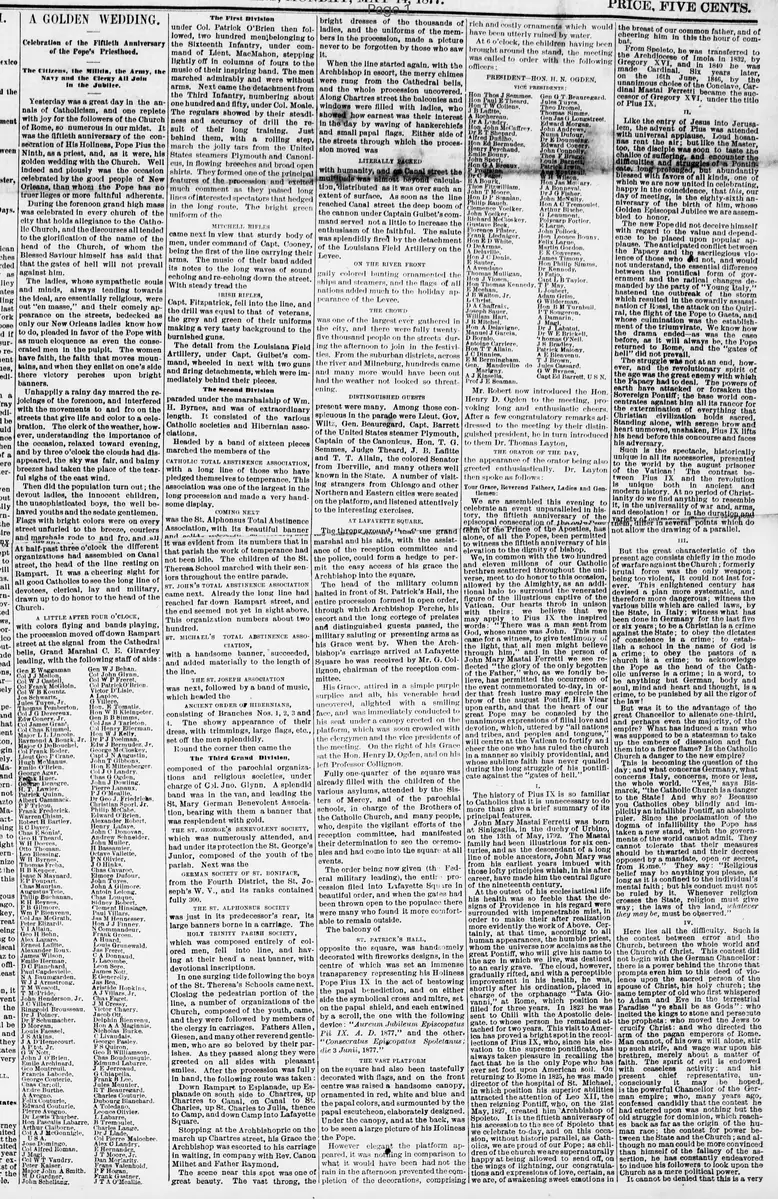
Celebration of the Fiftieth Anniversary of the Pope's Priesthood.
The Citizens, the Militia, the Army, the Navy and the Clergy All Join in the Jubilee.
Yesterday was a great day in the annals of Catholicism, and one replete with joy for the followers of the Church of Rome, so numerous in our midst. It was the fiftieth anniversary of the consecration of His Holiness, Pope Pius the Ninth, as a priest, and, as it were, his golden wedding with the Church. Well indeed and piously was the occasion celebrated by the good people of New Orleans, than whom the Pope has no truer lieges or more faithful adherents.
During the forenoon grand high mass was celebrated in every church of the city that holds allegiance to the Catholic Church, and the discourses all tended to the glorification of the name of the head of the Church, of whom the Blessed Saviour himself has said that the gates of hell will not prevail against him.
The ladies, whose sympathetic souls and minds, always tending towards the ideal, are essentially religious, were out en masse, and their comely appearance on the streets, bedecked as only our New Orleans ladies know how to do, pleaded in favor of the Pope with as much eloquence as even the consecrated men in the pulpit. The women have faith, the faith that moves mountains, and when they enlist on one's side there victory perches upon bright banners.
Unhappily a rainy day marred the rejoicings of the forenoon, and interfered with the movements to and fro on the streets that give life and color to a celebration. The clerk of the weather, however, understanding the importance of the occasion, relaxed toward evening, and by three o'clock the clouds had disappeared, the sky was fair, and balmy breezes had taken the place of the tearful sighs of the east wind.
Then did the population turn out; the devout ladies, the innocent children, the unsophisticated boys, the well-behaved youths and the sedate gentlemen. Flags with bright colors were on every street unfurled to the breeze, couriers and marshals rode to and fro, and all was animation.
At half-past three o'clock the different organizations had assembled on Canal street, the head of the line resting on Rampart. It was a cheering sight for all good Catholics to see the long line of devotees, clerical, lay and military, drawn up to do honor to the head of the Church.
A LITTLE AFTER FOUR O'CLOCK, with colors flying and bands playing, the procession moved off down Rampart street at the signal from the Cathedral bells, Grand Marshal C. E. Girardey leading, with the following staff of aids:
Gen E Waggaman, Gen W J Behan, Col J J Mellon, Col John Glynn, Col W J Castell, Col W P Freret, Col Frank MeGloin, Col Patrick O'Brien, Col W B Kountz, Victor D'Lisle, Jos Schwartz, A Lapice, Jules Tuyes, Jr., G Villere, Thomas Pemberton, Hon. E Tomatis, Col J G Devereux, Hon W B Kleinpeter, Edw Conerv. Jr., Gen B B Bimms, Col James Grant, Col Jas J Tarleton, Col Chas Kimmel, Col Henry Ellerman, Major L L Lincoln, Hon W J Kelly, Raymond A Bourk, Jr., Dr P J Poelman, Major O DeBouchel, Edw J Bermudez, Jr, Col Frank Roder, George MeCloskey, Lieut Goo P Crane, Capt J N Augustin, Hugh MoManus, John T Gibbons, Emile O'Brien, Hon E Miltenberger, George Agar, Col JO Landry, Frnk Huer, Chas G Ogden, George Denegre, John J Dowling, H. T. Lawler, Pierre Lanaux, Patrick Quinn, P J O'Meallie, Albert Cammack, Dr Geo J. Friedrichs, PF Tricou, Christian Sporl. Jr, Frank Frederick, Philip McCabe, Warren Chism, Edward O'Brien, Robert H Bartley, Alexander Robert, R C Davey, Henry Lafayo, Chas E Soniat, John C Donovan, Geo H Theard, Andrew Schneider, W H Deeves, John Muller, Otto Thoman, H Bassamier, Leo Blessing, Octave Vallette, W H Byrnes, P N Olivier, Thomas Freba, JOHinks, H B Kepper, Chas Cavaroc, Isaac N Maynard, Elmore Dufour, EP Poupart, John Tuyes, Chas Maurlan, John A Gilmore, Augustus Tete, Antoin Lelong, Philip Buchanan, Chas Louque, E H Reynes, Sidney Robert, PB Gilmore, Clement Hinslage, Wm P Bienvenu, Paul Villars, Col Jas MeGrath, Jas M Hennessey, Peter Elizardi, Hon J J Finney, VI Allain, N Commandeur, Geo H Behn, Frank Green, Alex Lazare, A Huard, Ernest Lafitte, Louis Grunewald, Alexander Roux, Jas Freret, James'Wilson, CA Donnaud, EmileHerman, LLacombe, D O Blanchard, Leon Sere, Paul Capdevielle, James Nott, N A Baumgarden, E Generelly, W J J Armstrong, Jas Rea, T M Wescott, Aristide Hopkins, T MePride, A J Villars, Jr., John Henderson, Jr., Chas Faget, JCVillars, J M Cressy, RinggoidBrousseau, Victor Chaery, Dr J Poincy, Jacob Ott, Dr FSchumacher, Delphin Bienvenu, D Morean, Hon A A Maginnis, Louis Faessel, Nicholas Burke, J S Atkins, C Livaudais, JA D'Hemecourt, George Pasley, A Ptot, Jr., FS Quiron, G W Nott, Geo B Williamson, John J O'Brien, Chas Boudousquie, Emile Archinard, Edmund Labarre, Geo Montreuil, J E Jerreaud, Francis Laborde, G Chiapella, George Couterie, Frank B Lee, Chas Car:oll, Jules Meunier, Ardre Burthe, R T Beauregard, A Avegno, Charles Couturie, Falix Couturie, Dubourg Blanchard, Edward Couturie, A Toledano, Plerre Avegno, Leonce Olivier, Dr Lewis Thurber, LLabarre, Hon Pascalis Labarre, B Tremoulet, Arthur Claiborne, Charles Lange, Col A JMeGonnigle, Dr J Llade, USA, Col Pierre Malochee, Jose Domingo, Alex U Landry, Col Alfred Roman, E Hernandez, J Magi, J T Moore. Jr., Col WT Vaudry, Dan Moriarity, Peter Kaiser, Frans Valenhold, Major John A Smith, PF Hogan, M D Gardner, Frank Gastner.
under Col. Patrick O'Brien then followed, two hundred men belonging to the Sixteenth Infantry, under command of Lieut. MacMahon, stepping lightly off in columns of fours to the music of their inspiring band. The men marched admirably and were without arms. Next came the detachment from the Third Infantry, numbering about one hundred and fifty, under Col. Moale. The regulars showed by their steadiness and accuracy of drill the result of their long training. Just behind them, with a rolling step, march the jolly tars from the United States steamers Plymouth and Canonicus, in flowing breeches and broad open shirts. They formed one of the principal features of the procession and excited much comment as they passed long lines of interested spectators that hedged in the long route. The bright green uniform of the MITCHELL RIFLES came next in view that sturdy body of men, under command of Capt. Cooney, being the first of the line carrying their arms. The music of their band added its notes to the long waves of sound echoing and re-echoing down the street. With steady tread the IRISH RIFLES, Capt. Fitzpatrick, fell into the line, and the drill was equal to that of veterans. The grey and green of their uniforms making a very tasty background to the burnished guns. The detail from the Louisiana Field Artillery, under Capt. Guibet's command, wheeled in next with two guns and firing detachments, which were immediately behind their pieces.
The Second Division paraded under the marshalship of Wm. H. Byrnes, and was of extraordinary length. It consisted of the various Catholic societies and Hibernian associations. Headed by a band of sixteen pieces marched the members of the CATHOLIC TOTAL ABSTINENCE ASSOCIATION, with a long line of those who have pledged themselves to temperance. This association was one of the largest in the long procession and made a very handsome display. COMING NEXT was the St. Alphonsus Total Abstinence Association, with its beautiful banner and sashes. It was evident from its numbers that in that parish the work of temperance had not been idle. The children of the St. Theresa School marched with their seniors throughout the entire parade. ST. JOHN'S TOTAL ABSTINENCE ASSOCIATION came next. Already the long line had reached far down Rampart street, and the end seemed not yet in sight above. This organization numbers about two hundred. ST. MICHAEL'S TOTAL ABSTINENCE ASSOCIATION, with a handsome banner, succeeded, and added materially to the length of the line. THE ST. JOSEPH ASSOCIATION was next, followed by a band of music, which headed the ANCIENT ORDER OF HIBERNIANS, consisting of Branches Nos. 1, 2, 3 and 4. The showy appearance of their dress, with trimmings, large flags, etc., set off the men splendidly.
Round the corner then came The Third Grand Division, composed of the parochial organizations and religious societies, under charge of Col. Jno. Glynn. A splendid band was in the van, and leading the St. Mary German Benevolent Association, bearing with them a banner that was resplendent with gold. THE ST. GEORGE'S BENEVOLENT SOCIETY, which was numerously attended, and had under its protection the St. George's Junior, composed of the youth of the parish. Next was the GERMAN SOCIETY OF ST. BONIFACE from the Fourth District, the St. Joseph's W. V., and its ranks contained fully 300. THE ST. ALPHONSUS SOCIETY was just in its predecessor's rear, its large banners borne in a carriage. The HOLY TRINITY PARISH SOCIETY, which was composed entirely of colored men, fell into line, and having at their head a neat banner, with devotional inscriptions. In one surging tide following the boys of the St. Theresa's Schools came next. Closing the pedestrian portion of the line, a number of organizations of the Church, composed of the youth, came, and they were followed by members of the clergy in carriages. Fathers Allen, Giesen, and many other reverend gentlemen, who are so beloved by their parishes. As they passed along they were greeted on all sides with pleasant smiles. After the procession was fully in hand, the following route was taken: Down Rampart to Esplanade, up Esplanade on south side to Chartres, up Chartres to Canal, on Canal to St. Charles, up St. Charles to Julia, thence to Camp, and down Camp into Lafayette Square. Stopping at the Archbishopric on the march up Chartres street, his Grace the Archbishop was escorted to his carriage in waiting, in company with Rev. Canon Milhet and Father Raymond. The scene near this spot was one of great beauty. The vast throng, the bright dresses of the thousands of ladies, and the uniforms of the members in the procession, made a picture never to be forgotten by those who saw it.
When the line started again, with the Archbishop in escort, the merry chimes were rung from the Cathedral bells, and the whole procession uncovered. Along Chartres street the balconies and windows were filled with ladies, who showed how earnest was their interest in the day by waving of handkerchiefs and small papal flags. Either side of the streets through which the procession moved was LITERALLY PACKED with humanity, and on Canal street the multitude was almost beyond calculation, distributed as it was over such an extent of surface. As soon as the line reached Canal street the deep boom of the cannon under Captain Guibet's command served not a little to increase the enthusiasm of the faithful. The salute was splendidly fired by the detachment of the Louisiana Field Artillery on the Levee. ON THE RIVER FRONT gaily colored bunting ornamented the ships and steamers, and the flags of all nations added much to the holiday appearance of the Levee. THE CROWD was one of the largest ever gathered in the city, and there were fully twenty-five thousand people on the streets during the afternoon to join in the festivities. From the suburban districts, across the river and Milneburg, hundreds came and many more would have been out had the weather not looked so threatening. DISTINGUISHED GUESTS present were many. Among those conspicuous in the parade were Lieut. Gov. Wiltz, Gen. Beauregard, Capt. Barrett of the United States steamer Plymouth, Captain of the Canonicus, Hon. T. G. Semmes, Judge Theard, J. B. Lafitte and T. T. Allain, the colored Senator from Iberville, and many others well known in the State. A number of visiting strangers from Chicago and other Northern and Eastern cities were seated on the platform, and listened attentively to the interesting exercises. AT LAFAYETTE SQUARE. The throng around what the grand marshal and his aids, with the assistance of the reception committee and the police, could form a hedge to permit the easy access of his grace the Archbishop into the square. The head of the military column halted in front of St. Patrick's Hall, the entire procession formed in open order, through which Archbishop Perche, his escort and the long cortege of prelates and distinguished guests passed, the military saluting or presenting arms as his Grace went by. When the Archbishop's carriage arrived at Lafayette Square he was received by Mr. G. Collignon, chairman of the reception committee.
His Grace, attired in a simple purple surplice and alb, his venerable head uncovered, alighted with a smiling face, and was immediately conducted to his seat under a canopy erected on the platform, which was soon crowded with the clergymen and the vice presidents of the meeting. On the right of his Grace sat the Hon. Henry D. Ogden, and on his left Professor Collignon. Fully one-quarter of the square was already filled with the children of the various asylums, attended by the Sisters of Mercy, and of the parochial schools, in charge of the Brothers of the Catholic Church, and many people, who, despite the vigilant efforts of the reception committee, had manifested their determination to see the ceremonies and had come into the square at all events. The order being now given (the Federal military leading), the entire procession filled into Lafayette Square in beautiful order, and when the gates had been thrown open to the populace there were many who found it more comfortable to remain outside. The balcony of ST. PATRICK'S HALL, opposite the square, was handsomely decorated with fireworks designs, in the centre of which was set an immense transparency representing his Holiness Pope Pius IX in the act of bestowing the papal benediction, and on either side the symbolical cross and mitre, set on the papal shield, and each entwined by a scroll, the one with the following device: "Aureum Jubileum Episcopatus Pii IX. A. D. 1877." and the other, "Consecratus Episcopatus Spoletanus; die 3 Junii. 1877." THE VAST PLATFORM on the square had also been tastefully decorated with flags, and on the front centre was raised a handsome canopy, ornamented in red, white and blue and the papal colors, and surmounted by the papal escutcheon, elaborately designed. Under the canopy, and at the back, was to be seen a large picture of his Holiness the Pope. However elegant the platform appeared, it was nothing in comparison to what it would have been had not the rain in the afternoon prevented the completion of the decorations, comprising festoons by water.
At 6 o'clock, the children having been brought around the stand, the meeting was called to order with the following officers:
PRESIDENT—HON. H. N. OGDEN.
VICE PRESIDENTS:
Mr. Robert now introduced the Hon. Henry D. Ogden to the meeting, provoking long and enthusiastic cheers. After a few congratulatory remarks addressed to the meeting by their distinguished president, he in turn introduced to them Dr. Thomas Layton, THE ORATOR OF THE DAY, the appearance of the orator being also greeted enthusiastically. Dr. Layton then spoke as follows:
Your Grace, Reverend Fathers, Ladies and Gentlemen:
We are assembled this evening to celebrate an event unparalleled in history, the fiftieth anniversary of the episcopal consecration of that Pontiff whose firmness of the Prince of the Apostles has alone, of all the Popes, been permitted to witness the fiftieth anniversary of his elevation to the dignity of bishop. We, in common with the two hundred and eleven millions of our Catholic brethren scattered throughout the universe, meet to do honor to this occasion, allowed by the Almighty, as an additional halo to surround the venerated figure of the illustrious captive of the Vatican. Our hearts throb in unison with theirs; we believe that we may apply to Pius IX the inspired words: "There was a man sent from God, whose name was John. This man came for a witness, to give testimony of the light, that all men might believe through him," and in the person of John Mary Mastai Ferretti we see reflected "the glory of the only begotten of the Father," who, as we fondly believe, has permitted the occurrence of the event commemorated to-day, in order that fresh lustre may encircle the brow of the august Pontiff, His Vicar upon earth, and that the heart of our great Pope may be consoled by the unanimous expressions of filial love and devotion, which, uttered by "all nations and tribes, and peoples and tongues," will centre at the Vatican to fortify and cheer the one who has ruled the church in a manner so visibly providential, and whose sublime faith has never quailed during the long struggle of his pontificate against the "gates of hell."
The history of Pius IX is so familiar to Catholics that it is unnecessary to do more than give a brief summary of its principal features. John Mary Mastai Ferretti was born at Sinigaglia, in the duchy of Urbino, on the 13th of May, 1792. The Mastai family had been illustrious for six centuries, and as the descendant of a long line of noble ancestors, John Mary was from his earliest years imbued with those lofty principles which, in his after career, have made him the central figure of the nineteenth century. At the outset of his ecclesiastical life his health was so feeble that the designs of Providence in his regard were surrounded with impenetrable mist, in order to make their after realization more evidently the work of Above. Certainly, at that time, according to all human appearances, the humble priest, whom the universe now acclaims as the great Pontiff, who will give his name to the age in which we live, was destined to an early grave. The cloud, however, gradually rifted, and with a perceptible improvement in his health, he was, shortly after his ordination, placed in charge of the orphanage "Tata Giovanni," at Rome, which position he filled for three years. In 1823 he was sent to Chili with the Apostolic delegate, to whose person he remained attached for two years. This visit to America has proved a bright spot in the recollections of Pius IX, who, since his elevation to the supreme pontificate, has always taken pleasure in recalling the fact that he is the only Pope who has ever set foot upon American soil. On returning to Rome in 1825, he was made director of the hospital of St. Michael, in which position his superior abilities attracted the attention of Leo XII, the then reigning Pontiff, who, on the 21st May, 1827, created him Archbishop of Spoleto. It is the fiftieth anniversary of his accession to the see of Spoleto that we celebrate to-day, and on this occasion, without historic parallel, as Catholics, we are proud of our Pope; as children of the church we are supernaturally happy at being allowed to send off, on the wings of lightning, our congratulations and expressions of love, certain, as we are, of awakening sweet emotions in the breast of our common father, and of cheering him in this the hour of combat.
From Spoleto, he was transferred to the Archdiocese of Imola in 1832, by Gregory XVI, and in 1840 he was made Cardinal. Six years later, on the 16th June, 1846, by the unanimous choice of the Conclave, Cardinal Mastai Ferretti became the successor of Gregory XVI, under the title of Pius IX.
II.
Like the entry of Jesus into Jerusalem, the advent of Pius was attended with universal applause. Loud hosannas rent the air; but like the Master, too, the disciple was soon to taste the chalice of suffering, and encounter the difficulties and struggles of a Pontificate, long prolonged, but abundantly blessed with favors of all kinds, one of which we are now united in celebrating, happy in the coincidence, that this, our day of meeting, is the eighty-sixth anniversary of the birth of him, whose Golden Episcopal Jubilee we are assembled to honor.
The new Pope did not deceive himself with regard to the value and dependence to be placed upon popular applause. The anticipated conflict between the Papacy and the sacrilegious violence of those who did not, and would not understand, the essential difference between the pontifical form of government and the radical changes demanded by the party of "Young Italy," hastened the outbreak of the storm which resulted in the cowardly assassination of Rossi, the attack on the Quirinal, the flight of the Pope to Gaeta, and whose culmination was the establishment of the triumvirate. We know how the drama ended—as was the case before, as it will always be, the Pope returned to Rome, and the "gates of hell" did not prevail.
The struggle was not at an end, however, and the revolutionary spirit of the age was the great enemy with which the Papacy had to deal. The powers of earth have attacked or forsaken the Sovereign Pontiff; the base world concentrates against him all its rancor for the extermination of everything that Christian civilization holds sacred. Standing alone, with serene brow and heart unmoved, unshaken, Pius IX lifts his head before this concourse and faces his adversary.
Such is the spectacle, historically unique in all its accessories, presented to the world by the august prisoner of the Vatican! The contrast between Pius IX and the revolution is unique both in ancient and modern history. At no period of Christianity do we find anything to resemble it, in the universality of war and arms, and desolation! or in the duration and variety of outrages. They differ in several points which do not allow the drawing of a parallel.
III.
But the great characteristic of the present age consists chiefly in the mode of warfare against the Church; formerly brutal force was the only weapon: being too violent, it could not last forever. This enlightened century has devised a plan more systematic, and therefore more dangerous: witness the various bills which are called laws, by the State, in Italy; witness what has been done in Germany for the last five or six years; to be a Christian is a crime against the State; to obey the dictates of conscience is a crime; to establish a school in the name of God is a crime; to obey the pastors of a church is a crime; to acknowledge the Pope as the head of the Catholic universe is a crime; in a word, to be anything but German, body and soul, mind and heart and thought, is a crime, to be punished by all the rigor of the law!
But was it to the advantage of the great Chancellor to alienate one-third, and perhaps even the majority, of the empire? What has induced a man who was supposed to be a statesman to take up the embers of dissension and fan them into a fierce flame? Is the Catholic Church a danger to the new empire? This is becoming the question of the day; and what concerns Germany, what concerns Italy, concerns, more or less, the whole world. "Yes," says Bismarck, "the Catholic Church is a danger to the State!" And why so? Because you Catholics obey blindly and implicitly an infallible Pontiff, an absolute ruler. Since the proclamation of the dogma of infallibility the Pope has taken a new stand, which the governments of the world cannot admit. They cannot tolerate that their measures should be thwarted and their decrees opposed by a mandate, open or secret, from Rome. They say: "Religious belief may be anything you please, as long as it is confined to the individual's mental faith; but his conduct must not be ruled by it. Whenever religion crosses the State, religion must give way; the laws of the land, whatever they may be, must be observed."
IV.
Here lies all the difficulty. Such is the contest between error and the Church, between the whole world and the Church of Christ. This contest did not begin with the German Chancellor: there is a power behind the throne that prompts even him to this deed of violence upon the sacred person of the spouse of Christ, his holy church; the same tempter of old who first whispered to Adam and Eve in the terrestrial Paradise "ye shall be as Gods": who incited the kings to stone and persecute the prophets: who moved the Jews to crucify Christ: and who directed the arm of the pagan emperors of Rome. Man cannot, of his own will alone, stir up such strife, and wage war upon his brethren, merely about a matter of faith. The spirit of evil is endowed with ceaseless activity: and his present chief representative, unconsciously it may be hoped, is the powerful Chancellor of the German empire; who, many years ago, confessed candidly that the contest he had entered upon was nothing but the old struggle for dominion, which reaches back as far as the origin of the human race; the contest for power between the State and the Church; and although no man could be more convinced than himself of the fallacy of the assertion, he has constantly endeavored to induce his followers to look upon the Church as a mere political power. It cannot be denied that this is a very
| Hon Thos J Semmes, Hon Paul E Theard, Hon T W Collins, J B Laffite, A Rochereau, Dr A Londry, Hon John MeCaffrey, Dr E T Shepard, Alfred Dufilho, Hon Ed Bermudez, Henry Peychaud, Emile Bouny, John Sportl, Hon G A Breaux, P Pourine, Dr C Fuzet, R A Bourk, Thos Fitzwilliam, John T Moore, Hon D P Seanlan, Philip Rauch, Clemence Voelker, John Voelker, Richard McCloskey, Gustave Beck, Florence Pfister, Frank Liedniger, Hon E D White, O DeArmas, A Delaville, Hon J C Denis, E Sauter, A Avendano Thomas Mulligan, Hon J Viosca, Hon Thomas Kennedy, T P May, E Meehan, J B Walton, Jr, L Christ, D A Chaffraix, Joseph Sauer, William Hart, J R Mitchel, Hon A Delavigne, Manuel J Garcia, D Bornio, Antoine Carriere, Hon T T Allain, J C Dinnies, E M Bermingham, Gen. Mandeville de Marigny, A J Kinsella, Prof J E Seaman, | Gen G T Beauregard, Jules Tuyes, Theo Dromel, Thomas Simms, Gen Jas G Longstreet, Edward Morgan, John Andrews, Numa Dufour, Dr E Doumelg, Edward Conery, John Connolly, Thos F Bragg, Louis Barnett, Patrick Irwin, Ane Montreull, W H Wilson, Hon Jas Meary, J A Bonneval, Dr J G Fisher, John McNulty, Hon A O Tremoulet, Arthur Blache, G Leaumont, Polycarp Fortier, E Larue, John Pollock, Hon Leonce Bouny, Felix Larue, Martin Gordon, E K Converse, James Timony, Hon Philip Simms, Dr Kennedy, D Fatio, Capt L B Taylor, T P May, L Joubert, Adam Grim, G Wilderman, Hon B M Turnbull, P T Sougeron, A Damarin, J Magi, Dr J Labatut, Dr W E Brickell, 'homas O'Neil, J S Bradley, Patrick Malony, A E Bienvenu, T J Brown, Jules Cassard, G W Byrnes, Capt Ed Barrett, U S N, |
Fascinating doctrine for nations. Their rulers studiously misrepresent the Papacy, setting it down as a purely human institution, whose tendency is to clothe politics in the garb of religion, as Mahomet did, and give to its selfish schemes the name of the cause of God. Such was the meaning of the famous sentence put by Shakespeare in the mouth of King John: "No foreign pow- or shall tithe or toll in my dominions." Such also the meaning of these words uttered in later years by an English states- man: "You are about to disestablish the church in Ireland: but you will have a nation ruled by a foreign power: the Pope is an abso- lute sovereign." No man knew better than Disraeli the fallacy of his asser- tion; but he knew that it was the best party cry to stir the blood of patriotic Englishmen. For the same reason, some years ago, Mr. Gladstone told the House of Commons that the Irish University bill was defeated by Cardinal Cullen, under mandate, of course, from Rome: and the cry was echoed through- out the world. That same cry is muttered even here in certain parts of our own land. Terror of Rome! Such is the chord deemed best calculated to arouse popular feeling. The Catholics wish to surrender the country into the hands of the Pope! How is it possible to convince people that all these allegations are utterly and maliciously false? A thousand times they have been denied by the violent opponents of ultra-montanism, which they close their eyes to the truth that the Church has no connection whatever with politics, as politics simply. But where politics advances to trample upon religion, of course then the question changes, and as a matter of course religion must have its say, and must be taken into account. The Pope is infallible, and so was Peter, when our Lord made him the rock upon which he should build his church. Pius IX is engaged in the same conflict with modern emperors which fell to the lot of Peter with their pagan predecessors, and Peter was placed in that conflict, not simply because he was Peter, the head of the church on earth, and the Vicar of Jesus Christ, but because he was the true follower of his divine Master, and every Christian who is faithful to the law of his crucified Lord is bound to say to the State "I cannot," when the State would have him deny his Master and break loose from the teachings of the Church. It is not the Pope these men are fighting. It is Christianity. Consider those statutes enacted by modern society, making the divinely instituted sacrament of matrimony a mere civil contract, and enjoining disobedience to the lawful pastors. Were the Pope to die to-day, and were it possible that an interregnum should ensue, which is the ardent desire of many, that fact could not make the least difference in the opposition of Catholics to these State measures. Wrong would be wrong still; the laws of God would remain as binding as ever. And to hinge the Catholic faith in this manner, on the Papacy is a transparent trick. The Pope teaches what Jesus Christ teaches; and to be Catholic is to be a follower of Christ. The history of Christianity begins with the coming of the Messiah. All the rest, as far as theories of government, of the relations of the individual to the State are concerned, may be considered as blotted out, as a tabula rasa, and the world, in the moral order, began anew. Before the coming of our Lord, there was no government, in the modern sense of the word, outside of the Jewish nation: there was only brutal force. Jesus Christ laid down laws which should enter into every relation of the life of man, and could not be mistaken. These laws were just as binding on the monarch as on the subject, on the government as on the governed: they guided and helped it, and infused into it the first principles of freedom. Now, it seems obvious to common sense that, if Christ left a law to the world, he left it in somebody's keeping: he left a government and a head as the representative of himself. This representative is the Pope, whom all Christendom recognized for so many centuries, not as king of this mundane world, but as the supreme head of the universal Church of Christ. Here it is, then, that Catholics bind their faith in the Pope; not in Pius IX as a ruler of Rome, but in Pius IX as Vicar of Jesus Christ, as his living representative on earth. When, therefore, Christendom departs from Christianity, and devises measures or promulgates doctrines in opposition to the law of Christ, Catholics look to the decision of him with whom the Word abides to say if this be true or untrue, right or wrong. He pronounces and they believe and obey. The tendency of governments to-day is to say: "We bow to no law, we recognize nothing higher than our- selves." This is going back to the ante-Christian era, and reviving the worship of force. Disbelief in Christ, and consequently practical disbelief in his doctrines, such is the tendency of the nineteenth century. And, therefore, to be Catholic is to be anti-national in the eyes of the State, when in reality it is to be the most devoted citizen of the commonwealth. Rome employed a Christian legion; and though in bravery and fidelity to the empire that legion knew no superior, many of its members were martyred because they recognized a spiritual power higher than the State. From the foregoing considerations we conclude that Catholicity, dating from Christ, believing in Christ, and built upon Christ, will follow the State in all things save where it transgresses the commandments of Christ; hence the non possumus. Catholics cannot consent to the doctrine that, in the dominion of this world, the State has precedence. What is the State? An accident. The Czar of Russia, the Sultan of Turkey, Bismarck, the British Parliament, the Commune, all these in turn call themselves the State. Government, indeed, is supreme, and to be obeyed in its own sphere; but if there be no law higher than the material laws which men construct for themselves, and change as occasion demands, good-bye to all stable government. Its powers are limited, as those of all human institutions; once it over- steps these boundaries it becomes tyranny. We are bound to give thanks to the infinite goodness of the Redeemer who has left a power above this world: this power is religion, and the church is the embodiment of religion, and the Pope is the head of the corporate body, infallible indeed when teaching the universal church, else is he an accident as all the others. There will be always two laws in this world: the law of God and the law of man. The first is equivalent to right; the second is not necessarily so. The difficulty between States and the Catholic Church lies in the fact that the States consider legality synonymous with right, and that what is legal, therefore, must commend itself to the Christian conscience. Here, also, we see the peculiar mode of persecution against "the Church. used in modern times, as it was remarked before. The brutal force of former days is disguised under the forms of legality: the enemy masks its batteries behind the dazzling names of liberty, civilization and progress; and how many, even among Catholics and well-meaning men, have been the victims of the fatal illusion! This nineteenth century, at least the latter half of it, has been lauded and glorified as the liberal age. Catholics began to forget their history: they began to think the era of persecution for conscience sake over when they heard it proclaimed on all sides that perfect freedom of thought was the order of the day: there was to be no distinction of persons: the lion was to lie down with the lamb, the world to become a haven of brotherly love, and the dawn of the millennium was seen in heaven: the rack, the gib- bet, the fagot and the hurdle were all to be banished out of sight and forgotten, or only preserved in museums as evidence of what horrible beings our sires could become. It was all very gushing and nice: the narrow lines of prejudice were to be softened down, and old-fogy, stiff-kneed notions to be voted out. Suddenly rang out the voice of Peter's successor: Liberalism is false; beware of it. It is only a few years back since these words startled the world in the Syllabus. A storm of hatred and fury arose on all sides, endeavoring to drown the voice of the Church. Who are you who condemn us? asked the world: the infallible head of the Church spoke out boldly in these days, not to proclaim a new doctrine, but to acknowledge before a doubting world what it had always accepted and believed, that the head of the Church upon earth is infallible. There was no more talk of softening down lines: Catholics believed this, or they were not Catholics. And all the facts in these latter years have confirmed the sentence uttered by the Supreme Pontiff: Liberalism is false. Prince Bismarck deserted the conservative party to which he had adhered so long, and threw himself into the arms of the liberals; the odious ecclesiastical bills were the result of that conversion; such is liberalism. "We will force your children to go to our schools and receive the education we give them, which you call godless." says Huxley, scientific liberal like Dr. Falk. La Commune was the essence of liberalism, and it shot the Archbishop of Paris and the other victims out of pure sport apparently. "A free church in a free State," was the Cavour doctrine for liberal Italy, and the bill for the appropriation of church property and of that belonging to religious orders, and some other bills still more infamous, have followed naturally upon the appropriation of the Papal States, and the imprisonment of the venerable head of the Church. The South American States have done the same in the name of liberalism. The whole world may be traversed, and wherever liberalism is strongest, there is violence done in the name of freedom. Such is the result of that spirit of liberty which is nothing else but the liberty of corruption and of blasphemy: its only aim is to crush whatever is honorable and virtuous; it is not surprising to see a feeling of dissatisfaction at an undefined something in all the modern States. It is likewise very plain that the true Catholic, in battling for his religion, is battling at the same time for freedom and the rights of man. The mailed hand, red already with the life-blood of three nations, which now smites the Church, will not hesitate to crush to powder every semblance of freedom which stands in its path. He who attacks the rights of God will laugh at the puny rights of man, simply as man-and they who have bowed down before the State god, have forged for themselves an agent of self-destruction. Happily Catholics have faith in a God above it all. If this persecution has done no other good, it has brought out to the eyes of the world, in a wonderful manner, the vastness and unity of the Catholic Church. Some years ago, the cry was: infallibility will not be accepted. Later on, religious communities were banished from their homes; and when the last remnant of the Papal States was torn from the Holy Father, the world cried out: the Papacy is dead. When a few disappointed and faithless men showed their heads in Germany, with all the powers of the throne at their back, men cried out: there is to be a new schism. What do they say now? How stands Rome to-day? Never more united, though never did the world collect its forces with greater fury to overwhelm it! Meanwhile, the Catholic universe speaks out, and from the ends of the earth comes back the protest, echoed from point to point, and gathering volume as it goes: "We protest as men, we protest as free citizens, we protest as Christians!" Your unjust laws may be carried out, the bishops will go to prison, will pay the fines, or become exiles: but they will continue to ordain priests and educate them, in spite of Caesar and of his legions. The just rights of the State, whether monarchy or republic, are sacred in their eyes, but they live for something more than the State: all the armies in the world cannot coerce the free soul of one man, for they cannot reach it; it is beyond their province; the real difficulty begins now; Catholics cannot yield: sooner or later the State must. It seems as if the State foresaw this inevitable result, for, goaded on either with the madness of desperation or blinded by the insane fatuity of approaching doom, we are witnesses to the tremendous effort now being made by the Italian government to blot out the Church, by choking the utterances of the Pope. Such is in plain language the object of the "Clerical Abuses" bill at present pending before the parliament of Italy. A bitter mockery is this bill of "Clerical Abuses," thrown up into the face of that other product of liberalism, the "Law of Guarantees." The Holy Father delivers an allocution, and the Italian government, through its minister, keeper of the seals, issues a circular, which, to quote from the recent letter of Cardinal Simeoni, states: "that newspapers publishing this pontifical document will not be proceeded against, provided they do not accompany it by any comments expressing adhesion.... The fact is that if another argument were still wanting to throw additional light upon the deplorable condition of things exposed in the Holy Father's allocution, the circular in question furnishes it in a most striking manner. From the moment, in effect, that the publication of the pontifical expression is subject to the good will and pleasure of a keeper of seals, whoever he may be, the liberty accorded to this expression is only, and can only be illusory. But there are other points in this circular that reveal in a still stronger light, what the liberty so generously accorded to the Sovereign Pontiff consists in. This liberty consists in this: On the one hand, the press hostile to the Church is permitted to clamor in every way against the words of the Holy Father, by making them the subject of insult and blasphemy, and even by distorting their sense: whilst on the other hand, the honest press is forbidden to make any comment whatever to confirm the truth of the acts deplored, or the words of the august head of the Church, for his counsels, and for his teachings...... As to the clergy in particular, the liberty that is promised to them is formulated in now and more severe menaces, so that, if ministers of religion, in obedience to the voice of the supreme head, preach his doctrines and urge the people to practice them, they will find themselves under the ban of a law which declares this conduct an intolerable abuse, punishable by imprisonment and by the heaviest fines." Italian Catholics have just grounds for feeling themselves aggrieved. Cardinal Simeoni continues: "If the Catholics of other countries have none the less reason to complain. Their respective governments, therefore, have special interest in seriously examining into such a state of things, according to the recommendations made on this very subject by the Holy Father in his recent allocution. Were any additional proof required of the absolute necessity of the temporal power of the Pope, this "Clerical Abuses" bill would be sufficient to convince the greatest skeptic. This temporal power, let it be well understood, is not a national sovereignty: it is the sovereignty of the Vicar of Christ: and the Vicar of Christ is the head of the only true religion, which is to be preached, not to one nation, but to all rational creatures scattered throughout the whole universe; therefore, such a sovereignty is exceptional, and can never fall under the civil supremacy of any temporal ruler; it is also international, because it is the bond of all nations by the higher life of Faith, Charity and Unity. For this reason, the head of the Church holds an extra-national position, and being extra-national, he must be independent, and therefore sovereign: for between independence and sovereignty no line can be drawn. On that account, in his admirable allocution of March 15th, the Holy Father urges "upon the rulers of Christian nations a more careful consideration of the serious position in which the head of the Church is placed." Already French Catholics have taken the lead. A petition was addressed to Marshal MacMahon asking him to employ all means in his power to have the independence of the Pope respected. Other nations will follow this line of conduct: no Christian government can according to the words of Cardinal Manning, who says: "The nations of this world have closed round about the Vicar of Jesus Christ, and have accepted a solution which is not the solution of Divine Providence. It is the solution of a revolution and of a sacrilege. That solution will not stand. How long it may remain, it is not in my power to say...... Pius IX was shut up under the roof of the Apostolic palace in the year 1870. God only knows when will come the time of the solution: but if any man believes that the present condition of Rome is to be perpetuated let him go back and read his history over again. I have no desire to be a prophet of evil. For twelve months we have had all the torches of war kindling in the East.... What will be the end of this God only can tell. Pius IX, as the Vicar of our Lord and the representative of the Good Shepherd, will never strike the spark of war: but whatever war is kindled will involve the whole of Europe, and whatever war involves the whole of Europe will involve, as it always has in Christian history, Italy and Rome. Then will come the solution, not brought about by us. The world is at this moment under the sway and power of the anti-Christian revolution which began at the end of the last century.... In five and twenty years of revolution in Italy, ending, as men thought, in 1870, when they believed the Roman question was buried, those who saw further told them that the Roman question was only begun. Despite the gigantic struggle of the past few years the pontificate of Pius IX stands out in majestic relief, soaring high above the powerless assaults of its numerous enemies: and illustrated by such achievements and triumphs, that it has been said posterity will designate the nineteenth century as the century of Pius IX, the Pope of the Immaculate Conception. At the very dawn of the pontificate we find the Pope an exile. Under such circumstances, none but a Pope would have done what Pius IX did, when he issued at Gaeta on the 2d of February, 1849, the encyclical letter to the bishops of the world, that "they might signify.... what was the piety and devotion of their flocks toward the immaculate conception of the Mother of God, and especially what the bishops themselves thought about promulgating the definition. The answers poured in from all directions with the irresistible force of a torrent, and lo! 'The stream of the river maketh the city of God joyful: the Most High hath sanctified His own tabernacle.' and the universe hears Pius IX by his supreme judgment and authority, declare, pronounce and define that the doctrine which holds that the Blessed Virgin Mary, at the first instance of her conception, by a singular privilege and grace of the Omnipotent God, in virtue of the merits of Jesus Christ, the Saviour of mankind, was preserved immaculate from all stain of original sin, has been revealed by God, and therefore should firmly and constantly be believed by all the faithful. This proclamation must have been particularly pleasing to the Blessed Virgin, since she herself deigned to approve it during her apparitions at Lourdes, when she uttered the significant phrase: 'I am the Immaculate Conception.' Probably no pontificate has been more prolific of works than that of Pius IX, the effects of whose faith, like the midday sun, have extended their influence to the remote parts of the earth, and whose grand mental faculties, in spite of advancing years, remain unconscious of twilight: and, ever animated, to lay up additional treasures in heaven: where neither the rust nor the moth doth consume, and where thieves do not dig through nor steal. The untiring activity of the Sovereign Pontiff has produced results to which the universe looks with astonishment. During his reign, Pius IX has declared two saints doctors of the Church: St. Hilary, the opponent of Arianism, and St. Alphonsus of Liguori, whose theological teachings have thereby received the highest sanction. The splendid ceremonies attendant upon the canonization of the Japanese martyrs, of Blessed Margaret Mary, of Blessed Germain Cousin, of Blessed Andrew Bobola, of Blessed Benedict Labre, and their other "co-heirs of eternal glory:" the restoration of the Catholic Hierarchy in England, the solicitude displayed for the wants of the faithful by the creation of new Episcopal sees, especially in Holland, Australia and our own continent, the never-failing notes of warning and of protest sounded by the Holy Father at each new outrage, in the clarion tones of the pontifical allocutions and letters, admirable no less for their consistency and opportuneness than for the sublime faith of their author: these, and other instances, do not surprise us, Catholics, who believe, that although tempest tossed, the Church cannot "be sub- merged, but make our hearts swell with exultation at finding realized in the person of Pius IX, that 'there shall come forth a rod out of the root of Jesse, and a flower shall rise up out of his root. And the spirit of the Lord shall rest upon him; the spirit of wisdom and of understanding, the spirit of counsel and of fortitude, the spirit of knowledge and of godliness.' In 1864, during a temporary lull in the storm, at a time when the minds of men were apt either to become confused by the multitude of threatened points of attack, or were in danger of being swayed by specious doctrines, the Syllabus appears. What is the Syllabus? A beacon shining out through the darkness of ignorance and passion to teach the unwary and the wavering the "principal errors of our epoch;" a battle cry to encourage those who combat in the cause of right, and a providentially inspired prelude to the proclamation of the dogma of Papal Infallibility, that great, that necessary consummation of the labors of the most remarkable assemblage the world has ever witnessed. The successor of St. Peter speaks, and from the ice-bound regions of the Pole to the burning shores of the tropics: "from the rising of the sun unto the going down of the same," making use of all the improved means of communication and travel supplied by modern science, the invitation is accepted by the illustrious and venerable band of pilgrims, pastors of the Church, who, regardless of difficulty or distance, immediately set out for Rome at the call of the Great Shepherd. Never was Catholic Unity more strikingly demonstrated: never was there a Council so really Ecumenical as the august assemblage of the Vatican-and "Why have the Gentiles raged and the people devised vain things? The kings of the earth stood up and the princes met together against the Lord and against his Christ." The Vatican Council dealt their death blow: and the howl of rage that greeted the dogmatic definition of Papal Infallibility rendered unnecessary any attempt to prove that "the Pope, as successor of St. Peter, Prince of the Apostles, by virtue of the promises of Jesus Christ, is preserved from error of judgment when he promulgates to the Church a decision on faith or morals.' Since the prorogation of the Vatican Council, two crowning glories have been added to the pontificate of Pius IX. These glories were the legitimate result of the Council, and were ardently prayed for by the faithful, who were eager that the Church should be confided to the patronage of St. Joseph, and that the world should be consecrated to the Sacred Heart of Jesus. "Joseph, the spouse of Mary, of whom was born Jesus!" Did he not deserve to receive from the Vicar of Christ on earth the title of patron of the universal Church? Jesus Himself "being (as it was supposed) the son of Joseph" could not fail to ratify the placing of the Church under the special protection of the "faithful and prudent servant," to whose fostering care the early years of His earthly career had been committed! The wonderful propagation of the devotion to the Sacred Heart of Jesus, whose pulsations are the life of the world, found a willing response in the breast of Pius IX. None knew better than he the necessity, at the present time, for the consecration of the universe to the Sacred Heart, because no one had experienced more bitterly the baneful effects of the struggle waged by hatred, and no one knew better, that in the Adorable Heart of our Savior "all the elect make their dwelling: there they find the life of the soul with that of the heart. The soul finds there a fountain of living waters: the heart a furnace of love, so that it can no longer live except by love." The pontificate of Pius IX has been passed in review. Its struggles and its achievements have been contrasted. Three landmarks remain, the Immaculate Conception: the Vatican Council; Papal Infallibility. These will render it forever glorious! To-day, we are come together to celebrate the Golden Jubilee of the Episcopate of Pius IX. We assure him of our love and veneration. Like him, we feel neither weakness nor fear as to the final result. Through the shower of hostile darts raining around the Vatican can be read the lucid words written on the tiara of Pius IX: "I am the strength of God: let no man touch me!' In conclusion, let us repeat, in condensed terms, the beautiful discourse addressed some years ago by our Holy Father to the Catholic youth of Italy: "O! my sons," said he, "let us give battle, and fear nothing. Remember that the enemies of God are vanishing, and the Papacy remains. The child Jesus fled into Egypt; but in the night time He was told to return-for they are dead who sought the life of the child. How many persecutors of the Papacy are dead! after giving vent to their fury and decimating the faithful they are dead, and the Papacy remains. Yes! ipsi peribunt, but thou, O beloved Peter, living in thy successors; thou, constituted by God, his Vicar on earth, thou remainest, and thou shalt always remain: ipsi peribunt, tu autem permanebis." Such is, in substance, the allocution made by the Pope, on the feast of the Epiphany, four years ago, to the representatives of the Catholic youth of Italy. His wonderful facility, in conveying the most useful truths, on the least occasion, has become proverbial. Not only every page of the sacred book, but also the most trifling accident furnishes him with a rich mine of appropriate and important instructions. What a beautiful and valuable collection will be left to posterity, to pastors and people, in the innumerable discourses delivered, almost daily, every successive year of his long reign! The sublime words, quoted above, and uttered by our great Pontiff can be accommodated, with perfect propriety, to the supreme office of "the Vicarate of Christ, with which Pius IX is divinely invested, and which he sustains so gloriously, in the presence of God, of angels, of men, and of the infernal revolution itself. Dr. Bayley's address was frequently interrupted by cheers and applause. E. Howard McCaleb, Esq., now appeared, and was also greeted with enthusiastic cheers. On presenting the resolutions, Mr. E. Howard McCaleb spoke as follows: Mr. President and Fellow Catholics- As chairman of your committee, it now becomes my pleasing duty to submit for your adoption the preamble and resolutions expressing your opinions on this auspicious occasion. Your committee are well aware how vain and feeble are human words to represent the unutterable emotions of joy and affection which thrill every Catholic heart to-day. In performing the task allotted to me, I shall not attempt even a cursory review of the life, character and public services of our Sovereign Pontiff, Pope Pius the Ninth, whose name is associated with all that is truly noble, great and good of the nineteenth century. This duty has been creditably discharged by the learned and eloquent orator of the day, to whom we have just listened with rapt attention. Born at a time when the French revolution was about to startle the crowned heads of Europe from their dream of fancied security, he has pursued the even tenor of his way amid the storms of passion and the crash of thrones. He has witnessed more civil commotions and beheld the downfall of more human rulers than any other living monarch. Whether we regard his Holiness as a mere civil ruler, as a philanthropist and benefactor of the whole human race, as a patron of the arts and sciences, as a statesman in whom there is no guile, or as the head of the Holy Catholic Church, we find in him elements of true greatness and excellence, which but few have equaled and none have ever before surpassed. Called by the unanimous voice of the College of Cardinals to fill the Papal chair at a time when rationalism and infidelity were sapping the foundation of the faith, he has valiantly fought the battles of Christianity, and lived to see many of his adversaries, allies of the Devil, consigned to the merited oblivion of the grave. Protestantism and heresy, which formerly threatened the existence of the Church by their constant reiteration of calumnies, "designedly invented and circulated at the instance of wicked, corrupt and perverse kings," have been rapidly decreasing ever since Pius IX ascended the Papal throne. But their legitimate heir and successor, rationalism, has taken their place among the opponents of the faith, and the eminent doctors of the Church, under the leadership and guidance of the Pope, single-handed and alone, unaided by other Christian sects, or so-called Christian sovereigns, are everywhere engaged in combating and refuting this new enemy of the human race. Nor is this result surprising, when we remember that the germ of self-destruction is implanted in the primary principles of Protestantism. Rejecting the traditions and authority of the Church, relying solely upon the Bible and private interpretation for their guide, it is but natural that man's intelligence, limited, fallible, imperfect and liable to err when reasoning from the little known to the great unknown, should, deprived of the light of faith and the immutable dogmas of the Church, lead him into the quagmires of unbelief and infidelity. The time, it appears, is rapidly approaching when heresy and schism will pass away, when Protestantism shall be numbered among the things that were, and when the whole human race will be separated and marshaled into two grand divisions, the one composed of the members of the Holy Catholic Church, the other of the rationalists and materialists. The German schools and universities are a striking illustration of this tendency of the age. It is true that the civil authorities in monarchical governments will strive in the future, as they have in the past, to maintain their State religions, of which they are the ostensible heads, in order to shackle the minds and fetter the consciences of their subjects, but the divine right of kings is fast becoming an exploded theory, whose advocates are the lucky few, made so more by interest than by conviction. Upon the great highway of life we observe two sign boards, which arrest the attention of the weary travelers through this vale of tears. The one points to Rome and eternal salvation, the other to infidelity and the death of the soul. Heresy and rationalism, in their unholy alliance against the Church of Christ, are not content with the unavailing and harmless weapons of ridicule and argument. Beneath their gloved hand is concealed the sword to torture and destroy, not the immortal soul, but the frail body of man. And as Caesar's cohorts stood behind Pilate and Herod on that awful Good Friday morning, prepared to kill and mutilate the sacred body of our blessed Saviour, so in these evil days is the red hand of violence ready to do the bidding of Bismarck and Victor Emanuel in persecuting the brave disciples of the meek and lowly Jesus. The pen and the sword have combined together-the former is powerless to injure without the assistance of the latter. Gladstone, Huxley, Darwin and Tyndall belong to the same command as Bismarck, Garibaldi, Emperor William and Victor Emanuel. Satan is their general-in-chief, to whom they all yield implicit obedience. To-day his Holiness is a prisoner in the Vatican, and from the elevated heights of his imperial power looks down upon these wicked assaults made upon him by the princes and potentates of this wicked world, and with the same charitable magnanimity and compassion which animated his Divine Master when buffeted, scourged and spit upon by heartless, cruel, blood- thirsty Jews, exclaims: "Father, forgive them; they know not what they do!" The unparalleled oppression and base ingratitude which our Holy Father has received at the hands of Victor Emanuel in his cowardly invasion and wanton confiscation of the Papal dominions, when the French garrison had been withdrawn to participate in the Franco-Prussian war, is but another proof of man's injustice, cupidity and love of power. The Eternal City, during the happy reign of Pius the Ninth, had become the asylum for genius drawn from every portion of the world. Thousands of visitors, many of them from the most remote regions of the habitable globe, poured into her open gates. Schools, libraries, universities for the advancement of the arts and sciences were established, enlarged and encouraged. Hospitals and asylums for the succor of the sick, the poor, the infirm and the afflicted, embellished and ornamented every quarter of the city. Her hundred magnificent basilicas, grand models of Catholic architecture, were filled with devout worshipers, pilgrims from every nation of the earth. "On his memorable accession to the papal throne, even the prison doors were thrown open and those confined for political offenses released and set at liberty. The golden age of material prosperity had dawned again upon the Seven-Hill City "like another morn risen on mid-noon," when the corrupt and godless Italian king, jealous and envious of the happiness enjoyed by the subjects of his distinguished neighbors, in violation of the most solemn treaty obligations and in defiance of the will of Christendom, with force and arms invaded and occupied the unprotected Papal States, And with the same avaricious greed for the filthy lucre that Judas displayed when he betrayed the Saviour of men, this vicious tyrant suppressed and abolished schools for the young, the homes of the aged and infirm, the hospitals and pious establishments of religious orders, which our Pius the Ninth had founded. "The usurper confiscated their properties and appropriated the proceeds to replenish the empty exchequer of his bankrupt government. But, thanks be to God, the day of retribution is at hand! "They who take the sword shall perish by the sword," saith the Lord." Victor Emanuel will soon learn that there is an avenging Nemesis, which pursues with unrelenting fury the enemies of the human race, the impious. The tocsin of war is sounding along the shores of the Bosphorus. The Turks are leaving their harems, mosques and temples, and hurrying to the tented field. The Czar of all the Rus- sends forth his legions to commit the most atrocious crime known to the decalogue the shedding of human blood. "The great bear gnashes his teeth with rage at the sight of the Crescent. The children of Mohammed are buckling on their armor and marshaling their forces with the same religious enthusiasm that nerved their arms and fired their hearts in days of yore at the glamour of their prophet's name. Europe stands aghast at the terrors of war. Two continents are about to be deluged with blood. The great powers await with fear and trembling the progress of the conflict they have vainly endeavored to avert. The members of the Peace Congress, who imagined that they had discovered a panacea for international disputes in commissions and arbitration tribunals, hold up their hands in horror The whole map of Europe is about to be changed, and every great power involved in this gigantic contest "I wish for peace," said the illustrious Gen. Von Moltke in the German parliament a few days ago, "but the times do not permit such a hope: on the contrary, the day is not distant when every government will be compelled to strain all its strength for securing its existence. The reason for this is the regrettable distrust of governments toward each other." The Prisoner of the Vatican, secure in the love and affection of his people, looks down upon these evil days and the great events which are transpiring around him with the wisdom of the sage and the equanimity of the Christian philosopher. We, his children, regard these "wars and rumors of wars as the interposition of Divine Providence in the affairs of men, and we may reasonably hope, fellow Catholics, that ere the smoke of the battle shall have lifted from the face of Europe, the temporal power of Pius the Ninth over the Papal Dominions, so essential to his independence and the universal welfare of the church, will be restored, and the impious conqueror cease to torture the consecrated children of God. Our Holy Father knows full well that the integrity of his boundless empire, "on which the sun never sets," the authority of his commands, which the lapse of eighteen hundred years has not impaired, and the faith of his subjects cannot be destroyed by revolutions, wars, nor civil commotions. The immutable fiat has gone forth: "Thou art Peter: upon thee I build my Church, and the gates of hell shall not prevail against it." It comes sounding down the corridors of time, gathering new force as the world advances, increasing with its increasing years, stronger to-day than when these glad- some words fell from the hallowed lips of the resurrected Redeemer. Turning our gaze from the Old World to the New, and as Catholics we have much cause for congratulation. True it is that in South American States the spirit of persecution exists. Those gallant soldiers of the cross, the members of the Society of Jesus, justly styled "the body guard of the Church," have been pursued with remorseless vengeance, and expelled from the care of their loving flocks through the machinations of secret political societies, which love "darkness rather than light." But here, in this giant young republic, where free thought and free speech are the fundamental principles of the government, the humblest Catholic can worship God and practice the tenets of his religion unrestrained and unfettered by the interference of the State. The unprecedented progress and growth of Catholicism under the benign influence of free government and constitutional liberty, shows that the church is now, as she has always been, the people's best and truest friend, and refutes the malignant slander that she is, or has ever been, the advocate of arbitrary power, or the flatterer of kings and courtiers. She teaches her children to "render unto Caesar the things that are Caesar's, but unto God the things that are God's." The spirit of religious intolerance which first manifested itself in the proscriptive laws and constitutional enactments, disqualifying Catholics from holding positions of honor, trust or profit, of most of the thirteen States, have, happily for us and our posterity, been gradually amended, repealed and abolished, until the last vestige of this discriminating injustice has, we hope, forever disappeared from the statute books. Our
Protestant fellow-citizens have been taught, by association and experience, that there is nothing inconsistent or conflicting in our attachment to the Holy Father and our allegiance to the State and Federal governments. That a good Catholic is bound to be a good citizen, to obey the laws and respect those who administer, is a truism which none can deny. That the Catholic doctrine of restitution is one of the best guarantees for personal honesty and official integrity, and the surest safeguard of property, all will admit. That patriotism is one of the cardinal doctrines which the Church teaches her children, is universally known and conceded. What, then, is there, or can there possibly be, in her principles and dogmas inimical to the safety and well-being of the State? Assuredly nothing. In the domain of human conscience, and in the exercise of her jurisdiction over the souls of men, she alone claims complete, exclusive, paramount authority and cannot divide her sovereignty with the Caesars of the world.
Beloved Father—On this, the golden anniversary of thy Episcopal consecration, thy children have assembled here, in this great commercial metropolis of the New World, to pay their humble tribute of respect and admiration, and to offer thee their filial felicitations on this holy Sabbath evening. The sea of upturned faces, the joyous acclamations of the thousands who have come forth to attest their devotion, speak, in tones louder and in words more eloquent than tongue can express, the love and sympathy they bear for thee.
Beloved Father—But few of us in this vast multitude of Christians have ever beheld thy benevolent countenance, yet we feel that we are basking in the sunshine of thy parental smiles to-day. We know that thy heart and thy thoughts are with us, and with our brother Catholics throughout the world, who, in every clime and in every tongue, are offering up their prayers and thanksgiving to the throne of the Most High for thy health, prosperity and happiness. Time cannot change, nor distance diminish their loyalty to thee.
Venerable Pontiff! Two centuries spent life; two hemispheres shower upon thy holy name paeans of praise, and millions of Catholic hearts all over the world, from the rising to the setting sun, are beating in unison with thine to-day. The great God of the universe hath prolonged thy life to more than the full measure of man's existence, that thou mightst witness this ever memorable day. He 'who tempereth the wind to the shorn lamb,' hath permitted thee to behold the full fruition of thy glorious works in the cause of religion and humanity before calling thee from thy labors to thy reward. He has granted to thee the inestimable blessing of participating in thy children's joy, and He has graciously allowed us to greet thee, the Head and Ruler of the Catholic Church, upon the accomplishment of thy glorious mission for man's redemption. Human works may decay, but thine shall not perish forever! Thy body may commingle with its mother earth, but thy immortal soul shall return back to the God that gave it, purified by the persecutions suffered for Him and sanctified by the good deeds that cluster around thy blessed name.
Fellow Catholics, let us not permit the recollections of the day to pass away from our thoughts. Let us cherish them in our heart of hearts. Let us imitate, each one in his own humble way, the bright example of devotion to duty set us by our veteran Pontiff. Let us never forget that we each wear upon our brow the imperishable cross of undying love, and let us neither be afraid nor ashamed, at all times and in all places, to confess our Lord and Master.
And finally, when you return to your Catholic homes, this lovely Sabbath evening, before retiring to your slumbers for the night, let me beseech each one of you to offer up a prayer to Him, 'who presides over the destinies of nations,' to prolong the life of our Sovereign Pontiff, and to protect and defend him from the wrath and persecution of his enemies.
Mr. McCaleb then read the following RESOLUTIONS.
We, the Catholics of New Orleans, representing our brethren of the diocese and of the province, in mass meeting assembled on the occasion of the fiftieth anniversary of the Episcopal consecration of our Holy Father, Pope Pius the Ninth, do hereby announce and proclaim:
1. Our unshaken devotion to and sympathy for his Holiness in the trying persecutions to which he has been subjected for the sake of the Church and of her divine founder.
2. We tender him our filial love and heartfelt congratulations on the return of his Episcopal anniversary, which we now celebrate. Long may he live to serve our Lord and Master as his Vicar on earth, and to gladden the hearts of the faithful by his fearless discharge of the sacred duties confided to him.
3. In the name of humanity, religion and Christianity, we hereby enter our solemn protest against the tyranny and wanton cruelty of King Victor Emanuel and his supporters toward our Holy Father. By their cowardly invasion, occupation and confiscation of the Papal dominions, in contempt of solemn treaty pledges, by the suppression of charitable, religious and educational establishments, and lastly, by the attempted abolition of freedom of conscience, of speech, and of the Catholic press, they have placed themselves beyond the pale of civilization, and forfeited the respect of Christendom. As such we denounce them, and we hope and believe that God, in his mercy, will soon stay them in their wicked career and restore to the Holy Father that temporal power which is so essential to his independence and to the welfare of the whole Church.
What sub-type of article is it?
What themes does it cover?
What keywords are associated?
What entities or persons were involved?
Where did it happen?
Story Details
Key Persons
Location
New Orleans
Event Date
1877 06 03
Story Details
New Orleans Catholics hold masses, a massive procession with military, societies, and clergy, and a rally at Lafayette Square to celebrate Pope Pius IX's 50th episcopal anniversary, featuring speeches on his life, Church defenses against state persecutions, and resolutions of devotion.