Thank you for visiting SNEWPapers!
Sign up free
Editorial
February 25, 1859
Lynchburg Daily Virginian
Lynchburg, Virginia
What is this article about?
Editorial correspondence from Washington on Feb. 21, 1859, critiques congressional focus on appropriation bills, defeat of the Homestead Bill, Democratic Party divisions over tariff and foreign policy, rumors of extra session and war, and notes on political figures like Breckinridge and Goggin.
Merged-components note: The second component is a textual continuation of the editorial, with matching content and sequential reading order.
Clipping
OCR Quality
95%
Excellent
Full Text
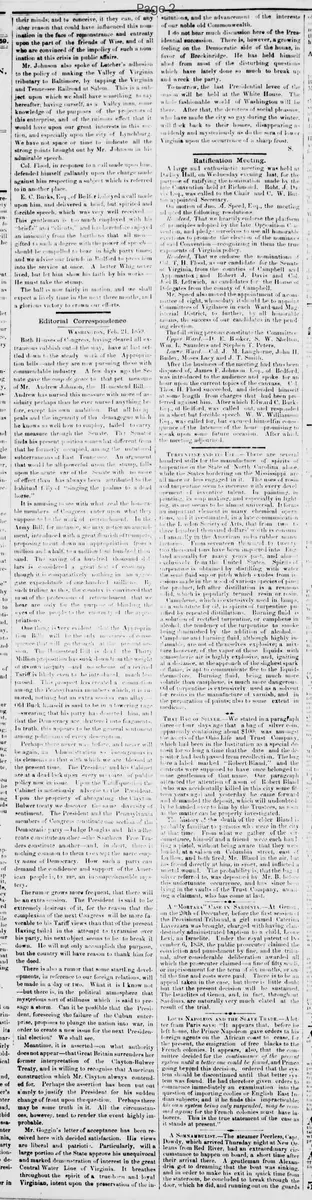
Editorial Correspondence.
Washington, Feb. 21, 1859.
Both Houses of Congress, having cleared all extraneous rubbish out of the way, have at last settled down to the steady work of the Appropriation bills—and they are now pursuing these with commendable industry. A few days ago the Senate gave the coup de grace to that pet measure of Mr. Andrew Johnson, the Homestead Bill. Andrew has nursed this measure with more of assiduity perhaps than he ever nursed anything before, except his own ambition. But all his appeals and the ingenuity of the demagogue which he knows so well how to employ, failed to carry the measure through the Senate. The Senator finds his present position somewhat different from that he formerly occupied, among the untutored subterraneans of East Tennessee. An argument that would be all-powerful upon the stump, falls upon the acute ear of the Senate with no more of effect than has always been attributed to the habitual folly of "singing the psalms to a dead horse."
It is amusing to see with what zeal the honorable members of Congress enter upon what they suppose to be the work of retrenchment. In the Army Bill, for instance, we may notice an amendment, introduced with a great flourish of trumpets, proposing to cut down an appropriation from a million and a half, to a million four hundred thousand. This saving of a hundred thousand dollars is considered a great test of economy, though it is comparatively nothing in an aggregate expenditure of one hundred million. By such trifling as this, the country is convinced that most of the professions of retrenchment that we hear are only for the purpose of blinding the eyes of the people to the enormity of the appropriations.
One thing is very evident—the Appropriation Bills will be the only measures of consequence that will go through at the present session. The Homestead Bill is dead—the Thirty Million proposition has sunk down from the weight of its own iniquity and no scheme of a revised Tariff is likely even to be introduced, much less passed. This prospect has created a commotion among the Pennsylvania members which, it is rumored, nothing but an extra session can allay. Old Buck himself is said to be in a towering rage—swearing that his party has deserted him, and that the Democracy are battered into fragments. In truth, this appears to be the general sentiment among politicians of every description. Perhaps there never was before, and never will be again, an Administration so incongruous in its elements as that with which we are blessed at the present time. The President and his Cabinet are at a dead lock upon every measure of public policy now in issue. Upon the Tariff question the Cabinet is notoriously adverse to the President. Upon the propriety of abrogating the Clayton-Bulwer treaty we discover the same diversity of sentiment. The President and the Pennsylvania members of Congress constitute one section of the Democratic party—Judge Douglas and his adherents constitute another—the Southern Free Traders constitute another—and, in short, there is nothing common to them except the mere empty name of Democracy. How such a party can demand the confidence and support of the American people is, to me, an incomprehensible mystery.
The rumor grows more frequent, that there will be an extra session. The President is said to be extremely desirous of it, for the reason that the complexion of the next Congress will be more favorable to his Tariff views than that of the present. Having failed in the attempt to tyrannise over his party, his next object seems to be to break it down. He will not only accomplish the purpose, but the country will have reason to thank him for the deed.
There is also a rumor that some startling developments, in reference to our foreign relations, will be made in a day or two. What it is I know not—but there is, in the political atmosphere that mysterious sort of stillness which is said to presage a storm. Can it be possible that the President, foreseeing the failure of the Cuban enterprise, proposes to plunge the nation into war, in order to create a new issue for the next Presidential election? We shall see.
Meantime, it is asserted—on what authority does not appear—that Great Britain surrenders her former interpretation of the Clayton-Bulwer Treaty, and is willing to recognise that American construction which Mr. Clayton always contended for. Perhaps the assertion has been put out simply to justify the President for his sudden change of front upon the question. Perhaps there may be some truth in it. All the circumstances, however, tend to render the event highly improbable.
Mr. Goggin's letter of acceptance has been received here with decided satisfaction. His views are liberal and patriotic. Particularly, will a large portion of the State approve his unequivocal and marked demonstration of interest in the great Central Water Line of Virginia. It breathes throughout the spirit of a true-born and loyal Virginian, intent upon the preservation of the institutions, and the advancement of the interests of our noble old Commonwealth.
I do not hear much discussion here of the Presidential succession. There is, however, a growing feeling on the Democratic side of the house, in favor of Breckinridge. He has held himself aloof from most of the disturbing questions which have lately done so much to break up and wreck the party.
To-morrow, the last Presidential levee of the season will be held at the White House. The whole fashionable world of Washington will be there. After that, the devotees of social pleasure, who have made the city so gay during the winter, will take back to their homes, disappearing as suddenly and mysteriously as do the soras of lower Virginia upon the occurrence of a sharp frost.
S.
Washington, Feb. 21, 1859.
Both Houses of Congress, having cleared all extraneous rubbish out of the way, have at last settled down to the steady work of the Appropriation bills—and they are now pursuing these with commendable industry. A few days ago the Senate gave the coup de grace to that pet measure of Mr. Andrew Johnson, the Homestead Bill. Andrew has nursed this measure with more of assiduity perhaps than he ever nursed anything before, except his own ambition. But all his appeals and the ingenuity of the demagogue which he knows so well how to employ, failed to carry the measure through the Senate. The Senator finds his present position somewhat different from that he formerly occupied, among the untutored subterraneans of East Tennessee. An argument that would be all-powerful upon the stump, falls upon the acute ear of the Senate with no more of effect than has always been attributed to the habitual folly of "singing the psalms to a dead horse."
It is amusing to see with what zeal the honorable members of Congress enter upon what they suppose to be the work of retrenchment. In the Army Bill, for instance, we may notice an amendment, introduced with a great flourish of trumpets, proposing to cut down an appropriation from a million and a half, to a million four hundred thousand. This saving of a hundred thousand dollars is considered a great test of economy, though it is comparatively nothing in an aggregate expenditure of one hundred million. By such trifling as this, the country is convinced that most of the professions of retrenchment that we hear are only for the purpose of blinding the eyes of the people to the enormity of the appropriations.
One thing is very evident—the Appropriation Bills will be the only measures of consequence that will go through at the present session. The Homestead Bill is dead—the Thirty Million proposition has sunk down from the weight of its own iniquity and no scheme of a revised Tariff is likely even to be introduced, much less passed. This prospect has created a commotion among the Pennsylvania members which, it is rumored, nothing but an extra session can allay. Old Buck himself is said to be in a towering rage—swearing that his party has deserted him, and that the Democracy are battered into fragments. In truth, this appears to be the general sentiment among politicians of every description. Perhaps there never was before, and never will be again, an Administration so incongruous in its elements as that with which we are blessed at the present time. The President and his Cabinet are at a dead lock upon every measure of public policy now in issue. Upon the Tariff question the Cabinet is notoriously adverse to the President. Upon the propriety of abrogating the Clayton-Bulwer treaty we discover the same diversity of sentiment. The President and the Pennsylvania members of Congress constitute one section of the Democratic party—Judge Douglas and his adherents constitute another—the Southern Free Traders constitute another—and, in short, there is nothing common to them except the mere empty name of Democracy. How such a party can demand the confidence and support of the American people is, to me, an incomprehensible mystery.
The rumor grows more frequent, that there will be an extra session. The President is said to be extremely desirous of it, for the reason that the complexion of the next Congress will be more favorable to his Tariff views than that of the present. Having failed in the attempt to tyrannise over his party, his next object seems to be to break it down. He will not only accomplish the purpose, but the country will have reason to thank him for the deed.
There is also a rumor that some startling developments, in reference to our foreign relations, will be made in a day or two. What it is I know not—but there is, in the political atmosphere that mysterious sort of stillness which is said to presage a storm. Can it be possible that the President, foreseeing the failure of the Cuban enterprise, proposes to plunge the nation into war, in order to create a new issue for the next Presidential election? We shall see.
Meantime, it is asserted—on what authority does not appear—that Great Britain surrenders her former interpretation of the Clayton-Bulwer Treaty, and is willing to recognise that American construction which Mr. Clayton always contended for. Perhaps the assertion has been put out simply to justify the President for his sudden change of front upon the question. Perhaps there may be some truth in it. All the circumstances, however, tend to render the event highly improbable.
Mr. Goggin's letter of acceptance has been received here with decided satisfaction. His views are liberal and patriotic. Particularly, will a large portion of the State approve his unequivocal and marked demonstration of interest in the great Central Water Line of Virginia. It breathes throughout the spirit of a true-born and loyal Virginian, intent upon the preservation of the institutions, and the advancement of the interests of our noble old Commonwealth.
I do not hear much discussion here of the Presidential succession. There is, however, a growing feeling on the Democratic side of the house, in favor of Breckinridge. He has held himself aloof from most of the disturbing questions which have lately done so much to break up and wreck the party.
To-morrow, the last Presidential levee of the season will be held at the White House. The whole fashionable world of Washington will be there. After that, the devotees of social pleasure, who have made the city so gay during the winter, will take back to their homes, disappearing as suddenly and mysteriously as do the soras of lower Virginia upon the occurrence of a sharp frost.
S.
What sub-type of article is it?
Partisan Politics
Economic Policy
Foreign Affairs
What keywords are associated?
Homestead Bill
Appropriation Bills
Democratic Party
Tariff Revision
Clayton Bulwer Treaty
Extra Session
Presidential Succession
What entities or persons were involved?
Andrew Johnson
President Buchanan
Judge Douglas
Breckinridge
Mr. Goggin
Pennsylvania Members
Southern Free Traders
Editorial Details
Primary Topic
Congressional Proceedings, Democratic Party Divisions, And Foreign Policy Rumors In 1859
Stance / Tone
Critical Of Administration And Party Disunity
Key Figures
Andrew Johnson
President Buchanan
Judge Douglas
Breckinridge
Mr. Goggin
Pennsylvania Members
Southern Free Traders
Key Arguments
Homestead Bill Defeated In Senate
Appropriation Bills Only Major Measures Passing
Democratic Party Fractured Over Tariff And Treaty Issues
Rumors Of Extra Session And Foreign Developments
Critique Of Pretended Retrenchment Efforts
Support For Breckinridge As Successor
Satisfaction With Goggin's Views On Virginia Infrastructure