Thank you for visiting SNEWPapers!
Sign up free
Literary
June 1, 1859
The Lancaster Ledger
Lancaster, Lancaster County, South Carolina
What is this article about?
George Washington's unpublished letter to nephew Howell Lewis, dated August 18, 1793, from Philadelphia, details farm management at Mount Vernon: corn topping experiment, wheat and barley sowing, clover seed accountability, hay and horse feeding economy, overseer reports, and potato care.
Clipping
OCR Quality
95%
Excellent
Full Text
[From the Field and Fireside.]
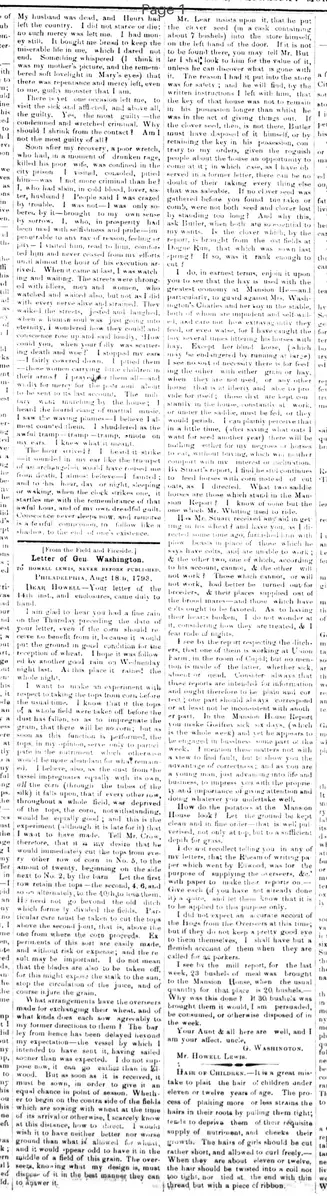
Letter of Gen. Washington.
TO HOWELL LEWIS, NEVER BEFORE PUBLISHED,
PHILADELPHIA, Aug. 18, 1793.
Dear Howell—Your letter of the 14th inst., and enclosures, came duly to hand.
I am glad to hear you had a fine rain on the Thursday preceding the date of your letter, even if the corn should receive no benefit from it, because it would put the ground in good condition for the reception of wheat. I hope it was followed by another good rain on Wednesday night last. At this place it rained the whole night.
I want to make an experiment with respect to taking the tops from corn before the usual time. I know that if the tops of a whole field were taken off before the dust has fallen, so as to impregnate the grain, that there will be no corn; but as soon as this function is performed, the tops, in my opinion, serve only to participate in the nutriment which otherwise would be more abundant for what remains. I believe, also, as the dust from the tassel impregnates equally with its own, all the corn (through the tubes of the silk) it falls upon, that if every other row, throughout a whole field, were deprived of the tops, the corn, notwithstanding, would be equally good: and this is the experiment (although it is late for it) that I want to have made. Tell Mr. Crow, therefore, that I wish he would immediately cut the tops from every other row of corn in No. 5, to the amount of twenty, beginning on the side next to No. 2, by the barn. Let the first row retain the tops—the second, 4, 6, and so on alternately, to the 40th, to lose them. It need not go beyond the old ditch which formerly divided the fields. Particular care must be taken to cut the tops above the second joint, that is, above the one from where the corn proceeds. Experiments of this sort are easily made, and without risk or expense: and the result may be important. I do not mean that the blades are also to be taken off for this might expose the stalk to the sun, stop the circulation of the juice, and of course injure the grain.
What arrangements have the overseers made for exchanging their wheat, and of what kinds does each sow agreeably to my former directions to them? The barley from hence has been delayed beyond my expectation—the vessel by which I intended to have sent it, having sailed sooner than was expected. I do not suppose now, it can go earlier than in Elwood. But as soon as it is received, it must be sown, in order to give it an equal chance in point of season. Whether to begin on the contra side of the fields which are sowing with wheat at the time of its arrival or otherwise, I scarcely know at this distance, how to direct. I would wish it to have neither better nor worse ground than what is allowed for wheat, and it would appear odd to have it in the middle of a field of this grain. The overseers, knowing what my design is, must dispose of it in the best manner they can to answer it.
Mr. Lear insists upon it, that he put the clover seed (in a cask containing about 7 bushels) into the store himself on the left hand of the door. If it is not to be found there, you may tell Mr. Butler I shall look to him for the value of it, unless he can discover what is gone with it. The reason I had it put into the store was for safety; and he will find, by the written instructions I left with him, that the key of that house was not to remain in his possession longer than whilst he was in the act of giving things out. If the clover seed, then, is not there, Butler must have disposed of it himself, or by retaining the key in his possession, contrary to my orders, given the roguish people about the house an opportunity to come at it: in which case, as I have observed in a former letter, there can be no doubt of their taking everything else that was saleable. If no clover seed was gathered before you found the rake or combs, were not both seed and clover lost by standing too long? And why this, ask Butler, when both are so essential to my wants. Is the clover which, by the report, is brought from the out fields at Dogue Run, that which was sown last spring? If so, was it rank enough to cut!
I do, in earnest terms, enjoin it upon you to see that the hay is used with the greatest economy at Mansion House—particularly, to guard against Mrs. Washington's Charles and her boy in the stable, both of whom are impudent and self-willed, and care not how extravagantly they feed, or even waste, for I have caught the boy several times littering his horses with hay. Except her blind horse, (which may be endangered by running at large) I see no sort of necessity there is for feeding the other with either grain or hay, when they are not used, or any other horse that is at liberty and able to provide for itself: those that are kept constantly in the house, constantly at work or under the saddle, must be fed, or they would perish. I can plainly perceive that in a little time, (after saving what oats I want for seed another year) there will be nothing either for my negroes or horses to eat, without buying, which we neither can nor ought to do consistent with my interest or inclination.
By Stuart's report, I find he still continues to feed horses with corn instead of cut oats, as I directed. What two saddle horses are those which stand in the Mansion Report? I know of none but the one which Mr. Whiting used to ride.
Has Mr. Stuart received any aid in getting in his wheat? and have you, as I directed some time ago, furnished him with plow beasts in place of those which he says have colts, and are unable to work; & the other two, one of which, according to his account, cannot, & the other will not work? Those which cannot, or will not work, had better be turned out for breeders, & their places supplied out of the brood mares—and those which have colts ought to be favored. As to having their hearts broken, I do not wonder at it, considering how they are treated, & I fear rode of nights.
I see by the report respecting the ditchers, that one of them is working at Union Farm, in the room of Cupid; but no mention is made of the latter, whether sick, absent or dead. Consider always that those reports are intended for information and ought therefore to be plain and correct; one part should always correspond or at least not be inconsistent with another part. In the Mansion House Report you make Godfrey sick six days, (which is the whole week) and yet he appears to be engaged in business some part of the week.? I mention these matters not with a view to find fault, but to show you the advantage of correctness: and as you are a young man, just advancing into life and business, to impress you with the propriety and importance of giving attention and doing whatever you undertake well.
How do the potatoes at the Mansion House look? Let the ground be kept clean and in fine order—that is well pulverised, not only at top, but to a sufficient depth for grass.
I do not recollect telling you in any of my letters, that the ream of writing paper which went by Elwood, was for the purpose of supplying the overseers, &c., with paper to make their reports on.—Give each (if you have not already done it) a quire, and let them know that it is to be applied to this purpose only.
I did not expect an accurate account of the hogs from the Overseers at this time; but if they do not keep a pretty good eye to them themselves, I shall have but a Flemish account of them when they are called for as porkers.
I see by the mill report, for the last week, 23 bushels of meal was brought to the Mansion House, when the usual quantity for that place is 20 bushels.—Why was this done? If 30 bushels was brought them it would, I am persuaded, be consumed, or otherwise disposed of in the week.
Your Aunt & all here are well, and I am your affect. uncle,
G. WASHINGTON.
Mr. Howell Lewis.
Letter of Gen. Washington.
TO HOWELL LEWIS, NEVER BEFORE PUBLISHED,
PHILADELPHIA, Aug. 18, 1793.
Dear Howell—Your letter of the 14th inst., and enclosures, came duly to hand.
I am glad to hear you had a fine rain on the Thursday preceding the date of your letter, even if the corn should receive no benefit from it, because it would put the ground in good condition for the reception of wheat. I hope it was followed by another good rain on Wednesday night last. At this place it rained the whole night.
I want to make an experiment with respect to taking the tops from corn before the usual time. I know that if the tops of a whole field were taken off before the dust has fallen, so as to impregnate the grain, that there will be no corn; but as soon as this function is performed, the tops, in my opinion, serve only to participate in the nutriment which otherwise would be more abundant for what remains. I believe, also, as the dust from the tassel impregnates equally with its own, all the corn (through the tubes of the silk) it falls upon, that if every other row, throughout a whole field, were deprived of the tops, the corn, notwithstanding, would be equally good: and this is the experiment (although it is late for it) that I want to have made. Tell Mr. Crow, therefore, that I wish he would immediately cut the tops from every other row of corn in No. 5, to the amount of twenty, beginning on the side next to No. 2, by the barn. Let the first row retain the tops—the second, 4, 6, and so on alternately, to the 40th, to lose them. It need not go beyond the old ditch which formerly divided the fields. Particular care must be taken to cut the tops above the second joint, that is, above the one from where the corn proceeds. Experiments of this sort are easily made, and without risk or expense: and the result may be important. I do not mean that the blades are also to be taken off for this might expose the stalk to the sun, stop the circulation of the juice, and of course injure the grain.
What arrangements have the overseers made for exchanging their wheat, and of what kinds does each sow agreeably to my former directions to them? The barley from hence has been delayed beyond my expectation—the vessel by which I intended to have sent it, having sailed sooner than was expected. I do not suppose now, it can go earlier than in Elwood. But as soon as it is received, it must be sown, in order to give it an equal chance in point of season. Whether to begin on the contra side of the fields which are sowing with wheat at the time of its arrival or otherwise, I scarcely know at this distance, how to direct. I would wish it to have neither better nor worse ground than what is allowed for wheat, and it would appear odd to have it in the middle of a field of this grain. The overseers, knowing what my design is, must dispose of it in the best manner they can to answer it.
Mr. Lear insists upon it, that he put the clover seed (in a cask containing about 7 bushels) into the store himself on the left hand of the door. If it is not to be found there, you may tell Mr. Butler I shall look to him for the value of it, unless he can discover what is gone with it. The reason I had it put into the store was for safety; and he will find, by the written instructions I left with him, that the key of that house was not to remain in his possession longer than whilst he was in the act of giving things out. If the clover seed, then, is not there, Butler must have disposed of it himself, or by retaining the key in his possession, contrary to my orders, given the roguish people about the house an opportunity to come at it: in which case, as I have observed in a former letter, there can be no doubt of their taking everything else that was saleable. If no clover seed was gathered before you found the rake or combs, were not both seed and clover lost by standing too long? And why this, ask Butler, when both are so essential to my wants. Is the clover which, by the report, is brought from the out fields at Dogue Run, that which was sown last spring? If so, was it rank enough to cut!
I do, in earnest terms, enjoin it upon you to see that the hay is used with the greatest economy at Mansion House—particularly, to guard against Mrs. Washington's Charles and her boy in the stable, both of whom are impudent and self-willed, and care not how extravagantly they feed, or even waste, for I have caught the boy several times littering his horses with hay. Except her blind horse, (which may be endangered by running at large) I see no sort of necessity there is for feeding the other with either grain or hay, when they are not used, or any other horse that is at liberty and able to provide for itself: those that are kept constantly in the house, constantly at work or under the saddle, must be fed, or they would perish. I can plainly perceive that in a little time, (after saving what oats I want for seed another year) there will be nothing either for my negroes or horses to eat, without buying, which we neither can nor ought to do consistent with my interest or inclination.
By Stuart's report, I find he still continues to feed horses with corn instead of cut oats, as I directed. What two saddle horses are those which stand in the Mansion Report? I know of none but the one which Mr. Whiting used to ride.
Has Mr. Stuart received any aid in getting in his wheat? and have you, as I directed some time ago, furnished him with plow beasts in place of those which he says have colts, and are unable to work; & the other two, one of which, according to his account, cannot, & the other will not work? Those which cannot, or will not work, had better be turned out for breeders, & their places supplied out of the brood mares—and those which have colts ought to be favored. As to having their hearts broken, I do not wonder at it, considering how they are treated, & I fear rode of nights.
I see by the report respecting the ditchers, that one of them is working at Union Farm, in the room of Cupid; but no mention is made of the latter, whether sick, absent or dead. Consider always that those reports are intended for information and ought therefore to be plain and correct; one part should always correspond or at least not be inconsistent with another part. In the Mansion House Report you make Godfrey sick six days, (which is the whole week) and yet he appears to be engaged in business some part of the week.? I mention these matters not with a view to find fault, but to show you the advantage of correctness: and as you are a young man, just advancing into life and business, to impress you with the propriety and importance of giving attention and doing whatever you undertake well.
How do the potatoes at the Mansion House look? Let the ground be kept clean and in fine order—that is well pulverised, not only at top, but to a sufficient depth for grass.
I do not recollect telling you in any of my letters, that the ream of writing paper which went by Elwood, was for the purpose of supplying the overseers, &c., with paper to make their reports on.—Give each (if you have not already done it) a quire, and let them know that it is to be applied to this purpose only.
I did not expect an accurate account of the hogs from the Overseers at this time; but if they do not keep a pretty good eye to them themselves, I shall have but a Flemish account of them when they are called for as porkers.
I see by the mill report, for the last week, 23 bushels of meal was brought to the Mansion House, when the usual quantity for that place is 20 bushels.—Why was this done? If 30 bushels was brought them it would, I am persuaded, be consumed, or otherwise disposed of in the week.
Your Aunt & all here are well, and I am your affect. uncle,
G. WASHINGTON.
Mr. Howell Lewis.
What sub-type of article is it?
Epistolary
What themes does it cover?
Agriculture Rural
Temperance
What keywords are associated?
Washington Letter
Corn Experiment
Farm Management
Hay Economy
Overseer Instructions
Mount Vernon
Agricultural Advice
What entities or persons were involved?
G. Washington
Literary Details
Title
Letter Of Gen. Washington. To Howell Lewis, Never Before Published
Author
G. Washington
Subject
Farm Management Instructions And Agricultural Experiments At Mount Vernon
Form / Style
Personal Epistolary Prose With Practical Agricultural Advice
Key Lines
I Want To Make An Experiment With Respect To Taking The Tops From Corn Before The Usual Time.
Tell Mr. Crow, Therefore, That I Wish He Would Immediately Cut The Tops From Every Other Row Of Corn In No. 5, To The Amount Of Twenty, Beginning On The Side Next To No. 2, By The Barn.
I Do, In Earnest Terms, Enjoin It Upon You To See That The Hay Is Used With The Greatest Economy At Mansion House
I Mention These Matters Not With A View To Find Fault, But To Show You The Advantage Of Correctness: And As You Are A Young Man, Just Advancing Into Life And Business, To Impress You With The Propriety And Importance Of Giving Attention And Doing Whatever You Undertake Well.
Your Aunt & All Here Are Well, And I Am Your Affect. Uncle,
G. Washington.