Thank you for visiting SNEWPapers!
Sign up free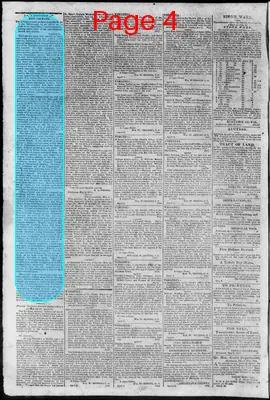
Story
May 20, 1815
Virginia Argus
Richmond, Virginia
What is this article about?
A British officer's letter details the failed assault on American positions at New Orleans on January 8, 1815, resulting in heavy British losses, the death of General Pakenham, and wounding of General Gibbs, with General Lambert assuming command amid strong enemy defenses.
Clipping

OCR Quality
95%
Excellent
Full Text
LATE DISASTER AT
NEW ORLEANS.
The following letter, written from the Banks of the Mississippi, by an officer on the staff of the expedition, contains some interesting particulars of the late disastrous attack and repulse.
January 16.
Here we are lying wet enough in sugar-cane huts, after having met with a severe repulse, on Sunday, the 8th of January, in a general assault on the strongly fortified position of the Yankees, covering the capital of this country. The 85th regiment, sailors, and marines, were, after incredible labour and exertion, passed over to the right bank of the Mississippi, during the night of the 7th, and morning of the 8th; but, owing to the unforeseen and unavoidable difficulties, they were not all over so soon as had been calculated on, consequently not sufficiently advanced when the signal for the general attack was made, just before dawn of day: owing to which untoward circumstance, those on the left bank, where the principal strong opposition lay, did not profit, as was meant they should, from their combined attack, and the fate of the day was decided on our part before they began to act; but for all this, I do not know that there could be any remedy, under all the circumstances of the case; nor do I know that blame can attach anywhere, however unfortunate the result has been.
General Gibbs commanded the 2nd brigade, consisting of the 4th, 21st, and 44th regiments; General Keane the 3d, consisting of the 85th, 93d, and 95th; Gen. Lambert had the 1st, consisting of the fusileers and 43d. This latter brigade was to be in reserve; the two first to begin the attack, which they accordingly did. The enemy's position was uncommonly strong, in the form of a crescent, flanked on the right by the Mississippi, on the left by a thick wood, and an impassible morass; the whole crowned with innumerable artillery, and all loop-holed for the musketry, with a narrow plain in front, not more than half a mile broad, by which only we could approach them.
The whole of our columns were at their appointed stations before day-light, awaiting the signal rocket to be thrown for the general attack. It was fired off as the day began to dawn: a short time before which Sir E. Pakenham had passed the first brigade, without speaking to anybody. We all moved on to the front, under a most galling fire of cannon and small arms; but, as the day opened, we soon observed the broken columns making for the rear, and a vast number of wounded passing and lying groaning around us. General Lambert was, at this present moment, informed, of the lamented fall of the Commander in Chief, and that, in consequence of this, and the severe wound of General Gibbs, he was left in command. We were ordered to deploy into line, and lie down in the swamp, to avoid the destructive showers of grape, which were within 300 yards, playing away most furiously on us. Here we lay till ten at night, as wet as ever poor devils were, seeing all the movements of our foes, and hearing all their orders.
A flag of truce was sent in towards the evening, and the Americans spoke much of peace, but every thing around them looked quite the contrary, as nothing could be seen before them but the dead and dying.
Major King, of the fusileers, was killed early, as was Captain Henry, with the Lieutenant Colonel detached with the third brigade. Lieutenant Hutchinson had no less than four balls through his cap: Lieutenant Lorentz, the other L. C. sob, received a wound between the shoulders, not very severe. The column lost a great many men. Captain Robinson, Brigade Major to Major General Lambert, had a ball through his saddle cloth, without injury. The Americans lost very few men: not one hundred to our thousand, being completely under cover of their position, and protected by a wet ditch, altogether too formidable for so trifling a force to carry: for we had not altogether above 5000 men in the attack.
The 1st brigade preserved a noble front, and wore too formidable an appearance for Jonathan to oppose them. The 7th lost above ninety, the 43d sixty-three. The 40th are just arrived from Cork, but are not to land, as we hope to be all on board our ships in less than a week. Indeed, we thought to have been so ere this. We ought to have had the free navigation of the Mississippi before we landed. We have several sickly from the wet weather, and if we are not off immediately, I fear we shall have numbers more.
We expect to go to Bermuda—they are this moment shelling us as fast as they can.—The Americans have no enterprize or we should not escape so well—we get nothing to buy, but bullocks and a few wild fowl—we are on a sugar plantation, and, of course, have plenty of sweets without cost. The river is a fine one: but believe me, there is nothing else in this quarter worth coming 6000 miles to see. The people appear to be Dons and Blacks, none of whom seem anxious to be our Allies.
NEW ORLEANS.
The following letter, written from the Banks of the Mississippi, by an officer on the staff of the expedition, contains some interesting particulars of the late disastrous attack and repulse.
January 16.
Here we are lying wet enough in sugar-cane huts, after having met with a severe repulse, on Sunday, the 8th of January, in a general assault on the strongly fortified position of the Yankees, covering the capital of this country. The 85th regiment, sailors, and marines, were, after incredible labour and exertion, passed over to the right bank of the Mississippi, during the night of the 7th, and morning of the 8th; but, owing to the unforeseen and unavoidable difficulties, they were not all over so soon as had been calculated on, consequently not sufficiently advanced when the signal for the general attack was made, just before dawn of day: owing to which untoward circumstance, those on the left bank, where the principal strong opposition lay, did not profit, as was meant they should, from their combined attack, and the fate of the day was decided on our part before they began to act; but for all this, I do not know that there could be any remedy, under all the circumstances of the case; nor do I know that blame can attach anywhere, however unfortunate the result has been.
General Gibbs commanded the 2nd brigade, consisting of the 4th, 21st, and 44th regiments; General Keane the 3d, consisting of the 85th, 93d, and 95th; Gen. Lambert had the 1st, consisting of the fusileers and 43d. This latter brigade was to be in reserve; the two first to begin the attack, which they accordingly did. The enemy's position was uncommonly strong, in the form of a crescent, flanked on the right by the Mississippi, on the left by a thick wood, and an impassible morass; the whole crowned with innumerable artillery, and all loop-holed for the musketry, with a narrow plain in front, not more than half a mile broad, by which only we could approach them.
The whole of our columns were at their appointed stations before day-light, awaiting the signal rocket to be thrown for the general attack. It was fired off as the day began to dawn: a short time before which Sir E. Pakenham had passed the first brigade, without speaking to anybody. We all moved on to the front, under a most galling fire of cannon and small arms; but, as the day opened, we soon observed the broken columns making for the rear, and a vast number of wounded passing and lying groaning around us. General Lambert was, at this present moment, informed, of the lamented fall of the Commander in Chief, and that, in consequence of this, and the severe wound of General Gibbs, he was left in command. We were ordered to deploy into line, and lie down in the swamp, to avoid the destructive showers of grape, which were within 300 yards, playing away most furiously on us. Here we lay till ten at night, as wet as ever poor devils were, seeing all the movements of our foes, and hearing all their orders.
A flag of truce was sent in towards the evening, and the Americans spoke much of peace, but every thing around them looked quite the contrary, as nothing could be seen before them but the dead and dying.
Major King, of the fusileers, was killed early, as was Captain Henry, with the Lieutenant Colonel detached with the third brigade. Lieutenant Hutchinson had no less than four balls through his cap: Lieutenant Lorentz, the other L. C. sob, received a wound between the shoulders, not very severe. The column lost a great many men. Captain Robinson, Brigade Major to Major General Lambert, had a ball through his saddle cloth, without injury. The Americans lost very few men: not one hundred to our thousand, being completely under cover of their position, and protected by a wet ditch, altogether too formidable for so trifling a force to carry: for we had not altogether above 5000 men in the attack.
The 1st brigade preserved a noble front, and wore too formidable an appearance for Jonathan to oppose them. The 7th lost above ninety, the 43d sixty-three. The 40th are just arrived from Cork, but are not to land, as we hope to be all on board our ships in less than a week. Indeed, we thought to have been so ere this. We ought to have had the free navigation of the Mississippi before we landed. We have several sickly from the wet weather, and if we are not off immediately, I fear we shall have numbers more.
We expect to go to Bermuda—they are this moment shelling us as fast as they can.—The Americans have no enterprize or we should not escape so well—we get nothing to buy, but bullocks and a few wild fowl—we are on a sugar plantation, and, of course, have plenty of sweets without cost. The river is a fine one: but believe me, there is nothing else in this quarter worth coming 6000 miles to see. The people appear to be Dons and Blacks, none of whom seem anxious to be our Allies.
What sub-type of article is it?
Historical Event
Military Action
Disaster
What themes does it cover?
Catastrophe
Bravery Heroism
Misfortune
What keywords are associated?
Battle Of New Orleans
British Repulse
Pakenham Death
Mississippi River
Military Assault
American Defenses
What entities or persons were involved?
Sir E. Pakenham
General Gibbs
General Keane
Gen. Lambert
Major King
Captain Henry
Lieutenant Hutchinson
Lieutenant Lorentz
Captain Robinson
Where did it happen?
New Orleans, Banks Of The Mississippi
Story Details
Key Persons
Sir E. Pakenham
General Gibbs
General Keane
Gen. Lambert
Major King
Captain Henry
Lieutenant Hutchinson
Lieutenant Lorentz
Captain Robinson
Location
New Orleans, Banks Of The Mississippi
Event Date
Sunday, The 8th Of January
Story Details
British forces under Sir E. Pakenham launched a general assault on fortified American positions at New Orleans but suffered a severe repulse due to delays in crossing the river and strong enemy defenses, resulting in heavy casualties, Pakenham's death, Gibbs' wounding, and Lambert assuming command.