Thank you for visiting SNEWPapers!
Sign up free
The Rhode Island Republican
Newport, Newport County, Rhode Island
What is this article about?
Brigadier General Alexander Macomb's 1814 report on defending Plattsburgh, NY, against 14,000 British troops led by Sir George Prevost. With 1,500 regulars and militia, they repelled attacks, won a naval battle, and forced the enemy's retreat, suffering minimal losses (37 killed, 64 wounded).
Merged-components note: These components form a continuous narrative: the letter from Brigadier General Macomb detailing the defense of Plattsburgh.
Clipping
OCR Quality
Full Text
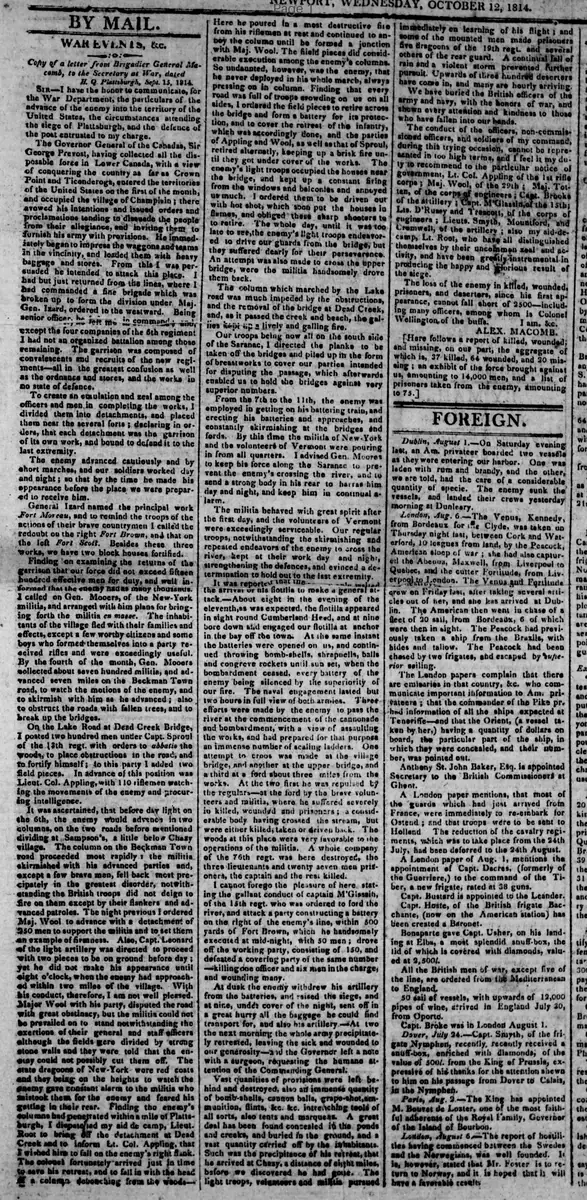
WAR EVENTS, &C.
Copy of a letter from Brigadier General Macomb, to the Secretary at War, dated
H. Q. Plattsburgh, Sept. 15, 1814.
Sir—I have the honor to communicate to the War Department, the particulars of the advance of the enemy into the territory of the United States, the circumstances attending the siege of Plattsburgh, and the defence of the post entrusted to my charge.
The Governor General of the Canadas, Sir George Prevost, having collected all the disposable force in Lower Canada, with a view of conquering the country as far as Crown Point and Ticonderoga, entered the territories of the United States on the first of the month, and occupied the village of Champlain; there avowed his intentions—and issued orders and proclamations tending to dissuade the people from their allegiance, and inviting them to furnish his army with provisions. He immediately began to impress the wagons and teams in the vicinity, and loaded them with heavy baggage and stores. From this I was persuaded he intended to attack this place. I had but just returned from the lines, where I had commanded a fine brigade which was broken up to form the division under Maj. Gen. Izard, ordered to the westward. Being senior officer, he left me in command;—and, except the four companies of the 6th regiment, I had not an organized battalion among those remaining. The garrison was composed of convalescents and recruits of the new regiments—all in the greatest confusion as well as the ordnance and stores, and the works in no state of defence.
To create an emulation and zeal among the officers and men, in completing the works, I divided them into detachments, and placed them near the several forts; declaring in orders, that each detachment was the garrison of its own work, and bound to defend it to the last extremity.
The enemy advanced cautiously and by short marches, and our soldiers worked day and night; so that by the time he made his appearance before the place we were prepared to receive him.
General Izard named the principal work Fort Moreau, and to remind the troops of the actions of their brave countrymen I called the redoubt on the right Fort Brown, and that on the left Fort Scott. Besides these three works, we have two block houses fortified.
Finding on examining the returns of the garrison that our force did not exceed fifteen hundred effective men for duty, and well informed that the enemy had as many thousands, I called on Gen. Mooers, of the New-York militia, and arranged with him plans for bringing forth the militia en masse. The inhabitants of the village fled with their families and effects, except a few worthy citizens and some boys who formed themselves into a party, received rifles and were exceedingly useful.
By the fourth of the month, Gen. Mooers collected about seven hundred militia, and advanced seven miles on the Beekmantown road, to watch the motions of the enemy, and to skirmish with him as he advanced; also to obstruct the roads with fallen trees, and to break up the bridges.
On the Lake Road at Dead Creek Bridge, I posted two hundred men under Capt. Sproul of the 13th regt. with orders to abattis the woods, to place obstructions in the road, and to fortify himself;—to this party I added two field pieces. In advance of this position was Lieut. Col. Appling, with 110 riflemen watching the movements of the enemy and procuring intelligence.
It was ascertained, that before day light on the 6th, the enemy would advance in two columns, on the two roads before mentioned dividing at Sampson's, a little below Chazy village. The column on the Beekmantown road proceeded most rapidly: the militia skirmished with his advanced parties and, except a few brave men, fell back most precipitately in the greatest disorder, notwithstanding the British troops did not deign to fire on them except by their flankers and advanced patroles. The night previous I ordered Maj. Wool, to advance with a detachment of 50 men to support the militia and to set them an example of firmness. Also, Capt. Leonard of the light artillery was directed to proceed with two pieces to be on the ground before day; yet he did not make his appearance until eight o'clock, when the enemy had approached within two miles of the village. With his conduct, therefore, I am not well pleased.
Major Wool with his party, disputed the road with great obstinacy, but the militia could not be prevailed on to stand notwithstanding the exertions of their general and staff officers although the fields were divided by strong stone walls and they were told that the enemy could not possibly cut them off. The state dragoons of New-York wore red coats and they being on the heights to watch the enemy gave constant alarm to the militia who mistook them for the enemy and feared his getting in their rear. Finding the enemy's columns had penetrated within a mile of Plattsburgh, I dispatched my aid de camp, Lieut. Root to bring off the detachment at Dead Creek and to inform Lt. Col. Appling, that I wished him to fall on the enemy's right flank. The colonel fortunately arrived just in time to save his retreat, and to fall in with the head of a column encroaching from my woods—
Here he poured in a most destructive fire from his riflemen at short and continued to annoy the column until he formed a junction with Maj. Wool. The field pieces did considerable execution among the enemy columns. So undaunted, however, was the enemy, that he never deployed in his whole march, always pressing on in column. Finding that every road was full of troops swarming on us on all sides, I ordered the field pieces to retire across the bridge and form battery for its protection, and to cover the retreat of the infantry, which was accordingly done, and the parties of Appling and Wool, as well as that of Sproul; retired alternately, keeping up a brisk fire until they got under cover of the works. The enemy's light troops occupied the houses near the bridge, and kept up a constant firing from the windows and balconies and annoyed us much. I ordered them to be driven out with hot shot, which soon put the houses in flames, and obliged these sharp shooters to retire. The whole day, until it was too late to see, the enemy's light troops endeavored to drive our guards from the bridge, but they suffered dearly for their perseverance. An attempt was also made to cross the upper bridge, where the militia handsomely drove them back.
The column which marched by the Lake road was much impeded by the obstructions, and the removal of the bridge at Dead Creek, and, as it passed the creek and beach, the galleys kept up a lively and galling fire.
Our troops being now all on the south side of the Saranac, I directed the plank to be taken off the bridges and piled up in the form of breastworks to cover our parties intended for disputing the passage, which afterwards enabled us to hold the bridges against very superior numbers.
From the 7th to the 11th, the enemy was employed in getting on his battering train, and erecting his batteries and approaches, and constantly skirmishing at the bridges and fords. By this time the militia of New-York and the volunteers of Vermont were pouring in from all quarters. I advised Gen. Mooers to keep his force along the Saranac to prevent the enemy's crossing the river, and to send a strong body in his rear to harass him day and night, and keep him in continual alarm.
The militia behaved with great spirit after the first day, and the volunteers of Vermont were exceedingly serviceable. Our regular troops, notwithstanding the skirmishing and repeated endeavors of the enemy to cross the river, kept at their work day and night, strengthening the defences, and evinced a determination to hold out to the last extremity.
It was reported that the arrival of his flotilla to make a general attack.—About eight in the evening of the eleventh, as was expected, the flotilla appeared in sight round Cumberland Head, and at nine bore down and engaged our flotilla at anchor in the bay off the town. At the same instant the batteries were opened on us, and continued throwing bomb-shells, shrapnels, balls and congreve rockets until sun set, when the bombardment ceased, every battery of the enemy being silenced by the superiority of our fire. The naval engagement lasted but two hours in full view of both armies. Three efforts were made by the enemy to pass the river at the commencement of the cannonade and bombardment, with a view of assaulting the works, and had prepared for that purpose an immense number of scaling ladders. One attempt to cross was made at the village bridge, and another at the upper bridge, and a third at a ford about three miles from the works. At the two first he was repulsed by the regulars—at the ford by the brave volunteers and militia, where he suffered severely in killed, wounded and prisoners; a considerable body having crossed the stream, but were either killed, taken or driven back. The woods at this place were very favorable to the operations of the militia. A whole company of the 76th regt. was here destroyed, the three lieutenants and twenty seven men prisoners, the captain and the rest killed.
I cannot forego the pleasure of here stating the gallant conduct of captain M'Glassin, of the 15th regt. who was ordered to ford the river, and attack a party constructing a battery on the right of the enemy's line, within 500 yards of Fort Brown, which he handsomely executed at mid-night, with 50 men; drove off the working party, consisting of 150, and defeated a covering party of the same number—killing one officer and six men in the charge; and wounding many.
At dusk the enemy withdrew his artillery from the batteries, and raised the siege, and at nine, under cover of the night, sent off in a great hurry all the baggage he could find transport for, and also his artillery.—At two the next morning the whole army precipitately retreated, leaving the sick and wounded to our generosity and the Governor left a note with a surgeon, requesting the humane attention of the Commanding General.
Vast quantities of provisions were left behind and destroyed, also an immense quantity of bomb-shells, cannon balls, grape-shot, ammunition, flints, &c. &c. intrenching tools of all sorts, also tents and marquees. A great deal has been found concealed in the ponds and creeks, and buried in the ground, and a vast quantity carried off by the inhabitants.
Such was the precipitation of his retreat, that he arrived at Chazy, a distance of eight miles, before we discovered he had gone. The light troops, volunteers and militia pursued
immediately on learning of his flight and some of the mounted men made prisoners five Dragoons of the 19th regt. and several others of the rear guard. A continual fall of rain and a violent storm prevented further pursuit. Upwards of three hundred deserters have come in, and many are hourly arriving.
We have buried the British officers of the army and navy, with the honors of war, and shown every attention and kindness to those who have fallen into our hands.
The conduct of the officers, non-commissioned officers, and soldiers of my command, during this trying occasion, cannot be represented in too high terms, and I feel it my duty to recommend to the particular notice of government, Lt. Col. Appling of the 1st rifle corps; Maj. Wool, of the 29th; Maj. Totten, of the corps of engineers; Capt. Bissel of the artillery; Capt. M'Glassin, of the 15th; Lieuts. D'Russy and Trescott, of the corps of engineers; Lieuts. Smyth, Mountford, and Cromwell, of the artillery; also my aid-de-camp, Lt. Root, who have all distinguished themselves by their uncommon zeal and activity, and have been greatly instrumental in producing the happy and glorious result of the siege.
The loss of the enemy in killed, wounded, prisoners, and deserters, since his first appearance, cannot fall short of 2500—including many officers, among whom is Colonel Wellington of the buffs.
I am, &c.
ALEX. MACOMB.
Here follows a report of killed, wounded; and missing, on our part, the aggregate of which is, 37 killed, 64 wounded, and 20 missing; an exhibit of the force brought against us, amounting to 14,000 men, and a list of prisoners taken from the enemy, amounting to 175.
What sub-type of article is it?
What themes does it cover?
What keywords are associated?
What entities or persons were involved?
Where did it happen?
Story Details
Key Persons
Location
Plattsburgh
Event Date
September 1 11, 1814
Story Details
Brigadier General Macomb details the British advance under Sir George Prevost into U.S. territory, the siege of Plattsburgh, defensive preparations with regulars and militia, skirmishes, naval engagement, repulses of crossing attempts, and the enemy's hasty retreat, leaving behind supplies and wounded.