Thank you for visiting SNEWPapers!
Sign up free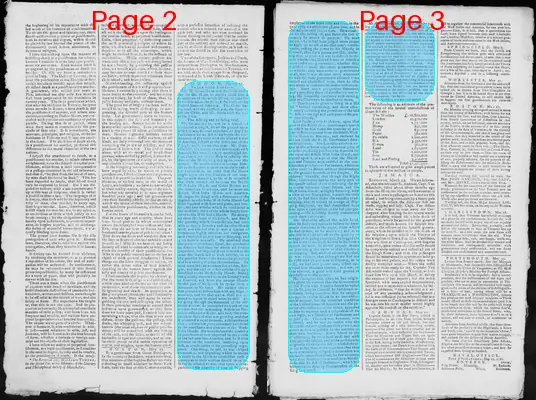
Fowle's New Hampshire Gazette And General Advertiser
Portsmouth, Rockingham County, New Hampshire
What is this article about?
In the British House of Commons on March 12, Mr. W. Grenville moved to continue trade with the United States for another year under Privy Council discretion, citing benefits to West India Islands' supplies and shipping. Debate ensued with Lord Penrhyn and Mr. Dempster; the motion to introduce a bill was agreed to.
Merged-components note: Continuation of the parliamentary debate on trade with America across multiple components.
Clippings
1 of 2
OCR Quality
Full Text
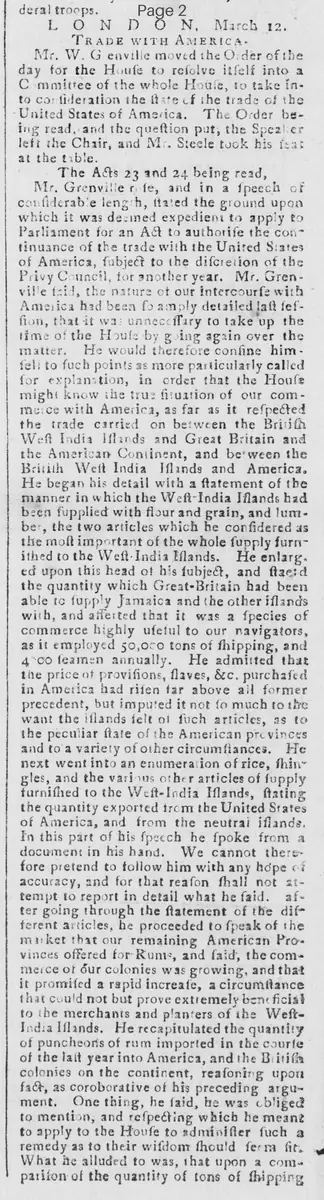
TRADE WITH AMERICA—
Mr. W. Grenville moved the Order of the day for the House to resolve itself into a Committee of the whole House, to take into consideration the state of the trade of the United States of America. The Order being read, and the question put, the Speaker left the Chair, and Mr. Steele took his seat at the table.
The Acts 23 and 24 being read,
Mr. Grenville rose, and in a speech of considerable length, stated the ground upon which it was deemed expedient to apply to Parliament for an Act to authorize the continuance of the trade with the United States of America, subject to the discretion of the Privy Council, for another year. Mr. Grenville said, the nature of our intercourse with America had been so amply detailed last session, that it was unnecessary to take up the time of the House by going again over the matter. He would therefore confine himself to such points as more particularly called for explanation, in order that the House might know the true situation of our commerce with America, as far as it respected the trade carried on between the British West India Islands and Great Britain and the American Continent, and between the British West India Islands and America.
He began his detail with a statement of the manner in which the West-India Islands had been supplied with flour and grain, and lumber, the two articles which he considered as the most important of the whole supply furnished to the West-India Islands. He enlarged upon this head of his subject, and stated the quantity which Great-Britain had been able to supply Jamaica and the other islands with, and asserted that it was a species of commerce highly useful to our navigators, as it employed 20,000 tons of shipping, and 4,000 seamen annually. He admitted that the price of provisions, slaves, &c. purchased in America had risen far above all former precedent, but imputed it not so much to the want the islands felt of such articles, as to the peculiar state of the American provinces and to a variety of other circumstances. He next went into an enumeration of rice, shingles, and the various other articles of supply furnished to the West-India Islands, stating the quantity exported from the United States of America, and from the neutral islands.
In this part of his speech he spoke from a document in his hand. We cannot therefore pretend to follow him with any hope of accuracy, and for that reason shall not attempt to report in detail what he said, after going through the statement of the different articles, he proceeded to speak of the market that our remaining American Provinces offered for Rums, and said, the commerce of our colonies was growing, and that it promised a rapid increase, a circumstance that could not but prove extremely beneficial to the merchants and planters of the West India Islands. He recapitulated the quantity of puncheons of rum imported in the course of the last year into America, and the British colonies on the continent, reasoning upon fact, as corroborative of his preceding argument. One thing, he said, he was obliged to mention, and respecting which he meant to apply to the House to administer such a remedy as to their wisdom should seem fit. What he alluded to was, that upon a comparison of the quantity of tons of shipping
Employed in the years 1785 and 1786, in the year 1785 we employed 58,000 tons, and in the last year only 50,000 tons. He accounted for this falling off, and stated the sort of remedy he meant to propose. He next stated, why it had been judged more proper to apply for an act of another year's continuance, vesting the power in his Majesty in Council, than for a permanent Bill, declaring that, at present it was so difficult to decide whether the United States of America were under one government, whether they consisted of many discordant governments, or whether they were under no government at all, that it was deemed more expedient to wait till their government assumed some settled and established form, than to offer any terms of commercial intercourse at present. After much perspicuous statement, and a necessary share of elucidatory reasoning, Mr. Grenville concluded with moving, that the Chairman be directed to move, "That leave be given to bring in a Bill for further continuing, and more effectually enforcing the provisions of the said Acts of the 23d and 24th years of his present Majesty."
Lord Penrhyn rose to observe, upon that part of the Right Hon. Gentleman's speech in which he had stated the quantity of gallons of Rum exported from the British West India Islands to America, and declared he did not think the R. H. Gentleman's statement accurate. His Lordship also took notice of the acknowledged advanced price of articles necessarily purchased in America for the use of the British West India Islands, and argued upon it, as a proof that the Merchants and Planters were entitled to the consideration and favor of Parliament, wherever either could be shown, without disadvantage to the general interests of the Empire. He observed likewise, that though the Right Hon. Gentleman had in the early part of his speech talked of our continuing the intercourse between Great Britain and the West India Islands, as highly flattering, with a view to our Navigation, towards the close of it, he had been under the necessity of admitting, that in respect of tonnage of shipping employed, we had diminished 8000 tons upon a comparison of the last year preceding. His Lordship shortly commented upon these particulars.
Mr. Grenville assured the noble Lord, that he had every reason to believe the statements contained in the paper, from which he had spoken, to be accurate: and as to the deficiency in respect to the quantity of tonnage of shipping employed, he begged the noble Lord to recollect, he had in his former speech declared, he should propose means of preventing the cause of that deficiency continuing. But, without adverting to that, it was evident, that although we had not in 1786 used 58,000 tons of shipping, as in 1785, we had used 50,000 tons, which employed four thousand seamen: and was, on that account, a great and solid ground of satisfaction to the country.
Mr. Dempster said, when he had originally given his consent that the Government of The Trade with America should be vested in his Majesty in Council, he had done it reluctantly, being conscious that he resigned the powers of that House in an unconstitutional manner, but the unsettled condition of the United States of America and the peculiar circumstances of the times, appeared to him to warrant such a resignation of his own right, as a Member of Parliament and to justify it. The case was, however, now different, and he saw no reason why the House should not reassume their powers, and return as soon as possible to the exercise of their own functions. Every friend to the Constitution, he conceived must feel with him upon the subject, and as the persons who originally asked for the Act, confessed themselves at the time, to be conscious that they were unavoidably obliged to desire what was obviously unconstitutional, he saw no reason why they should not be as anxious as himself to do that by Act of Parliament, which had hitherto been done by Proclamation of the King in Council.
Mr. Grenville replied, and stated, that the passing of an Act from year to year, equally spoke the sense and caution of that House, and of the administration upon the subject, and while America remained in the present unsettled state, it did not appear to him that the matter could, with any sort of public convenience, be better regulated. The conduct of the Privy Council was, he said, amenable to Parliament, and therefore he saw not any danger to the constitution from the business continuing another year in their hands.
Mr. Dempster said, annual Acts were no novelty; they had repeated instances of them. Why not, therefore, put the intercourse between Great-Britain and the West India Islands, under the authority of an Act of Parliament? As to the United States of America, he had no objection to the matter respecting them remaining in the hands of the Privy Council, 'till the Government of the United States was settled; but the sooner the House returned to the ancient practice, and the less they trusted to the discretion of the executive Government, the better.
The Question was put and agreed to.
What sub-type of article is it?
What keywords are associated?
What entities or persons were involved?
Where did it happen?
Foreign News Details
Primary Location
United States Of America
Event Date
March 12
Key Persons
Outcome
motion agreed to for leave to bring in a bill continuing the acts of the 23d and 24th years of his present majesty for another year, vesting power in the privy council.
Event Details
Mr. Grenville proposed continuing trade with the United States under Privy Council discretion due to unsettled American government, detailing supplies to West India Islands like flour, grain, lumber, rice; benefits to shipping (20,000 tons, 4,000 seamen); rising prices; rum exports; tonnage decline from 58,000 to 50,000 tons. Lord Penrhyn questioned rum export figures and tonnage drop. Mr. Dempster argued against vesting power in Council, favoring parliamentary acts. Debate concluded with motion passed.