Thank you for visiting SNEWPapers!
Sign up free
Literary
September 2, 1806
The New Hampshire Gazette
Portsmouth, Rockingham County, New Hampshire
What is this article about?
An essay from the Baltimore Evening Post reflecting on the futility of unchecked human ambition for wealth and power, using historical anecdotes like Pyrrhus's conquests, a miser's rent worries, a usurer's anxiety, and a captain's fatal voyage, urging contentment and awareness of mortality.
Clipping
OCR Quality
95%
Excellent
Full Text
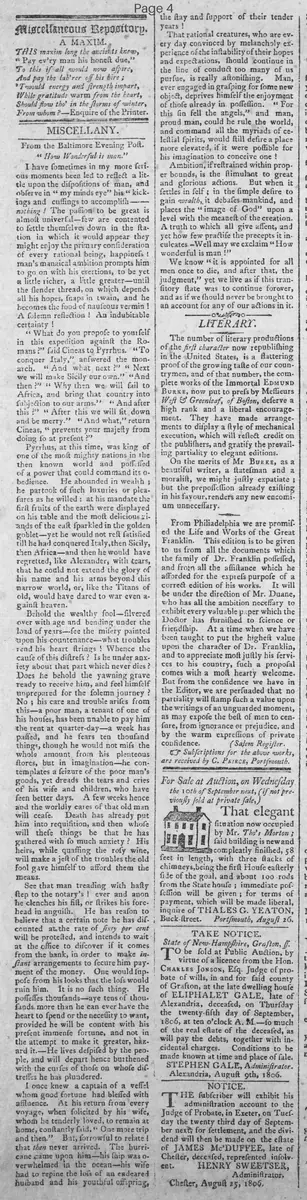
MISCELLANY.
From the Baltimore Evening Post.
"How Wonderful is man."
I have sometimes in my more serious moments been led to reflect a little upon the dispositions of man, and observe in "my mind's eye" his "kickings and cuffings to accomplish-- nothing! The passion to be great is almost universal--few are contented to settle themselves down in the station in which it would appear they might enjoy the primary consideration of every rational being, happiness! Man's maniacal ambition prompts him to go on with his exertions, to be yet a little richer, a little greater--until the slender thread, on which depends all his hopes, snaps in twain, and he becomes the food of nauseous vermin!
A solemn reflection! An indubitable certainty!
"What do you propose to yourself in this expedition against the Romans?" said Cineas to Pyrrhus. "To conquer Italy," answered the monarch. "And what next?" "Next we will make Sicily our own." "And then?" "Why then we will sail to Africa, and bring that country into subjection to our arms." "And after this?" "After this we will sit down and be merry." "And what," return Cineas, "prevents your majesty from doing so at present?"
Pyrrhus, at this time, was king of one of the most mighty nations in the then known world and possessed of a power that could command its obedience. He abounded in wealth; he partook of such luxuries or pleasures as he willed: at his mandate the first fruits of the earth were displayed on his table and the most delicious wines of the east sparkled in the golden goblet--yet he would not rest satisfied till he had conquered Italy, then Sicily then Africa--and then he would have regretted, like Alexander, with tears, that he could not extend the glory of his name and his arms beyond this narrow world, or, like the Titans of old, would have dared to war even against heaven.
Behold the wealthy fool--silvered over with age and bending under the load of years--see the misery painted upon his countenance--what troubles rend his heart strings! Whence the cause of this distress? Is he under anxiety about that part which never dies? Does he behold the yawning grave ready to receive him, and feel himself unprepared for the solemn journey?
No: his care and trouble arises from this--a poor man, a tenant of one of his houses, has been unable to pay him the rent at quarter-day--a week has passed, and he fears ten thousand things, though he would not miss the whole amount from his plenteous stores, but in imagination--he contemplates a seizure of the poor man's goods, yet dreads the tears and cries of his wife and children, who have seen better days. A few weeks hence and the worldly cares of that old man will cease. Death has already put him into requisition, and then whose will these things be that he has gathered with so much anxiety? His heirs, while quaffing the rich wine, will make a jest of the troubles the old fool gave himself to afford them the means.
See that man treading with hasty step to the notary's! ever and anon he clenches his fist, or strikes his forehead in anguish. He has reason to believe that a certain note he has discounted at the rate of sixty per cent will be protested, and intends to wait at the office to discover if it comes from the bank, in order to make instant arrangements to secure him payment of the money. One would suppose from his looks that the loss would ruin him. It is no such thing. He possesses thousands--aye tens of thousands, more than he can ever have the heart to spend or the necessity to want, provided he will be content with his present immense fortune, and not in the attempt to make it greater, hazard it.--He lives despised by the people, and will depart hence burdened with the curses of those on whose distresses he has plundered.
I once knew a captain of a vessel whom good fortune had blessed with affluence. At his return from every voyage, when solicited by his wife, whom he tenderly loved, to remain at home, constantly said, "One more trip and then." But, sorrowful to relate! that then never arrived. The hurricane came upon him--his ship was overwhelmed in the ocean--his wife had to repine the loss of an endeared husband and his youthful offspring the stay and support of their tender years!
That rational creatures, who are every day convinced by melancholy experience of the instability of their hopes and expectations, should continue in the line of conduct too many of us pursue, is really astonishing. Man, ever engaged in grasping for some new object, deprives himself the enjoyment of those already in possession. "For this in self the angels," and man, proud man, could he rule the world, and command all the myriads of celestial spirits, would still desire a place more elevated, if it were possible for his imagination to conceive one!
Ambition, if restrained within proper bounds, is the stimulus to great and glorious actions. But when it settles in self; in the simple desire to gain wealth, it debases mankind, and places the "image of God" upon a level with the meanest of the creation.
A truth to which all give assent, and yet how few practice the precepts it inculcates.--Well may we exclaim "How wonderful is man!"
We know "it is appointed for all men once to die, and after that, the judgment," yet we live as if this transitory state was to continue forever, and as if we should never be brought to an account for any of our actions in it.
From the Baltimore Evening Post.
"How Wonderful is man."
I have sometimes in my more serious moments been led to reflect a little upon the dispositions of man, and observe in "my mind's eye" his "kickings and cuffings to accomplish-- nothing! The passion to be great is almost universal--few are contented to settle themselves down in the station in which it would appear they might enjoy the primary consideration of every rational being, happiness! Man's maniacal ambition prompts him to go on with his exertions, to be yet a little richer, a little greater--until the slender thread, on which depends all his hopes, snaps in twain, and he becomes the food of nauseous vermin!
A solemn reflection! An indubitable certainty!
"What do you propose to yourself in this expedition against the Romans?" said Cineas to Pyrrhus. "To conquer Italy," answered the monarch. "And what next?" "Next we will make Sicily our own." "And then?" "Why then we will sail to Africa, and bring that country into subjection to our arms." "And after this?" "After this we will sit down and be merry." "And what," return Cineas, "prevents your majesty from doing so at present?"
Pyrrhus, at this time, was king of one of the most mighty nations in the then known world and possessed of a power that could command its obedience. He abounded in wealth; he partook of such luxuries or pleasures as he willed: at his mandate the first fruits of the earth were displayed on his table and the most delicious wines of the east sparkled in the golden goblet--yet he would not rest satisfied till he had conquered Italy, then Sicily then Africa--and then he would have regretted, like Alexander, with tears, that he could not extend the glory of his name and his arms beyond this narrow world, or, like the Titans of old, would have dared to war even against heaven.
Behold the wealthy fool--silvered over with age and bending under the load of years--see the misery painted upon his countenance--what troubles rend his heart strings! Whence the cause of this distress? Is he under anxiety about that part which never dies? Does he behold the yawning grave ready to receive him, and feel himself unprepared for the solemn journey?
No: his care and trouble arises from this--a poor man, a tenant of one of his houses, has been unable to pay him the rent at quarter-day--a week has passed, and he fears ten thousand things, though he would not miss the whole amount from his plenteous stores, but in imagination--he contemplates a seizure of the poor man's goods, yet dreads the tears and cries of his wife and children, who have seen better days. A few weeks hence and the worldly cares of that old man will cease. Death has already put him into requisition, and then whose will these things be that he has gathered with so much anxiety? His heirs, while quaffing the rich wine, will make a jest of the troubles the old fool gave himself to afford them the means.
See that man treading with hasty step to the notary's! ever and anon he clenches his fist, or strikes his forehead in anguish. He has reason to believe that a certain note he has discounted at the rate of sixty per cent will be protested, and intends to wait at the office to discover if it comes from the bank, in order to make instant arrangements to secure him payment of the money. One would suppose from his looks that the loss would ruin him. It is no such thing. He possesses thousands--aye tens of thousands, more than he can ever have the heart to spend or the necessity to want, provided he will be content with his present immense fortune, and not in the attempt to make it greater, hazard it.--He lives despised by the people, and will depart hence burdened with the curses of those on whose distresses he has plundered.
I once knew a captain of a vessel whom good fortune had blessed with affluence. At his return from every voyage, when solicited by his wife, whom he tenderly loved, to remain at home, constantly said, "One more trip and then." But, sorrowful to relate! that then never arrived. The hurricane came upon him--his ship was overwhelmed in the ocean--his wife had to repine the loss of an endeared husband and his youthful offspring the stay and support of their tender years!
That rational creatures, who are every day convinced by melancholy experience of the instability of their hopes and expectations, should continue in the line of conduct too many of us pursue, is really astonishing. Man, ever engaged in grasping for some new object, deprives himself the enjoyment of those already in possession. "For this in self the angels," and man, proud man, could he rule the world, and command all the myriads of celestial spirits, would still desire a place more elevated, if it were possible for his imagination to conceive one!
Ambition, if restrained within proper bounds, is the stimulus to great and glorious actions. But when it settles in self; in the simple desire to gain wealth, it debases mankind, and places the "image of God" upon a level with the meanest of the creation.
A truth to which all give assent, and yet how few practice the precepts it inculcates.--Well may we exclaim "How wonderful is man!"
We know "it is appointed for all men once to die, and after that, the judgment," yet we live as if this transitory state was to continue forever, and as if we should never be brought to an account for any of our actions in it.
What sub-type of article is it?
Essay
What themes does it cover?
Moral Virtue
Death Mortality
Commerce Trade
What keywords are associated?
Human Ambition
Mortality
Wealth Pursuit
Contentment
Pyrrhus Dialogue
What entities or persons were involved?
From The Baltimore Evening Post.
Literary Details
Title
How Wonderful Is Man.
Author
From The Baltimore Evening Post.
Key Lines
"What Do You Propose To Yourself In This Expedition Against The Romans?" Said Cineas To Pyrrhus. "To Conquer Italy," Answered The Monarch. "And What Next?" "Next We Will Make Sicily Our Own." "And Then?" "Why Then We Will Sail To Africa, And Bring That Country Into Subjection To Our Arms." "And After This?" "After This We Will Sit Down And Be Merry." "And What," Return Cineas, "Prevents Your Majesty From Doing So At Present?"
A Solemn Reflection! An Indubitable Certainty!
Well May We Exclaim "How Wonderful Is Man!"
We Know "It Is Appointed For All Men Once To Die, And After That, The Judgment," Yet We Live As If This Transitory State Was To Continue Forever, And As If We Should Never Be Brought To An Account For Any Of Our Actions In It.
Ambition, If Restrained Within Proper Bounds, Is The Stimulus To Great And Glorious Actions. But When It Settles In Self; In The Simple Desire To Gain Wealth, It Debases Mankind, And Places The "Image Of God" Upon A Level With The Meanest Of The Creation.