Thank you for visiting SNEWPapers!
Sign up free
Literary
December 4, 1790
Gazette Of The United States
New York, New York County, New York
What is this article about?
Continuation of historical discourse on French religious and political conflicts. Describes Huguenot recovery post-Edict of January, led by Prince of Conde and Admiral; Queen Catherine's deceptive maneuvers to gain their trust while protecting her interests; shifts in alliances; critiques unbalanced government leading to constant intrigue.
Clipping
OCR Quality
95%
Excellent
Full Text
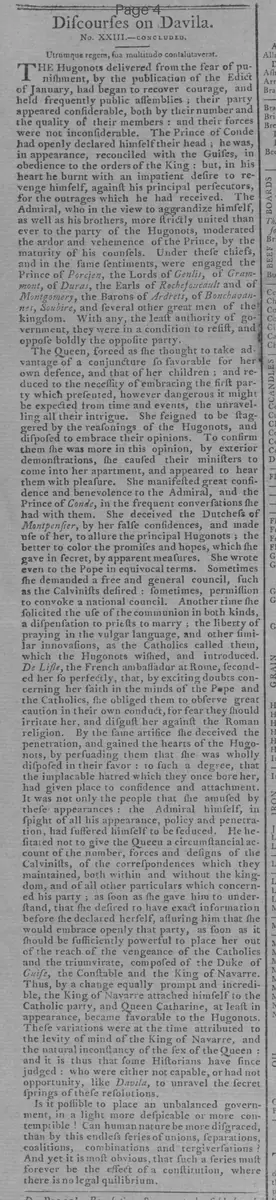
Discourses on Davila.
No. XXIII.-CONCLUDED.
Utrumque regem, sua multitudo conlaudaverat.
THE Hugonots delivered from the fear of punishment, by the publication of the Edict of January, had began to recover courage, and held frequently public assemblies; their party appeared considerable, both by their number and the quality of their members: and their forces were not inconsiderable. The Prince of Conde had openly declared himself their head; he was, in appearance, reconciled with the Guises, in obedience to the orders of the King: but, in his heart he burnt with an impatient desire to revenge himself, against his principal persecutors, for the outrages which he had received. The Admiral, who in the view to aggrandize himself, as well as his brothers, more strictly united than ever to the party of the Hugonots, moderated the ardor and vehemence of the Prince, by the maturity of his counsels. Under these chiefs, and in the same sentiments, were engaged the Prince of Porcien, the Lords of Genlis, of Gramont, of Duras, the Earls of Rochefoucault and of Montgomery, the Barons of Ardrets, of Bouchavannes, Soubise, and several other great men of the kingdom. With any, the least authority of government, they were in a condition to resist, and oppose boldly the opposite party.
The Queen, forced as she thought to take advantage of a conjuncture so favorable for her own defence, and that of her children; and reduced to the necessity of embracing the first party which presented, however dangerous it might be expected from time and events, the unravelling all their intrigue. She feigned to be staggered by the reasonings of the Hugonots, and disposed to embrace their opinions. To confirm them she was more in this opinion, by exterior demonstrations, she caused their ministers to come into her apartment, and appeared to hear them with pleasure. She manifested great confidence and benevolence to the Admiral, and the Prince of Conde, in the frequent conversations she had with them. She deceived the Duchess of Montpensier, by her false confidences, and made use of her, to allure the principal Hugonots; the better to color the promises and hopes, which she gave in secret, by apparent measures. She wrote even to the Pope in equivocal terms. Sometimes she demanded a free and general council, such as the Calvinists desired: sometimes, permission to convoke a national council. Another time she solicited the use of the communion in both kinds, a dispensation to priests to marry; the liberty of praying in the vulgar language, and other similar innovations, as the Catholics called them, which the Hugonots wished, and introduced. De l'Isle, the French ambassador at Rome, seconded her so perfectly, that, by exciting doubts concerning her faith in the minds of the Pope and the Catholics, she obliged them to observe great caution in their own conduct, for fear they should irritate her, and disgust her against the Roman religion. By the same artifice she deceived the penetration, and gained the hearts of the Hugonots, by persuading them that she was wholly disposed in their favor: to such a degree, that the implacable hatred which they once bore her, had given place to confidence and attachment.
It was not only the people that she amused by these appearances: the Admiral himself, in spite of all his experience, policy and penetration, had suffered himself to be seduced. He hesitated not to give the Queen a circumstantial account of the number, forces and designs of the Calvinists, of the correspondences which they maintained, both within and without the kingdom, and of all other particulars which concerned his party; as soon as she gave him to understand, that she desired to have exact information before she declared herself, assuring him that she would embrace openly that party, as soon as it should be sufficiently powerful to place her out of the reach of the vengeance of the Catholics and the triumvirate, composed of the Duke of Guise, the Constable and the King of Navarre.
Thus, by a change equally prompt and incredible, the King of Navarre attached himself to the Catholic party, and Queen Catharine, at least in appearance, became favorable to the Hugonots. These variations were at the time attributed to the levity of mind of the King of Navarre, and the natural inconstancy of the sex of the Queen: and it is thus that some Historians have since judged: who were either not capable, or had not opportunity, like Davila, to unravel the secret springs of these resolutions.
Is it possible to place an unbalanced government, in a light more despicable or more contemptible! Can human nature be more disgraced, than by this endless series of unions, separations, coalitions, combinations and tergiversations? And yet it is most obvious, that such a series must forever be the effect of a constitution, where there is no legal equilibrium.
No. XXIII.-CONCLUDED.
Utrumque regem, sua multitudo conlaudaverat.
THE Hugonots delivered from the fear of punishment, by the publication of the Edict of January, had began to recover courage, and held frequently public assemblies; their party appeared considerable, both by their number and the quality of their members: and their forces were not inconsiderable. The Prince of Conde had openly declared himself their head; he was, in appearance, reconciled with the Guises, in obedience to the orders of the King: but, in his heart he burnt with an impatient desire to revenge himself, against his principal persecutors, for the outrages which he had received. The Admiral, who in the view to aggrandize himself, as well as his brothers, more strictly united than ever to the party of the Hugonots, moderated the ardor and vehemence of the Prince, by the maturity of his counsels. Under these chiefs, and in the same sentiments, were engaged the Prince of Porcien, the Lords of Genlis, of Gramont, of Duras, the Earls of Rochefoucault and of Montgomery, the Barons of Ardrets, of Bouchavannes, Soubise, and several other great men of the kingdom. With any, the least authority of government, they were in a condition to resist, and oppose boldly the opposite party.
The Queen, forced as she thought to take advantage of a conjuncture so favorable for her own defence, and that of her children; and reduced to the necessity of embracing the first party which presented, however dangerous it might be expected from time and events, the unravelling all their intrigue. She feigned to be staggered by the reasonings of the Hugonots, and disposed to embrace their opinions. To confirm them she was more in this opinion, by exterior demonstrations, she caused their ministers to come into her apartment, and appeared to hear them with pleasure. She manifested great confidence and benevolence to the Admiral, and the Prince of Conde, in the frequent conversations she had with them. She deceived the Duchess of Montpensier, by her false confidences, and made use of her, to allure the principal Hugonots; the better to color the promises and hopes, which she gave in secret, by apparent measures. She wrote even to the Pope in equivocal terms. Sometimes she demanded a free and general council, such as the Calvinists desired: sometimes, permission to convoke a national council. Another time she solicited the use of the communion in both kinds, a dispensation to priests to marry; the liberty of praying in the vulgar language, and other similar innovations, as the Catholics called them, which the Hugonots wished, and introduced. De l'Isle, the French ambassador at Rome, seconded her so perfectly, that, by exciting doubts concerning her faith in the minds of the Pope and the Catholics, she obliged them to observe great caution in their own conduct, for fear they should irritate her, and disgust her against the Roman religion. By the same artifice she deceived the penetration, and gained the hearts of the Hugonots, by persuading them that she was wholly disposed in their favor: to such a degree, that the implacable hatred which they once bore her, had given place to confidence and attachment.
It was not only the people that she amused by these appearances: the Admiral himself, in spite of all his experience, policy and penetration, had suffered himself to be seduced. He hesitated not to give the Queen a circumstantial account of the number, forces and designs of the Calvinists, of the correspondences which they maintained, both within and without the kingdom, and of all other particulars which concerned his party; as soon as she gave him to understand, that she desired to have exact information before she declared herself, assuring him that she would embrace openly that party, as soon as it should be sufficiently powerful to place her out of the reach of the vengeance of the Catholics and the triumvirate, composed of the Duke of Guise, the Constable and the King of Navarre.
Thus, by a change equally prompt and incredible, the King of Navarre attached himself to the Catholic party, and Queen Catharine, at least in appearance, became favorable to the Hugonots. These variations were at the time attributed to the levity of mind of the King of Navarre, and the natural inconstancy of the sex of the Queen: and it is thus that some Historians have since judged: who were either not capable, or had not opportunity, like Davila, to unravel the secret springs of these resolutions.
Is it possible to place an unbalanced government, in a light more despicable or more contemptible! Can human nature be more disgraced, than by this endless series of unions, separations, coalitions, combinations and tergiversations? And yet it is most obvious, that such a series must forever be the effect of a constitution, where there is no legal equilibrium.
What sub-type of article is it?
Essay
What themes does it cover?
Political
Religious
Liberty Freedom
What keywords are associated?
Huguenots
Queen Catherine
Prince Conde
Admiral Coligny
Political Intrigue
French Wars Religion
Edict January
Literary Details
Title
Discourses On Davila. No. Xxiii. Concluded.
Key Lines
Utrumque Regem, Sua Multitudo Conlaudaverat.
Is It Possible To Place An Unbalanced Government, In A Light More Despicable Or More Contemptible! Can Human Nature Be More Disgraced, Than By This Endless Series Of Unions, Separations, Coalitions, Combinations And Tergiversations? And Yet It Is Most Obvious, That Such A Series Must Forever Be The Effect Of A Constitution, Where There Is No Legal Equilibrium.