Thank you for visiting SNEWPapers!
Sign up free
Tucker Democrat
St. George, Tucker County, West Virginia
What is this article about?
Article discusses ganja, a hemp-derived narcotic in India, its criminal effects compared to opium, government restrictions, and historical uses in assassinations and the 1857-1858 Indian mutiny. Reports a recent stabbing in Bombay bazar by a ganja user.
Clipping
OCR Quality
Full Text
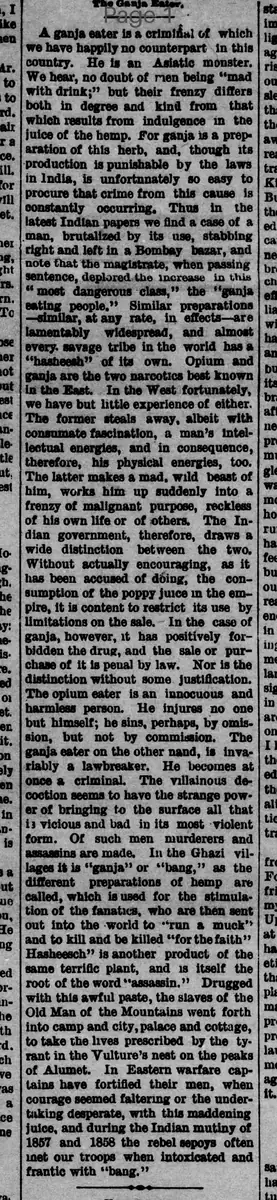
We hear, no doubt of men being "mad with drink:" but their frenzy differs both in degree and kind from that which results from indulgence in the juice of the hemp. For ganja is a preparation of this herb, and, though its production is punishable by the laws in India, is unfortunately so easy to procure that crime from this cause is constantly occurring. Thus in the latest Indian papers we find a case of a man, brutalized by its use, stabbing right and left in a Bombay bazar, and note that the magistrate, when passing sentence, deplored the increase in this "most dangerous class," the ganja eating people. Similar preparations--similar, at any rate, in effects--are lamentably widespread, and almost every savage tribe in the world has a "hasheesh" of its own. Opium and ganja are the two narcotics best known in the East. In the West fortunately we have but little experience of either.
The former steals away, albeit with consummate fascination, a man's intellectual energies, and in consequence, therefore, his physical energies, too. The latter makes a mad, wild beast of him, works him up suddenly into a frenzy of malignant purpose, reckless of his own life or of others. The Indian government, therefore, draws a wide distinction between the two. Without actually encouraging, as it has been accused of doing, the consumption of the poppy juice in the empire, it is content to restrict its use by limitations on the sale. In the case of ganja, however, it has positively forbidden the drug, and the sale or purchase of it is penal by law. Nor is the distinction without some justification.
The opium eater is an innocuous and harmless person. He injures no one but himself; he sins, perhaps, by omission, but not by commission. The ganja eater on the other hand, is invariably a lawbreaker. He becomes at once a criminal. The villainous decoction seems to have the strange power of bringing to the surface all that is vicious and bad in its most violent form. Of such men murderers and assassins are made. In the Ghazi villages it is "ganja" or "sbang," as the different preparations of hemp are called, which is used for the stimulation of the fanatics, who are then sent out into the world to run a muck and to kill and be killed "for the faith."
"Hasheesh" is another product of the same terrific plant, and is itself the root of the word "assassin." Drugged with this awful paste, the slaves of the Old Man of the Mountains went forth into camp and city, palace and cottage, to take the lives prescribed by the tyrant in the Vulture's nest on the peaks of Alamut. In Eastern warfare captains have fortified their men, when courage seemed faltering or the undertaking desperate, with this maddening juice, and during the Indian mutiny of 1857 and 1858 the rebel sepoys often met our troops when intoxicated and frantic with "bang."
What sub-type of article is it?
What keywords are associated?
Where did it happen?
Foreign News Details
Primary Location
India
Outcome
stabbing incident in bombay bazar; general increase in ganja-related crimes; historical uses leading to murders and fanaticism in mutinies and assassinations.
Event Details
Description of ganja as a dangerous narcotic in India causing criminal frenzy, contrasting with opium; Indian laws banning ganja while restricting opium; recent case of ganja-induced stabbing in Bombay; historical references to its use in assassinations, Eastern warfare, and 1857-1858 Indian mutiny.