Thank you for visiting SNEWPapers!
Sign up free
Story
February 26, 1911
University Missourian
Columbia, Boone County, Missouri
What is this article about?
Dr. Charles A. Ellwood, professor of sociology, presents a paper refuting Karl Marx's materialistic conception of history, arguing that economic conditions do not solely determine social phenomena. He cites ethnography and history, like the Tungs of Siberia and Christianity's spread, and disputes socialism's ability to eradicate crime.
Clipping
OCR Quality
95%
Excellent
Full Text
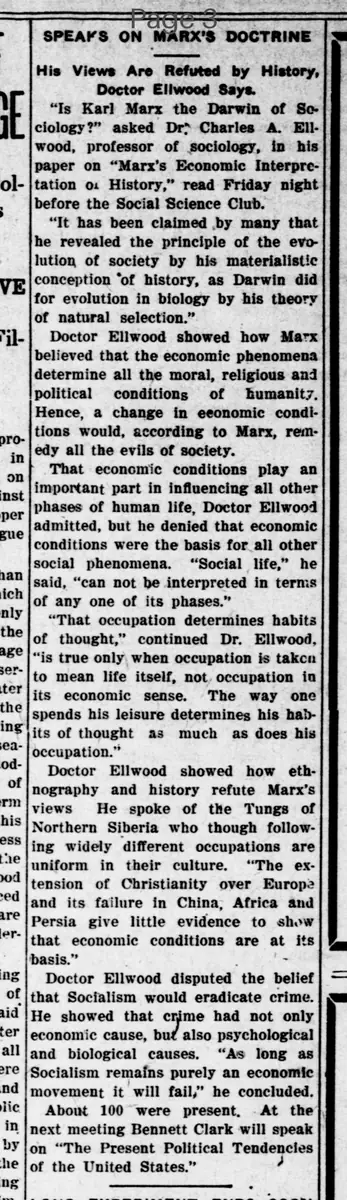
SPEAKS ON MARX'S DOCTRINE
His Views Are Refuted by History.
Doctor Ellwood Says.
"Is Karl Marx the Darwin of Sociology?" asked Dr Charles A. Ellwood, professor of sociology, in his paper on "Marx's Economic Interpretation of History," read Friday night before the Social Science Club.
"It has been claimed by many that he revealed the principle of the evolution of society by his materialistic conception of history, as Darwin did for evolution in biology by his theory of natural selection."
Doctor Ellwood showed how Marx believed that the economic phenomena determine all the moral, religious and political conditions of Humanity
Hence, a change in economic conditions would, according to Marx, remedy all the evils of society.
That economic conditions play an important part in influencing all other phases of human life, Doctor Ellwood admitted, but he denied that economic conditions were the basis for all other social phenomena.
"Social life," he said, "can not be interpreted in terms of any one of its phases."
"That occupation determines habits of thought," continued Dr. Ellwood, "is true only when occupation is taken to mean life itself, not, occupation in its economic sense. The way one spends his leisure determines his habits of thought as much as does his occupation."
Doctor Ellwood showed how ethnography and history refute Marx's views. He spoke of the Tungs of Northern Siberia who though following widely different occupations are uniform in their culture. "The extension of Christianity over Europe and its failure in China, Africa and Persia give little evidence to show that economic conditions are at its basis."
Doctor Ellwood disputed the belief that Socialism would eradicate crime. He showed that crime had not only economic cause, but also psychological and biological causes.
"As long as Socialism remains purely an economic movement it will fail," he concluded
About 100 were present. At the next meeting Bennett Clark will speak on "The Present Political Tendencies of the United States."
His Views Are Refuted by History.
Doctor Ellwood Says.
"Is Karl Marx the Darwin of Sociology?" asked Dr Charles A. Ellwood, professor of sociology, in his paper on "Marx's Economic Interpretation of History," read Friday night before the Social Science Club.
"It has been claimed by many that he revealed the principle of the evolution of society by his materialistic conception of history, as Darwin did for evolution in biology by his theory of natural selection."
Doctor Ellwood showed how Marx believed that the economic phenomena determine all the moral, religious and political conditions of Humanity
Hence, a change in economic conditions would, according to Marx, remedy all the evils of society.
That economic conditions play an important part in influencing all other phases of human life, Doctor Ellwood admitted, but he denied that economic conditions were the basis for all other social phenomena.
"Social life," he said, "can not be interpreted in terms of any one of its phases."
"That occupation determines habits of thought," continued Dr. Ellwood, "is true only when occupation is taken to mean life itself, not, occupation in its economic sense. The way one spends his leisure determines his habits of thought as much as does his occupation."
Doctor Ellwood showed how ethnography and history refute Marx's views. He spoke of the Tungs of Northern Siberia who though following widely different occupations are uniform in their culture. "The extension of Christianity over Europe and its failure in China, Africa and Persia give little evidence to show that economic conditions are at its basis."
Doctor Ellwood disputed the belief that Socialism would eradicate crime. He showed that crime had not only economic cause, but also psychological and biological causes.
"As long as Socialism remains purely an economic movement it will fail," he concluded
About 100 were present. At the next meeting Bennett Clark will speak on "The Present Political Tendencies of the United States."
What sub-type of article is it?
Historical Event
What themes does it cover?
Moral Virtue
What keywords are associated?
Marx Doctrine
Economic Interpretation
Sociology Lecture
Social Science Club
Socialism Critique
What entities or persons were involved?
Charles A. Ellwood
Karl Marx
Story Details
Key Persons
Charles A. Ellwood
Karl Marx
Event Date
Friday Night
Story Details
Dr. Ellwood refutes Marx's economic interpretation of history, arguing social life cannot be reduced to economics alone, using examples from ethnography and history, and concludes socialism fails if purely economic.