Thank you for visiting SNEWPapers!
Sign up free
Keowee Courier
Walhalla, Pickens, Oconee County, Pickens County, South Carolina
What is this article about?
Oconee County Farm Demonstration Agent G. H. Griffin shares notes on soybean cultivation and specialist visit by R. W. Hamilton on May 4-5, poultry pest control, co-operative poultry marketing in May, and monthly agronomy, animal husbandry, garden, entomology, poultry, dairying, and plant disease tasks.
Clipping
OCR Quality
Full Text
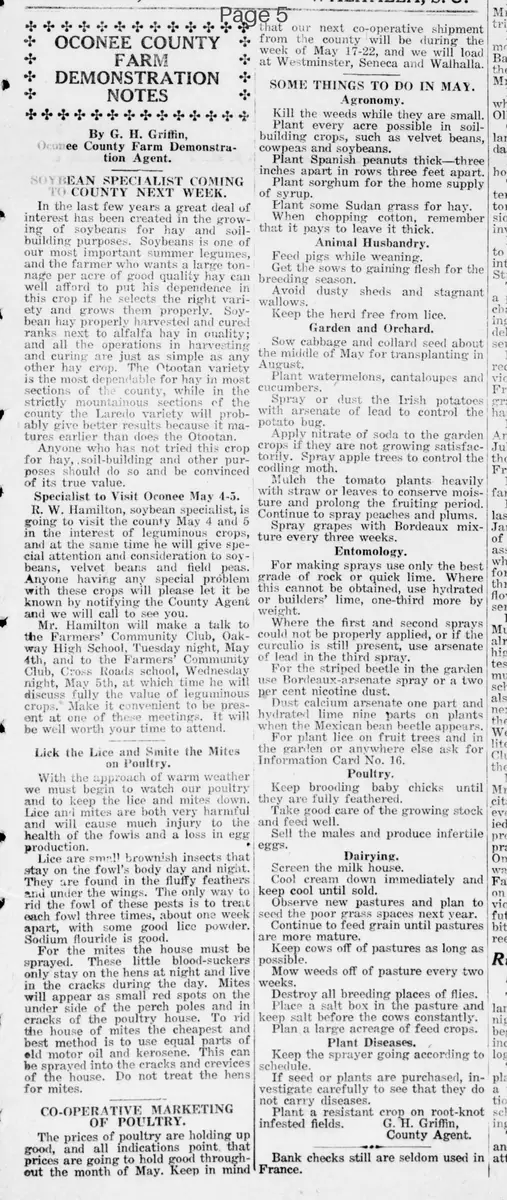
FARM
DEMONSTRATION
NOTES
By G. H. Griffin,
Oconee County Farm Demonstration Agent.
SOYBEAN SPECIALIST COMING TO COUNTY NEXT WEEK.
In the last few years a great deal of interest has been created in the growing of soybeans for hay and soil-building purposes. Soybeans is one of our most important summer legumes, and the farmer who wants a large tonnage per acre of good quality hay can well afford to put his dependence in this crop if he selects the right variety and grows them properly. Soybean hay properly harvested and cured ranks next to alfalfa hay in quality; and all the operations in harvesting and curing are just as simple as any other hay crop. The Otootan variety is the most dependable for hay in most sections of the county, while in the strictly mountainous sections of the county the Laredo variety will probably give better results because it matures earlier than does the Otootan. Anyone who has not tried this crop for hay, soil-building and other purposes should do so and be convinced of its true value.
Specialist to Visit Oconee May 4-5.
R. W. Hamilton, soybean specialist, is going to visit the county May 4 and 5 in the interest of leguminous crops, and at the same time he will give special attention and consideration to soybeans, velvet beans and field peas. Anyone having any special problem with these crops will please let it be known by notifying the County Agent and we will call to see you. Mr. Hamilton will make a talk to the Farmers' Community Club, Oakway High School, Tuesday night, May 4th, and to the Farmers' Community Club, Cross Roads school, Wednesday night, May 5th, at which time he will discuss fully the value of leguminous crops. Make it convenient to be present at one of these meetings. It will be well worth your time to attend.
Lick the Lice and Smite the Mites on Poultry.
With the approach of warm weather we must begin to watch our poultry and to keep the lice and mites down. Lice and mites are both very harmful and will cause much injury to the health of the fowls and a loss in egg production. Lice are small brownish insects that stay on the fowl's body day and night. They are found in the fluffy feathers and under the wings. The only way to rid the fowl of these pests is to treat each fowl three times, about one week apart, with some good lice powder. Sodium fluoride is good. For the mites the house must be sprayed. These little blood-suckers only stay on the hens at night and live in the cracks during the day. Mites will appear as small red spots on the under side of the perch poles and in cracks of the poultry house. To rid the house of mites the cheapest and best method is to use equal parts of old motor oil and kerosene. This can be sprayed into the cracks and crevices of the house. Do not treat the hens for mites.
CO-OPERATIVE MARKETING OF POULTRY.
The prices of poultry are holding up good, and all indications point that prices are going to hold good throughout the month of May. Keep in mind that our next co-operative shipment from the county will be during the week of May 17-22, and we will load at Westminster, Seneca and Walhalla.
SOME THINGS TO DO IN MAY.
Agronomy.
Kill the weeds while they are small. Plant every acre possible in soil-building crops, such as velvet beans, cowpeas and soybeans. Plant Spanish peanuts thick-three inches apart in rows three feet apart. Plant sorghum for the home supply of syrup. Plant some Sudan grass for hay. When chopping cotton, remember that it pays to leave it thick.
Animal Husbandry.
Feed pigs while weaning. Get the sows to gaining flesh for the breeding season. Avoid dusty sheds and stagnant wallows. Keep the herd free from lice.
Garden and Orchard.
Sow cabbage and collard seed about the middle of May for transplanting in August. Plant watermelons, cantaloupes and cucumbers. Spray or dust the Irish potatoes with arsenate of lead to control the potato bug. Apply nitrate of soda to the garden crops if they are not growing satisfactorily. Spray apple trees to control the codling moth. Mulch the tomato plants heavily with straw or leaves to conserve moisture and prolong the fruiting period. Continue to spray peaches and plums. Spray grapes with Bordeaux mixture every three weeks.
Entomology.
For making sprays use only the best grade of rock or quick lime. Where this cannot be obtained, use hydrated or builders' lime, one-third more by weight. Where the first and second sprays could not be properly applied, or if the curculio is still present, use arsenate of lead in the third spray. For the striped beetle in the garden use Bordeaux-arsenate spray or a two per cent nicotine dust. Dust calcium arsenate one part and hydrated lime nine parts on plants when the Mexican bean beetle appears. For plant lice on fruit trees and in the garden or anywhere else ask for Information Card No. 16.
Poultry.
Keep brooding baby chicks until they are fully feathered. Take good care of the growing stock and feed well. Sell the males and produce infertile eggs.
Dairying.
Screen the milk house. Cool cream down immediately and keep cool until sold. Observe new pastures and plan to seed the poor grass spaces next year. Continue to feed grain until pastures are more mature. Keep cows off of pastures as long as possible. Mow weeds off of pasture every two weeks. Destroy all breeding places of flies. Place a salt box in the pasture and keep salt before the cows constantly. Plan a large acreage of feed crops.
Plant Diseases.
Keep the sprayer going according to schedule. If seed or plants are purchased, investigate carefully to see that they do not carry diseases. Plant a resistant crop on root-knot infested fields.
G. H. Griffin,
County Agent.
What sub-type of article is it?
What keywords are associated?
What entities or persons were involved?
Where did it happen?
Domestic News Details
Primary Location
Oconee County
Event Date
May
Key Persons
Event Details
Farm demonstration notes covering soybean growing interest, specialist visit for leguminous crops talks at Oakway High School and Cross Roads school on May 4-5, poultry lice and mite control methods, co-operative poultry shipment May 17-22, and May tasks in agronomy, animal husbandry, garden/orchard, entomology, poultry, dairying, and plant diseases.