Thank you for visiting SNEWPapers!
Sign up free
Literary
January 22, 1930
The Daily Worker
Chicago, Cook County, Illinois
What is this article about?
Excerpt from Lenin's 'What is to be Done?' arguing that workers' political consciousness must develop from broader class relations and state interactions, not just economic struggles. Social-Democrats should engage all classes as tribunes against oppression to promote proletarian emancipation.
Clipping
OCR Quality
95%
Excellent
Full Text
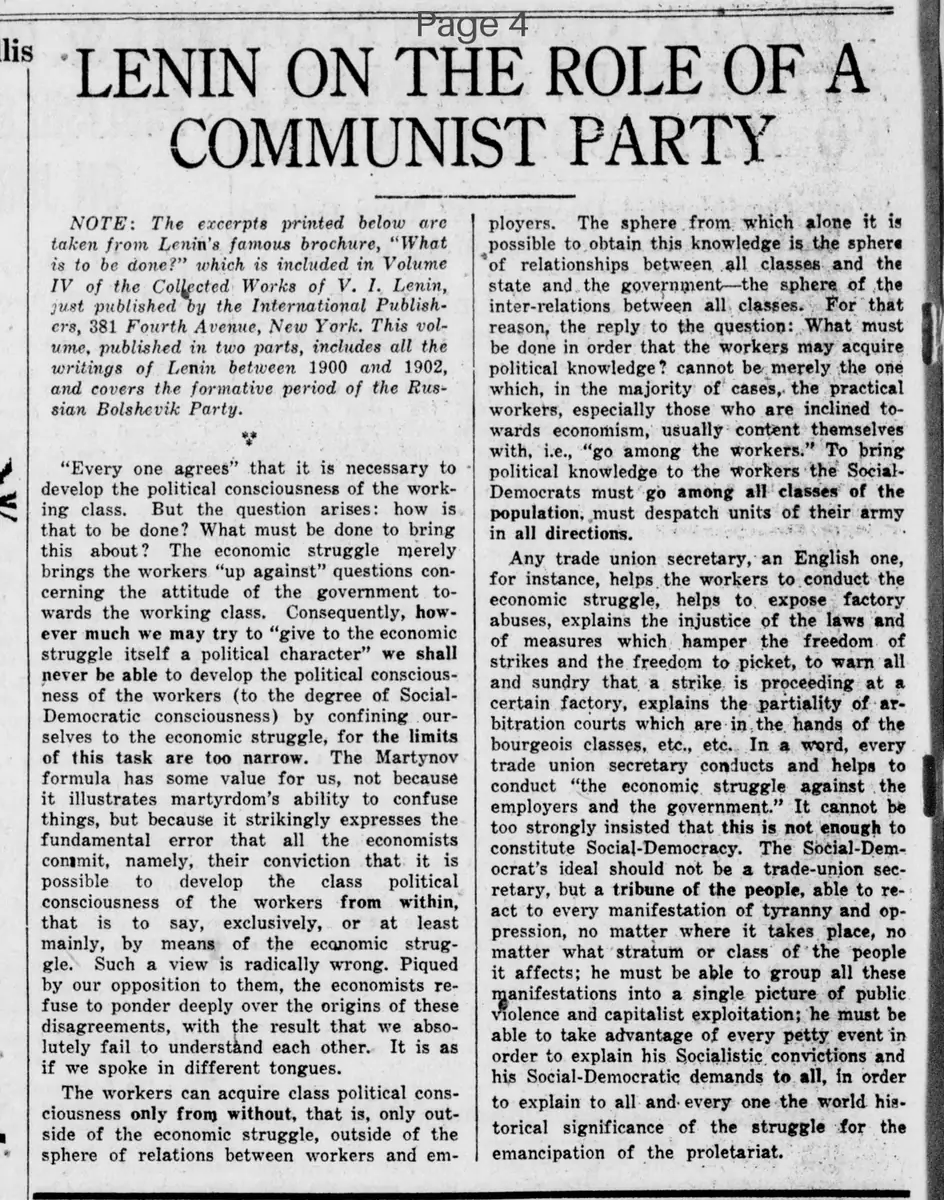
LENIN ON THE ROLE OF A COMMUNIST PARTY
NOTE: The excerpts printed below are taken from Lenin's famous brochure, "What is to be done?" which is included in Volume IV of the Collected Works of V. I. Lenin, just published by the International Publishers, 381 Fourth Avenue, New York. This volume, published in two parts, includes all the writings of Lenin between 1900 and 1902. and covers the formative period of the Russian Bolshevik Party.
"Every one agrees" that it is necessary to develop the political consciousness of the working class. But the question arises: how is that to be done? What must be done to bring this about? The economic struggle merely brings the workers "up against" questions concerning the attitude of the government towards the working class. Consequently, however much we may try to "give to the economic struggle itself a political character" we shall never be able to develop the political consciousness of the workers (to the degree of Social-Democratic consciousness by confining ourselves to the economic struggle. for the limits of this task are too narrow. The Martynov formula has some value for us, not because it illustrates martyrdom's ability to confuse things, but because it strikingly expresses the fundamental error that all the economists commit, namely, their conviction that it is possible to develop the class political consciousness of the workers from within, that is to say, exclusively, or at least mainly, by means of the economic struggle. Such a view is radically wrong. Piqued by our opposition to them, the economists refuse to ponder deeply over the origins of these disagreements. with the result that we absolutely fail to understand each other. It is as if we spoke in different tongues.
The workers can acquire class political consciousness only from without, that is. only outside of the economic struggle, outside of the sphere of relations between workers and employers. The sphere from which alone it is possible to obtain this knowledge is the sphere of relationships between all classes. and the state and the government--the sphere of the inter-relations between all classes. For that reason, the reply to the question: What must be done in order that the workers may acquire political knowledge? cannot be merely the one which, in the majority of cases. the practical workers, especially those who are inclined towards economism, usually content themselves with, i.e., "go among the workers." To bring political knowledge to the workers the Social-Democrats must go among all classes of the population, must despatch units of their army in all directions.
Any trade union secretary, an English one, for instance. helps the workers to conduct the economic struggle, helps to expose factory abuses, explains the injustice of the laws and of measures which hamper the freedom of strikes and the freedom to picket, to warn all and sundry that a strike. is proceeding at a certain factory, explains the partiality of arbitration courts which are in the hands of the bourgeois classes, etc., etc. In a word, every trade union secretary conducts and helps to conduct "the economic struggle against the employers and the government." It cannot be too strongly insisted that this is not enough to constitute Social-Democracy. The Social-Democrat's ideal should not be a trade-union secretary. but a tribune of the people, able to react to every manifestation of tyranny and oppression, no matter where it takes place, no matter what stratum or class of the people it affects; he must be able to group all these manifestations into a single picture of public violence and capitalist exploitation; he must be able to take advantage of every petty event in order to explain his Socialistic convictions and his Social-Democratic demands to all, in order to explain to all and every one the world historical significance of the struggle for the emancipation of the proletariat.
NOTE: The excerpts printed below are taken from Lenin's famous brochure, "What is to be done?" which is included in Volume IV of the Collected Works of V. I. Lenin, just published by the International Publishers, 381 Fourth Avenue, New York. This volume, published in two parts, includes all the writings of Lenin between 1900 and 1902. and covers the formative period of the Russian Bolshevik Party.
"Every one agrees" that it is necessary to develop the political consciousness of the working class. But the question arises: how is that to be done? What must be done to bring this about? The economic struggle merely brings the workers "up against" questions concerning the attitude of the government towards the working class. Consequently, however much we may try to "give to the economic struggle itself a political character" we shall never be able to develop the political consciousness of the workers (to the degree of Social-Democratic consciousness by confining ourselves to the economic struggle. for the limits of this task are too narrow. The Martynov formula has some value for us, not because it illustrates martyrdom's ability to confuse things, but because it strikingly expresses the fundamental error that all the economists commit, namely, their conviction that it is possible to develop the class political consciousness of the workers from within, that is to say, exclusively, or at least mainly, by means of the economic struggle. Such a view is radically wrong. Piqued by our opposition to them, the economists refuse to ponder deeply over the origins of these disagreements. with the result that we absolutely fail to understand each other. It is as if we spoke in different tongues.
The workers can acquire class political consciousness only from without, that is. only outside of the economic struggle, outside of the sphere of relations between workers and employers. The sphere from which alone it is possible to obtain this knowledge is the sphere of relationships between all classes. and the state and the government--the sphere of the inter-relations between all classes. For that reason, the reply to the question: What must be done in order that the workers may acquire political knowledge? cannot be merely the one which, in the majority of cases. the practical workers, especially those who are inclined towards economism, usually content themselves with, i.e., "go among the workers." To bring political knowledge to the workers the Social-Democrats must go among all classes of the population, must despatch units of their army in all directions.
Any trade union secretary, an English one, for instance. helps the workers to conduct the economic struggle, helps to expose factory abuses, explains the injustice of the laws and of measures which hamper the freedom of strikes and the freedom to picket, to warn all and sundry that a strike. is proceeding at a certain factory, explains the partiality of arbitration courts which are in the hands of the bourgeois classes, etc., etc. In a word, every trade union secretary conducts and helps to conduct "the economic struggle against the employers and the government." It cannot be too strongly insisted that this is not enough to constitute Social-Democracy. The Social-Democrat's ideal should not be a trade-union secretary. but a tribune of the people, able to react to every manifestation of tyranny and oppression, no matter where it takes place, no matter what stratum or class of the people it affects; he must be able to group all these manifestations into a single picture of public violence and capitalist exploitation; he must be able to take advantage of every petty event in order to explain his Socialistic convictions and his Social-Democratic demands to all, in order to explain to all and every one the world historical significance of the struggle for the emancipation of the proletariat.
What sub-type of article is it?
Essay
What themes does it cover?
Political
What keywords are associated?
Lenin
Communist Party
Political Consciousness
Working Class
Social Democracy
Class Struggle
Proletarian Emancipation
What entities or persons were involved?
V. I. Lenin
Literary Details
Title
Lenin On The Role Of A Communist Party
Author
V. I. Lenin
Subject
Developing Political Consciousness Of The Working Class
Form / Style
Argumentative Prose Excerpt From Brochure
Key Lines
The Workers Can Acquire Class Political Consciousness Only From Without, That Is. Only Outside Of The Economic Struggle, Outside Of The Sphere Of Relations Between Workers And Employers.
The Social Democrat's Ideal Should Not Be A Trade Union Secretary. But A Tribune Of The People, Able To React To Every Manifestation Of Tyranny And Oppression...